Breaking News
Breaking News
from Washington and beyond

Teen Dies in ICE Custody, Youngest Person Yet of Trump’s Term

Royer Perez-Jimenez was just 19 years old.

A person holds up a sign that says, "ICE out for good!" during an anti-ICE protest in Los Angeles, California.
Genaro Molina/Los Angeles Times/Getty Images
An anti-ICE protest in Los Angeles

A 19-year-old Mexican teenager arrested over a minor traffic infraction died in an ICE facility in south Florida this week.

Royer Perez-Jimenez died on Monday of a “presumed suicide” in his cell at Glades County Detention Center in Moore Haven, Florida, according to a statement from ICE. His official cause of death remains under investigation.

Perez-Jimenez was arrested on January 22 after police officers spotted him crossing multiple lanes of traffic on a scooter without using a crosswalk, according to the Miami New Times. When officers tried to arrest him, the teenager refused to stop and provided false names. He was charged with felony fraud for impersonation and misdemeanor resisting an officer.

Perez-Jimenez eventually told police he had overstayed his visa, and ICE placed a detainer on him. He was moved to ICE custody on February 21, and then into Glades County Detention Center a few days later. During his intake, he denied having behavioral health issues and answered no to all suicide screening questions.

Perez-Jimenez is the thirteenth person to die in ICE custody this year, and the thirty-sixth person to die in detention since Donald Trump launched his sweeping immigration crackdown. He is also the youngest to die in custody since Trump resumed office.

The number of detainee deaths at ICE facilities has significantly increased as nearly 70,000 people are currently held in detention, and the agency has stopped paying for health care altogether.

ICE has repeatedly failed to disclose information about detainee deaths, according to Zeteo.

As of Monday, ICE’s detainee death–reporting web page only lists two deaths in 2026. But ICE has published press releases documenting nine deaths since the beginning of 2026—a year that began with one detainee being choked to death by a guard.

Republicans Start to Rebel as Trump Asks for $200 Billion for Iran War

Republicans in Congress are finally beginning to question President Trump’s war on Iran.

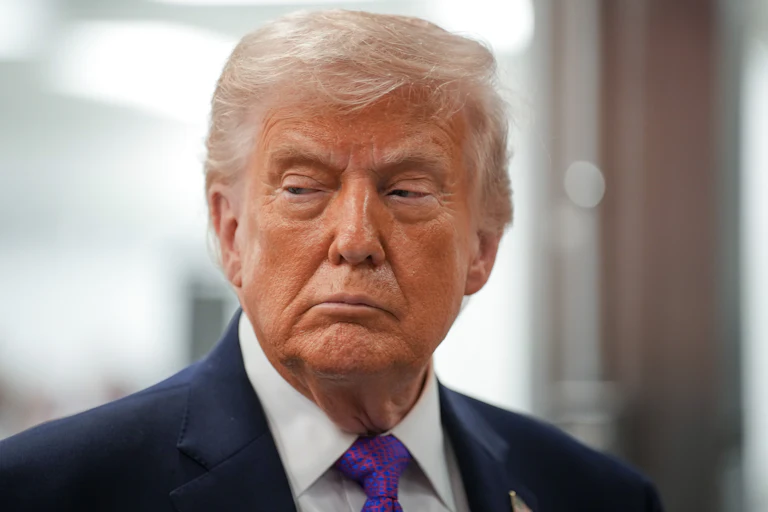
Donald Trump grimaces while looking sideways to his right
Andrew Harnik/Getty Images

Republicans in Congress may not be on board with sending hundreds of billions of dollars in additional funding for the war with Iran.

The Department of Defense asked the White House for over $200 billion in additional funding for the war, and that price tag is proving to be too steep for even Donald Trump’s allies. Representative Lauren Boebert told CNN Thursday that “I am a no. I have already told leadership. I am a no on any war supplemental. I am so tired of spending money over there.”

“I have folks in Colorado who can’t afford to live. We need America first policies right now,” Boebert added. While other Republicans haven’t come out as a firm no like her, they are expressing misgivings with the staggering cost attached to the war, which could make the Pentagon request dead on arrival.

“What are we doing? We’re talking about boots on the ground. We’re talking about that kind of extended activity. Now we’re in a whole ‘nother zip code,” Representative Chip Roy said to the news outlet. “They got a whole lot more briefing and a whole lot more explaining to do on how we’re going to pay for it, and what’s the mission here?”

One of Trump’s few Republican critics in Congress, Representative Thomas Massie, echoed concerns about the cost and the time frame of the war.

“It begs the question, how long do they plan to be there? What are the goals? Is this the first $200 billion? Does this turn into a trillion?” Massie asked.

Senator Lisa Murkowski said that she wouldn’t approve any more funding for the war until the Trump administration explained its plans to Congress.

“The people in Alaska are asking me how long is this going on? Are there going to be boots on the ground, how much is this going to cost?” Murkowski told CNN Thursday. “The answer to most of this is I don’t know.”

Trump’s actual goal for the war still isn’t clear, as members of his administration—and Israeli officials—have offered shifting explanations. In a Thursday congressional hearing, Director of National Intelligence Tulsi Gabbard admitted that the U.S. and Israel aren’t aligned on the war’s endgame, saying that Trump is more focused on Iran’s offensive weapons capability while Israeli Prime Minister Benjamin Netanyahu is seeking total regime change, which would require more funding and more time.

If that means ground troops, more Republicans may openly come out and oppose the war going any further. Representative Tim Burchett told CNN, “I think we need to find an exit strategy as fast as possible. I don’t want to put Americans on the ground out there in any shape, form or fashion.”

Tulsi Gabbard Says U.S. and Israel Have Very Different Goals in Iran

The director of national intelligence testified under oath that Israel isn’t aligned with the Trump administration on the endgame in the Iran war.

Director of National Intelligence Tulsi Gabbard testifies in Congress.
Heather Diehl/Getty Images
Director of National Intelligence Tulsi Gabbard testifies during a House Select Intelligence Committee hearing, on March 19.

National Intelligence Director Tulsi Gabbard admitted that there are key differences in the Israeli and U.S. goals in their joint war on Iran.

At a House hearing on Thursday, Democratic Representative Joaquin Castro asked Gabbard, CIA Director John Ratcliffe, and a panel of other intelligence operatives if the U.S. and Israel are “aligned” on the war. Gabbard used a lot of words to confirm that the answer was essentially “no.”

“The objectives that have been laid out by the president are different from the objectives that have been laid out by the Israeli government,” Gabbard testified. “We can see through the operations that the Israeli government has been focused on disabling the Iranian leadership and taking out several members, obviously beginning with the ayatollah, the supreme leader, and they continue to focus on that.”

“How does that differ from our goals?” Castro continued.

“The president has stated that his objectives are to destroy Iran’s ballistic missile–launching capability, their ballistic missile production capability, and their navy, the IRGC navy, and mine-laying capability,” Gabbard replied.

While both options are destructive, it seems that the stated Israeli objective is a long, drawn-out regime change war—as Prime Minister Benjamin Netanyahu has been pushing for for decades—while the United States, at least initially, seemed to leave the option of an off-ramp open. These two competing aims can only coexist for so long.

Trump Says Surging Iran War Cost Is Worth Keeping Military “Tippy-Top”

Meanwhile, food and gas prices for Americans continue to rise.

Donald Trump speaks to reporters in the Oval Office
Jim WATSON/AFP/Getty Images

Donald Trump claimed Thursday that $200 billion more going to an unpopular, illegal overseas war wasn’t all that big a deal.

During a White House meeting with Japanese Prime Minister Sanae Takaichi, Trump was asked about the Pentagon’s request to Congress for $200 billion to support the ongoing war in Iran. The request was first reported on Wednesday by The Washington Post.

After waffling about how good U.S. anti-air equipment was at shooting Iranian missiles down, Trump said that the money was “a small price to pay to make sure that we stay tippy-top.”

The Pentagon’s request may struggle to pass Congress, as even some Republicans are beginning to balk at the amount being spent on the unpopular war.

The first six days of the war cost taxpayers over $11.3 billion. In addition to this $200 billion request, Trump has petitioned Congress to increase the defense budget by $500 billion to $1.5 trillion in 2027, which would be by far the highest figure ever. (The Pentagon has yet to submit its official 2027 budget request.)

It all looks like a slap in the face for average Americans, who face a struggling economy at home: Inflation is rising, job creation is low, and gas prices are through the roof. Trump has blown through the money saved by cutting medical research grants and food bank programs, leaving “America First” feeling more and more like a pipe dream.

U.S. Fighter Jet Struck as Trump Brags Iran Is “Close to Demolished”

A jet had to make an emergency landing after being struck by what is believed to be Iranian fire.

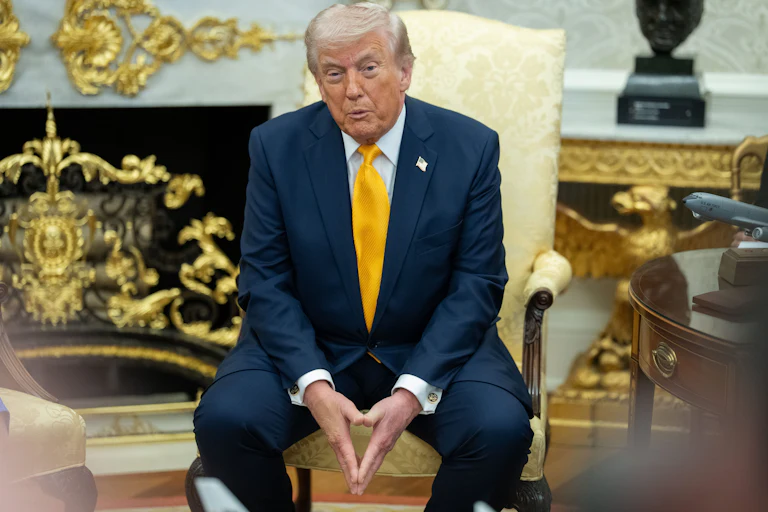
Donald Trump puckers his lips while speaking to reporters. He is seated in an armchair in the Oval Office and has his fingertips pressed together between his legs.
Aaron Schwartz/CNP/Bloomberg/Getty Images

As President Donald Trump bragged once again Thursday about how the war was essentially over, Iran is believed to have hit its first U.S. military jet since the war began.

A U.S. military aircraft flying a combat mission was struck by what is suspected to be an Iranian missile and forced to make an emergency landing in the Middle East. A U.S. F-35 fighter jet costs upward of $100 million. “The aircraft landed safely, and the pilot is in stable condition,” said Capt. Tim Hawkins, a spokesperson for the U.S. Central Command. “This incident is under investigation.”

Additionally, fallen shrapnel struck the Bazan oil refinery in Haifa, Israel, but did not cause “significant damage,” according to Israel’s energy minister. The Iranian Revolutionary Guard Corps said that it had targeted refineries across Israel, but it wasn’t clear if another refinery had been hit.

While Iran continued to launch retaliatory attacks, Trump continued to claim a premature victory.

Speaking to Japanese Prime Minister Sanae Takaichi Thursday, Trump once again bragged about the destruction of Iran’s military capability.

“We’ve demolished—their country is close to demolished,” Trump said. “The only thing is the Strait. It’s very hard, you could take two people and they could drop little bombs in the water, and they’re holding things up. But we don’t want that to happen.”

Trump was referring to the Strait of Hormuz, where global trade has come to an abrupt halt due to the threat of Iranian strikes and mines.