Breaking News
Breaking News
from Washington and beyond

Trump’s Economy Is Most Unpopular It’s Ever Been, Brutal Polls Show

Donald Trump’s approval ratings somehow continue to drop.

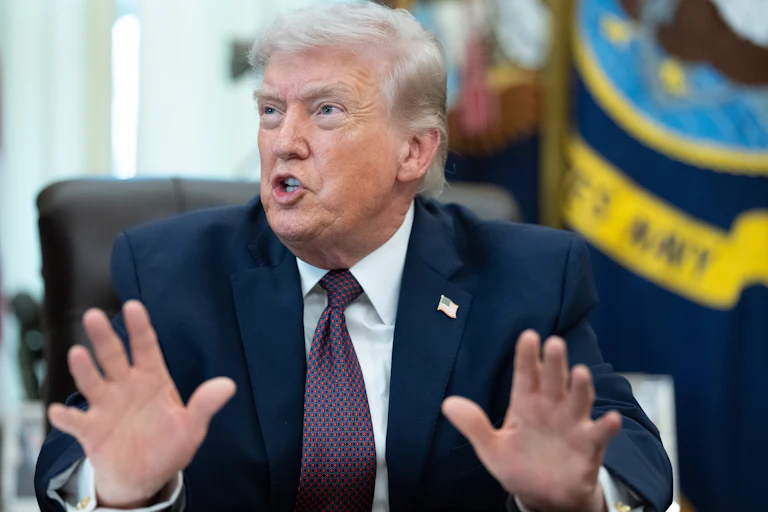
Donald Trump sits at his desk in the Oval Office
Brendan SMIALOWSKI/AFP/Getty Images

Donald Trump’s approval rating on the economy has hit some horrendous—and historic—new lows.

Speaking on CNN’s The Odds Wednesday, chief data analyst Harry Enten reported damning numbers for the Trump administration’s handling of the economy.

“This is no April Fools’ joke, this is a disaster. All these numbers are a disaster for President Trump,” Enten said.

Trump’s disapproval rating on inflation had dropped to 72 percent, according to Enten’s poll, putting him on par with Presidents Joe Biden and Jimmy Carter, two other commanders-in-chief whose terms were marred by high inflation. At about the same point in their presidencies, Biden had a 68 percent disapproval rating on inflation, and Carter had a 68 percent disapproval rating overall.

“When you have Joe Biden and Jimmy Carter on the board, and you’re matching them or slightly exceeding them, you know it’s bad,” Enten said.

CNN News Central’s John Berman pointed out that inflation had been far higher under Biden and Carter.

That may matter a little less in Trump’s case, considering the fact that the president has repeatedly claimed to have “defeated” inflation entirely. Meanwhile, the economy in Trump’s first year back in office saw rising inflation, very little GDP growth, and practically no job growth.

More than two-thirds of Americans disapproved of Trump’s handling of gas prices, as his reckless war in Iran has shuttered global energy trade through the Strait of Hormuz and sent gas prices skyrocketing to $4 per gallon within only a few weeks. Trump’s 76 percent disapproval rating dwarfed Biden’s highest all-time disapproval rating on gas prices, which was only 72 percent.

Trump’s disapproval rating on the economy was greater than the highest disapproval ratings for two-term presidents at about this time in their second terms. His disapproval rating on the economy was 69 percent, while George Bush was at 57 percent, and Barack Obama at 56 percent.

Enten called it: “The worst of all time at this point in term number two.”
Read more about Trump’s economy:

Trump Flips Out After Leaving Supreme Court Early

The Supreme Court appears skeptical of the Trump administration’s arguments on repealing birthright citizenship—and the president is pissed.

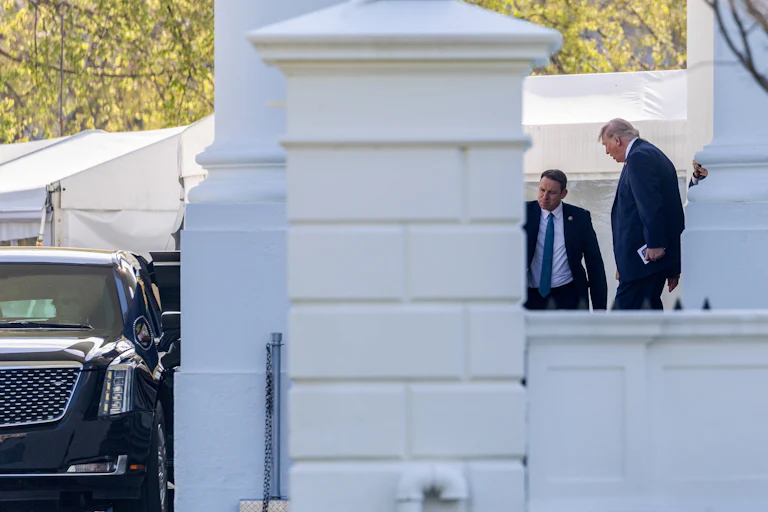
President Donald Trump departs the White House
Shawn Thew/EPA/Bloomberg/Getty Images
President Donald Trump departs the White House to head to the Supreme Court, April 1, 2026.

President Trump broadcast his anger Wednesday as the Supreme Court appeared to doubt his executive order repealing birthright citizenship.

“We are the only Country in the World STUPID enough to allow ‘Birthright’ Citizenship! President DONALD J. TRUMP,” he wrote on Truth Social shortly after oral arguments concluded.

The U.S. is of course not the only country in the world with birthright citizenship. After breaking precedent and attending oral arguments in person, Trump ended up leaving early when it began to look like the Supreme Court wouldn’t rule in his favor.

Multiple justices on the court appeared skeptical of the Department of Justice’s case. Chief Justice John Roberts, Neil Gorsuch, and Amy Coney Barrett all pushed back on Solicitor General D. John Sauer’s arguments.

At one point, Roberts expressed confusion regarding Sauer’s argument that Trump’s executive order makes sense because children of ambassadors and hostile enemies already don’t have access to birthright citizenship.

“Then you expand it to the whole class of illegal aliens who are here in the country,” Roberts said. “I’m not quite sure how you can get to that big group from such tiny and sort of idiosyncratic examples.”

The solicitor general tried to point to birther tourism as an example of how things have changed since the Fourteenth Amendment. “It’s a new world,” Sauer said.

“It’s the same Constitution,” the chief justice replied.

Trump was in the room for this exchange—and others that likely only further frustrated him after his nightmare week with the judiciary.

DOJ Lawyer Face-Plants on Native Americans and Birthright Citizenship

The Department of Justice just had a shocking exchange before the Supreme Court.

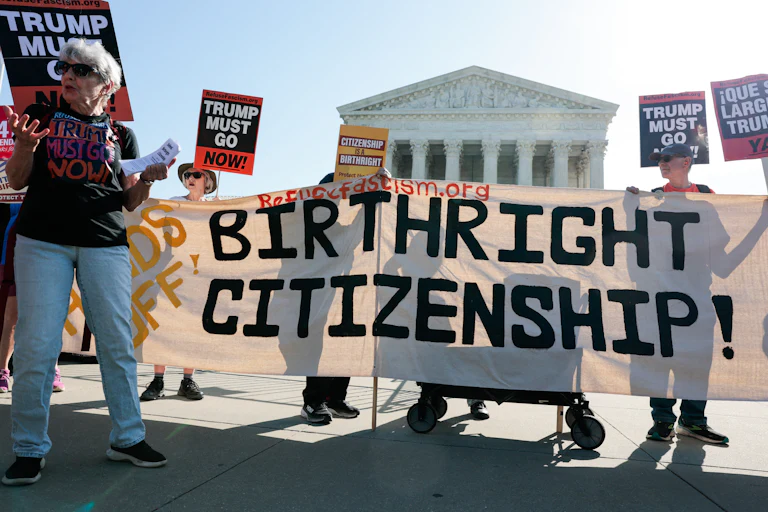
Demonstrators hold signs in support of birthright citizenship outside the Supreme Court.
Kent Nishimura/AFP/Getty Images
Demonstrators rally in support of birthright citizenship outside the Supreme Court on April 1.

The Trump administration’s lawyer, Solicitor General John Sauer, admitted before the Supreme Court Wednesday that he hadn’t thought too much about one of the big questions in President Donald Trump’s attempt to repeal birthright citizenship: What happens to Native Americans?

Supreme Court Justice Neil Gorsuch, who has carved out a niche for himself by carefully considering Indian law, asked Sauer if Native Americans today would be considered birthright citizens under the Trump administration’s test.

“I think so?” Sauer replied, clearly unsure. “I mean, obviously they’ve been granted citizenship by statute.”

“Put aside the statute; do you think they’re birthright citizens?” Gorsuch said again.

“No, I think the clear understanding that everybody agrees in the congressional debates is that the children of tribal Indians are not birthright.”

“I understand that’s what they said,” Gorsuch said. “But your test is the domicile of the parents, and that would be the test you’d have us apply today, right?”

“Yes, yes,” Sauer said.

“Are tribal Indians born today birthright citizens?” Gorsuch asked yet again.

Ah, I think so, if they were lawfully domiciled here,” Sauer replied. “I’m not sure—I have to think that through.”

“I’ll take the yes,” Gorsuch said.

The Trump administration clearly hasn’t considered the implications of the executive order Trump signed on his first day in office repealing birthright citizenship. That a DOJ lawyer can’t explain whether Native Americans would be U.S. citizens in Trump’s vision is certainly unsettling.

Trump Threatens to Leave NATO—but There’s One Big Problem

President Trump has renewed his threat to leave NATO as his Iran war doesn’t go to plan.

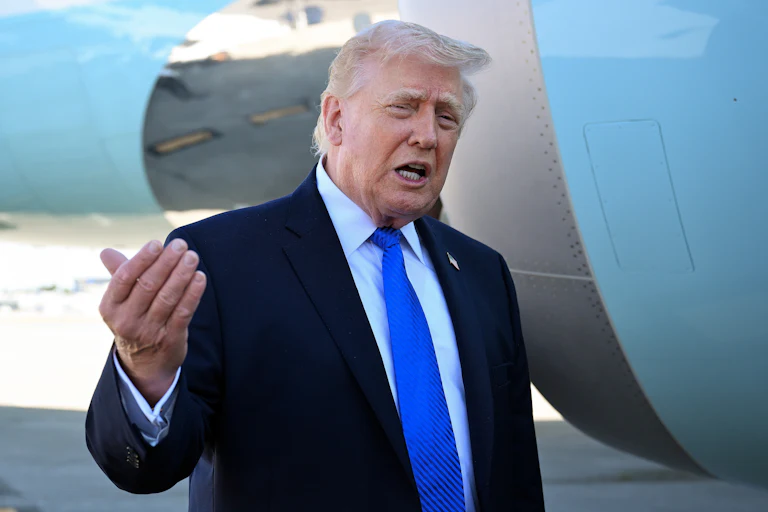
President Donald Trump speaks outside a plane
Roberto Schmidt/Getty Images

Donald Trump’s threat to leave NATO has one very big hurdle: approval from Congress.

The president told The Telegraph Wednesday that he is weighing an exit from the 1949 compact, saying it is “beyond reconsideration.” He later clarified to Reuters that he planned to mention his dissatisfaction with NATO countries such as France, Poland, the U.K., and others refusing to join the war in Iran during a live address to the country Wednesday night.

“I’ll be discussing my disgust with NATO,” Trump said. When Reuters asked him if he was considering withdrawing from the organization, he said: “Oh, absolutely, without question. Wouldn’t you do that if you were me?”

“They haven’t been friends when we needed them,” Trump added. “We’ve never asked them for much … it’s a one-way street.”

The U.S. joined NATO in 1949 after the Senate ratified the North Atlantic Treaty, and is considered a core founding member of the organization. The National Defense Authorization Act of 2024 made it harder for a future president to leave NATO, requiring a two-thirds Senate majority or a bill passed by both houses of Congress.

The only way Trump could unilaterally leave NATO is to invoke presidential authority over foreign policy. Republicans in Congress would then probably refrain from challenging Trump’s decision in court, possibly leading to NATO’s downfall without its most powerful member.

“I hope that amid the emotions surrounding the president of ​the United States today, a moment of calm will come,” Polish Defense Minister Władysław Kosiniak-Kamysz said Wednesday. “And why? Because there is no NATO without the United States, and it is in our interest that this calm comes. But there is ‌also no ⁠American power without NATO.”

On Thursday, Secretary of Defense Pete Hegseth declined to commit to NATO’s collective defense provision, refusing to say whether the U.S. would defend its allies if they were attacked by another country, such as Russia.

“As far ​as NATO is concerned, that’s a decision that will be left to the president. But I’ll just say a lot has been laid bare,” Hegseth said at a press conference Tuesday. “You don’t have much of an alliance if you have countries that are not willing to stand with you when you need them.”

That would seem to foreshadow doom for NATO, and further unravel America’s long-standing alliances with European countries. Trump may not realize it, but that would make the U.S. a much weaker country.

Iran Immediately Shuts Down Trump’s Ceasefire Talk Claims

Donald Trump also insisted that he wouldn’t make peace until the Strait of Hormuz was reopened.

Donald Trump gestures and speaks while sitting at his desk in the Oval Office
Aaron Schwartz/CNP/Bloomberg/Getty Images

Donald Trump’s plan for Iran is changing by the minute.

Iran’s newly installed leadership immediately refuted Trump’s claims that the country was open to a ceasefire, informing state media Wednesday morning that the idea was “false and baseless.”

Iran’s revolutionary guard issued a separate statement with regard to the Strait of Hormuz, writing that the oil passageway “is firmly and decisively under the control” of Iranian forces.

“This strait will not be opened to the enemies of this nation through the ridiculous spectacle by the president of the United States,” the revolutionary guard wrote.

The notice came moments after Trump boasted online that Iran had requested a ceasefire, which the U.S. leader insisted would not happen unless the strait opened up to trade.

“Iran’s New Regime President, much less Radicalized and far more intelligent than his predecessors, has just asked the United States of America for a CEASEFIRE!” Trump wrote Wednesday morning. “We will consider when Hormuz Strait is open, free, and clear. Until then, we are blasting Iran into oblivion or, as they say, back to the Stone Ages!!!”

It is possible that Trump’s morning remarks were in response to Iranian President Masoud Pezeshkian, who suggested Tuesday that his country had the “necessary will” to end the war but would first need guarantees that the conflict would not repeat itself. Pezeshkian is not new to his presidential role, nor is he the new Supreme Leader of Iran—that would be Mojtaba Khamenei, the son of previous Supreme Leader Ali Khamenei, who was assassinated in February by a U.S.-Israeli joint operation. The junior Khamenei is considered even more extreme, and has been described as his father “on steroids.”

The White House’s stance Wednesday was even more bewildering in light of comments that Trump had made the night before. He claimed he was entirely uninterested in the strait and was considering backing out of Iran even while the waterway remains closed, effectively delaying the conflict for a future administration.

“We will be leaving very soon, and if France or some other country wants to get oil or gas, they will go up through the strait, the Hormuz Strait, and will be able to fend for themselves,” Trump said. “But we have nothing to do with that. What happens in the strait—we aren’t going to have anything to do with it.

“There is no reason for us to do it,” he said.

Situated between Iran and the United Arab Emirates, the Strait of Hormuz is the single most important energy transit point in the world, funneling approximately one-fifth of all crude oil shipments. In 2024, the U.S. imported roughly 500,000 barrels of crude oil per day through the strait, accounting for about 7 percent of total U.S. crude imports, according to the U.S. Energy Information Administration.

The price of oil and gas has skyrocketed in the weeks since the war began. On Tuesday, gas prices eclipsed $4 a gallon across the nation, hitting Americans in their wallets.