Breaking News
Breaking News
from Washington and beyond

GOP Senator Cassidy Turns Into One of Trump’s Biggest Headaches

Bill Cassidy is criticizing the president’s favorite projects after his primary defeat.

Senator Bill Cassidy in a congressional hearing
Kevin Dietsch/Getty Images

Republican Senator Bill Cassidy is now vocally opposing President Trump after losing his primary election last week thanks to the president’s endorsement of one of his opponents.

On Wednesday, Cassidy held nothing back in criticizing the White House ballroom Trump is building, complaining in particular about the president’s lack of transparency.

“There’s no architectural plans. There is no environmentals. There’s no engineering. There’s no sense of when we ask, how did it happen to cost exactly a billion,” Cassidy told CNN. “It could cost a lot less, it could cost a lot more, I just don’t get it.”

Cassidy also attacked the Department of Justice’s new $1.776 billion “weaponization” fund, designed to compensate people who say they were politically targeted by the government (read: Trump supporters).

“People are concerned about paying their mortgage or rent, affording groceries and paying for gas, not about putting together a $1.8 billion fund for the president and his allies to pay whomever they wish with no legal precedent or accountability. This is adding to our national debt. If there needs to be a settlement, the administration should bring it to Congress to decide,” Cassidy said in a post on X about the fund, created from a settlement agreement between Trump and the IRS.

It’s telling that Cassidy only feels emboldened to speak out once his political career is essentially over. He had plenty of earlier opportunities to publicly oppose Trump’s policies, especially considering he is a medical doctor and has seen some of the White House’s destructive public health decisions.

Instead, Cassidy voted to confirm Robert F. Kennedy Jr., a well-known anti-vaccine activist, as secretary of health and human services, and has refused to address Kennedy’s weakening of vaccine policies since then. In the end, it didn’t help him politically, as Trump still criticized him and backed Representative Julia Letlow in the Louisiana Senate Republican primary. Now he’s pretending to have some courage.

Try to Make Any Sense of This Trump Answer on the Future of AI

Donald Trump quickly switched topics to Iran.

Donald Trump speaks as reporters hold boom microphones out towards him
Kent NISHIMURA/AFP/Getty Images

Donald Trump cannot be living the same reality as the rest of America.

The president aggressively dodged questions about the future impact of artificial intelligence Wednesday, claiming that nothing but good has come from the technology’s rapid implementation across industry.

“What’s your message to American families who are scared by the rise of AI?” asked a reporter on the tarmac of Joint Base Andrews. “They’re worried that their kids are not going to be able to have jobs someday because AI is going to take over—”

“No, I’ll tell you, AI has been amazing because right now we have more jobs, more people working right now, in the United States by far than we ever had before,” Trump interjected.

But that’s just not true. The lowest unemployment rate in recorded U.S. history was in 1953, when a postwar boom brought rates down to 2.5 percent, according to data from the Bureau of Labor Statistics. The lowest rate in the last 50 years happened in 2023, when unemployment dropped to 3.4 percent. Today, unemployment sits at 4.3 percent—and is gradually rising.

Beyond that, the initial rollout of artificial intelligence has decimated thousands of early-career opportunities and massively disrupted myriad industries, including the higher education system, which is currently pumping out thousands of degree-bearing professionals with nowhere to go.

Hours before Trump’s remarks, Mark Zuckerberg’s Meta—which owns Facebook, Instagram, and WhatsApp—laid off 8,000 employees in favor of the emergent technology. All in all, analysts predict that AI and automation will claim 6 percent of U.S. jobs by 2030.

Trump, however, was not willing to speak to that. Instead, he decided to harp on his handling of the Iran war, suggesting that the economy was actually thriving due to the wildly unpopular Middle East conflict.

“The stock market is higher now than it was before I started the Iran situation, and on Iran—I had no choice because they were going to have a nuclear weapon,” Trump said. “Oil is going to come tumbling down.”

But analysts do not predict that oil and gas costs will come crashing down—at least not anytime soon.

The average cost of gas nationwide is $4.55 per gallon, with large swaths of the U.S. pushing $5 a gallon, according to the AAA’s price tracker. That’s about 50 percent higher than prices were before the war started.

The situation has become so dire that Trump’s Cabinet members have stopped speculating as to when prices will actually go back down. Analysts, meanwhile, have projected that gas and oil costs will likely continue to climb—potentially even after midterms.

Republicans Forced to Abandon Latest Tactic to Fund Trump Ballroom

A growing number of Republicans don’t want to put their names behind this White House ballroom.

Donald Trump holds up a rendering of the White House ballroom
Aaron Schwartz/CNP/Bloomberg/Getty Images

President Donald Trump’s proposed ballroom, which would boast lavish golden interiors and is totally needed for, uh, security reasons, is beginning to face backlash from Republicans as well as Democrats.

On Wednesday, Republican Senator John Kennedy told Samantha Handler of Punchbowl News that the GOP doesn’t have enough votes to provide $1 billion in taxpayer money to the ballroom project, and the amendment is expected to be removed from the budget bill going to the Senate floor this week.

Four Republican senators have publicly voiced opposition to public money going to the vanity project. They are Bill Cassidy of Louisiana, Susan Collins of Maine, Lisa Murkowski of Alaska, and Thom Tillis of North Carolina.

Cassidy lost his primary last week, thanks in large part to a Trump endorsement of one of his opponents, and has also vocally spoken out against Trump’s $1.8 billion slush fund, which was announced Monday. Collins and Murkowski are each expected to face tough Democratic challengers in the November midterms, while Tillis is retiring.

Just these four “no” votes would probably kill the $1 billion going to the ballroom given the widespread Democratic opposition to the project. A larger group inside the GOP is privately against the ballroom, according to five anonymous insiders who spoke with Politico.

The White House originally said the ballroom would be funded with approximately $200 million from Trump and “other patriot donors.” That number soon doubled to $400 million.

Senate Republicans, at the president’s behest, then attempted to sneak in a $1 billion sum for White House security—including $220 million for ballroom security—into the larger budget bill. The allotment was deemed spurious by the nonpartisan Senate parliamentarian. Trump then, of course, tried to get her fired.

Judge Grants Emergency Order to Block Trump From Destroying Records

A federal judge has ruled that Trump can’t violate the Presidential Records Act just because he feels like it.

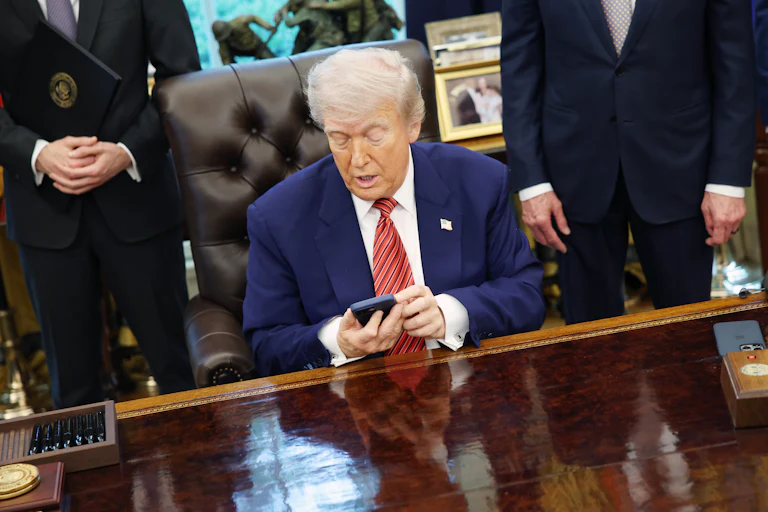
President Donald Trump looks at his phone while sitting at his desk in the Oval Office of the White House.
Samuel Corum/Sipa/Bloomberg/Getty Images
Donald Trump in 2025

A federal judge ruled Wednesday that President Trump has to comply with the Presidential Records Act, overruling an opinion from the Department of Justice last month.

The DOJ’s Office of Legal Counsel issued an opinion in April claiming that the act was unconstitutional because it unfairly restricted “the constitutional independence and autonomy of the Executive.” In response, two organizations, the nonprofit watchdog group American Oversight and the American Historical Association sued in federal court, and on Wednesday U.S. District John Bates ruled that the act is in fact constitutional.

“The original public meaning of the text of the Constitution, canons of interpretation, Supreme Court precedent, general principles of property law, and almost 50 years of practice confirm that Congress has the enumerated power to regulate presidential records under the [Constitution’s] Property Clause,” Bates wrote in his ruling.

Bates noted that Trump had no problem following the law during his first term as president. Bates’s order takes effect on May 26. It’s not clear if the White House is following the law at the moment, and it will likely appeal the ruling to a higher court, as Trump has shown little respect for recorded documents during his presidency.

Trump was charged with hoarding classified documents in his Florida estate in a case that was eventually dismissed thanks to a judge he appointed. In his first term as president, Trump also reportedly used to tear documents into small pieces and throw them on the floor. Trump doesn’t plan to keep any documents at his proposed presidential library, instead planning to make the Miami skyscraper more like a hotel as he doesn’t “believe in building libraries or museums.”

Trump Ropes Banks Into His Immigration Crackdown With Wild Order

He wants their help tracking immigrants.

Donald Trump
Kent NISHIMURA/AFP/Getty Images

Donald Trump has signed an executive order that will require U.S. banks to take a closer look at their clients’ citizenship details.

The Tuesday order, titled “Restoring Integrity to America’s Financial System,” directs bank regulators and the government agencies to look into the legal status of people applying for credit cards or loans or opening bank accounts.

“My Administration will not tolerate national security and public safety risks caused by illicit cross-border financial activity, nor will it permit risks to our financial system posed by the extension of credit or financial services to the inadmissible and removable alien population,” the order states.

The White House wrote that America’s financial institutions should “be attentive” to the potential credit risks posed by extending loans to undocumented immigrants, specifying that that situation creates a “structural ‘ability to repay’ deficiency that undermines the safety and soundness of the national banking system” in the event that those individuals are deported.

Exactly how much risk these individuals pose is unknown, since banks have never collected information about their customers’ citizenship or immigration status, reported the Associated Press.

Treasury Secretary Scott Bessent is expected to issue a formal advisory on the new regulations within the next 60 days that will specifically describe certain “red flags and typologies” employers are to be suspicious of, such as potential payroll tax evasion, the use of “foreign-identity documents,” the use of an individual taxpayer identification number (a code typically used by undocumented immigrants in place of a Social Security number), or the use of third-party payment processors that the order claimed could be indicative of “off-the-books” wage payments.

Somehow, the order was less severe than bank executives expected. Early reports on the executive order suggested that the White House was weighing whether to make it mandatory for financial institutions to collect their customers’ citizenship data.