Breaking News
Breaking News
from Washington and beyond

DOJ Wants to End Key Watergate-Era Rule to Help Trump

The Presidential Records Act is key for transparency.

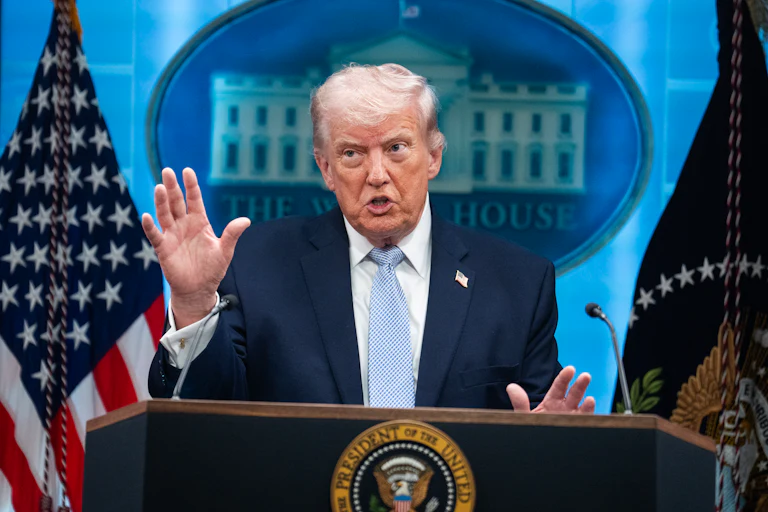
Donald Trump puckers his lips and gestures with both hands while speaking at a podium
Maxine Wallace/The Washington Post/Getty Images

The Trump administration is fighting to make the executive branch even more secretive.

A 52-page memorandum from the Justice Department reveals that the agency is putting up a fight against the Presidential Records Act. The department’s Office of Legal Counsel argued on April 1 that the 1978 law, which was passed in direct response to the fallout of Richard Nixon’s Watergate scandal, is actually “unconstitutional.”

The office further claimed that the congressionally passed act “exceeds” the legislative branch’s powers and “aggrandizes” Congress “at the expense of the constitutional independence and autonomy of the Executive.”

In doing this, the DOJ is trying to keep the president’s records private—rather than public, as mandated by the country’s representatives nearly 50 years ago.

The DOJ’s position already faces several legal challenges. Days after the memorandum was released, the nonpartisan watchdog organization American Oversight joined with the American Historical Association to sue a couple dozen figures within the Trump administration. In a 46-page legal complaint, the two nonprofits argued that the Oval Office was attempting to nullify and supersede the constitutional authorities of the other branches of government, and trod over the separation of powers.

“In the Administration’s view, the records of the official activities of the President and nearly 1,000 White House employees—generated using taxpayer funds, on government property, regarding official government business—belong to the President personally, and not to the American people,” the complaint reads. “Government for the people, by the people, and of the people this is not.”

Donald Trump has expressed little to no respect for the laws and regulations that bind him to public accountability. At the end of his first presidency, Trump allegedly broke seven laws by retaining hundreds of classified documents. He was charged with 37 felony counts in 2023 as a result, making him the first president to be criminally charged. Trump-appointed federal Judge Aileen Cannon dismissed the charges the following year, arguing that special counsel Jack Smith, the man appointed to investigate and prosecute the case, had not been properly installed.

The president has also not shown any interest in offering the public an inside view into the maneuverings of his administration, even retroactively. Trump’s presidential library is expected to be a glass skyscraper, operating as more of a hotel rather than anything close to a facility dedicated to learning.

Renderings of the building posted to Trump’s Truth Social late last month included a red, white, and blue needle on top, a U.S. flag hanging down the side, and a gargantuan plane on the first floor that resembles the super-luxury jumbo jet Qatar gifted him last year.

Trump Says Netanyahu Promises to “Low-Key It” Now

President Trump doesn’t seem to be fully grasping that his ceasefire is on the verge of collapse.

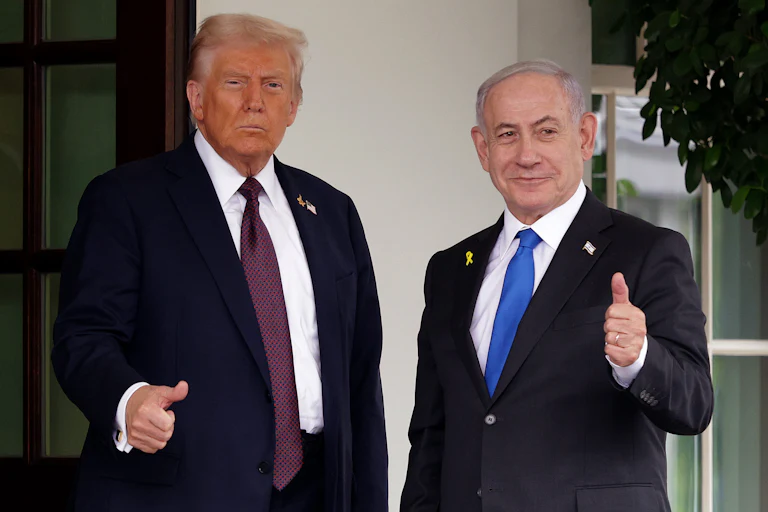
U.S. President Donald Trump and Israeli Prime Minister Benjamin Netanyahu both give a thumbs up outside the White House.
Alex Wong/Getty Images
President Donald Trump greets Israeli Prime Minister Benjamin Netanyahu at the White House, on September 29, 2025.

Donald Trump’s solution to Israeli Prime Minister Benjamin Netanyahu continuing to bomb Lebanon, and thus threatening to upend the entire ceasefire with Iran, is to ask him to tone it down.

Trump spoke to Netanyahu on the phone Wednesday, a senior administration official told NBC News, and told him to pull back. Trump later told the network in an interview Thursday that Israel would be “scaling back” its attacks on Lebanon.

“I spoke with Bibi and he’s going to low-key it. I just think we have to be sort of a little more low-key,” Trump said.

What that means is anyone’s guess. Lebanon was supposed to be included in the 10-point ceasefire deal, according to Iran and mediator Pakistan. Netanyahu said Wednesday that he “insisted that the temporary ceasefire with Iran not include Hezbollah, and we continue to strike them forcefully,” and following more bombs on Thursday, claimed his government is ready to negotiate directly with the Lebanese government (but not till next week).

These negotiations, Al Jazeera reports, are the result of U.S. pressure. The Trump administration is requesting a pause on Israeli airstrikes in Lebanon to help negotiations with Iran. But Israeli Defense Minister Israel Katz said Thursday that “the war will not be stopped,” even after Netanyahu’s announcement of negotiations with Lebanon.

Israeli strikes killed over 300 people in southern Lebanon Wednesday, according to the Lebanese Health Ministry, with over 1,000 wounded. At least seven people were killed in the southern Lebanese town of Abbassiyeh on Thursday. Democrats and leaders around the world have condemned Israel’s continued attacks on Lebanon. Is Trump really going to let Netanyahu just “low-key it” and wait to see what happens next?

DNC Kills Resolution Condemning AIPAC Influence in Elections

The Democratic National Committee has once again proved it is out of step with the base of the party.

Israeli Prime Minister Benjamin Netanyahu speaks on two giant screens at the AIPAC conference.
Cheriss May/NurPhoto/Getty Images
Israeli Prime Minister Benjamin Netanyahu speaks at AIPAC’s 2019 Policy Conference in Washington, D.C.

A Democratic National Committee panel on Thursday killed a resolution condemning the “growing influence” of dark money groups like the American Israel Public Affairs Committee, or AIPAC—even as an overwhelming majority of Democrat voters have an unfavorable view of the country that has committed genocide in Gaza, started a war in Iran, and continues to bomb civilians in Lebanon.

“The use of massive outside spending to support or oppose candidates based on their positions regarding international conflicts or foreign governments raises concerns about undue influence over democratic debate and policymaking, potentially constraining elected officials’ ability to represent the views of their constituents,” read the nonbinding resolution.

At least two potential 2028 Democratic nominees may have played a role in killing the resolution, with one DNC member telling Politico they received direct calls from the presidential hopefuls expressing concern about the resolution.

The DNC resolutions committee also punted on two other resolutions on recognizing a Palestinian state and conditioning military aid to Israel.

It’s clear that the Democratic establishment is not ready to let go of AIPAC, even as Israel’s genocide on Gaza and influence on American politics has become perhaps the defining progressive issue of this era. AIPAC wouldn’t be spending millions of dollars every year trying to oust progressive Democrats if that wasn’t the case. And while public opinion continues to shift sharply against it, party leadership continues to squirm and offer nonanswers when confronted with that reality.

Trump Stranded Students in Persian Gulf With Iran War

About six American cadets were working on ships in the Persian Gulf when Donald Trump launched a war.

Donald Trump gestures while speaking at a podium
Tom Williams/CQ-Roll Call, Inc/Getty Images

The bombs began raining down in Iran on February 28. Israel had successfully convinced Donald Trump to launch a joint attack on the Gulf nation. There was just one thing that the White House had forgotten about: half a dozen U.S. cadets who were working just off the coast, sitting ducks in the Persian Gulf.

Five privately owned ships flying the U.S. flag were nearby carrying students from the U.S. Merchant Marine Academy, the U.S. Merchant Marine, and the transportation industry when the U.S. military started the war in Iran, NOTUS reported Thursday.

Unlike previous conflicts, there was no advance word or warning to the ships to evacuate, effectively trapping them as the violence began.

“Nobody told them. They were caught unawares,” one source close to the situation told NOTUS. “It was very strange that [officials] weren’t even given a whiff, weren’t even given an indication.”

The military had no plan to transport the vessels out of the Strait of Hormuz. Instead, the students were forced to find safe refuge in harbors around the Gulf, living on their ships. They were evacuated a month later, three sources told NOTUS, though it is not known whether all the students have made it back to American soil.

“If they’d had even just a day’s notice, they could have gotten them out,” another person familiar with the situation told NOTUS.

But the cadets weren’t the only Americans in the region that the White House forgot.

The Trump administration also failed to properly notify regional embassy staff of the impending bloodshed that week. In an email delivered February 27, Ambassador Mike Huckabee gave nonemergency workers at the U.S. Embassy in Jerusalem less than 24 hours to exit Israel, informing them that anyone planning to leave the country “should do so TODAY.”

The order and its timeline were highly unusual: Embassy staff are typically provided several days’ notice in order to comply with state-mandated evacuations, with some warnings given as much as a month in advance of the anticipated departure date. By comparison, Huckabee’s 24-hour deadline was shockingly short.

RFK Jr.’s CDC Delays Report Proving the Covid Vaccine Worked

Anti-vax nonsense has infiltrated every corner of America’s public health agencies.

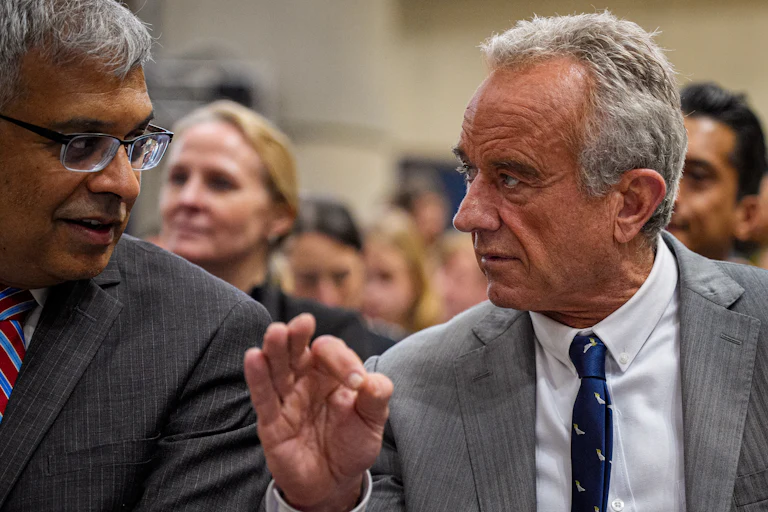
Jayanta Bhattacharya speaks with Robert F. Kennedy Jr.
Andrew Harnik/Getty Images
Acting CDC Head Jayanta Bhattacharya and Health Secretary Robert F. Kennedy Jr. on April 22, 2025, in Washington, D.C.

The Centers for Disease Control and Prevention has delayed the release of a report showing that the Covid-19 vaccine cut hospitalizations and emergency room visits for healthy adults by half last winter.

The Washington Post reports that acting CDC director Jay Bhattacharya made the decision because he was purportedly concerned about the report’s methodology, even though it has been used by the agency for years to examine vaccine effectiveness for other respiratory viruses like the flu.

In fact, the agency published a similar report about the flu vaccine with the same methodology on March 12 in its Morbidity and Mortality Weekly Report. The Covid-19 vaccine report had cleared the CDC’s scientific review process, and was scheduled to be published in the MMWR before Bhattacharya’s decision.

The same methodology is also used to evaluate vaccines by numerous medical journals including the New England Journal of Medicine, JAMA Network Open, the Lancet, and Pediatrics, according to the Post.

The newspaper obtained a copy of the report, which states that between September and December 2025, healthy adults who got the vaccine cut their likelihood of visiting urgent care or the emergency room by 50 percent and of Covid-related hospital stays by 55 percent, compared to those who didn’t get a Covid vaccine in 2025.

Bhattacharya was a staunch critic of the CDC’s Covid-19 response, calling for an early end to lockdowns in the “Great Barrington Declaration” he helped write, and said that calling for masking was “pseudoscience.” However, he did tell a Senate committee in February that he didn’t think vaccines cause autism.

On the other hand, Bhattacharya’s boss, Secretary of Health and Human Services Robert F. Kennedy Jr., is a longtime anti-vax activist, calling the Covid-19 vaccine the “deadliest vaccine ever made” in 2021. Last year, Kennedy announced that the CDC would no longer recommend the vaccine to healthy pregnant women and children.

In Trump’s second term, vaccination has been discouraged, resulting in rising and more severe illnesses. Meanwhile, the administration, under the thrall of Kennedy’s MAHA pseudoscience, is burying anything that proves their ideology wrong.