Breaking News
Breaking News
from Washington and beyond

Mitch McConnell Is Entirely Nonverbal in New Video

The 84-year-old senator also appeared to freeze up.

Senator Mitch McConnell sits in a committee meeting
Senator Mitch McConnell
Kevin Dietsch/Getty Images
Senator Mitch McConnell

Senator Mitch McConnell is still refusing to speak publicly after a monthslong absence from the Senate, raising concerns about whether he is still fit for office.

A video posted on X Tuesday by Desiree Townsend, the conservative journalist who first reported on McConnell’s health emergency, showed the longtime Kentucky Republican being wheeled into a large black car ahead of a Senate vote.

As Townsend questioned McConnell on his weekend and whether he felt ready to return to work, the Republican offered only a weak wave. “Do you want to be at work, sir? Would you rather be home?” Townsend asked, but still McConnell did not reply. As the car door slowly closed, McConnell held up a peace sign.

In her post, Townsend wrote that McConnell “appeared somewhat confused by the rain and showed a delayed response, but still gave no verbal acknowledgment.”

This isn’t the only alarming development in McConnell’s ongoing health saga. This past weekend, his wife, Elaine Chao, stood in for McConnell at an event at the University of Louisiana’s McConnell Center.

In June, McConnell was found unconscious in his Washington, D.C., home and rushed to the hospital. His office spent weeks refusing to explain his extended hospitalization or elaborate on his eventual return to Capitol Hill. Since returning, McConnell has not appeared lucid or aware, and has remained eerily silent to the public. When the Republican finally did break his silence, he voted incorrectly on a Senate bill and had to be instructed on how to vote.

Iran President Tells U.N. Iran Will Not Bow Down to Trump’s Terrorism

Iranian President Masoud Pezeshkian said there’s no way Trump is getting the Strait of Hormuz like this.

Iranian President Masoud Pezeshkian at the podium at the U.N. General Assembly.
Iranian President Masoud Pezeshkian at the United Nations General Assembly in New York on September 23
John Lamparski/Bloomberg/Getty Images
Iranian President Masoud Pezeshkian at the United Nations General Assembly in New York on September 23

Iranian President Masoud Pezeshkian used his United Nations General Assembly speech to call out President Trump and Israel, challenging narratives about Iran as a terrorist threat, shedding light on the aggressions committed against the Iranian population, and doubling down on Iran’s hold on the Strait of Hormuz.

“The United States president described us as terrorists. We have been the victims of terrorism. I come from an Iran in which our esteemed Supreme Leader was assassinated without any legal framework or reason,” Pezeshkian said, referring to Ayatollah Ali Khamenei, who ruled for 37 years until his assassination in February. “I come from an Iran where in truth, they bombed a school … with weapons used by the United States and Israel. They were innocent.... Those who are terrorists … describe us as such.”

It was at this point in Pezeshkian’s speech that the U.S. delegate to the U.N. walked out—as the Cuban and Iranian delegations had done during Trump’s speech the day before.

“We responded, but we did not hit civilian populations,” he continued. “They came into surrounding territories and targeted our universities, our health care centers, our schools, our hospitals.”

The Iranian president also refused to reopen the Strait of Hormuz, an issue that has caused prices to rise in the U.S. and one that Trump claimed would be resolved months ago.

“In the waters of the Strait of Hormuz … we cannot let some have free access and gain their interest from a waterway, while at the same time using that waterway to impose their aggressions upon us, to impose insecurity upon us, to forbid us access to our own waterways,” he said. “They close access for us to our own waterway, yet they keep supplying missiles and deadly military technologies to bring insecurity to all of the lands surrounding that waterway.”

He also reaffirmed Iran’s commitment to pursuing “peaceful nuclear technology”—which Trump has long claimed to be an existential threat to the entire world.

“Iran does not accept for nuclear technology to be at the exclusive disposal of some, of a handful. We will not bow our head and give up the right that is inherently ours,” Pezeshkian said. “We say it clearly: no nuclear weapons, and no limitations to peaceful nuclear technology.”

This speech comes the day after Trump asked the U.N. audience—in front of the Iranian delegation—if he should “annihilate the Islamic Republic and do it quickly” or “drive them into hell with no chance of survival.” It comes almost seven months into a war that has resulted in at least 3,000 Iranian deaths, 19 American deaths, and virtually none of the Trump administration’s initial goals.

U.S. Rep. Leaves U.N. as Iranian President Calls Out Strikes on Kids

The U.S. delegate at the United Nations General Assembly didn’t want to hear about children killed in the Iran war.

Iranian President Masoud Pezeshkian gestures and speaks at the UNGA
Iranian President Masoud Pezeshkian at the United Nations General Assembly
Selcuk Acar/Anadolu/Getty Images
Iranian President Masoud Pezeshkian at the United Nations General Assembly

The only present U.S. representative walked out of Iranian President Masoud Pezeshkian’s speech at the United Nations General Assembly Wednesday.

The quiet protest came immediately after Pezeshkian mentioned two airstrikes by American forces in February that killed 178 civilians, most of them children.

Pezeshkian showed images of the sites to the international delegation, holding up posterboards and books that contained photographs before and after the devastation of Shajareh Tayyebeh Primary School in Minab.

“You see these children? These children perished under bombs with weapons used by the United States and Israel,” Pezeshkian said. “They were innocent, had committed no crimes.”

He then displayed pictures of the second attack site, a sports complex in Lamerd.

“A sports hall, where children were busy playing,” Pezeshkian said. “The United States, by using weapons with multiple warheads, targeted that sports hall. They martyred, assassinated, our scientists, our men, women, and children.”

“Those who are terrorists, and train and protect terrorists, describe us as such,” Pezeshkian continued as the U.S. representative stood up from his desk and walked out. “We have only defended ourselves. We are not terrorists.”

At the time of the strikes, U.S. military officials denied that they were behind the attack. Defense Secretary Pete Hegseth insisted that the U.S. “never” targets civilians during foreign conflicts. Early reports indicated that outdated Pentagon intel had led them to believe that the school was actually an Iranian base.

But a report by the Independent International Fact-Finding Mission on Iran, submitted earlier this month to the U.N. Human Rights Council in Geneva, found that the U.S. had, unequivocally, perpetrated the bloodshed. The independent group found “reasonable grounds” to believe that the U.S. committed war crimes in Iran because American military officials had failed to do basic due diligence on the proposed attack site, such as analyzing publicly available information that would have revealed the site was a children’s school and not a military base.

The group confirmed that the U.S. was behind the attacks by analyzing the damage the strikes inflicted on the surrounding area, as well as to the victims’ bodies. The group said the distinctive pockmarking left behind by a wide spray of tungsten bullets suggested that the weapon of choice was Lockheed Martin’s Precision Strike missiles, also identified as “PRsM.” The U.S., the independent body concluded, is the only nation in the conflict that possessed such weapons.

Postal Worker Says He Threw Out Hundreds of Ballots Out of “Laziness”

A USPS worker was indicted for throwing away around 300 ballots.

USPS van
Charles-McClintock Wilson/NurPhoto/Getty Images

A former U.S. Postal Service mail carrier was indicted for throwing away hundreds of ballots in Utah, claiming that he did so because he felt lazy.

According to court documents, the mail carrier, Damon Matai Seei, said his June 3 mail load was too heavy, and in an effort to “lighten his workload,” he threw some of the mail into a dumpster in a church parking lot. The mail he threw away included advertisements and about 300 ballots he was supposed to deliver to voters in Eagle Mountain, Utah, for a June 23 primary election.

Thanks to Seei, those voters never got their ballots, and some of them were not able to vote in the election. Now Seei is being charged in the U.S. District Court in Utah for secretion, destruction, and delay of mail.

Court documents say Seei admitted to throwing out mail because he was “overwhelmed” by how much he had to deliver that day. He claimed in a written statement that the load felt “heavier” than usual that day, and that he chose to get “rid of advertisement mail” to focus on other deliveries, not realizing that he was throwing away ballots.

Seei denied a political motive, claiming that he didn’t have a political agenda, isn’t a “very political person, and did not intend to disrupt the “political process.” Instead, he said he made a “poor decision” based on “frustration” and “laziness.” But law enforcement officers, according to court records, said that Seei put aside the ballots at the beginning of his shift and didn’t deliver a single one, throwing them in a dumpster within about 90 minutes of beginning his route. He only worked six hours that day, leaving early at 3:15 p.m.

“The evidence does not suggest that Seei made any effort at all to deliver the approximately 300 mail-in ballots. Nor does it seem plausible that he could not have noticed them—even if he mixed them in with advertisements at some point,” the documents state.

We don’t know for sure if Seei actually was feeling lazy or had an ulterior motive, but President Trump did have his supporters pledge to “cheat like hell” at the Republican midterm convention earlier this month. Scores of ballots around the country have been thrown out for lateness, and a spacing issue nearly led to a Florida county’s ballots being blocked by the USPS. With an election less than two months away, more mail-in ballot chaos could be coming.

Trump Official Was in a “Cult”-Like AA Group That Abused Teen Girls

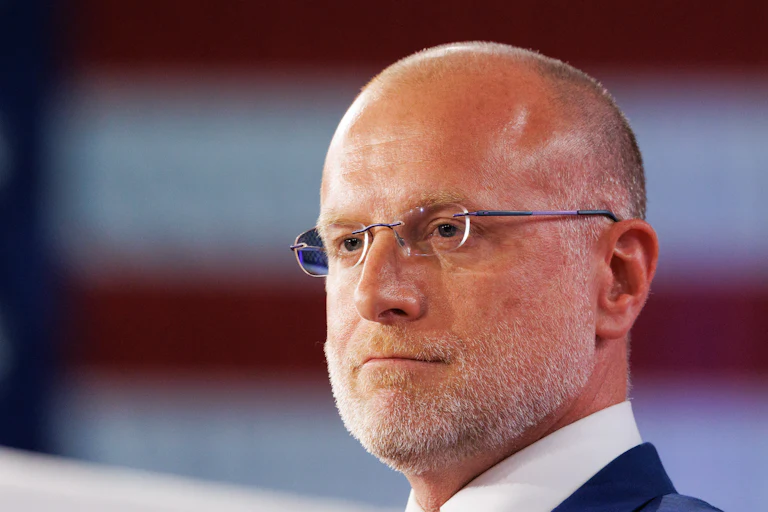
Brendan Carr does not appear to have participated in the abuse.

FCC Commissioner Brendan Carr
Shelby Tauber/Bloomberg/Getty Images
FCC Commissioner Brendan Carr

Former members of the the Washington-based Alcoholics Anonymous chapter known as the Midtown Group call it more of a “sex cult” than a support group. FCC Chairman Brendan Carr was reportedly a member for a decade.

Young people flocked to the Midtown Group in the late 1990s and early 2000s as a social haven away from alcohol. But instead they would find that the group’s leader, a fiftysomething named Michael Quinones, would come to control nearly every aspect of their lives, according to an investigation by The Guardian.

One former member of the group told The Guardian that Quinones was the “Epstein of AA.” He would coerce and pressure women and girls as young as 16 into “dating” and having sex with men sometimes many decades their senior. But it was not always apparent to those “entrenched” in Midtown that what was happening was wrong.

“Obviously it was widely known that teenage girls were sleeping with older men, it was such a part of our culture. It took me to my late 20s to understand it was wrong,” one woman told The Guardian. “I was 16, sleeping with a 55-year-old. That was just the way things worked there.”

Another former member told the newspaper that what happened to her could be described as sex trafficking.

The Guardian investigation was built on interviews with 14 former members of the group, recordings of Midtown sobriety discussions, and photographs. Carr joined the group in 1996, when he was 17 years old, and remained a presence until at least 2005, when he was recorded at Midtown discussing his own sobriety journey. The following year, Carr was photographed at a men’s retreat, a few rows behind Quinones.

People that knew Carr at the time said they did not believe he engaged in any misconduct. Instead, one former member described Carr as a “safe respite” from the psychological manipulation that suffused the rest of the group.

One woman recalled that Carr had snuck her French fries to eat after Quinones had forced her onto a strict diet. The group leader liked his women “bone thin,” she said.

Another former member said that Carr was “never among” the predators, going so far as to describe him as a “victim of Midtown.” Yet another described Carr as sensitive and desperate for approval.

Still, some others insisted that Carr’s speckled history be made public because of the tremendous influence afforded him by his position in the Trump administration.

“The wounds inflicted upon us during our time trapped at Midtown have formed scars,” one former member named Lydia told The Guardian. “A man who has the power to control what types of stories the mainstream public have access to is a man who should expect the narrative of his own life to fall under scrutiny.”

Under Carr’s command, the FCC has targeted ABC, CBS, and NBC, as well as their parent companies. Carr even went so far as to describe his agency’s investigation into CBS as a “penalty.”

A spokesperson for Carr denied that the FCC chairman had been a member of the Midtown Group “up to and through 2006,” and claimed that Carr’s decision to get “sober over 30 years ago as a teenager” was being weaponized by a small group of people in order to “embarrass or pressure him into doing his job differently.”