Eight decades after the writer H.P. Lovecraft died of intestinal cancer, having published in his lifetime only one book, riddled with printing errors, his name appeared on billboards throughout the United States. Promoting the HBO show Lovecraft Country, the advertisements seemed to suggest that Lovecraft, who died in 1937 in penury in his hometown of Providence, Rhode Island, had finally returned home as an unofficial monarch, king of a genre of horror writing that, especially in the past decade, has provoked an energetic wave of new fiction inspired by Lovecraft’s trailblazing example.
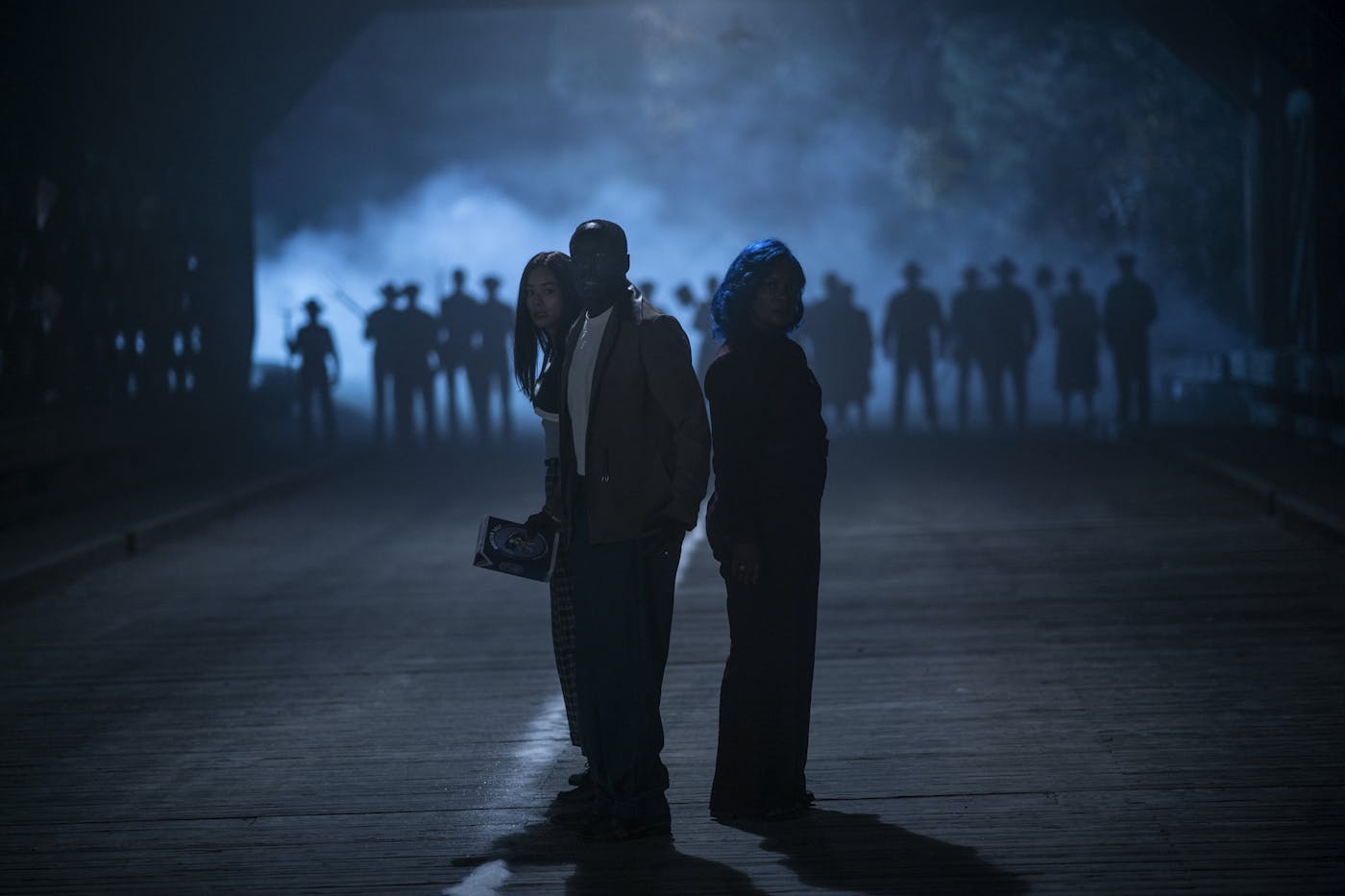
But the devil, in Lovecraft’s case, is in the details. The signature poster of the show features the actors Jurnee Smollett and Jonathan Majors, octopoid tentacles flickering around their faces. The tentacles are found everywhere in Lovecraft’s fiction; Black protagonists are not. Based on a 2016 novel by Matt Ruff, the show depicts a cast of Black characters dealing with magic in a segregated America, including the New England territories where Lovecraft set most of his fiction. Premiering in August, when the United States was reeling from the highest number of coronavirus infections in the world as well as the virulent racism of a reelection-seeking Donald Trump, Lovecraft Country appeared to offer a reclamation as well as a homecoming, seemingly delighting in the writer’s genre tropes while forcefully excising his racism.
This is standard practice in contemporary American writing inspired by Lovecraft. Ruff makes a critique of Lovecraft’s racism a central aspect of his story, particularly in the fraught interaction between the father-son duo Montrose and Atticus. Before we’ve gone far in the novel, on page 15, Montrose digs out from the Chicago library system a literary journal featuring the Lovecraft poem, “On the Creation of N------.” Montrose, portrayed as burdened, even embittered, by his experience of racism, wants his son to understand the worldview of the writer whose fiction he has fallen in love with. A reading list at the end of the novel, meanwhile, offers a number of nonfiction works on segregation as well as fiction by Octavia Butler and Victor LaValle as a seeming corrective.
The author Kij Johnson makes a similar move in her quasi-feminist novella, The Dream-Quest of Vellitt Boe. In the book’s acknowledgments, she writes, “And I must of course acknowledge Lovecraft’s The Dream-Quest of Unknown Kadath. I first read it at ten, thrilled and terrified, and uncomfortable with the racism but not yet aware that the total absence of women was also problematic.” Victor LaValle’s The Ballad of Black Tom begins with the dedication, “For H.P. Lovecraft, with all my conflicted feelings.” And in Paul La Farge’s The Night Ocean—which, unlike the above genre examples, is a work of literary fiction—the plot revolves around the narrator Marina Willett’s attempt to trace her missing husband, Charlie, an African American writer obsessed with the work and life of Lovecraft.
In the energetic sphere of commentary and fandom that surrounds Lovecraft and his growing influence, the same approach is evident. “I would address the issue of Lovecraft’s racism first,” the horror writer Mary SanGiovanni said last year in an interview with Library Journal meant to offer a guide for librarians on Lovecraftian fiction. On occasion, the desire to address Lovecraft’s racism has led to disputes prefiguring many of today’s debates over cancel culture. In 2015, after a campaign led by the writers Daniel José Older and Nnedi Okorafor, the World Fantasy Convention stopped handing out a Lovecraft bust to its winning writers, replacing this with the representation of a tree in front of a full moon.
Yet confusion rather than clarity hangs over Lovecraft and the relation between his writing, his racism, the world he lived in, and the one we live in now. Was Lovecraft racist because he was an insular New Englander, limiting himself largely to Providence after a serious mental crisis provoked by encountering the immigrant population of New York? That is one interpretation, and not entirely without substance, given that Lovecraft channeled his troubled experience of New York into the story “The Horror at Red Hook.” Or was his racism an expression of the times Lovecraft lived in and not entirely germane to his fiction, as S.T. Joshi, biographer and one-man critical industry on Lovecraft, argued while protesting vehemently against the cancellation of the Lovecraft bust?
Both arguments sequester Lovecraft, either in time or in space, and yet everyone argues for Lovecraft’s continuing validity as a writer, his relevance so contemporary that it has, in recent years, burst beyond the subculture of horror and into the mainstream. Known today both as “weird fiction,” as Lovecraft called his own work, as well as “cosmic horror,” his writing is an unending source for films, from 2016’s The Void to a 2019 adaptation of The Color Out of Space. Lovecraft himself is to be the subject of a forthcoming project fronted by David Benioff and D.B. Weiss—the duo behind the Game of Thrones show—who plan to adapt Hans Rodionoff’s graphic novel, Lovecraft. In music, video games, cartoons, plush toys, politics—the satirical website “Cthulhu for America” launched in 2015 and is still going—and in the school of philosophy known as “speculative realism,” Lovecraft is rampant. Still, the question remains: Are horror and racism so easily separated in our times, or are they far more deeply intertwined than the mainstreaming of Lovecraft can admit?
Lovecraft’s racism was neither the accidental byproduct of provincialism nor a simple reflection of his zeitgeist. It percolated down into the very bones of his writing, including some of his most powerful works of fiction, the stories “The Call of Cthulhu,” “The Shadow Over Innsmouth,” and the novella-length “At the Mountains of Madness.” Written during the 1920s and 1930s, these texts offer a relentless vision of man confronting the horror of an indifferent universe. Man is, of course, always white, from the neurotic New Englanders who tend to be Lovecraft’s narrator-protagonists to the hardy Nordic types who serve as working-class ballast. Between man and monster dance the nonwhite peoples of the world.
In “The Call of Cthulhu,” published in 1928, the narrator describes his gradual awareness of the Cthulhu cult, a global alliance of Inuit (to whom he refers with a slur), mixed-race “West Indians or Brava Portuguese from the Cape Verde Islands,” and “undying leaders of the cult in the mountains of China” that hopes to resurrect Cthulhu, one of a species of ancient extraterrestrial beings whose presence on Earth long precedes the advent of Homo sapiens. An accidental knowledge of this cult has claimed the life of the narrator’s uncle, a Brown University professor, at the beginning of the tale. By the end, in an arc composed of stories nested within stories and a world-spanning journey that takes us from Providence to New Jersey, Louisiana, Greenland, New Zealand, and Oslo, we are made to understand that the narrator, too, will be eliminated by this cult determined to continue its secretive program of restoring Cthulhu.
Overwrought though this might appear in summary, “The Call of Cthulhu” is Lovecraft’s most iconic work (and one that his contemporary Jorge Luis Borges would pay tribute to half a century later in his own far more minimalist riff, “There Are More Things”). It is an imaginative rendering of a cataclysmic cultural and racial anxiety that first began to shape itself clearly in the early twentieth century. This was the fear of a white, Christian West in decline and under severe threat from other groups, a fear that comes across as eerily contemporary, and whose most overt expression in recent times has been from Trump and his supporters.
Lovecraft’s worldview was influenced by other writers, men who were not working, like him, in the trenches of genre fiction, but who were advocating national and world policies through seemingly respectable nonfiction books. These include William Benjamin Smith, who published The Color Line: A Brief in Behalf of the Unborn in 1905; Madison Grant, who brought out The Passing of the Great Race in 1916; Lothrop Stoddard, whose bestselling The Rising Tide of Color Against White World-Supremacy was published in 1920; and the German philosopher Oswald Spengler, the first volume of whose The Decline of the West appeared in 1918 and inspired, among others, Adolf Hitler and the Italian fascist thinker Julius Evola, the latter in turn an inspiration for Trumpian figures like Steve Bannon.
Provoked by the outcome of the Civil War in the United States, the “internal” slaughter of World War I in which European armies turned their advanced weaponry upon one another, the Bolshevik Revolution, and the rise of anti-colonialism, but provoked, too, by the paradoxical effects of the success of a colonial system that had knitted the world closer together—a globalization avant la lettre—these books expressed immense anxiety and paranoia. Lovecraft, for his part, was not a passive recipient of such ideas. He referred to Spengler often, arguing that the German had merely popularized conclusions he himself had arrived at long ago. Not only did Lovecraft read Smith, a professor of mathematics at Tulane University; he dedicated his poem “De Triumpho Naturae: The Triumph of Nature Over Northern Ignorance” to him.
Lovecraft’s loathing of Africans, of America’s native-born Black population, of immigrants, nonwhite peoples, and Jews finds expression in ways large and small in his fiction, and this in spite of his brief marriage to Sonia Greene, a Jewish immigrant who bankrolled his fiction and later wrote a memoir about life with him. There is, of course, the near-demented roll call in “The Horror at Red Hook” of “unclassified slant-eyed folk who used the Arabic alphabet” and Syrian, Spanish, Italian, and Black “elements impinging upon one another.” In “The Shadow Over Innsmouth,” a story of a New England port town that is “depopulated” by federal agencies, its residents taken to “concentration camps” because they are discovered to be hybrid creatures, offspring of humans and an undersea species, the slippage between nonhumans and nonwhite peoples—“South Sea islander[s],” “Chinese,” “East-Indian or Indo-Chinese”—is constant.
And yet, as contemporary writers influenced by Lovecraft make evident, in their Lovecraft-inflected fiction as well as in their contextual comments, there is a strange power to his writing. Edmund Wilson, discussing Lovecraft in The New Yorker in 1945, was summarily dismissive:
The principal feature of his work is an elaborate concocted myth … assum[ing] a race of outlandish gods and grotesque prehistoric peoples who are always playing tricks with time and space and breaking through into the contemporary world, usually somewhere in Massachusetts.
But Lovecraft has outlasted Wilson, his “tricks with time and space” allowing him to strike contemporary notes in a manner that far exceeds that of many of his more respectable literary peers. Amitav Ghosh in The Great Derangement has written about how realist fiction from the nineteenth century onward embraced the bourgeois and the rational at the expense of the supernatural or exceptional, a hierarchy of aesthetic values that reduced the varied world to mere backdrop and that now means realist fiction struggles to deal with the cataclysmic nature of climate collapse. Lovecraft, with his contempt for realism, managed to capture both the world he lived in as well as the one we live in now.
His depiction of civilizational ruin, coupled with attention to landscape, allows him to sound as if he is addressing our apocalyptic present of climate change, pandemics, and a ravaged, postindustrial, post-agricultural environment. “At the Mountains of Madness” opens with the narrator protesting “the melting of the ancient ice-cap” of the Antarctic, an eerie pronouncement even if the narrator is talking about a scientific expedition’s plans to drill through the permafrost in order to recover fossils. In “The Shadow Over Innsmouth,” the narrator notes almost in passing how “a fertile and thickly settled countryside” has turned into ruin with “the unwise cutting of woodlands near the shore, which robbed the soil of its best protection and opened the way for waves of wind-blown sand.” When it is suggested that an alternative cause for the decline of Innsmouth and its surroundings might be an epidemic, “probably some foreign kind of disease brought from China or somewhere by the shipping,” Lovecraft can sound especially uncanny.
These lines do not reveal some kind of oracular capacity in Lovecraft. What they show is that he was, in spite of his reputation as a recluse, drawing on the sensitivities of his time as a purveyor of a kind of global fiction. Depending heavily upon the landscape of New England, his Rhode Island and Massachusetts are nevertheless connected, uneasily, with other places and other times. They are Puritan settler colonies looking back nostalgically at England, Rome, and Greece, in denial of indigenous and nonwhite immigrant populations. At the same time, they are also linked to the rest of the world by capitalism, trading—as a character in “The Shadow Over Innsmouth” puts it—“with queer ports in Africa, Asia, the South Seas, and everywhere else, and what queer kinds of people.” The result is writing that is simultaneously inward looking and outward facing, disturbing and engaging at the same time.
For Lovecraft did not derive inspiration only from the racists and eugenicists of his era. Fueled by an autodidact’s curiosity, he drew heavily from Western artists, mystics, and scientists who offered parallel modes of engaging with the bewildering world that had been made visible by colonialism and capitalism. “The Call of Cthulhu” begins by invoking the Theosophists, a mystical order founded in New York City in the late nineteenth century by the Russian immigrant Helena (“Madame”) Blavatsky and later relocated to India. In “At the Mountains of Madness,” Lovecraft repeatedly compares his fictional polar mountain range populated by extraterrestrials to the paintings of the Russian mystic Nicholas Roerich, whose eerie depictions of the Himalayas Lovecraft encountered in a New York museum where they are still to be found today.
Often, Lovecraft’s use of such material—as in his invention of the occult ur-text Necronomicon, written by the “mad Arab Abdul Alhazred”—veers into what Edward Said termed Orientalism. Yet Lovecraft’s attention to nature and to far-flung worlds also creates the addictive, melancholy beauty of some of his writing, with landscapes that are otherworldly and yet hauntingly familiar. Victor LaValle writes of reading Lovecraft for the first time at ten and getting “serious shivers” from the phrase “secrets, and wonders that planets tell planets alone in the night.”
Like the Theosophists and Roerich, Lovecraft constructed his own elaborate mythology, picking and choosing from his voracious readings in biology, astronomy, and geology. China Miéville, a fantasy writer and a Marxist, notes the way in which Lovecraft’s “pantheon and bestiary are absolutely sui generis,” and how he—along with contemporaries like H.G. Wells and M.R. James—privileged the tentacle as a monstrous appendage for the first time in Western fiction. Yet, Miéville writes, “Though his conception of the monstrous and his approach to the fantastic are utterly new, he pretends that they are not.”
A modern, settler colonial figure disconnected from folk renditions of monsters and heavily influenced by contemporary theories of biology, Lovecraft invents his own tradition, pretending that his tentacled monsters have always existed. This tendency to invent a remote past—the Necronomicon; the nonwhite, non-Western Cthulhu cults—marks Lovecraft out as a man of his time. There is a demented genius to many of these inventions, including his fictional alien language: “Iä! Iä! Cthulhu fhtagn! Ph’nglui mglw’nafh Cthulhu R’lyeh wgah-nagl fhtagn.” At the same time, his fertile world-building and invented histories are also a manifestation of the anxieties of the West in the early twentieth century, a grappling with its own status as what Max Weber called a “disenchanted” society in a larger world filled with threatening, non-modern societies of magic. (The non-Western, colonized world had its own anxieties, about being behind rather than falling behind, and it came up with its own invented traditions, such as the Indian “ancient” text about Vimanas or mythical aircrafts.) And of course, it places him solidly in our present, where our own invented traditions attempt a response to anxieties that are remarkably similar to Lovecraft’s.
We live, once again, in a world rendered frenetic by its own success. In the post–Cold War era, the West and the Western way of capitalism are seemingly triumphant. A passport from a G7 country signals membership in the upper tier of humanity; one from a “failed state” is tantamount to a death certificate when attempting to cross borders. Yet, as the eruptions of Trump and Brexit, the armed gathering of self-described “Western chauvinists” the Proud Boys, and clusters of adult males from the United States, the U.K., Canada, Australia, and Germany on 4chan make apparent, a significant number of people feel once again that the West and white nationalism are under threat. Even the books promoting these views sound the same as they did a century ago: bestsellers like Patrick Buchanan’s The Death of the West: How Dying Populations and Immigrant Invasions Imperil Our Country and Civilization, Jonah Goldberg’s Suicide of the West: How the Rebirth of Tribalism, Nationalism, and Socialism Is Destroying American Democracy, and pretty much everything from Charles Murray and Samuel Huntington.
Invented monsters and mythologies thrive again, but in the public realm and on the manic, proliferating outlets of the internet rather than in the fiction pages of pulp magazines. The QAnon movement, which believes leading Democrats to be human-trafficking pedophiles operating out of pizza restaurants and underground military bases in order to harvest a chemical called “adrenochrome” from the bodies of their victims, is among the most obvious of such manifestations. There is the “cult of Kek,” a frog that connects Trump to frog-headed deities from ancient Egypt, as well as Trump himself speaking about the “people that are in the dark shadows” who control his political opponents. The horned man who was perhaps the most visually striking of the Trump supporters to break into the U.S. Capitol posted elaborate fantasies on YouTube that pulled together “Eastern occult traditions,” “Captain America,” and Lovecraft.
Lovecraft shows up with prominence on the right-wing website Counter-Currents, where careful considerations of his writing are trailed by racist and antisemitic comments and discussed alongside books titled White Nationalist Manifesto. Connecting such febrile outpourings with dour policy books about the end of the West are high-culture figures like the French writer Michel Houellebecq, who, before his rise to fame as a novelist of ideas giving voice to white European men under threat from women, immigrants, and Muslims, wrote a book about Lovecraft, describing him as “one of the greatest” writers of the fantastic who “pursued racism brutally to its most profound source: fear.”
Nevertheless, very little of this present reality and its abiding connections to the past is acknowledged in most contemporary adaptations of Lovecraft’s fiction. The disavowals of Lovecraft’s racism follow, instead, the methodology of liberal capitalism: a generalized posturing that racism is largely a matter of the past or of uneducated white masses; a picture of the present as a scene of joyous diversity; and, as Claudia Rankine and Beth Loffreda put it in an essay on writing and questions of race, “the enduring American thing of seeing race as a white and black affair … accompanied by the trope of the discount: the one that fails to extend to other people of color an authentic fullness of experience, a myopia that renders them in the terms of the ‘not really.’”
The HBO show of Ruff’s novel is, perhaps, the most egregious example of such failure. Whereas the book limits itself to referencing the Tulsa riots of 1921 and a cast of heterosexual characters, the television series shoehorns in the white gynecologist J. Marion Sims (whose Central Park statue was canceled in 2018), the murder of Emmett Till, and queer characters functioning in a system that is homophobic as well as sexist and racist. “The series shamelessly name-drops events and figures from Black history as if crossing off squares on a racial Bingo card,” the poet Maya Phillips wrote in a recent review in The New York Times. “The series seems to want to upend racial and sexual stereotypes … but more often ends up reinforcing those same stereotypes, serving offensive messages about Blackness, queerness, sexuality and gender in tasteless, gratuitous ways.”
The show’s failure is surprising: Lovecraft Country was produced by Jordan Peele, whose films Get Out (2017) and Us (2019) did so much to infuse horror brilliantly with contemporary, complex accounts of racism. It is worth noting that the most incisive episode in the show, set in South Korea, is wholly original to the television series and borrows nothing from the novel. For the most part, though, as Phillips points out, the HBO series simply offers “the message that racism is bad and that Black people have suffered—hardly anything enlightening, and hardly worth borrowing tragedies from history for those brief, ornamental reminders.” The episodes are free with superficial references to Black culture—W.E.B. Du Bois’s portrait in the background at a library used by the characters, or the radio playing James Baldwin at his famous Cambridge University debate with William F. Buckley Jr. as the protagonists drive to Massachusetts—while devoting significant screen time to disturbing acts of violence by, as well as toward, its protagonists. The show is not alone in such missteps. The portrayal of Montrose in Ruff’s novel as abusive toward his son and almost always angry in the presence of white people has no nuance. Nor does his rejection of Lovecraft’s writing or his anger at his son’s joining the U.S. military. He serves simply as a foil—the bad Black man, unassimilated in contrast to his more liberal son and half brother.
Kij Johnson’s novella, The Dream-Quest of Vellitt Boe, published in 2016, is stylistically wonderful, enthralling in its exploration of women and their hunger for knowledge in a male-dominated world for much of the narrative. At its best, it is reminiscent of the writing of Ursula K. Le Guin, who blurbed the novella. Yet, once the protagonist Vellitt Boe leaves her capricious, cruel fantasy realm behind, there follows a panegyric to this world. Johnson’s characters exult over its gasoline, commercial signs, coffee shops, and its universities—“Harvard Yale UW Mizzou Minnesota Menomonie Baker Oxford Cambridge Sorbonne”—where anyone can, apparently, study anything. Race has been quite absent from the novella, but now, suddenly, in Montana, “there are women everywhere and people in different colors, and it’s all amazing.” Almost without intending to, and yet inevitably so, it slips back into a warped contemporary version of Lovecraft’s Orientalism, of non-Western, “foreign”-sounding places—“Sarnath, Sarkomand, Khem, and Toldees”—where cruel, capricious gods rule in place of benign capitalism and gasoline.
The exception among these contemporary renderings is LaValle’s novella The Ballad of Black Tom. Set in the 1920s and riffing off Lovecraft’s Red Hook story, it is equally a comment on contemporary life, including the Black Lives Matter protests, anti-immigrant violence, and climate change. A loving father-son relationship is at the heart of the story, with its protagonist, Tommy Tester, hustling for a living between Harlem, Flushing, and Red Hook until his father is brutally murdered by a private detective working with the police. Instead of Lovecraft Country’s superficial gestures of anti-racism, LaValle’s novella leads its protagonist to a genuinely radical realization: the knowledge that Cthulhu might be vastly preferable in his inhumanity to the anthropocentric, and racist, violence of the police and military as well as the more covert systemic oppression that killed his mother earlier, through sheer overwork. “I’ll take Cthulhu over you devils any day,” he cries out in protest as he becomes Black Tom, foreseeing an apocalyptic future where the seas rise and cities built on gasoline, inequality, and police violence are swallowed up by the oceans.
For the most part, though, the mainstreaming of Lovecraft does not connect past with present or understand how these currents of time run into one another. It cannot, given its attachment—in spite of all evidence to the contrary—to the claim that we live in the best of all possible worlds, a claim likely to derive a sudden boost from Trump’s electoral defeat. This Whiggish position, captured in the unofficial slogan “America Is Already Great,” treats racism as bounded, in time, in space, or in class, as something to be depicted from the vantage of our supposedly cosmopolitan, post-racial present, where it is all too easy to filter out the dross while keeping the magic and the fantasy.
The power of Lovecraft’s fiction, however, derives from the close proximity in it of racism and wonder, of hierarchy and marginality, an entangling that continues into our times. Writing poetry denouncing pacifists for opposing the entry of the United States into World War I, all machismo and bluster in words (“They say our country’s close to war, / And soon must man the guns; / But we see naught to struggle for— / We love the gentle Huns!”), Lovecraft comes across as a contemporary internet troll. In other ways, however, he was marginal, the fiction he wrote lacking all respectability and cultural status, an oddball who mirrored today’s vulnerable, marginalized subcultures attempting to insert imagination and fantasy into their desiccated lives.
It should not be surprising that these uncomfortable juxtapositions and their visceral, cross-wired intimacies resonate with us today. That is the horror of our present circumstances, of boundaries dissolved by the internet and chains of global consumption, of walls and barriers raised by nationalism and racism, of the unwitting invitation into our existence of things not human, things that mutate and stalk and proliferate while we struggle not only with the apparent divisions between self and other but with the divisions between self and self. This is a time made perfectly for Lovecraft’s tainted legacy.