Many of us who remember the 1970s energy crisis are experiencing right now a strong sense of déjà vu. I acquired my California driver’s license in January 1974, three months after the Arab petrostates imposed an oil embargo against the United States for supporting Israel in the Yom Kippur War. At its peak, the price of gas at the pump rose about 40 percent to today’s after-inflation equivalent of $3.51 per gallon. At the moment, that looks like a bargain, with the national average a whisker under $4 per gallon.
The oil embargo’s effect on me was that I accepted steep gas prices and long queues at the gas station as a normal fact of life. Its effect on the United States was more severe. The embargo brought an abrupt end to the unmatched prosperity of the post–World War II era, accelerated the decline of labor unions, reversed a three-decade trend toward fairer income distribution, and initiated dismantlement of the New Deal consensus. When historians try to pinpoint when the confident assumptions behind Henry Luce’s American Century began to falter, they tend to gravitate toward my high school days behind the wheel of my parents’ dark green Mustang.
The current run-up in gas prices won’t likely stop at $4 per gallon, raising the question of whether we’re about to experience societal transformation comparable to that of the mid-1970s. The general consensus is that we won’t, a significant reason being that the United States is now itself a petrostate. But with congressional Republicans reduced to saying things like “What we’re paying at the gas pump is a small price to pay,” gas prices ought to help Democrats win back the House, and maybe even the Senate.
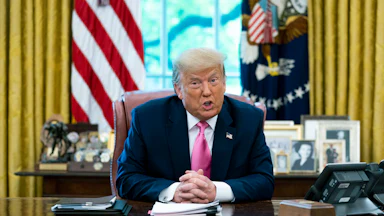
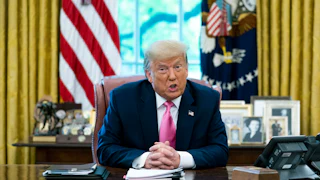
When the 1970s oil embargo hit, the U.S. was importing more than one-third of its oil. Today, the U.S. is a net oil exporter. We still import plenty of oil, but more of it is from Canada and less from the Persian Gulf. This ought to make oil a less urgent consideration in the formulation of foreign policy. But President Donald Trump thinks about oil all the time. Partly that’s because his brain never left the 1970s (“Y.M.C.A.,” Trump’s signature rally song, was released in 1978), but mostly it’s because Trump wants to control the global oil market in general, and Middle East oil in particular.
When Trump looks at the oil industry, he doesn’t see an energy source. He just sees a pile of money. In 2011, as the United States was preparing to remove troops from Iraq, Trump told Kelly Evans of The Wall Street Journal that he’d rather stay and “take the oil” as compensation for removing Saddam Hussein. Trump was likely unaware (and may be still) that the U.S. already had sort of “taken the oil” in Iraq, in the sense that Iraq’s oil revenue was and remains collected and controlled by the New York Fed as a check on corruption and other potential mischief by our client state. Around the same time Trump was mouthing off to The Wall Street Journal, he also advocated seizing Libya’s oil from Muammar Qaddafi. He kept saying this stuff during his 2016 presidential campaign, and during his first presidency, when he sent troops into Syria, he said, “We’re keeping the oil.” (We didn’t.)
Trump’s January invasion of Venezuela, in which the United States arrested President Nicolás Maduro and brought him to the U.S. for trial, left Maduro’s corrupt Marxist regime in place, raising the question of why we’d bothered. We’d bothered, it turned out, because Trump fantasized that he could bring American companies back to Venezuela, whose oil, he claimed, had been “stolen” from the Americans who pumped it out of the ground. (That wasn’t true, but never mind.) Trump was furious when Exxon’s chief executive told him at a televised White House meeting that the country was “uninvestable”; only Chevron is operating there now, and it was there before. Meanwhile, Trump is using oil as a weapon to topple Cuba’s antique Communist regime.
Trump’s ever-shifting explanations for why he went to war with Iran mostly reveal an old man’s confused mind, but somewhere in that maelstrom is the idea that he can gain control of Iran’s oil. And now, whaddya know, he’s talking obliquely about sending in the Marines to seize Kharg Island, where Iran stores its oil prior to exporting it. The idea is to deprive Iran of oil revenue to pressure it into reopening the Strait of Hormuz. At the same time, though, Trump is expanding Iran’s oil revenue by removing sanctions from 140 barrels of Iranian crude oil that’s already loaded onto tankers, in hopes that that will lower oil prices at home. If there’s a larger purpose, it’s to control Iran’s oil—never mind whether to enrich the enemy, starve it, or do both simultaneously.
Trump’s environmental policy consists almost entirely in boosting oil revenues. In January, he repealed the Environmental Protection Agency’s 2009 “endangerment finding” establishing the agency’s jurisdiction over greenhouse gas emissions under the 1970 Clean Air Act. Previously, he eliminated the Biden administration’s $7,500 tax credit for electric vehicles, clawed back grants to promote wind and solar energy, reopened the Arctic National Wildlife Refuge for drilling, eliminated from regulatory cost-benefit analyses considerations of public health, canceled grants to research climate change—you get the idea. Trump’s top environmental priority is to extend as long as possible the primacy of petroleum as an energy source, ceding renewables (that is to say, our energy future) to China. Don’t ask what the strategy is. The strategy is, he can’t help himself.
At an April 2024 Mar-a-Lago dinner, Trump bluntly told a group of oil executives, including representatives from Exxon, Chevron, and Occidental, that if they raised $1 billion for his presidential campaign he’d reverse Biden’s environmental policies. “You’ve been waiting on a permit to drill” in the Arctic for five years, Trump said. “You’ll get it on Day One.” Energy companies ended up spending about a quarter of one billion dollars in that election cycle, virtually all of it on Republicans, more than doubling their spending four years earlier on soft money and outside groups. Sure enough, on his first day in office, Trump issued an executive order opening Alaska’s Arctic National Wildlife Refuge to drilling.
I’m not the first to observe that Trump’s style of governing apes that of authoritarian leaders in the Gulf and Russian petrostates. His personnel policy is unapologetically nepotistic, and he prioritizes the collection of bribes. Four days before his inauguration, the president of the United States accepted as his business partner the United Arab Emirates, which (unlike Trump) had to pay for its 49 percent stake in the Trump family crypto firm, World Liberty Financial. Eric Trump, who signed the document, had previously said of the UAE that it was “the developers’ greatest dream, because they never say ‘no’ to anything.”
Last May, the UAE purchased $2 billion in WLF stablecoin; two weeks later, Trump lifted national security restrictions on UAE’s importation of high-end AI chips. That was, as I’ve noted more than once, the worst political bribery scandal in America since Teapot Dome, the main differences being that this time out a sitting president was himself implicated and that the sums were, after inflation, much vaster. More recently, Trump bypassed Congress to sell $23 billion in weapons to UAE, Kuwait, and Jordan.
Not to be outdone, UAE rival Saudi Arabia’s Dar Global, a firm with close ties to the monarchy, has initiated four Trump Organization projects in that country since Trump’s inauguration, including a billion-dollar “Trump Plaza” in Jeddah. And last week we learned that Trump’s son-in-law, Jared Kushner, even as he acts as Trump’s Middle East envoy, has been soliciting investment from the Saudis for a private-equity fund that made Kushner a billionaire after his previous stint as Trump’s Mideast negotiator. Nobody shoves money into Trump’s pockets like the oil-producing Arab nations.
A May 2025 essay published in The National Interest by Tatiana Mitrova and Anne-Sophie Corbeau of Columbia’s Center on Global Energy Policy suggested we may see the emergence of a new oil cartel consisting of the three largest petrostates—Saudi Arabia, Russia, and the United States—because their combined oil production now exceeds that of all OPEC nations. One potential obstacle is that international cartels are illegal in the United States (though American judges and Congress have always been too chicken to apply that reasoning to OPEC). Another obstacle is that the oil business doesn’t have a great future. Global demand is high now, promising windfall profits to foreign sheikdoms and American oil executives. But it’s projected to decline in the next decade with the spread of conservation and renewables in other nations, and, after Trump leaves office, in the U.S. as well.
Still, at the present moment, the price of oil remains sufficiently relevant to voters’ well-being that Trump’s driving them higher with his war of choice in Iran is the height of madness. Less than a month ago, Trump boasted in his State of the Union address that gasoline had dropped to $2.30 per gallon. Now it’s $3.94 per gallon and Trump is boasting on Truth Social that “the United States is the largest Oil Producer in the World, by far, so when oil prices go up, we make a lot of money.” You have to wonder whether by “we,” Trump means the Trump Organization and that the price of a presidential bribe is rising accordingly. For Trump, oil prices are a game of heads I win, tails you lose.