Because the 2024 elections start now

The Race to Defeat Ted Cruz Is Getting Crowded

PLUS: Why Jamie Raskin isn’t running for the Senate

Texas Senator Ted Cruz
Anna Moneymaker/Getty Images
Texas Senator Ted Cruz

The top

And then there were two. 

That was the situation when, on Monday, Texas State Senator Roland Gutierrez formally jumped into the Senate race to unseat Senator Ted Cruz. The addition of Gutierrez means there are two high-profile candidates in the Democratic primary to take on Cruz. Until Gutierrez’s announcement Representative Colin Allred was far and away the front-runner in the primary.

In the past, the most high-profile Democrats running for office (Beto O’RourkeWendy DavisM.J. Hegar) have all effectively had their primaries to themselves, allowing them to focus on their then-likely Republican opponent in the general election. 

And they all lost.  

But that was then and this is now. Every election is different and this time Democrats have Cruz’s 2021 absence from the state during a big power outage and the 2022 Uvalde shootings to criticize him on, in addition to all the regular knocks on Cruz. Oh, and then there are also Texas’s strict abortion laws. 

Then again, this is Texas, the reddest of the red states and divided primaries do affect the outcome of an election. One veteran Democratic campaign manager who’s worked in Texas put it this way:

Both of these campaigns are going to have to be splitting their attention to do a lot of work.… There’s enough factions in Texas right now. You gotta get your party on board. You gotta get groups on board—and by the way Texas is a crab bucket. Texas is fighting to pull everybody to get to the top but they pull each other down in order to do it. And you don’t have time for that right now. The stakes are too high. There’s too much work to be doing that. They need to learn how to get along and to start winning—this doesn’t help that. This is going to have people pick sides and more dangerously it’s going to put people on the sidelines. Luckily they’re still running against Ted Cruz.

Polling is sparse but a Texas Hispanic Policy Foundation poll from May found Allred leading the primary field with 33 percent and then Gutierrez with 22 percent. Now, it’s early, it’s just one poll, and all the other caveats, but Gutierrez’s entrance means this will likely be a divided primary. Democrats will have to hope it won’t be too divided. 

Trivia, tips, and pet pics

We want to hear from you! Which fundraising announcements have surprised you the most ahead of the end of the third quarter? Are you excited to see the new Mission Impossible movie?

Or do you want to enter our weekly dog and cat photo contest (winner at the bottom)? Email us: dstrauss@tnr.com and gsegers@tnr.com.

Lessons from 2022

“It all comes down to turnout” is a cliché for a reason. A new report from Pew Research Center shows that Republicans won the House in 2022 in large part due to higher turnout by GOP voters, with 71 percent of those who supported Donald Trump in the 2020 presidential election voting in the 2022 midterms, compared to 67 percent of people who had cast ballots for Joe Biden.

“This report offers, to some degree, some guidance to the parties about who they need to turn out if they hope to win,” said Andrew Daniller, a research associate at Pew Research Center. While these results “are not shocking revelations,” they further confirm that Democrats need to turn out women in greater numbers relative to men, and younger voters compared to older voters, for example. “Those are the kinds of things, if we assume turnout is the biggest factor here, that the parties probably need to focus on if they want to do well in the next election,” Daniller continued.

The report sheds further light on some of the narratives that have recently swirled among the political commentariat: the idea, for example, that Republicans are making gains with Hispanic voters, who have historically supported Democrats. Hispanic voters continued to support Democrats in 2022, but by a much smaller margin than in 2018. This was due not to changes in party affiliation, but to “asymmetric changes in voter turnout,” according to the report. 

“Our interpretation is that Hispanic voters who tend to be Republican voters may not have shown up in 2018, but did show up in 2022,” said Daniller. “By the same token, there are some Hispanic voters who went to vote in 2018, and had they voted in 2022, might have been inclined to stick with the Democrats—but they didn’t actually turn out in 2022.”

The report also found that the vast majority of voters stuck with their partisan preferences, with just 6 percent crossing party lines between midterm elections. But Daniller noted that, of those voters who changed their preferences between 2018 and 2022, Republicans gained ground particularly with rural voters and with white, non-college-educated voters. Among rural voters, for example, Republican candidates earned support from 97 percent who supported them in 2018, while Democrats held onto only 91 percent.

“We’re in an era when almost every election is determined by two, three, maybe four [percentage] points,” Daniller said. “So even if we’re only measuring the impact of persuasion as affecting a [percentage] point or two, it’s very possible that [that] could swing a national election.”

Although turnout in 2022 was not as high as it was in 2018, it was still largely unprecedented for a midterm election in the modern era. Because presidential elections tend to see higher participation rates than midterms, it’s entirely likely that party turnout will determine the outcomes in 2024, not just of who ends up in the White House, but who maintains or gains control in the House and Senate.

“2022 suggests to me that we might just be in an era where we’re going to see higher turnout. And it may not always be as high as 2018, but it might be high for a few years to come,” Daniller said.

Raskin’s reasons

Maryland Representative Jamie Raskin surprised some political observers when he announced last week that he would not run for Senate. Raskin had been publicly mulling a bid after longtime Senator Ben Cardin announced he would retire at the end of his term. TRU spoke with Raskin about his decision, and whether he’d consider a bid in the future. This interview has been lightly edited and condensed for length and clarity.

TRU: Why did you end up making this decision?

 Jamie Raskin: It’s been a convergence of things. I’m in the thick of this struggle to defend democratic institutions against this MAGA attack on the rule of law, and I feel like I’m in a significant position to do that as the ranking Democrat on the Oversight Committee. If we take the House back, I’ll be the chair of the committee.

I’m being called upon by a lot of colleagues to help them out in the country and I think I can contribute to their campaigns in lots of different ways. That was one part of it.

My family’s been through a lot. In the week before the Fourth of July, this guy got picked up at the Obamas’ house with firearms and Molotov cocktails in his car. And he’d come to our house first, he visited one of the schools where my kids went to school. And a lot of things converged just to say that perhaps it’s not the right time to do that.

On the other side of it, I was getting tremendous encouragement and some pressure from people in Maryland [to run for Senate]. And that’s the part of it that still tugs at me. I love our state, as well as the country, and I don’t want to let people down. And I said in my letter that I would remain attentive to everything that’s happening in the race, and I would do whatever I could to make sure that we elect a strong, true-blue Democrat.

TRU: Do you think if a Senate seat came open again in the near future, you would consider running?

J.R.: In normal times I think it would have been a relatively easy choice to run for the Senate, precisely because I love not just the district so much but the whole state. It would have been an opportunity to interact with the state. But I just felt that it would take me out of the day-to-day defense of democracy against this continuing effort by Trump and his acolytes to overturn our institutions. 

I found it a very close choice, two excellent choices. A lot of it came down to that I prefer to spend the next year helping to elect a Democratic majority in the House, which is so essential, rather than running against Democrats. Perhaps there’s a way of doing both, but I wasn’t able to figure out at that point how to do it.

TRU: Do you have any plans to endorse in the primary?

J.R.: I haven’t gotten to any of that stuff yet. It’s still very, very early in the campaign season. But I was just so besieged by people calling and texting and wanting to meet that I felt the need to say something now in order to focus on my work.

News and views

Local flavor

Complaint alleges opponents of Alaska’s ranked choice voting formed church to skirt disclosure laws, by Iris Samuels in The Anchorage Daily News

Nebraska GOP donations yet to bounce back a year after tumultuous convention, by Erin Bamer in The Omaha World-Herald

Slotkin raised nearly $3M for Senate bid in second quarter, by Melissa Nann Burke in The Detroit News

Rebecca Cooke announces bid to unseat Derrick Van Orden in Wisconsin’s purple 3rd Congressional District, by Lawrence Andrea in The Milwaukee Journal Sentinel

Court upholds protective order against lobbyist who stalked WA lawmaker, by Jim Brunner in The Seattle Times

Montana Democrat Monica Tranel announces run for U.S. Congress, by Noah Corrin and Bradley Warren in ABC Fox Montana

Army veteran Sam Brown enters U.S. Senate race, by Gabby Birenbaum and Noel Sims in The Nevada Independent

Iowa lawmakers pass 6-week ‘fetal heartbeat’ abortion ban; Reynolds to sign bill Friday, by Stephen Gruber-Miller, Katie Akin, and Galen Bacharier in The Des Moines Register

Democrats want to take on Rick Scott next year. They still need to find a candidate, by Max Greenwood in The Miami Herald  

Long reads

Ohio Republicans’ devious plot to stop voters from legalizing abortion, by Grace Segers in The New Republic: Republican state lawmakers have scheduled an August election that could make it more difficult for Ohioans to change the state constitution—just months before a vote on a proposed amendment to enshrine abortion rights in the state.

America is moving on from Covid. That’s not good for Ron DeSantis, by Dave Weigel in Semafor: “Ron DeSantis, whose battles against mask and vaccine mandates made him a Republican star, has lost ground as voters move on from the pandemic.”

 The influencer who came to Congress, by Eric Cortellessa in Time: “To some, [Anna Paulina Luna is] a dangerously effective new version of the millennial MAGA politician ready to tear down the institutions of government in pursuit of an ultraconservative revolution. To others, she’s something more, the vanguard of a potentially significant turn in American politics.”

 Got a long read you’d like to share? Email us, and we’d be happy to include it in next week’s newsletter.

Winston the Winner

This week’s Pet of the Week is Winston whose human is Laura Engquist. As of Monday, Winston is a one-year-old mini goldendoodle who was born in southwest Missouri and now lives in Washington, D.C. He loves going on long walks, hanging out with his pals at the Salt Line, and sprinting through the Capitol sans a leash. 

Latest From Politics

Mondaire Jones’s Plan to Win Back a Seat in Congress

PLUS: Some eye-popping fundraising numbers—both good and bad.

Mondaire Jones on Capitol Hill
Jemal Countess/Getty
Mondaire Jones on Capitol Hill last year

The top

Former Representative Mondaire Jones launched his comeback bid for Congress on Wednesday. Jones, the first of two openly gay Black men in the House, was elected in 2020 to represent a district just north of New York City. But after a newly drawn congressional map placed him in the same district as Representative Sean Patrick Maloney, then the chair of the Democratic Congressional Campaign Committee, Jones opted to run instead in a lower-Manhattan and Brooklyn district. Jones lost in the primary to now-Representative Dan Goldman, and in a stunning upset, GOP Representative Mike Lawler defeated Maloney.

Now Jones is seeking to reclaim the lower–Hudson Valley district, rolling out his campaign with endorsements from more than 100 local officials. Joe Biden carried the old 17th congressional district by 20 percentage points, compared to 10 percentage points in the new district. (The governor and attorney general of New York are appealing for the right to redraw the map.) But Lawler isn’t the only opponent Jones is facing: First, he will need to prevail in the primary, which includes Liz Gereghty, a former member of the Katonah-Lewisboro school board and the younger sister of Michigan Governor Gretchen Whitmer. The Run-Up spoke with Jones about his campaign, and the challenges ahead. The interview has been edited and condensed for length and clarity.

The Run-Up: Mike Lawler won this district in a bit of an upset in 2022. Why do you think that you’re the best candidate to defeat him?

Mondaire Jones: Well, Mike Lawler has also told a number of people that, had I been the Democratic nominee, he would not have run against me, because he thought that he would have lost against me. I think that speaks to the fact that even Mike Lawler understands the strength of my candidacy, and for good reason. My constituents were very pleased with my record of delivering tangible results for the people of the lower Hudson Valley, and I for one never imagined that one day I would wake up and see a redistricting debacle in New York state like what we saw last year.

I’m from this district; in particular, I’m from Rockland County, which is a critical voting bloc. I am someone who is very committed to representing the communities that raised me. And I think you see that in the testimonials, both in the video that I released today and in the many months to come on what will be a very long campaign.

[Author’s note: When I asked Lawler’s campaign if Lawler said he would not have run against Jones, a spokesperson replied, “Let’s just say, not exactly …” then continued: “While it’s true that Congressman Lawler told people he was surprised that Mr. Jones ran away from the 2022 race and carpetbagged to another district instead of fighting for his seat, Mike was then—and is now—more than happy to run against someone with Mr. Jones’s far-left voting record.”]

TRU: Do you feel like you have unfinished business in Congress?

M.J.: I do. The work of saving democracy itself is unfinished, [including] the Senate filibuster of voting rights legislation and other democracy reforms that I co-authored. And now fascism is even more ascendant within the Republican Party, with the likely Republican nominee for president saying he will pardon the insurrectionists from January 6. The work of protecting basic freedoms, like the freedom of women to have an abortion, is unfinished work. We passed the Women’s Health Protection Act [in the House], but now we have to do it again in the House and in the Senate. And I definitely want to continue lowering the cost of prescription drugs, not just for people on Medicare, which we were able to do in the Inflation Reduction Act last year, but for people throughout our society regardless of their age.

We still have a uniquely American epidemic of gun violence in this country, largely because of Republican obstruction of commonsense reforms like assault weapons ban[s] and universal background checks. We have to get Mike Lawler out of Congress and restore the Democratic majority in the House in order to pass that legislation once and for all.

TRU: You mentioned that redistricted map. It’s arguable that the Republican majority this year ran through New York. Why do you think that so many districts in New York flipped Republican, and how do you correct that this time around?

M.J.: There were unique things happening in New York state politics last year, and uniquely bad decisions that were made by certain Democrats that collectively created the crisis we are now experiencing in this country, where New York and California are responsible for the Republican majority in the House. A self-described Republican drew, single-handedly, the congressional maps that we are now living with, which is why there is litigation as we speak to have the Independent Redistricting Commission redraw those maps.

In the 17th district, there was a lack of enthusiasm for the Democratic nominee and feeling wrong [about] redistricting that led [people] to either not come out to vote, to leave their ballots blank, or to even vote for another candidate for Congress.

TRU: You wouldn’t be willing to say who those “certain Democrats” who made “uniquely bad decisions” are, would you?

M.J.: [Laughs] Oh, no. I think it’s a matter of public record.

TRU: You already have the National Republican Campaign Committee and a primary opponent of yours, Liz Gereghty, saying that you left your constituents in the lurch by running in the 10th district in 2022, and now running in the 17th district. How do you respond to those criticisms? And do you think that your voters might be a bit resentful of that?

M.J.: It is extraordinary to see a Democratic candidate for Congress adopt GOP talking points regarding the nightmare redistricting last year that everyone saw for what it was. My constituents know that I didn’t wake up one day and decide not to represent the community that raised me and that means so much to me. They understood that my decision to avoid a bruising Democratic primary in a swing district was intended solely to increase the likelihood that they would continue to be represented by someone who would protect democracy and freedoms like abortion, and continuing to cut costs for working people like the family I grew up in. My constituents, to a person, whether I am in the grocery store or just walking streets, do not blame me for redistricting last year, and have urged me to represent them once again. That is exactly why I’m doing this.

TRU: Can you tell me a bit more about your strategy for reaching out to voters and ensuring that your community really feels as if you care about them and want to represent them?


M.J.: We have a four-county strategy of engaging with voters of all political stripes. It’s why I’m so proud that on the list of 109 in-district elected officials and party chairs, I’ve got a lifelong Republican who serves on the Rockland County legislature speaking to my effectiveness and endorsing my campaign. That is what being rooted in the community, and having grown up in Rockland County in particular, means for my candidacy and for this district.

Trivia, tips, and pet pics

We want to hear from you! What was the goal of Ron DeSantis’s homophobic campaign ad? How did you celebrate your Fourth of July weekend/Tuesday?

Or do you want to enter our weekly dog and cat photo contest (winner at the bottom)? Email us: dstrauss@tnr.com and gsegers@tnr.com.

Segment two

For political reporters it’s the most wonderful time of the year: the time when campaigns have to file quarterly finance reports. There are always tons of gems hidden in these if you know where to look and are a political junkie. Because this has been an annoyingly weird workweek, we decided to devote some space here to rounding up some of the big Federal Election Commission quarterly fundraising reports. They are below:

  • Representative Adam Schiff, who is running for Senate, raised an eye-popping $8.1 million.
  • Senator Tammy Baldwin raised $3.2 million, her campaign announced.
  • Senator Bob Casey raised $4 million, his campaign announced.
  • Representative Colin Allred raised $6.2 million, according to The Texas Tribune.
  • The Arizona Republican Party had less than $50,000 in cash reserves, according to Reuters.
  • Missouri Democrat Lucas Kunce raised $1.2 million, according to The Kansas City Star.

Document of the week

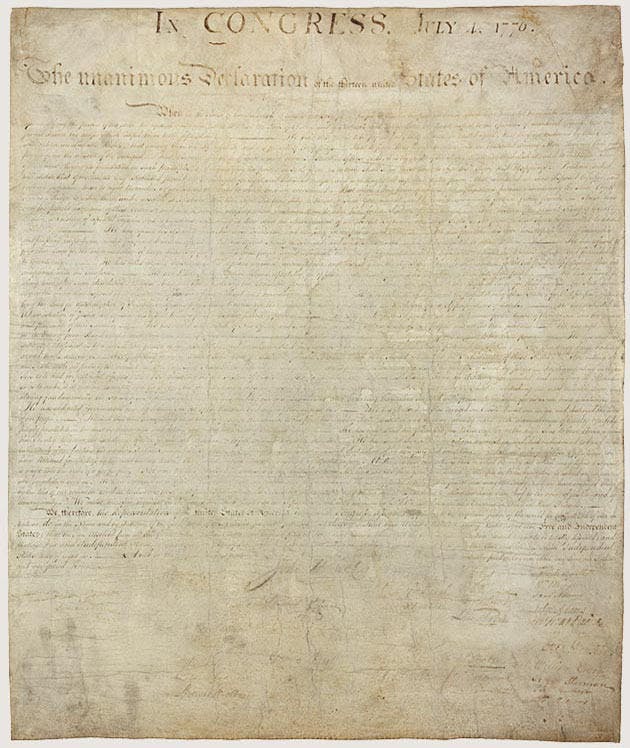
In light of this being the first TRU after July 4, this week’s document is the Declaration of Independence. Image courtesy of the National Archives.

News and views

Local flavor

Mayor for Hire: Francis Suarez’s wealth boomed while he promoted Miami as tech capital, by Sarah Blaskey, Tess Riski, and Joey Flechas in The Miami Herald

Meagan Wolfe finds herself back where she started as elections chief: In the middle of a firestorm, by Molly Beck and Jessie Opoien in The Milwaukee Journal Sentinel

Zeldin’s inroads highlight changing dynamics in Assembly for Democrats, by Joshua Solomon in The Albany Times Union

Ohio abortion rights supporters file more than 700K signatures to make the November ballot, by Jessie Balmert in The Columbus Dispatch

Some Dems worry Newsom’s 28th Amendment plan could open up a constitutional Pandora’s box, by Shira Stein and Sophia Bollag in The San Francisco Chronicle

Defeated for governor last year, Darren Bailey sets his sights on Congress and a downstate GOP primary with Mike Bost, by Rick Pearson in The Chicago Tribune

Long reads

What Democrats can accomplish when they control a whole state, by Grace Segers in The New Republic: “The party had a Minnesota legislative ‘bonanza,’ passing abortion protections, paid family leave, and a child tax credit, among a raft of new laws.”

DeSantis, furries, and Trump merch: I went to the Moms for Liberty summit, by Kate Briquelet in The Daily Beast: “Conservative parents, Bible-thumpers, and atheist moles all gathered in Philly over the weekend to court GOP candidates and thunder against the woke.”

The DNC has a primary problem, by Ross Barkan in The New York Times Magazine: “The White House wanted South Carolina to vote first in 2024. The Democratic National Committee obliged. It hasn’t gone according to plan.”

The push for legal weed faces hostile ground in red states, by Mona Zhang, Paul Demko, and Natalie Fertig in Politico: “There are increasing signs of a legalization backlash in deep red America: Voters in four states—Arkansas, Oklahoma, North Dakota, and South Dakota—have rejected adult-use referendums in the last nine months.”

Conservatives go to red states and liberals go to blue as the country grows more polarized, by Nick Riccardi in the Associated Press: “Americans are segregating by their politics at a rapid clip, helping fuel the greatest divide between the states in modern history.”

Got a long read you’d like to share? Email us, and we’d be happy to include it in next week’s newsletter.

Yankee Doodle Dandy

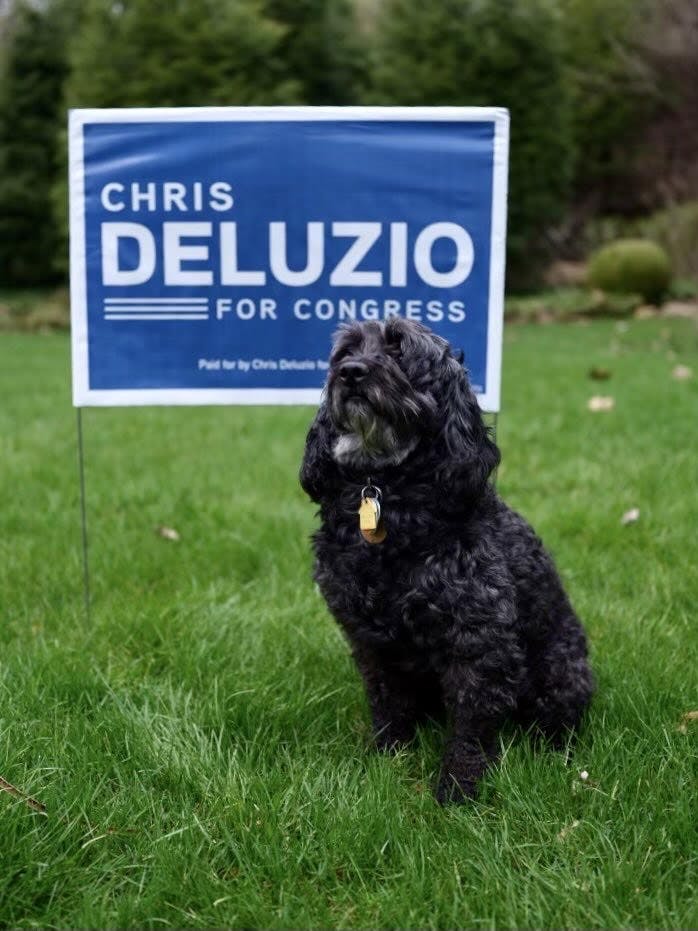
This week’s winner of our weekly pet photo contest is Yankee Doodle, submitted by Representative Chris Deluzio. Yankee Doodle is a rambunctious, patriotic little sweetie who loves freedom but hates fireworks (a hot yet correct take). He lives in western Pennsylvania with his humans: Deluzio, his wife, Zoë, and their three kids. Happy Independence Day/Week from Yankee Doodle!

Latest From Politics

The Powerful Democratic Senator Who Wants to Race Harleys With Mike Pence

Gary Peters is revving Dems’ engine for 2024. Plus, a new political group is pushing a universal basic income.

Senator Gary Peters
Al Drago/Bloomberg/Getty
Senator Gary Peters

The top

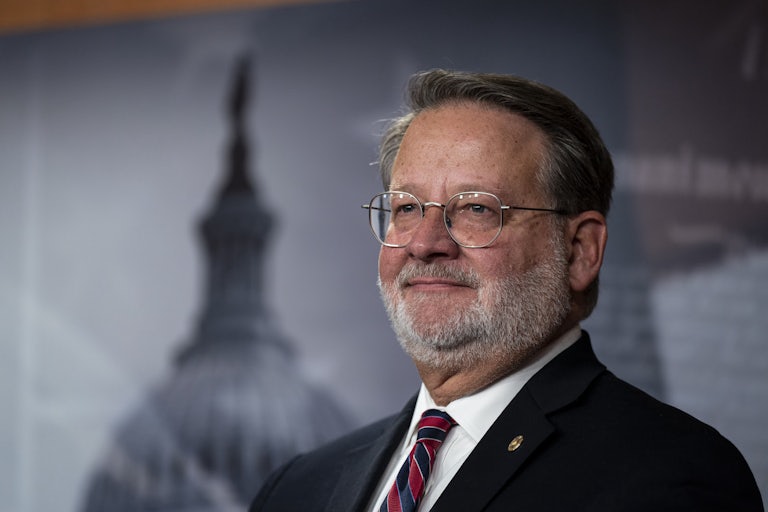
Earlier this week, the TRU Detectives sat down with Senator Gary Peters, the chairman of the Democratic Senatorial Campaign Committee. Peters, the junior senator from Michigan, is one of the lesser-known Democratic senators in American politics. But make no mistake, he is a major player in Democratic politics. He is the chairman of the Senate Homeland Security and Governmental Affairs Committee, whose portfolio includes a range of national security and anti-terrorism topics. A businessman who served in the Navy Reserve, Peters is well liked among Washington Democrats and chaired the DSCC in 2022, when Democrats dramatically exceeded expectations in the midterm cycle and successfully defended every incumbent Senate seat—the first time that’s happened since 1934.

Some highlights of our interview with Gary Peters:

“Some of the same issues are at play [in 2024 as in 2022]. One will be candidate quality. There was no question a big factor in our victory last cycle was the fact that our candidates were clearly superior to what the Republicans put forward. Our incumbents and candidates were able to raise the resources they needed. They ran great campaigns, and they were more in line with the issues voters care about.”

“Clearly the Dobbs decision was a factor.… That’s still going to be a big issue. Abortion is not going away in this election. The Republicans are completely out of step with where a large majority of the American people are. And we’re going to run good campaigns. Even if you have a better candidate, that doesn’t mean you automatically win an election. You have to run strong campaigns. A big part of our victory last time was the fact that we invested unprecedented amounts in the ground campaign, going door-to-door, starting conversations with voters not just a couple of months before the election but over a long period of time. Build up that kind of infrastructure. In fact I made a strategic decision [for] the DSCC last cycle that we would spend more money on our field operation than we did on television and that kind of media. It was the first time in the history of the [committee] that we did that.”

“Reproductive freedom was front and center on the ballot: incredibly powerful in turning folks to turn out. I remember getting pushback from a lot of folks because we were talking about abortion a lot in the campaign and folks said, ‘Why are you doing that?’ and ‘Well, let me remind you our Democratic candidates are primarily talking about economic issues … but they were talking about [abortion as a component of] economic freedom, and they were doing it for one reason: It worked. It was incredibly powerful to turn out people, especially young voters. It was amazing.”

“When you look at who did the worst in these elections, they were election deniers, and a lot of Republicans had election deniers on the ballot, and I was just so encouraged by the results that they lost. They lost. That was not a popular thing to take in a general election. It helped them win primaries.”

The Run-Up: If Donald Trump is the Republican presidential nominee again, will Democrats be talking a lot about election denying?

Gary Peters: Absolutely.

In many ways, I look at my job more as a mayor than a U.S. senator. What is important in my state? What is important in the individual communities in my state? How can I make a difference in their people’s lives for the things that they care most about? And there are some common themes, but there are also some things that are unique.… So you’ll see tailored messages in all of our states because that’s how senators do their jobs every day. They’re always fighting for people in their individual communities, and we have a lot of successes to talk about.

TRU: Where is the DSCC on the Arizona Senate race? Will the committee endorse either Sinema or Gallego? Is there a timetable on endorsing?

G.P.: In Arizona it’s still early. We’ll have to wait and see how that unfolds. You mentioned Kyrsten Sinema has not made an announcement that she’s running. We’re not endorsing anywhere right now. We’re doing our early work of investing in states that we know we can’t let a Republican win. So in Michigan there are a number of folks running … but our focus is, how do we build the infrastructure in Michigan so whoever our candidate is will have the opportunity and the resources necessary to win? I work with Kyrsten Sinema. She’s a member of my Homeland Security Committee. She’s a valuable member of the committee and works with us very closely on a variety of issues, but she’s not announced her intentions so we’ll have some time to see what unfolds in Arizona. But in the meantime, we’re going to be focused on building up the infrastructure in key states and we’re going to be absolutely focused on making sure that, whatever happens, a Republican does not win in Arizona.

TRU: The National Republican Senatorial Committee has been endorsing candidates in primaries this cycle. In the past, the DSCC has done that, but it’s been a while. Will the committee do that this cycle?

G.P.: Actually last cycle was the first cycle in a while that that didn’t happen. When I came in, last cycle, I did not endorse and that was my intention, not to close the door. There could be a reason why we’d have to endorse, but if we had good candidates running, my view is, let the people in the state decide who they want to have as their nominee in the race and then we will be supportive. But having said that, although we may not be involved in a primary, that doesn’t stop us from investing in a state.

TRU: When did you start riding motorcycles? What was your first Harley?

G.P.: When I started I think I was 11 or 12, actually. I really wanted this little minibike. There was this little minibike that I dreamed [of having], and I went to my mom and I said, “Mom, I really want to have this little minibike,” and she said, “Well you’re not going to have that because they’re too dangerous. I’m not buying you a little motorcycle. It’s not going to happen unless you buy it yourself. If you can’t buy it yourself, you’re not getting it.”

And I went out and got myself a paper route for the Pontiac Press, at that time—it’s a different paper now.

I worked a little over a year and a half delivering my papers and saving up my money, and I went to my mom and said, “Mom, I have the money. I can buy that now.” She was not particularly pleased, but there was no way she could renege on that, so I went to the dealer with my dad and bought it, and from then I’ve been riding ever since. It is kind of my therapy.

TRU: Would you race Mike Pence? He rode a Harley recently at Joni Ernst’s Roast and Ride fundraiser.


G.P.: Race him? Yeah, especially on the new one I have. I’m on the Pan America Harley. It’ll take anything he’s riding, so I’d be happy to do it.

Trivia, tips, and pet pics

We want to hear from you! Do you think Ron DeSantis has made a crucial strategic error in allegedly angering the Republican women of New Hampshire? What are your July Fourth plans? Who’s most correct on this Jessica Sidman Twitter thread about the most overrated and underrated restaurants in D.C.? Will you be watching the season premiere of The Witcher this weekend? Should Henry Cavill stay as Geralt? Did you watch Extraction 2?

Or do you want to enter our weekly dog and cat photo contest (winner at the bottom)? Email us: dstrauss@tnr.com and gsegers@tnr.com.

No more Moore

The Supreme Court this week dismissed the once-fringe “independent state legislature” theory, which has become increasingly mainstream among Republican politicians and played a prominent role in efforts to overturn the 2020 presidential election.

The decision in Moore v. Harper has far-reaching implications for future elections. Accepting some portion of the independent state legislature theory could have resulted in unchecked partisan gerrymandering, wherein state legislatures under one-party control could divvy up congressional districts without judicial oversight.

The decision could also affect the 2024 presidential election. In 2020, supporters of President Donald Trump attempted to use the independent state legislature theory as justification to overturn the election results. Hilary Harris Klein, the senior counsel for voting rights at the Southern Coalition for Social Justice, said Tuesday that accepting the theory could have opened a legal can of worms with an “absolute tsunami of litigation challenging state court decisions.”

“Any of those challenges that could have been lodged may still be attempted. We cannot say they won’t be attempted, but they should be shut down very swiftly by lower courts,” Klein said. “I think that we have, thankfully avoided this immense amount of election chaos and uncertainty that we could have had going into 2024, if any version of this theory had been adopted by the court.”

Moore v. Harper was brought to the Supreme Court after North Carolina’s highest court ruled that its congressional districts were illegally gerrymandered to benefit Republicans. The state Supreme Court later reversed that decision, after Republican judges obtained the majority. The ruling will have little effect on North Carolina, given that the state court has already issued a ruling on its congressional map.

“While the court made the right decision in dismissing a fringe and extreme legal theory outright, we know that the authoritarian forces behind this case will not give up so easily,” argued Neha Patel, co–executive director of State Innovation Exchange, an interstate network of legislators committed to advancing progressive policies. The North Carolina legislature, for example, is likely to redraw its congressional map to favor Republicans once more. Patel also pointed out that several Republican-led state legislatures, particularly in the South, have recently introduced and passed restrictive legislation affecting voting access.

But this ruling could also affect a state like Wisconsin, which has an incoming liberal majority that may choose to strike down the state’s gerrymandered congressional map. That, in turn, could help determine which party takes control of the House after the 2024 elections. The ruling is also a blow to Ohio Republicans, who ignored a state Supreme Court order to redraw the congressional map ahead of the 2024 election, citing the independent state legislature theory.

But others raised concerns about the powers the Supreme Court reserved for itself in this decision. “In our view, democracy dodged the bullet that shouldn’t have been fired,” said Stasha Rhodes, campaign director of United for Democracy, which advocates for more serious checks for the Supreme Court. “This independent state legislature theory is so extreme, it really had no business at the court in the first place.”

Rhodes argued that the court left the door open for “serious meddling and mischief” in future elections, particularly at the presidential level, in an aside which our colleague Matt Ford likened to a “judicial version of a Marvel post-credits scene.” As law professor Rick Hasen argued in Slate, this decision could allow the Supreme Court “to second-guess state court rulings in the most sensitive of cases,” as it did in Bush v. Gore.

Efforts to overturn election results likely will not go away in states like Wisconsin, Michigan, and Arizona, Patel argued. “That’s still an ongoing fight,” she said. “This case has been years in the making … and so what we do from here on out, it’s years in the making to come.”

Hot universal basic income scoop

Remember Michael Tubbs? The former mayor of Stockton, California, who got national attention for pushing for a universal basic income during his tenure? Well, he’s back and taking the lead in a new 501(c)4 organization aimed at supporting lawmakers in favor of introducing an income floor. Tubbs and Saint Paul Mayor Melvin Carter are running the group, whose existence is being first reported by The Run-Up. It will be called United for a Guaranteed Income, or UGI.

According to a copy of the announcement, which your TRU detectives got their hands on: “United for a Guaranteed Income will advocate for anti-poverty legislation at the local, state and federal level, support candidates that are working to create an income floor in the United States, and mobilize Americans to join the fight. This will be a seven-figure campaign through 2024, and will grow from there.”


United for a Guaranteed Income is really an evolution of the work of mayors in our country in trying to get a guaranteed income,” Tubbs told Daniel. “The idea is to build on the momentum we’ve seen, the success the pilots, the champions have created, and really organize with a unified voice and speak to the federal government and state governments about the need to make a guaranteed income a policy. So it’s really about the evolution from piloting to policy and having the capacity to do so and to use the political system to achieve that goal.”

UGI has raised $500,000 to start, according to a spokeswoman for the group.

Document of the week

This week’s document is a fundraising invite for Representative Ruben Gallego’s Senate campaign. The interesting thing about this fundraiser is that the headliner is none other than former House Speaker Nancy Pelosi. The fundraiser was first reported by NBC News.

News and views

Local flavor

On the trail: Trump-DeSantis split-screen moment in N.H., by Paul Steinhauser in The Concord Monitor

Sarah McBride announces run for US House seat to become first trans member of Congress, by Meredith Newman in The Delaware News Journal

Supreme Court sends case over Louisiana congressional maps back to 5th Circuit, by Sam Karlin in The Advocate

At Texas-Mexico border, Ron DeSantis unveils immigration platform with Trump in mind, by Patrick Svitek and Renzo Downey in The Texas Tribune

Republican Tim Sheehy enters U.S. Senate race, by Holly Michels in The Billings Gazette

In major ruling, US Supreme Court rejects elections theory put forth by NC Republicans, by Danielle Battaglia, Avi Bajpai, and Lars Dolder in The Charlotte Observer

Gov. Kay Ivey calls special session to redraw Alabama’s congressional districts, by Mike Cason in AL.com

Is the Confederate flag still an issue in Mississippi elections? Chris McDaniel campaign tries to revive it, by Geoff Pender in Mississippi Today

An unlikely duo is key to Adam Schiff’s Senate campaign: Nancy Pelosi and Donald Trump, by Joe Garofoli in The San Francisco Chronicle

Long reads

DeSantis voters: Angry at Fauci, anxious about ‘Cinderfella,’ tiring of Trump, by Hannah Knowles, Colby Itkowitz, and Dylan Wells in The Washington Post: “The Florida governor is appealing to the GOP’s right flank as he tries to peel support away from Donald Trump. But many are still drawn to the former president, who leads by a wide margin in the polls.”

Inside the mind of Robert F. Kennedy Jr., by John Hendrickson in The Atlantic: “What had initially been written off as a stunt has evolved into a complex threat to both Biden and the establishment wing of the Democratic Party. Put another way: Kennedy’s support is real.”

Meet the Democrat who warned us about Kyrsten Sinema, by Daniel Strauss in The New Republic: “Andrei Cherny, whom Sinema beat more than a decade ago, is running in one of the country’s most competitive House races.”

‘Ego, pure delusion and fantasy’: How the 2024 GOP field got so big, by Adam Wren in Politico: “The hottest club in GOP politics right now is the party’s presidential primary. The calculus of every longshot is that anything could happen. And the likely, worst-case scenario? It isn’t that bad at all.”

Hakeem Jeffries is staging a takeover of the New York Democrats. His hope to become Speaker may depend on it, by Edward-Isaac Dovere in CNN: “Hakeem Jeffries’ path to winning the majority and becoming speaker runs through his backyard in New York, and he is methodically staging a takeover of Democratic House campaigns in the state to make it happen.”

Got a long read you’d like to share? Email us, and we’d be happy to include it in next week’s newsletter.

Miso soup

This week’s winner of our weekly pet contest is Miso, submitted by her human, Shefali Luthra of The 19th. Miso is a cat of contradictions: She hates to be picked up, but she loves a very gentle belly rub. Miso also hates the rap duo Run the Jewels (specifically Meow the Jewels) and Porgs but loves watching The Sopranos and playing with dumbbells and bike pedals.

Latest From Politics

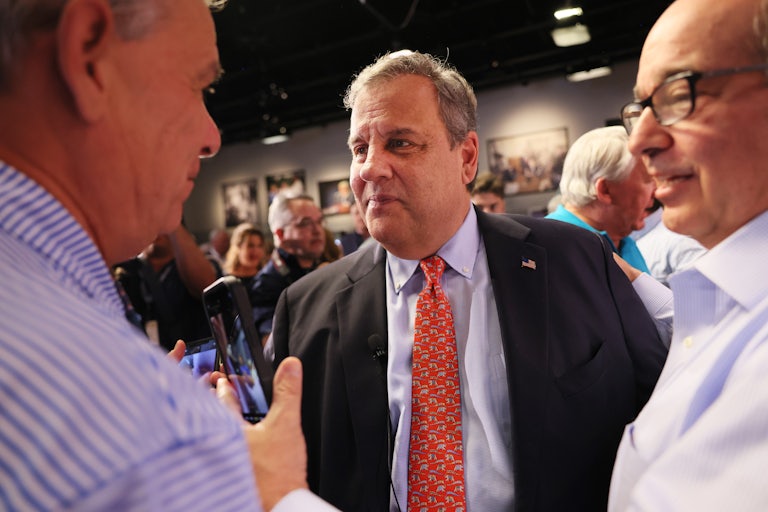
Chris Christie’s Weird Appeal Among Democrats

PLUS: The politics of abortion, a year after the Dobbs ruling

Chris Christie at an event in New Hampshire
Michael M. Santiago/Getty Images
Chris Christie at an event in New Hampshire earlier this month

The top

This weekend marks the first anniversary of the Supreme Court decision overturning Roe v. Wade. In the wake of that momentous ruling, abortion has been a critical issue in special elections, midterm contests, and ballot measures. Abortion rights advocates say that the passage of time will not dim the matter’s salience with voters but will continue to motivate them to turn out at the ballot box.

“Abortion is a kitchen table issue for voters,” argued Angela Vasquez-Giroux, the vice president of communications and research at NARAL Pro-Choice America. “There’s not a single person in the United States whose life is not affected by the Dobbs decision, and I think that the sooner we begin to understand that, the easier it will be to understand why voters are reacting and acting the way they are.”

December poll by PerryUndem, a Democratic public opinion research firm, found that 64 percent of first-time voters in the midterms were motivated by the Supreme Court’s decision overturning the right to an abortion, and 59 percent of registered voters said that the issue would motivate their vote in the long term.

“It arguably, I think, made the difference between what should have been a pretty massive red wave and what wasn’t,” said Christina Reynolds, the senior vice president for communications at Emily’s List.

recent Gallup poll found that a record high of 69 percent of Americans say abortion should be generally legal in the first three months of pregnancy, and 61 percent believe overturning Roe was a “bad thing.” Support for abortion has particularly increased among women, with 40 percent saying that the procedure should be legal under any circumstances. 

As Republican-led states pass increasingly stringent laws severely restricting or banning abortion, Reynolds argued, voters will make their voices heard at the ballot box. She contrasted those policies with steps taken by state governments in Minnesota and Michigan to protect access to abortion.

“The more we illustrate what can happen if you vote this way, if you ensure that you are represented by people who will protect your rights and not rip them away, the more voters will be inspired to come out,” Reynolds said. Tuesday’s primary elections in Virginia offered another example of the salience of abortion rights, with a primary challenger toppling a Democratic incumbent state senator who has described himself as “pro-life.”

In a Wednesday press conference on marking Dobbs’s first anniversary, Representative Suzan DelBene, the chair of the Democratic Congressional Campaign Committee, said that Republicans’ positions on abortion would “cost [them] the House majority.” Senator Gary Peters, chair of the Democratic Senatorial Campaign Committee, highlighted key states where the Democratic incumbents support abortion rights, such as Ohio, Wisconsin, and Arizona.

Senator Tammy Baldwin pointed to an April election in her home state of Wisconsin where a pro–abortion rights candidate overwhelmingly won a state Supreme Court seat. That court may consider an 1849 statute restricting abortion in the state. “It will remain a very significant issue for Wisconsinites, and so I believe that it will be a major topic in the 2024 elections,” said Baldwin, who is up for reelection.

USA Today/Suffolk University poll published this week reflects this trend: The survey found that one in four Americans say state efforts to restrict abortion have made them more supportive of abortion rights. (For their part, anti-abortion advocates at the Susan B. Anthony List are pressing candidates to support a 15-week abortion ban, Semafor reported.)


Nevada Senator Jacky Rosen, who is up for reelection this year, promised Wednesday that she would make abortion a key campaign issue. “As long as I’m here, and Senate Democrats remain in the majority, we won’t let a restrictive abortion ban pass,” she said.

Trivia, tips, and pet pics

We want to hear from you! Is Hunter Biden’s proposed plea deal a “slap on the wrist” or justice being served? Is this CNN poll showing Trump losing steam an outlier or a sign of things to come?

Or do you want to enter our weekly dog and cat photo contest (winner at the bottom)? Email us: dstrauss@tnr.com and gsegers@tnr.com.

Chris Christie’s weird Democratic appeal

There’s something about Chris Christie that Democrats seem to find—maybe not appealing but less atrocious than other Republicans. That’s the situation in this Republican presidential election, at least. On Pod Save America, for example,  the Pod Save bros occasionally like to give Christie a softer drubbing than they do other GOP candidates. On a recent episode, Jon Favreau and Dan Pfeiffer played a clip of Christie’s raison d’être for running (which is to defeat Donald Trump, contra almost any other candidate in the race). “​​I loved it,” Favreau said. “Of course. Of course. How could you not love that?” Pfeiffer similarly said later in the episode that most of the Republican primary field has “the same problem, which is: How do you make a case against Trump when you were just slavishly defending every terrible thing he did six months ago? At least Christie says he’s wrong.” 

This sentiment isn’t exactly new or unique. Going all the way back to 2014, Democrats have found Christie appealing if the only other options are Republicans. According to a Christian Science Monitor article from that year titled “Is Chris Christie the Democrats’ favorite Republican?” the then–New Jersey governor was Democrats’ “favorite possible GOP candidate.” 

Christie, formerly both a U.S. attorney for the district of New Jersey and top-tier Republican presidential candidate (certainly in 2012, when he passed on the race, and arguably in 2016), is still able to go on conservative-leaning networks and podcasts and prosecute the case against Trump. Over on the Ruthless podcast, which is somewhat of a conservative Pod Save America analog, Christie recently said Trump “intentionally hid dozens of boxes of documents from his own lawyer … I mean look, it is a tough indictment, and I guarantee—having done something like this for seven years—is that that’s about a third of the evidence. You never put all your evidence in the indictment—ever.” These are just things to which conservatives won’t listen coming from a liberal but which a card-carrying, abrasive Republican can say. 

What’s more, Christie isn’t exactly popular among Republicans. When he finally decided to run for president in 2016, he bet the barn on a good New Hampshire showing, only to meet embarrassingly dismal resultsposting behind Trump, former Ohio Governor John Kasich, Senator Ted Cruz, former Florida Governor Jeb(!) Bushand Senator Marco Rubio

Christie’s popularity isn’t exactly rebounding. According to FiveThirtyEight, Christie is currently “more unpopular than ever among Republican registered voters: His national net favorability rating in the latest Monmouth poll was -26 points (21 percent to 47 percent).” The former Garden State governor, though, isn’t exactly an old-school liberal Republican from New Jersey. He recently said that while he thought the original Roe v. Wade ruling was “wrong,” voters wouldn’t have to worry about a federal abortion ban if he is elected president. 

All of which is to say that, given the current crop of Republicans vying for the party’s presidential nomination, it’s understandable why Democrats might see Christie as the least nefarious of the various candidates. Too bad for Christie that Democrats don’t decide who wins the Republican nomination.

Document of the week

This week’s document is a fundraising invite for President Joe Biden featuring Biden, Illinois Governor J.B. Pritzker, and Pritzker’s wife, first lady M.K. Pritzker. Pritzker, it’s worth noting, has been mentioned as a possible presidential candidate, but it’s clear as long as Biden is running, the second-term governor is eager to support the sitting president to lead the Democratic Party. 

News and views

Local flavor

Ohio Supreme Court OKs August election for plan to make it harder to amend constitution, by Haley BeMiller in The Columbus Dispatch

Democratic National Committee ‘alarmed by’ Alabama party losing diversity caucuses, by Brian Lyman in AL.com

Meet the next generation of LGBTQ+ rights activists in New York, by Rebecca C. Lewis in City & State New York

DeSantis aside, few presidential hopefuls heading to early state Nevada, by Gabby Birenbaum in The Nevada Independent

London Breed saved herself. Can she save San Francisco? by Josh Koehn in The San Francisco Standard

Lisa Blunt Rochester, Delaware’s sole congresswoman, will run to fill Carper’s Senate seat, by Meredith Newman in The Delaware News Journal

Aird ousts Morrissey in Senate primary; Bagby beats Gooch, by Michael Martz in The Richmond Times-Dispatch

Long reads

He’s deeply religious and a Democrat. He might be the next big thing in Texas politics., by Adam Wren in Politico Magazine: “James Talarico confounds Fox News hosts, fights the culture wars by quoting scripture, and has fellow Democrats talking about his statewide future.”

Gov. Ron DeSantis used secretive panel to flip state Supreme Court, by Beth Reinhard and Josh Dawsey in The Washington Post: “Leonard Leo, the key architect of the U.S. Supreme Court’s conservative majority, led the advisers who helped DeSantis reshape the state court.”

Team Trump suspects his former chief of staff is a ‘rat’, by Asawin Suebsaeng and Adam Rawnsley in Rolling Stone: “Earlier this year, Donald Trump sent some of his lawyers and political advisers on a ‘small fact-finding mission,’ as a person with knowledge of the matter describes it to Rolling Stone. The former president wanted to know, according to that source and another person close to Trump: ‘What is Mark doing?’”

The Virginians who can’t vote on Tuesday because of Glenn Youngkin, by Alex Burness in Bolts Magazine: “Under Youngkin’s predecessor, Virginians automatically regained the right to vote upon leaving prison, an approach that would have made Hawkins eligible to vote. But Youngkin has revived the state’s lifetime ban on voting for people with felony convictions.”

Got a long read you’d like to share? Email us, and we’d be happy to include it in next week’s newsletter.

Taco Thursday

This week’s winners of our pet photo contest are Shrimp Taco (front) and Señor Don Gato (back). Submitted by Emily Perlstein of NARAL, Shrimp and Señor are polar opposites in terms of personality—the former pathologically friendly, the latter allergic to all non-Emily human connection—but they agree on their love for each other. They may have one brain cell between the two of them, usually in use by Señor, but their cuteness knows no bounds.

Latest From Politics

What If Trump’s Indictment Doesn’t Change a Thing?

PLUS: Congress tackles A.I., and GOP senators stay neutral.

Stephanie Keith/Getty Images

The top

Artificial intelligence arrived in the Capitol this week as lawmakers got the first of three closed briefings on the suddenly everywhere technology. The briefing was about where A.I. is today and was conducted by MIT professor Antonio Torralba, an expert in the field. Senate Majority Leader Chuck Schumer, speaking on the Senate floor, described it as a senators-only hearing about A.I.’s “capabilities, its applications, its limitations, and its challenges.”

Tuesday’s session was part of the scramble both Democrats and Republicans are undergoing to try to figure out how to respond to A.I. technology in politics. Caucuses are forming. Lawmakers are holding subcommittee hearings. Republicans hope that the technology can help improve border security. Former Google CEO Eric Schmidt has testified on how the technology will impact “our society, economy, and ultimately national security.”

The hullabaloo is as frantic in the campaign sphere. There have been predictions that A.I. will produce a waterfall of deep-fake video and audio clips (there are already a few disturbing examples thanks to Florida Governor Ron DeSantis’s campaign, as well as phony clips of Nancy Pelosi and former Chicago mayoral candidate Paul Vallas).

The optimistic flip side is that A.I. will make it easier for underdog candidates to compete, especially by helping streamline some lower-tier campaign jobs—what Democratic strategist Colin Strother characterizes as “brute” work, such as rapid response or microtargeting. “If you can automate all of that, then these previously time-intensive, labor-intensive and therefore cash-intensive campaign functions get a lot easier to do and a lot cheaper to accomplish,” Strother told Roll Call.

So that’s the positive. The negative, again, is that A.I. will put the practice of spreading misinformation into overdrive. But let’s take a breath here. It’s not like misinformation in campaigns is anything new or new in just the past few years. The fear, though, is that with A.I.’s good will come a lot of bad as well.

“It’s going to be an accelerant and a scaler of things that are both nefarious and positive, things that people have already been able to do,” said Teddy Goff, a Democratic strategist who was the new-media guru for Barack Obama’s first presidential campaign. “There’s been the ability to mislead voters dating back to people putting flyers on trees that claim something or other. Then obviously push polls are a whole other thing. So misleading voters as to what candidates have said and done is not a new tactic, but this could allow people to do it faster and more convincingly, at greater scale.”

Goff added, in terms of targeted disinformation: “It’s sort of an extension of the trends that we’ve seen in every election in memory, where those who want to muck around [in] our elections have more tools at their disposal to do it faster and smarter and at greater scale.”

Goff, though, cautioned that the worst-case scenario isn’t a news cycle in which a campaign is caught perpetuating a very convincing A.I. deep fake.

“That’s actually probably the preferable scenario,” Goff said. “Even that preferable scenario is bad. As we all know, more people are probably reached by the lie than are reached by the fact check, that’s one. Two, I think, even when something is successfully debunked or fact-checked, the whole incident has worsened the dynamic where nobody knows what to trust and everyone thinks everything else is lying; everyone thinks information ought to be taken with a grain of salt. I think that’s, basically, bad for democracy, bad for Democrats, and I think bad for people’s mental health and bad for society.”

The worst-case scenario is different, Goff continued.

“What’s also likely to happen is millions of deep fakes all the time making it onto people’s feeds, sometimes individually targeted or targeted toward tiny little subcommunities,” Goff said. “Not exactly going viral but reaching 100 or 10,000 people at a time, well below the pay grade of any professional fact-checking operation, and I think the aggregate impact of that at scale could be impossible to track and hugely deleterious to democracy and also [to] the only one of our two parties that believes in protecting our democracy.”

Indictment indifference

For the sake of argument, let’s agree that getting indicted and arrested for hoarding classified documents in a resort bathroom is, generally speaking, not great for a presidential candidate. But Donald Trump isn’t any candidate—he’s a former president who has bounced back from scandals that would wipe out any other politician’s career a thousand times over.

There’s conflicting conventional wisdom as to how the latest indictment news will affect Trump’s candidacy. One theory, that it will only strengthen him as a candidate, points to polling showing that his previous indictment, by the Manhattan district attorney, bolstered his support among Republican voters. Others believe that it may help him in the short term but could further alienate voters in a general election.

But there’s a third possibility: What if this doesn’t change anything? What if Trump still becomes the Republican nominee, facing off against Joe Biden, and the country gets to experience 2020 Part II: Electric Boogaloo? According to a recent ABC News/Ipsos poll, a plurality of Americans believe the federal grand jury was correct to indict Trump, with predictable splits along party lines. Yes, he is the first-ever former president to be federally indicted—but voters’ beliefs about him are likely baked in, regardless of what he has allegedly done.

A Quinnipiac University poll released on Wednesday found that support for Trump among Republican and Republican-leaning voters remains unchanged in the wake of the indictment, with 53 percent saying they would support him in the primary. The poll also found that in a head-to-head matchup, Biden would narrowly lead Trump by 48 percent to 44 percent.


“I don’t think this changes Donald Trump’s profile,” Senator Josh Hawley said. “I think people who hated him will be like, ‘See, I knew I hated him.’”

Trivia, tips, and pet pics

We want to hear from you! Do you think Trump’s indictment and arrest will change anyone’s mind? Are you also tired of constantly dealing with presidential campaign news when we’re still a year and a half away from the general election?

Or do you want to enter our weekly dog and cat photo contest (winner at the bottom)? Email us: dstrauss@tnr.com and gsegers@tnr.com.

Senate Republicans stay neutral

While many House Republicans have flocked to endorse presidential candidates, GOP senators have been more circumspect, often declining to wade into the primary. Trump has garnered support from 10 conservative senators, while North Dakota Governor Doug Burgum’s two home-state senators have endorsed him, and Senator Tim Scott has the support of South Dakota’s two senators. But no other candidate has earned a senatorial endorsement, and many Republicans in the upper chamber seem happy to stay out of the game.

Senator Marco Rubio said that he had spoken to “most of” the candidates— including the governor of his state, Ron DeSantis—but did not plan to endorse in the near future. “I don’t think my endorsement is going to decide [anything],” Rubio said. “Frankly, I don’t think endorsements from senators right now are going to change the outcome.”

That sentiment was echoed by Senator Cynthia Lummis, who said she hadn’t heard from any of the campaigns about an endorsement but her “inclination is to not endorse in the primary.” Senator John Cornyn did not respond directly when asked if any campaign had reached out and asked for his endorsement, only saying: “Well, I like Tim Scott an awful lot, but I’m not going to get involved in the primary.”

Hawley, however, indicated that he believed an endorsement in the primary would be a moot point. “I think Donald Trump is going to be the nominee. I just think it’s inevitable,” he said. “No offense to anybody else.”

Document of the week

This week’s document is a fundraising invitation for Virginia House Minority Leader Don Scott, a Democrat. The fundraiser on Tuesday was headlined by special guests former Governor Terry McAuliffe and Congressman Bobby Scott, both Democrats.

News and views

Local flavor

Wisconsin Rep. Mike Gallagher says he will not run for Senate in 2024, leaving an open GOP field, by Lawrence Andrea in The Milwaukee Journal-Sentinel

Anti-Boebert campaign PAC accuses Colorado congresswoman of defamation, by Nick Coltrain in The Denver Post

​​Georgia GOP elects election deniers to key posts, by Greg Bluestein and Mark Niesse in The Atlanta Journal-Constitution

Why what happened in 2021 Arizona election ‘audit’ still matters, by Robert Anglen in The Arizona Republic

Feds Got Permission To Trace Ald. Jim Gardiner’s Phone Calls As Part Of FBI Investigation, Court Records Show, by Ariel Parella-Aureli in Block Club Chicago

Scott Wiener is quietly amassing female leaders’ support in his campaign-in-waiting for Nancy Pelosi’s seat, by Joe Garofoli in The San Francisco Chronicle

Haley Stevens endorses Elissa Slotkin for U.S. Senate, by Riley Beggin in The Detroit News

‘Food for everyone.’ Trump detours to Versailles to court Hispanic voters after arraignment, by Michelle Marchante, Ana Ceballos, Linda Robertson, and Jimena Tavel in The Miami Herald

Long reads

Sarah Huckabee Sanders is content in Little Rock. For now. by Grace Segers in The New Republic: “[Sanders’s] prominent knack for partisan warfare, and early legislative successes, have cemented her as the Republican governor to watch in the not-quite-post-Trump era.”

This California Democrat might be the future of the party, by Jonathan Martin in Politico Magazine: “As his party attempts to reclaim the majority next year, [Aguilar is] embracing a new role: mentor, guide and, he hopes, eventually leader for the next generation of California Democrats emerging and arriving in Washington.”

Can Elise Stefanik become MAGA’s messenger in chief? by Abigail Tracy in Vanity Fair: “Once a Paul Ryan protégé, New York Republican Elise Stefanik has morphed into one of Donald Trump’s biggest cheerleaders. She’s now being charged with keeping the House GOP on message for a critical election cycle—and as Trump indictments mount.”

Colin Allred wants to be Beto O’Rourke—without the losing, by Sam Brodey in The Daily Beast: “Allred has a needle to thread with his candidacy. He needs to capture the excitement that O’Rourke generated, while not generating the GOP backlash. He wants to build a movement, while not raising the alarm for Republicans so they rally to Cruz’s side.”

The next Georgia? Biden campaign targets North Carolina to reshape 2024 electoral map, by Joey Garrison in USA Today: “Biden’s reelection campaign is targeting North Carolina as a top state to try to flip in 2024, with Democrats convinced that the Tar Heel state’s booming suburbs with college-educated voters around Charlotte and Raleigh’s Research Triangle, combined with its sizable Black population, make it prime for a Democratic pickup.”

No Labels, Mo’ Problems

This week saw several articles interrogating the motivations of No Labels, the controversial organization floating a third-party presidential bid. Here’s a roundup of some of our favorites:

No Labels’ latest recruit: The North Carolina ex-governor behind the infamous “Bathroom Bill,” by Daniel Strauss in The New Republic: “Pat McCrory oversaw the most contentious, divisive four years in the Tarheel State’s modern history. This is transpartisanship?”

No Labels likely to back off third party bid if DeSantis emerges as GOP nominee, by Shia Kapos in Politico: “That No Labels is hinging its third-party effort in part on Trump’s fate underscores that the group’s calculus is not tied tightly to ideological considerations.”

Democrats meet with anti-Trump conservatives to fight No Labels 2024 bid, by Michael Scherer in The Washington Post: “Their mission: to figure out how to best subvert a potential third-party presidential bid by the group No Labels, an effort they all agreed risked undermining Biden’s reelection campaign and reelecting former president Donald Trump to the White House.”

No Labels is helping a firm that raises money for right-wing extremists, by David Corn in Mother Jones: “The self-proclaimed centrist group is using a vendor that assists election deniers, MAGA Republicans, and the radical Trump right.”

Got a long read you’d like to share? Email us, and we’d be happy to include it in next week’s newsletter.

Cammie and Sammie

This week, we’re featuring Cammie and Sammie, submitted by Lauren Zelt of Zelt Communications. Cammie, a tan American foxhound, was adopted from Rural Dog Rescue in 2018. Lauren describes her as “the sassiest hound around,” who loves long walks and Ray LaMontagne (don’t we all?). Sammie, a black beagle, was adopted from Lucky Dog Animal Rescue in 2019 and currently reigns as the king of snuggles and carrier of his three favorite toys—Lamby, Pony, and Mr. Shark, in that order.

Latest From Politics