Newsletter
Power Mad
A weekly review of the rogues and scoundrels of American politics

Look Who’s Defying the Supreme Court Now

Republicans haven’t lost too often at the high court of late—but when they do, they’re sore losers indeed.

Celal Gunes/Getty Images

It goes without saying that Democrats don’t believe they’ve fared particularly well at the Supreme Court in recent years. This past term was no different, as the high court’s conservative majority ruled against affirmative action in higher education, sandbagged the Environmental Protection Agency, and struck down President Joe Biden’s plan to alleviate the burden of student loans. What’s interesting about these and other radical acts of the Roberts Court, though, is that Democrats have watched the political fallout redound to their benefit. That probably explains why liberals lately have been content to wage war with the court using political rhetoric or strategic policy work-arounds, allowing the public’s increasingly low esteem for the Supreme Court speak for itself.

But Roberts and his crew haven’t actually given Republicans everything they’ve wanted—or at least not everything to which they’ve felt entitled after spending so much money and effort to purchase the Supreme Court of their dreams. And the party that’s been getting the most cake from their comrades on the bench have proven, on those rare occasions where they’ve not prevailed, to be pretty sore losers. Now, as Garrett Epps at The Washington Monthly reports, they seem poised to do something radical about it.

At issue is Allen v. Milligan, a case which Matt Ford recently enthused as a rare instance in which the Roberts Court actually did something good on voting rights: a 5–4 ruling that the state of Alabama had to draw a second majority-Black congressional district. John Roberts and Brett Kavanaugh joined the liberal justices in declaring that Alabama had violated Section 2 of the Voting Rights Act of 1965. But the plaintiffs on the losing end of this case apparently plan to do something altogether different than the Democrats typically have on those numerous occasions when they’ve been hard done by the Supreme Court: They’re contemplating simply defying it.

This would be a very Alabama thing to do. As Epps recalls, former Governor George Wallace became the poster boy for defying the federal courts in 1963 when he “stood in the door of the University of Alabama six months later to block a federal court order that the university admit two Black students.” This is an interesting fact about the Supreme Court: They don’t actually have cops on hand who can go around ensuring compliance with their orders. Those familiar with the history of the high court might remember President Andrew Jackson’s semi-apocryphal response to the court’s decision in Worcester v. Georgia, one of the foundational rulings enforcing tribal sovereignty in the United States: “John Marshall has made his decision, now let him enforce it.”

This kind of open defiance of the court may not end up being necessary in the Alabama dispute, as Kavanaugh indicated that he’d be open to resolving the matter in a different way. But Epps notes that Republicans seem unusually keyed up to go to war with a Supreme Court that mostly just delivers everything they want, gift wrapped:

Let’s begin with the states; they are raring to go. Texas, for example, seems to regard Supreme Court decisions as mild suggestions. In 2021, its SB 8 abortion bill didn’t merely test the boundaries of Roe v. Wade but successfully negated it, even though the landmark 1973 ruling was affirmed by the Court as recently as 2016. The Court meekly allowed that bill to take effect. Months later, after the Court’s majority issued its opinion in Dobbs v. Jackson Women’s Health Organization and scrapped Roe, Texas Attorney General Ken Paxton invited state officials to begin prosecuting LGBTQ persons for “sodomy” and refusing same-sex marriage licenses (both forbidden by the Court). I am surely not the only one wondering what will happen if a federal court orders Governor Greg Abbott to remove the deadly pontoons he uses to block the Rio Grande.

I wonder how the political media will respond if Republicans revive the George Wallace/Andrew Jackson style of court opposition. Back in May, I observed that the rancid coverage of the debt ceiling crisis was emblematic of the asymmetrical way the media treats the two parties, where Republicans are “allowed to exert maximal power” to get what they want while Democrats are “forced into the role of helpmate, permitted to step up occasionally to buffer the GOP’s excesses but not to exert maximal power themselves.” It’s a fairly consistent pattern that puts Democrats in a bind while granting the GOP broad permission to test the limits of our norms and institutions.

So it’s not a great sign that The New York Times covered these goings on in Alabama with a piece headlined, “Alabama Lawmakers Decline to Create New Majority-Black Congressional District”—as if the court had merely offered a suggestion that could be opted out of instead of issuing a ruling. It is hard to believe that the same paper would have treated Biden as mildly if he had, say, refused to comply with the Supreme Court’s decision to scuttle his student loan relief plan. The political press seems overly vigilant about what Democrats might do in response to a wayward Supreme Court. (Even Epps is hard-pressed to deliver the examples of court defiance on the left that his piece promises.) During the last presidential campaign, they treated the mere notion that Biden might countenance court-packing as radical beyond words—this after largely treating the GOP’s refusal to grant Merrick Garland a hearing as the normal stuff of politics.

In any event, Democrats aren’t in any rush to impose those kinds of radical reforms on SCOTUS, and as TNR contributor Simon Lazarus explains, they have good reason: For the time being, the rhetorical and political campaigns they’ve waged against an unpopular court, coupled with some creative policy responses, have proven to be sufficient to mitigate some of the damage done. What’s more, liberals seem to be having an influence on the justices themselves: In Allen v. Milligan, Roberts was able to temper his previously well-documented hostility to the Voting Rights Act, which Lazarus chalks up to the fact that liberals have been highly effective politically of late, even as they’ve faced adversity from the court. Still, if that adversity ever gets to be too much, it will be worth remembering that the GOP has made it fair game to openly defy the court’s rulings.

This article first appeared in Power Mad, a weekly TNR newsletter authored by deputy editor Jason Linkins. Sign up here.


This Week’s Republican Faceplant Has a 2024 Lesson for Democrats

The failure of Ohio’s Issue One shows that abortion—and democracy—are still potent issues for voters.

Anna Rose Layden/Getty Images

Did Ohio Republicans actually think their plan was going to work? The idea was, at least, somewhat simple to understand: To head off the possibility that a majority of Ohioans might approve a referendum to enshrine abortion rights in the state constitution this November, Buckeye State conservatives decided to rig the rules of the game with a referendum of their own. Issue 1, as it came to be known, would change the ballot initiative rules so that a 60 percent supermajority would be required to carry the day instead of the simple majority Ohioans had hitherto enjoyed. Then they scheduled the Issue 1 vote for August—the silliest of seasons—believing that doing so would lead to low turnout.

These well-laid plans went spectacularly awry this week as voters rejected the call to restrict their own voting rights. Turnout was massive, and Ohio Republicans got mauled.

It sure seems as if the Supreme Court’s decision in Dobbs has created the ultimate “be careful what you wish for” situation for conservatives, who’ve watched as voters all across the country beat back plans to further restrict abortion rights at the ballot box. Whenever they’ve been given a chance to do so, voters have rejected the call to limit reproductive freedoms—including in ruby-red redoubts such as Kentucky and Kansas. The Ohio result was a “five-alarm fire for the pro-life movement” for anti-abortion activist Patrick Brown, who tweeted, “The cause of life has to adapt, even if that means unwelcome compromise for the time being. We’ll keep getting run into the ground if we don’t.”

Whether or not that’s true is still up for debate in some quarters. The New York Times’ David Leonhardt noted on Wednesday that Democrats failed “to defeat Republicans by emphasizing their hostility to abortion” in statewide races held in Florida, Ohio, and Texas, calling it “an important caveat” to the issue’s “political potency.” But The Washington Post’s Greg Sargent was not convinced by Leonhardt’s argument, noting that there were numerous electoral successes on the other side of the ledger that were in whole or in part driven by backlash to the Supreme Court’s Dobbs decision, including several 2022 gubernatorial races (Arizona, Pennsylvania, Wisconsin, and Michigan); Senate races in Arizona and Georgia; and a crucial Wisconsin state Supreme Court election earlier this year.

There are no silver bullets in politics, but to paraphrase Dave Wasserman, I’ve seen enough to contend that the instability of the post-Dobbs world has become a motivating force for voters and a critical piece of electoral ammunition for Democrats. But Ohio Republicans may have unwittingly thrown a healthy dose of accelerant on an already burning fire by launching a broadside against democracy on top of their attack on abortion rights, as The Guardian’s Moira Donegan wrote this week:

And so the fight over abortion rights and Issue 1 in Ohio has become a proxy for the broader fight many Republicans are waging across the states: when voters don’t like the party’s proposed policies—and overwhelmingly, voters do not like abortion bans—then instead of changing their platforms or setting out to persuade the electorate to change their minds, Republicans simply change the rules, so that the voters’ wishes don’t get in the way of their preferred policy outcomes. Don’t want to vote for the Republican party line? Then state Republicans will make sure that your vote doesn’t matter.

In 2022, the Democrats’ decision to put democracy on the ballot and wage a campaign against the illiberal aims of the Republican Party was greeted with puzzlement by many pundits. But as Axios subsequently reported, the exit polls proved that Democrats had gotten it right: “National polling showed abortion and democracy turned out to be big issues with voters. Coverage in the run-up to midterms had focused heavily on pocketbook issues.” That Ohio Republicans, with this knowledge in hand, decided to court backlash in these potent areas with this ballot initiative fight makes me wonder if they ever really thought that they were going to pull off this plot against their own voters.

But it’s not like the GOP have given themselves much of a choice. Having abandoned the work of policymaking in favor of an increasingly weird and rapidly expanding universe of culture-war obsessions, Republicans don’t have all that many political moves at their disposal. The fact that voters are torpedoing the GOP agenda at the ballot box, TNR contributor Alex Thomas reported this week, means that Republicans will try even harder to demolish these avenues of direct democracy.

Democrats have lately endeavored to highlight the success of Bidenomics; there’s no doubt that pocketbook issues will be a critical component of the 2024 campaign. But there’s still a considerable amount of voltage flowing through the third rails of last year’s midterms. As TNR contributor Laleh Ispahani argued this week, Democrats should stay invested in Dobbs and democracy, especially as Republicans continue to wage war on voting rights—and dream of a national abortion ban.

This article was adapted from one that first appeared in Power Mad, a weekly TNR newsletter authored by deputy editor Jason Linkins. Sign up here.
The 2024 Election Cycle Has Entered Its Summer of Discontent

It seems like the primaries are over before they even began—and people are feeling unsatisfied.

Dustin Frank/Getty Images

On a good day, our two-year-long presidential election cycle often seems like a lengthy road trip spent in the company of the world’s most insipid people. But it’s especially dull in the August before the presidential primaries, when the novelty of all the pre-primary activity has worn off but the most substantive and consequential days are far ahead.

“So what are we going to talk about?” says the bored passenger to his dull-witted driver, having exhausted what little interest there is to be had in, say, the quixotic bid of anthropomorphic Reddit comment thread Robert F. Kennedy Jr. and the even less interesting political peregrinations of centrist nincompoops No Labels, who still somehow have deep-pocketed donors left to fleece. “Well,” the driver responds, “we could just accept the fact that this looks like it’s going to be a rematch between Donald Trump and Joe Biden.”

The endgame has slouched into view way earlier than anyone wanted it, and people are restless, testy, and dissatisfied. To wit: This week, thanks to Dean Phillips, we were made to endure yet another round of discourse over whether Joe Biden is too old to be running for president. Wait—who is Dean Phillips?

So asked everyone. It turns out he’s a three-term Democratic representative from Minnesota who spent the weekend “meeting with Democratic donors in New York City … to explore a run for the White House” and then, I guess, made a point of telling some reporters that he’d met with some donors in New York City to explore a run for the White House.

Phillips has been going on about Biden’s age for some time now, apparently. He told Politico’s Jonathan Martin in February, “If he were 15-20 years younger it would be a no-brainer to nominate him, but considering his age it’s absurd we’re not promoting competition but trying to extinguish it.”

So why aren’t Democrats trying to sabotage their incumbent presidential candidate? While I share the broad concerns about Biden’s age, the time to resolve this conundrum was back in 2015, when many younger Democrats were champing at the bit to be president. Democratic elites took stock of what was on offer and swung behind Biden; voters proclaimed their support for him soon after. Credit Phillips for consistency—he endorsed the comparatively younger Amy Klobuchar during the last primary. But another bed got made back when it mattered, and there’s no choice but to lie in it.

And so, I’m sorry to say, the die is cast: Biden has the best chance of any Democrat to win right now, and no one who might have a shot at the Democratic nomination in 2028 is going to burn bridges with the party pursuing a 2024 campaign that is likely to fail and hurt Biden’s chances. If Dean Phillips and his donors want to mount a campaign and ride a single percentage point all the way to becoming the answer to a pub trivia question in the years to come, they can be my guest.

Here’s some good news for Democrats, however. Joe Biden is definitely aging better than this quote: “What is the downside for humoring him for this little bit of time?” That line was spoken by a “senior Republican official” who, on November 8 of 2020, didn’t really see a problem with Donald Trump’s constant stream of “baseless assertions that fraud had cost him the election”—after a week in which the former president was indicted for a series of alleged criminal activities that led to the January 6, 2021, attack on the U.S. Capitol. Which brings us to this week’s New York Times/Siena poll showing that Trump is eviscerating his primary competition—including Florida Governor Ron DeSantis, who trails him by a cool 37 points.

Why isn’t DeSantis faring better? Probably because his candidacy is a knotty tangle of contradiction and nonsense. TNR’s Grace Segers deftly summarized the DeSantis campaign’s raison d’être like so: “I’m not Trump, but I’m like Trump, but Trump has baggage, but he also won the 2020 election, but I’m better than Trump, but Trump was also an incredible president.” This will fit real nice on a bumper sticker.

As I wrote back in April, this was the obvious contradiction at the heart of the candidacies of Trump’s rivals: Few have reconciled their support for Trump’s stolen-election claims with their desire to supplant him. So the people who should be fighting to tear Trump down have instead bestowed on him the sheen of an incumbent, and the Republican base has, to no one’s surprise, followed these cues. As my colleague Alex Shephard noted this week, this latest polling underscores just how deeply entrenched the idea of Trump’s Avignon presidency has become—and how it remains a third rail for challengers like DeSantis.

Still, all things being equal, you’d rather have the Democrats’ problems (that Biden is extremely old) than the GOP’s. (And here I should belatedly add that Trump, in addition to being a one-man wrecking ball of criminality and corruption, is also really frigging old.) Besides, as TNR contributor Osita Nwanevu once noted, Biden’s most important campaign promise is that he’ll beat Trump, and should he succeed again, there’s nothing stopping him from getting re-inaugurated, taking Jill out for a few spins on the dance floor, and then waking up the next morning to resign from office. That would resolve the concerns of Democrats swiftly and handily. And Republicans might wish for Biden to beat Trump in 2024 as well, because let’s face it—the only thing that’s likely to solve their Trumpism problem is a savage, election-year shellacking.

This article was adapted from one that first appeared in Power Mad, a weekly TNR newsletter authored by deputy editor Jason Linkins. Sign up here.

Will the Debt Ceiling Deal Mortgage the Democrats’ Future in Washington?

Lawmakers might once again forestall a debt default, but not without teaching the GOP that they can get away with holding the economy hostage.

Katherine Frey/Getty Images
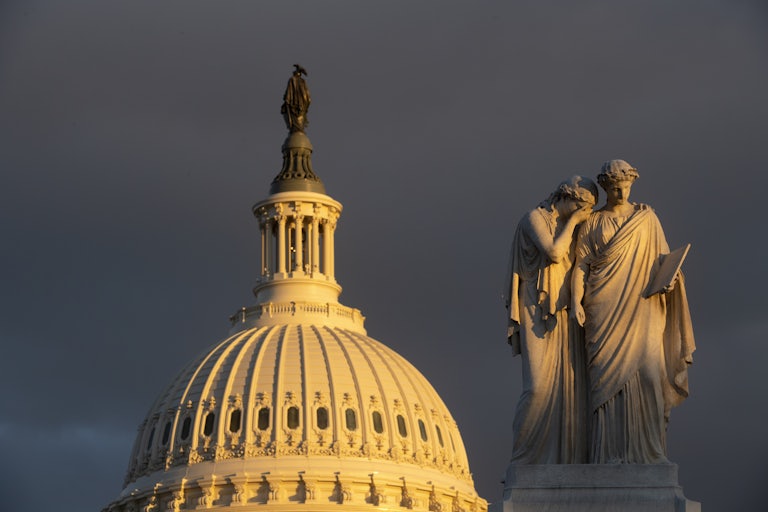
Statuary depicting Grief covering her face as she weeps in mourning on the shoulder of History stands overlooking the U.S. Capitol as lawmakers try to solve the debt ceiling crisis.

While it’s been more popular to refer to our current situation as “the latest” or “the most recent” debt limit calamity, the truth is that there’s only ever really been one debt ceiling crisis, and it’s now lasted well over 12 years. It began when President Barack Obama, in one of his less lucid moments as a politician and public intellectual, broke from the tradition of treating the process as the fake, ritualistic bit of nonsense that it was and decided it was a good idea to pair the ceremonial raising of the ceiling with budget negotiations. He did this despite knowing that the GOP wanted an excuse to try to destroy his presidency. A dumb new problem was unnecessarily invented that day, and it handed Republicans yet another weapon in their asymmetrical war with the Democrats.

Much of what’s transpired in the intervening years has been reruns of the same show: The GOP takes the debt ceiling hostage, the Democrats come to rue all those past occasions when they might have disarmed the ticking time bomb when they had the power, and I publish numerous essays full of solid gold advice on how to stop this from happening again—advice that will get ignored by the many dimwits who hold power, to their lasting regret. In terms of what’s changed, there are now more Republicans who think a default would be either no big deal or even preferable to the status quo. We also have a president who, despite having a few good unilateral options at his disposal to end the crisis, refuses to do so because he believes that he was elected to be the Guardian of Phantasmal Norms instead of president of the United States.

And so we slouch, inexorably, toward some future “X-day” when Janet Yellen announces that the magic unraveling of all things has begun. Between then and now, some sort of “debt ceiling deal” might be reached. The Beltway media, possessed of the brains of the average lutefisk, continue to speak about ongoing negotiations despite the fact that the GOP’s one avowed concession is that they’ll raise the debt ceiling—as if the targeted outcome of a negotiation can be considered a concession. But at the moment, I’m more interested in what the future holds. Specifically, what will be the new rules of Washington once all of this is over?

Right now, the deal that is coming into view is a strange one. Where spending is concerned, the talk is of Democrats agreeing to pare back some of $80 billion recently allocated to the IRS along with acceding to GOP demands to reduce discretionary spending across the board. But, according to CNBC’s Christina Wilkie, in a weird face-saving twist, Democrats will be allowed to divert the money originally headed to the IRS “to cover much of the shortfall in domestic funding created by the GOP spending cuts, essentially preserving the programs while technically cutting the overall topline figure.” The end result would thus be farce, instead of tragedy—and we may wonder why we went through all this strife in the first place. As The American Prospect’s David Dayen pointed out on Twitter, “If this is the emerging deal the CBO score is going to be hilarious. Might not even reduce the deficit! What did we do all this for?”

But the kicker is that there’s no real guarantee that the extremists in the GOP caucus will support a deal that’s not actually a deal. And so there’s already talk about how Democrats will apparently need to provide as many as 100 votes to participate in the great negation of their own accomplishments. That’s right: House Speaker Kevin McCarthy can’t even count on the support of his own caucus to get this dumb deal over the line. But he will have no need to feel that humiliated if Democrats volunteer to hold the bag on his behalf.

It’s pretty incredible how quickly we’ve slid from “Biden vows not to repeat Obama’s mistakes” to “Sorry, but we need 100 Democrats to send this bladder of rancid cream to the Senate.” It’s one thing to meekly cave; another thing entirely to offer your own gravedigger to take a turn with the spade.

But the most salient feature of the deal is that it will merely shove the next debt default “X-date” past the next presidential election, which means our 12-year-long debt ceiling crisis will continue. Only now, Democrats—who hope to re-elect Biden—will have confirmed that it’s OK for the GOP to govern in this fashion should they maintain leverage over the debt ceiling. So, where is the limit? What can’t the GOP ask for, in exchange for avoiding default? And will Democrats, when they find themselves with the power to take the debt ceiling hostage, hold it hostage to advance key Democratic priorities over the objection of a Republican president? If this is to be the only possible way of governing going forward, I’d want to know now if Democrats have the stomach for it.

Because I don’t think they do. Biden is said to be balking at the idea of invoking the Fourteenth Amendment to unilaterally disarm the debt ceiling; there is no small amount of concern that should he try this maneuver, it would be the conservative majority on the Supreme Court who might get the final say. The long and checkered history of the Supreme Court primarily runs in the direction of promoting corporate hegemony above all other concerns, so I’m not fully convinced there are five Supreme Court votes to destroy the economy, and I’m not alone in this regard.

But this is all beside the point. If Democrats are willing to concede that the high court might go so far as to destroy the global economy to thwart Joe Biden, then they need to ask themselves: How shall we govern if all roads lead to the depredations of the Roberts court? Biden will be the one to determine whether Democrats spend the next two decades cowering in fear of what the Supreme Court might do. And as The American Prospect’s Ryan Cooper explains, that’s no way to run a country: “A sensible president would not be preemptively conceding the Court’s authority in this area. They would be attacking its legitimacy, and preparing—as Franklin Roosevelt did in a similarly dire circumstance—to disobey it.”

This matter needs to be quickly resolved. Because while you might be able to get enough people to vote in the next election for enough Democrats to hold enough seats in Washington to cast enough votes to avoid future debt ceiling showdowns, there’s no easy way to change the makeup of a 6–3 conservative Supreme Court majority. And if we’re already of the mind that this majority will merrily destroy the economy just to thwart a Democratic president, then what won’t they be willing to do? Why should we suppose that Democrats, even if they were somehow able to earn a filibuster-proof trifecta, would be permitted to govern at all by this donor-funded, far-right superlegislature in baggy robes?

All of which is to say that the rules in Washington might be on the verge of radical change. We are nearing the Rubicon. The formula by which liberal governance is effectively outlawed in the United States is coming into view, and if too much is given away to Republicans today, then they’ll only come back tomorrow with more radical demands. If Democrats do not intend to take a stand now, when do they plan to do it?

This article was adapted from one that first appeared in Power Mad, a weekly TNR newsletter authored by deputy editor Jason Linkins. Sign up here.

The Beltway Media Is Spreading Debt Limit Misinformation

The political press bears a share of the blame for the fact we are once again on the precipice of default.

Kent Nishimura/Getty Images
Speaker of the House Kevin McCarthy speaks to reporters.

Having watched Capitol Hill fall into chaotic convulsions over the debt ceiling a million times before, I’ve come to the conclusion that the only way to properly negotiate your way through a debt ceiling crisis is to not negotiate at all. But it would seem, for the moment, that President Biden is going to dip a toe in those waters and fashion some sort of compromise. A deal may not be possible; it won’t take but a handful of House Republicans to scuttle any sort of bipartisan offering. So it may be too early to say that Biden is breaking his vow not to repeat the mistakes his former boss made in 2011.

But this might be a good occasion to point out the other big mistakes that have brought us to this point. Namely, those of the political media, who can rightly be said to have spent the last decade botching their coverage of the debt ceiling, mainly by failing to speak one plain truth: We keep getting dragged to the brink of default because the GOP has become a gang of extremists. This is villainy—their villainy—and the media has let them off the hook by treating this psychosis as all part of the natural order.

Over at New York, Jonathan Chait (not for the first time) runs down the most recent spate of examples that indicate we’ve already slid down a slippery slope: Here’s an unchallenged contention in The New York Times categorizing the debt ceiling standoff as “the ordinary stuff of politics”; there’s Jake Sherman blithely declaring that in “modern times, the debt ceiling is raised with negotiations.” (The American Prospect’s David Dayen has a deeper dive into Sherman’s particular brand of malpractice in this regard.) This is misinformation—or at the very least, it omits the most critical fact of all. As Chait writes: “These arguments conflate negotiation, which is historically common in debt-ceiling bills, with extortion, which isn’t.”

That the media cannot keep what is and what isn’t a “norm” straight in their head is the venial sin embedded within their debt ceiling coverage. The mortal sin is that the media has essentially conferred on the Republican Party the right to regularly stage these extortions. Imagine what would happen if the shoe was on the other foot—that a Democratic-controlled House majority was threatening to push the country into default unless a Republican president consented to a massive increase of the welfare state. It’s hard to imagine journalists referring to liberal hostage-taking as merely “the ordinary stuff of politics.”

This is another big lesson of the Obama era: The burden of bipartisanship, and the compromises that the media covets to a fetishistic extent, must be entirely shouldered by Democrats. (Marvel at the double standard: David Broder once made the insane insistence that the Obama-era Democrats needed to earn 70 Senate votes for any law they passed to be considered legitimate.) Throughout his tenure, Obama was regularly filleted for failing to reach a compromise with a Republican Party that had vowed to make him a one-term president by denying him a bipartisan win on anything. Pundits contorted themselves into pretzels in an attempt to ignore the fact that Obama and his fellow Democrats were the only party willing to stand in the ideological middle to make deals, a move that The Washington Post’s Greg Sargent referred to as “the centrist dodge.”

Obama spent an inordinate amount of time trying to play this game and please the naysayers. He allowed bipartisan “gangs” to build out their own health care reform ideas alongside the Affordable Care Act. He stumped for the votes of people like Olympia Snowe and Charles Grassley. He signed the Budget Control Act into law, unleashing the doomed “super committee” and the brutal sequestration budget cuts. And as soon as Obama was out of office, the moronic pundit drumbeat demanding more and bigger compromises fell silent. Donald Trump was never burdened by any such demands. The media’s bipartisanship fetishists essentially took four years off.

Now, with Biden back in office, we’ve returned to the Obama-era status quo where it’s up to him to make a series of painful choices in order to stave off economic collapse. There is never a demand that Republicans sacrifice anything, and you can see this in the coverage: You are probably aware that the White House is mulling across-the-board cuts to social spending and adding new and onerous work requirements to various aid programs. What are Republicans offering in return? As Politico reported on Wednesday, “House Republicans maintain that their job is done. They passed a bill. And now they are waiting for Biden to make a move toward agreeing to the spending restrictions outlined in their bill.” This reporting is included, without critique, in an article that repeatedly insists that “negotiations” are ongoing.

The Beltway media consensus conceives of the GOP as the party that’s allowed to exert maximal power to govern, while the Democrats are forced into the role of helpmate, permitted to step up occasionally to buffer the GOP’s excesses but not to exert maximal power themselves to advance their agenda. Any ambitious bit of liberal governance is usually confronted in the Beltway press with the question, “But how will you pay for it?” We may have become inured to this, but it is journalistic malpractice all the same. How have we paid for it? Quite dearly.

This article first appeared in Power Mad, a weekly TNR newsletter authored by deputy editor Jason Linkins. Sign up here.