Newsletter
Power Mad
A weekly review of the rogues and scoundrels of American politics

Why Is Biden Scared of the Most Logical Solution to Debt Ceiling Insanity?

To avoid a default crisis, the president should combine the power of the Constitution with a touch of Dark Brandon.

Brendan Smialowski/Getty Images

Here we go again: sliding headlong into yet another round of brinkmanship over the debt ceiling, with GOP extremists tempting an economy-crippling default. In recent years, this has become a regular occurrence in Washington, a ritual of learned helplessness among our elected leaders. It’s getting to the point where each iteration of this manufactured crisis has its own vintage, with a unique set of tasting notes. As TNR’s Grace Segers reported this week, the 2023 version is highly redolent of the 2011, Obama-era bottling, with a similar scent of failure and flop sweat on the nose, only this time with an especially apocalyptic mouthfeel.

But maybe we don’t have to choke down wine from this poisoned chalice. This week, the Biden administration has started to sound a little more serious about a solution involving the Fourteenth Amendment that would shut down this nonsense—perhaps for good. But according to reports, Biden’s still wavering on the edge, so let’s give him a push.

Every article about the debt ceiling requires a primer to cut through Republicans’ bullshit rhetoric about it. First, “raising” the ceiling has nothing to do with Congress incurring new debts, it merely reaffirms Congress’s commitment to pay the bills it’s already agreed to pay. Second, no other nation on earth except for Denmark has a “debt ceiling,” and the Danes have set their ceiling so high as to be impossible to breach—a good idea, which we should steal. Finally, as TNR contributor Tom Geoghegan has explained at length, the Founders would have rejected the modern-day notion of a “debt ceiling” outright, so anything that defuses or abolishes it is on safe grounds.

But the biggest thing you need to know about the debt ceiling is that it’s fake. It’s not an actual thing. It didn’t exist until 1917, when it was created specifically for the purpose of funding America’s involvement in World War I. It was extended to government debt broadly in 1939, and thus became a political football. For decades, members of Congress have marked the occasion of raising the ceiling with grandstanding speeches about the other side’s spending priorities.

These were fake debates, fake votes, with fake stakes. So anyone who tells you that debt ceiling “debates” are some kind of “norm” is lying to you. As Treasury Secretary Janet Yellen recently pointed out, the debt ceiling has been cleanly raised 78 times since 1960. That’s the “norm.” Even here, “raising the debt ceiling” is more akin to an eldritch incantation than a legislative act.

Two things changed to bring us to the point of crisis. First, President Obama made the fateful decision to use a debt ceiling deadline to invite bipartisan budget negotiations. This coincided with the Republican Party’s shift from a loyal opposition party to a gang of rabid extremists who will treat every debt ceiling deadline under a Democratic president as an opportunity to take hostages. This time around, the GOP’s demands are nonstarters: Either Biden must either tear down his legislative accomplishments and impose painful austerity on the American people, or Republicans will take the country into default.

As I’ve said before, the only way to win at “Debt Ceiling Crisis” is to refuse to play, and in recent days the Biden administration is said to be flirting with an elegant solution to the problem. Namely, invoking the Fourteenth Amendment’s language that the public debt “shall not be questioned” as a permission slip to ignore the fiasco entirely and continue making payments over the objections of the legislative branch. As Vox’s Ian Millhiser notes, the legal arguments backing this play are strong, but they suffer from having never been tested. So it’s not hard to see why Biden, having warmed to the idea, isn’t quite there yet. The president has reportedly expressed concerns that this is not a “viable short-term solution” and that it would invite “litigation” from the GOP and, perhaps, end up at the Supreme Court.

But as TNR contributor Jess Coleman noted on Twitter, this is precisely the wrong way to think about the Fourteenth Amendment solution. “This is a fundamental misunderstanding of how the law works,” he tweeted. “The onus is on those challenging a government action to change the status quo. Biden can blow past the debt ceiling and … nothing would happen. It would be on the courts to stop him. He doesn’t need permission!”

My preferred way of dealing with the debt ceiling is to treat it like the absurdity that it is, ideally with Biden in “Dark Brandon” mode. But the worst possible idea is to have a “debt ceiling debate,” because the debt ceiling is fake and to pretend otherwise is madness. Biden is correct that invoking the Fourteenth Amendment’s passing mention of the public debt leaves open the door to further litigation. But the move would deprive Republicans of the political safe harbor that comes with pretending to be negotiating. If Republicans or their allies in the Supreme Court super-legislature want to take the steps necessary to reimpose the threat of default, they’d have to step forward and do it on their own. It would no longer be on Biden or the Democrats.

This article first appeared in Power Mad, a weekly TNR newsletter authored by deputy editor Jason Linkins. Sign up here.

King Charles Should Abolish Himself

The best thing the newly-minted monarch could do is bring an end to the monarchy.

Dan Kitwood/Getty Images

This Saturday will bring the coronation of King Charles III, and the stateside media is, as always, in rapture over the royals. CNN, per habit, will be dedicating itself to a special day of live coverage of people standing around on streets waiting for things to happen. Here in Washington, D.C., The Washington Post has decided to cover it from every angle possible, from a guide on where to watch the festivities (which kick off in the early morning hours), to an upgraded recipe for “coronation quiche,” to an article from the paper’s own living tribute to patrimonial inertia, Sally Quinn—who argues that Charles might be the one figure who can get the world to take the climate calamity seriously. It is to be hoped that she’s wrong.

I’ve always found the weird hold the Royals have on the citizens of the United States to be fascinating. But what’s more keenly important is the weird hold that the Royals have on the United Kingdom—a hold that is starting to slip. According to a poll released last week by the National Centre for Social Research, “public support for the monarchy has fallen to a historic low,” with 45 percent of respondents saying “it should be abolished, was not at all important or not very important.” Still, that leaves a majority in favor of continuing the monarchy. What will it take to turn this around? Perhaps it’s up to Charles, who wants to be thought of as a transformational leader, to be the King that shuts down the kingdom.

Naturally, I shouldn’t expect our cousins across the pond to take advice from someone who lives in a gun-crazy dystopia that’s soon to have a third consecutive election to decide, by razor-thin margins, whether we’ll continue our experiment in democracy or hand the reins over to a caudillo. But there’s a long tradition at TNR of urging the abolition of the monarchy—and even advising Charles to be the one to do the deed. “If Charles I gave the British regicide, and Charles II gave it restoration, why shouldn’t you, at the moment of coronation, give it at long last a republic?” advised Thomas Mallon on these pages back in 2013, urging Charles to set the crown “aside, a simple and grand refusal” that might “smash the strongest pillar of his people’s magical thinking and subconscious self-hatred.”

But the best reason to dismantle the monarchy isn’t because it might bring about some vibe shift in a nation’s sense of self-worth. It’s because the monarchy is a huge scam. The royal family is staggeringly wealthy, with a net worth in the vicinity of $28 billion. This, on its own, TNR’s Tim Noah writes, is a fitting test of Thomas Piketty’s “r > g” hypothesis, in which the rate of return on capital is unsustainably outrunning the rate of return on labor, leading to a vicious cycle of ever-increasing income inequality. Piketty would probably appreciate Meghan Markle’s coping strategy: She may have married into a den of vipers, but in Piketty’s view, the way the economy has devolved into this “r > g” argy-bargy means that one of the few ways to play the game of capitalism and win is to marry into money. It’s getting harder and harder to accumulate wealth by simply earning an honest living.

And as Noah points out, an honest living is something that the Royals cannot claim to be making. Charles won’t be paying a cent of tax on the estate he’s about to inherit. What’s more, a significant chunk of his wealth is stashed in offshore accounts in Bermuda and the Cayman Islands, where they’re kept safe from the taxman’s clutches. Buckingham Palace has, naturally, disputed that they derive a substantial tax break by offshoring their wealth; there is no way to know for sure. But their noses are hardly clean, because they also play a substantial role in keeping the larger world of global tax dodgers spinning.

As TNR contributor Kojo Koram reported last September, a study from the Tax Justice Network found that “the world’s three most corrosive corporate tax havens are all British Overseas Territories”—the British Virgin Islands, Bermuda, and the Cayman Islands. “These tax havens are often presented in the media as strange foreign hideouts for dirty money,” writes Koram, “but they are all ruled by a British governor who represents the crown, carries the final say on the law and, every year leads the celebration of the queen’s birthday in a manner that resurrects the era of the old British West Indies.” It is precisely this royal sheen that allows these tax havens to “present themselves as part of the long history of English financial and legal expertise, not simply grubby secret money dens.”

The bottom line, Noah writes, is that while the monarchy might be a “ridiculous anachronism” as a governing institution, “as a form of capitalism, it’s the cutting edge,” largely because the royal family “accumulates wealth the same way it governs—by not doing anything.” And even beyond all that money sitting in secret accounts, earning money on top of itself, the royals take in another annual haul of boodle in the form of the taxpayer-funded Sovereign Grant, which in 2022 exceeded $107 million.

And though he may have the funds, I’m not sure that Charles truly has the charisma to be a transformational leader or Sally Quinn’s hoped-for climate savior. Julie Burchill, writing for TNR in 1993, described Charles as “a horrible hybrid of American psychobabbling self-pity, German pomposity and Scandinavian introspection. Knowing full well that he is not possessed of anything like a first-class mind, he settled into a sort of permanent whining restlessness that dumb people consider makes them seem ‘deep.’ But being dissatisfied and being deep are not the same thing.”

Three decades later, from this side of the pond, it’s not clear that Charles should be described any differently—except that he is vastly richer. He can hardly expect to harness his celebrity for positive change in the world while simultaneously serving as the central figure in a massive plutocratic con job. The best thing he can do with his reign is cash out, close up shop, give the lucre back to the people, and free all of us from the weird psychological fascination with the Crown.

This article first appeared in Power Mad, a weekly TNR newsletter authored by deputy editor Jason Linkins. Sign up here.
Trump’s 2024 Republican Opponents Are Caught in His Trap

Do they even realize the contradiction at the heart of their candidacies?

Chandan Khanna/Getty Images

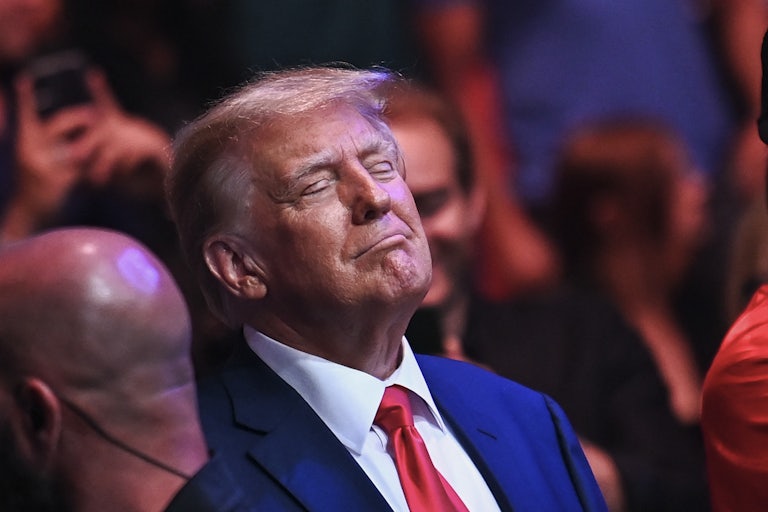
When it comes to moments that define the Republican Party, one in particular has kept ringing in my mind for the past few years. A week after the 2020 presidential election, with Trump making loud noises about contesting the results, an anonymous “senior Republican official” offered this shrug to a reporter from The Washington Post: “What is the downside for humoring him for this little bit of time? … He went golfing this weekend. It’s not like he’s plotting how to prevent Joe Biden from taking power on Jan. 20.”

It didn’t take long for this quote to age poorly; certainly by the time the sun set on January 6, 2021, it had gone fully rancid. But it shouldn’t be forgotten that there’s no one member of the Republican Party that cocked this up. That quote appeared in a story headlined “Top Republicans back Trump’s efforts to challenge election results,” which described precisely that: the party’s elite going all in on a campaign to support Trump’s plan to overturn the election. The notion that Trump was the deserved winner has remained a canonical belief among Republicans—the first purity test any member of the party must pass. But now it’s hanging over the Republican  presidential race like a dark shadow.

As Alex Shephard recently noted, the race has barely begun and yet feels like it’s already over. Trump is blasting ahead in the polls. His presumed main-stage combatant, Ron DeSantis, is looking and acting like a spent force. The rest of the field seems destined for single-digit polling and an asterisk on Ballotpedia’s recap of the election year. All in all, it’s a strange repeat of the last open Republican primary—following the “First as tragedy, then as farce” maxim.

In some cases, the historical repetition is literal, not metaphoric. In recent weeks, former New Jersey Governor Chris Christie somehow got some political reporters to listen to the sounds emanating from his mouth, and they recorded noises that sounded awfully like an intention to jump into the race. Along the way, Christie elucidated what he thought was the necessary skill set to beat Trump, which amounted to trenchant stuff like “Be fearless” and “Have guts.”   

In fairness to Christie, I do not think he’s that far off the mark. In 2016, the Republicans in the field allowed Trump to seize a surfeit of unearned alpha mystique by largely failing to retaliate—not with equal force, anyway—when he landed his crude and sometimes shocking blows. They treated him on the debate stage like an interloper with poor manners, and begged whatever referee happened to be standing by to please enforce the Marquess of Queensbury rules tout de suite, like a gang of gilded fops from some forgotten Molière comedy. 

But I’d take Christie more seriously if he had actually deployed these secret weapons when he had a chance. Instead, Christie ended up a supplicant, slaving for Trump’s transition team before finally getting murked by a Jared Kushner bent on settling family business. Such was the fate of Ted Cruz too. At the 2016 convention, Cruz asked delegates to “vote their conscience,” but by the fall was urging Republicans to vote Trump. This week, we learned just how much his own conscience had withered: He had a leading role in a collaborative effort with Fox News to overturn the election for Trump. Within the current GOP, it’s submission all the way down.

And this might be the reason that Trump—who’s not done much campaigning, doesn’t have a market-moving social media presence anymore, and demonstrated little kingmaking ability during the midterm elections—is somehow cleaning everyone’s clocks in the shadow primary. There’s hardly anyone left in the GOP willing to speak some plain truths: Trump lost the 2020 election; his attempt to hijack democracy makes him unfit to serve. This party is filled, stem to stern, with people who believe Trump is the rightful president. They have allowed a defeated president to take on the sheen of an incumbent, and the base—so far—is following these cues.

In Thank You for Your Servitude, which for my money is the only truly interesting book about the Trump presidency, author Mark Leibovich goes into harrowing detail about how the modern GOP readily turned itself into a gaggle of mendicants to serve Trump on bended knee. It’s a sumptuous and unsparing read about a party that hitched their wagon to a walking disaster and lost their spines in the exchange. But Leibovich didn’t get to write the next chapter, about how the GOP would behave in the 2024 presidential primary. 

Well, we’re getting a look now, and the scene is grim. Instead of capitalizing on Trump’s indictment by going in for the kill, Trump’s competitors are defending him. The only person in the field with the gumption to tell Trump to his face that he lost the 2020 election fair and square is Asa Hutchinson, a guy no one who’s not a blood relative or on his payroll remembers is even running. None of the rest of the field look like they’ll successfully reconcile their support for Trump’s stolen-election claims with their desire to supplant him. And so the most likely person to defeat Trump will, once again, be a Democrat.

This article first appeared in Power Mad, a weekly TNR newsletter authored by deputy editor Jason Linkins. Sign up here.
The Republicans Would Have Booted Dianne Feinstein by Now

President Biden’s agenda will be imperiled unless Democrats summon the courage to end this madness.

Kent Nishimura/Getty Images

This week an astute Twitter user reminded me of an interesting fact from our recent political history. In early January 2018, Democrat Doug Jones, the winner of a special election in Alabama some weeks prior, joined the U.S. Senate. This took the then Republican majority to a tight 51–49 margin—a majority that was all the more fragile by dint of the fact that one of their own, Mississippi Senator Thad Cochran, was in extremely poor health. An October 2017 article from Politico described the lawmaker as “frail and disoriented” and recounted one incident in which the senator got lost on the way to the Senate chamber and another in which he voted the wrong way. It also reported that the senator was determined to stay in office. “Don’t believe everything you hear,” Cochran quipped when asked about retirement rumors. Nevertheless, by April Fools’ Day of 2018, he’d been shown the door.

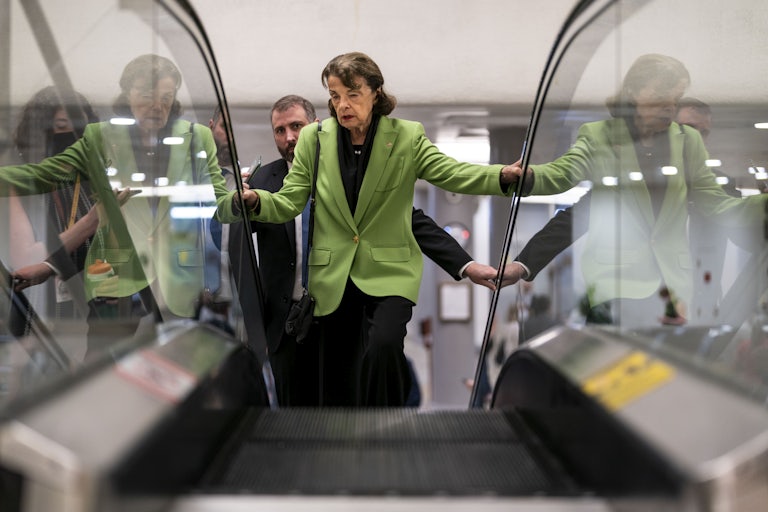
The Democrats find themselves in a similar jam today: clinging to a razor-thin majority, with one member in poor health yet refusing to retire from her position (one that, extant reports suggest, she only sporadically remembers that she even holds). But in the case of California Senator Dianne Feinstein, while calls for her retirement are coming from inside the House (of Representatives), Democratic leaders in the Senate do not yet seem to have the stomach to force her out. Their timidity is putting President Joe Biden’s agenda at risk.

They are also risking their credibility. On April 12, Politico reported that while Democrats were growing increasingly concerned that Feinstein’s bout with shingles might be severe enough to close off any possibility of her return to action, the California senator floated the idea of having a temporary replacement fill her seat on the powerful committees on which she sits (most importantly, the Judiciary Committee). It was a request that Senate Majority Leader Chuck Schumer appeared to have accepted with a stunning amount of sanguinity, in the wide-eyed belief that this was a realistic and actionable resolution.

It fell to TNR’s Grace Segers to point out that there wasn’t much of a precedent for temporarily replacing someone on a committee and that Republicans were absolutely going to put the kibosh on any attempt at such a move. But Schumer, with the same determination to march off to certain defeat that Faramir demonstrated in his hopeless effort to retake the city of Osgiliath in Return of the King, got the upper House to vote on this doomed plan and took a wholly unnecessary L at the hands of Senate Republicans. The entire episode ended up emphasizing two things: Schumer’s naïveté when it comes to the modern Republican Party and the Democrats’ lack of nerve in the face of an (easily resolvable) problem.  

Now Democrats in increasing numbers are calling for Feinstein to resign so that California Governor Gavin Newsom can name a replacement and return the Senate to its normal order. But it remains to be seen whether Democratic leaders—who seem inclined to simply accommodate Feinstein’s lengthy absence—will do the right thing and speed this matter to its resolution. And Feinstein still has some defenders who characterize the demand that she quit as sexist. “I’ve never seen them go after a man in the Senate in that way,” said former House Speaker Nancy Pelosi. (I will refer her to the first paragraph of this story for some much-needed edification.)

While Democrats dither on the horns of this eminently solvable dilemma, they incur no small cost to their agenda. Without a majority, the Senate Judiciary Committee cannot continue to do the necessary work of confirming Biden’s judicial nominees, the one material way that Democrats can quickly and effectively respond to Donald Trump’s wholesale makeover of the federal judiciary. Moreover, the Democratic members of the committee are unable to respond as robustly to the numerous unfolding stories of Justice Clarence Thomas’s evident corruption because they need a majority to issue a subpoena. This is a lot of critical work that voters asked Democrats to do that won’t get done as we wait for Feinstein to either return or not return.

In the face of Senate Democrats’ determined march toward self-abnegation, it’s hard not to look back at the events of 2018 in admiration of the GOP. Faced with a similar dilemma, the Republicans found the will to make the quick decisions they needed to make in order to wield power in a maximal fashion. It’s a model of determined governance. So is, believe it or not, Representative George Santos’s continued presence in the House. He may be a full-spectrum embarrassment as a human being, but he’s an important facilitator of Republican power in the lower chamber, and so he remains a member of the GOP caucus—if not in good standing, then in “good enough” standing. Last week, he announced he’ll be seeking reelection, and why not? Two years of doing his duty will forgive a great many sins—up until the point he’s either mentally or physically infirm, that is.

Meanwhile, the Democrats faff about, allowing an octogenarian multimillionaire with badly diminished faculties to continue to freeze their agenda because too many of them believe it is somehow cruel and demeaning to ask a lawmaker who’s no longer capable of doing her work to step aside and spend her last years on earth reclining on a mountain of money.

This article first appeared in Power Mad, a weekly TNR newsletter authored by deputy editor Jason Linkins. Sign up here.

It’s Really Quite Simple: Republicans Hate Young People

For all its grousing about “liberal indoctrination,” the GOP has no one to blame but itself for alienating the youth of America.

Alex Wong/Getty Images
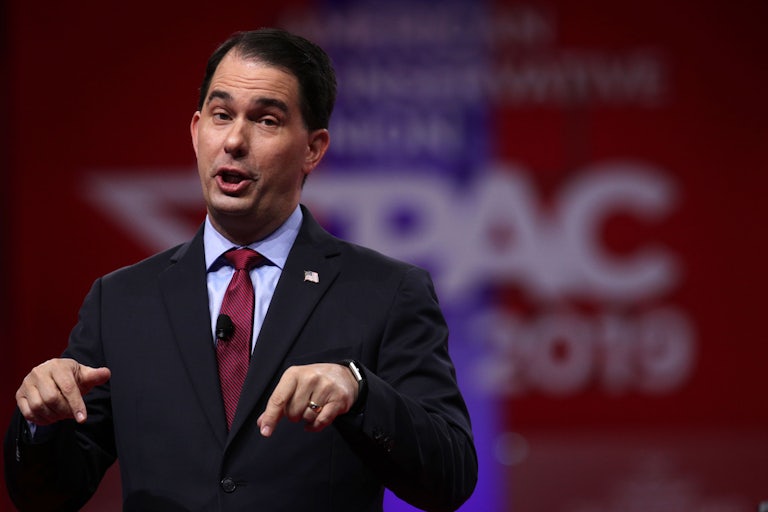
Former Wisconsin Governor Scott Walker

A liberal victory in Wisconsin’s recent high-stakes state Supreme Court election has left former Governor Scott Walker in a foot-stamping, multiplatform fume that targeted the young voters who swung behind the victorious Janet Protasiewicz. “Younger voters may be the behind [sic] the stinging loss for conservatives in WI this week,” he tweeted. “We have to undo years of liberal indoctrination.”

Not content to just tweet, Walker took his complaints to Fox News in an attempt to expand his brief against the “indoctrination” of youth. In his telling, the younger generations have been too exposed to “radical ideas,” such as “climate change and defunding the police … abortion, and all these sorts of other issues.” What’s more, “they have never heard the opposing viewpoint. And so, if that’s all they hear in college and high school and social media and culture, you can see why they’ve gone so lockstep in that regard. We’ve got to turn that around.”

Walker’s theory of the Wisconsin election might be more convincing if there wasn’t a far less convoluted explanation at the ready, which is simply that young voters did hear the opposing view and found it both substantially objectionable and antithetical to their interests.

Perhaps the largest matter at stake in that election was abortion. Everywhere you look, Republicans are finding it very difficult to actually run on the post-Roe dystopia they’ve engineered—so much so that they’re now trying to get people to just stop talking about it. But the fact that young voters back both reproductive rights and the Democrats who support them, by wide margins, is very well known. Republicans have had ample opportunities to account for this reality and moderate their position. They’ve failed to do so, and, wouldn’t you know it, young people have noticed.

So while Walker may believe that some level of “indoctrination” is behind the way the youth vote disproportionately tilts toward Democrats, perhaps there’s something to the theory that young voters are simply noticing what’s going on in the world around them and responding in kind to this abundance of observable information. For example, it could be that young Wisconsinites remember Walker, their would-be liberator from the chains of indoctrination, as the governor whose economic numbers lagged those of Democrat-run neighbor Minnesota, or the guy whose key achievement was saddling the state with his doomed FoxConn factory boondoggle.

Looking further afield, maybe young voters are similarly observing that Republicans seem to just not like them very much! They are probably reading about how conservatives are banning books and drag shows, demonizing gay and trans people, and thwarting progress on climate mitigation—an issue pretty dear to their hearts since they, along with their own children, will be greatly impacted by the environmental calamities to come. It could be that young voters actually have heard the “opposing view” very clearly and they find it to be out of touch and off-putting.

The GOP has had plenty of chances to avoid alienating young voters. Republican pollster Kristen Soltis Anderson has been sounding the alarm about this for several years now: In 2017, she warned that not only were young voters breaking toward Democrats “by massive margins,” they also weren’t “moving rightward” as they approached middle age. “Like the Gen Xers ahead of them,” she wrote, “they’re instead more and more likely to decide ‘liberal’ suits them just fine as a label.” This all came home to roost in 2018, when the highest youth turnout in the history of midterm elections swept Democrats into office. Four years later, the youth vote hit slightly smaller heights—but young voters got the lion’s share of the credit for breaking the “red wave” that was supposed to be on the way.

Naturally, nothing is promised to Democrats. In recent weeks, President Joe Biden has given young voters cause for consternation by backing a TikTok ban and landing in the squishy middle on the rights of trans athletes. And he’s historically had struggles keeping the affections of young voters—in 2021, his approvals with this cohort took a worrying drop that made headlines. Fortunately for Biden, this support rebounded by Election Day in 2022, perhaps because these voters were able to discern the difference between a Democratic Party filled with normal human beings who were sincerely interested in crafting policy and a Republican Party filled with antisocial weirdos.

After taking a licking in 2022, Republicans once again failed to respond with soul-searching about losing the youth vote. Instead, they packed the postelection discourse with complaints about voters they’d already so badly alienated, grousing about how the voting age was too low. In recent weeks, a concerted effort has begun to suppress the youth vote in Texas by banning polling places on college campuses; similar measures are likely on the way across the country. And so all of this pathetic caviling about youth indoctrination rings false against the clear evidence that what Republicans actually want is simply to crush the political power of the young.

This article first appeared in Power Mad, a weekly TNR newsletter authored by deputy editor Jason Linkins. Sign up here.