Breaking News
Breaking News
from Washington and beyond

Kari Lake Is Trying to Make People Forget Her Real Abortion Stance

The Republican Senate candidate said she thinks people should have a “choice” when it comes to abortion.

Rebecca Noble/Getty Images

Arizona Senate candidate Kari Lake is claiming she has switched sides on the abortion debate.

After galvanizing her budding, far-right political career by fearmongering about the medical procedure, Lake suddenly changed her tone following the Arizona Supreme Court’s decision to revive a 160-year-old anti-abortion law that offers no exemptions, even in cases of rape or incest. Apparently, actually getting what she had been advocating for was a step too far.

“This total ban on abortion the Arizona Supreme Court just ruled on is out of line with where the people of this state are,” Lake said in a video on Thursday, apparently coming out as in favor of abortion rights. “This is such a personal and private issue.”

“I chose life, but I’m not every woman,” she continued. “I want to make sure that every woman who finds herself pregnant has more choices so that she can make that choice that I made.”

“It’s natural for women to be nervous or anxious when they’re pregnant. I never would ever assume that any woman had the same exact feelings that I had or situation that I had,” Lake said. “We know that some women are economically in a horrible situation. They might be in an abusive relationship. They might be a victim of rape.”

It’s a strategic move from a woman who has previously supported banning the abortion pill, publicly identified as “100 percent pro-life,” and had previously called the 1864 ban a “great law.” When she entered the political sphere with her gubernatorial run in 2022, Lake called abortion the “ultimate sin.”

And lest you think she has truly moved away from those positions, earlier this week, she backed Arizona Republicans’ bill to replace the 1864 ban with a law banning abortion after 15 weeks. The proposed bill also does not make exceptions for rape or incest.

Trump took note of the turning tide this week, telling reporters on the tarmac of Atlanta’s airport on Wednesday that the Arizona high court went too far in actually banning the procedure. He promised that, if reelected, he would not sign a national abortion ban. But like Lake, his new stance is a little hard to believe.

Trump has made abortion a key component of all three of his campaigns, repeatedly promising over the last eight years to ban the medical procedure at every available opportunity. While in office, he expressed support for a bill that would have banned abortion nationwide at 20 weeks.

Since then, he has used scare tactics to spread disinformation about the procedure, erroneously claiming as recently as Monday that Democrats support “execution after birth.” And Trump’s track record includes the most egregious offense against national access: the appointment of three Supreme Court justices who voted to overturn Roe v. Wade.

Abortion has become a losing issue for Republicans nationwide. The Supreme Court’s decision to overturn nationwide abortion access proved disastrous for Republicans last November, resulting in major losses in districts where abortion was a key talking point. Postelection, those raw numbers turned into some stunning platform reversals for the conservative party, with GOP consultants referring to the turning tide on the issue as a “major wake-up call.”

Some Suggestions for Republicans’ Laundry List of Idiotic Bills

Republicans are really prioritizing bills about household appliances.

The burner on a gas stove
Stefan Rousseau/PA Images/Getty Images
Republicans fought hard in 2023 to prevent the government from implementing health and safety regulations on gas stoves.

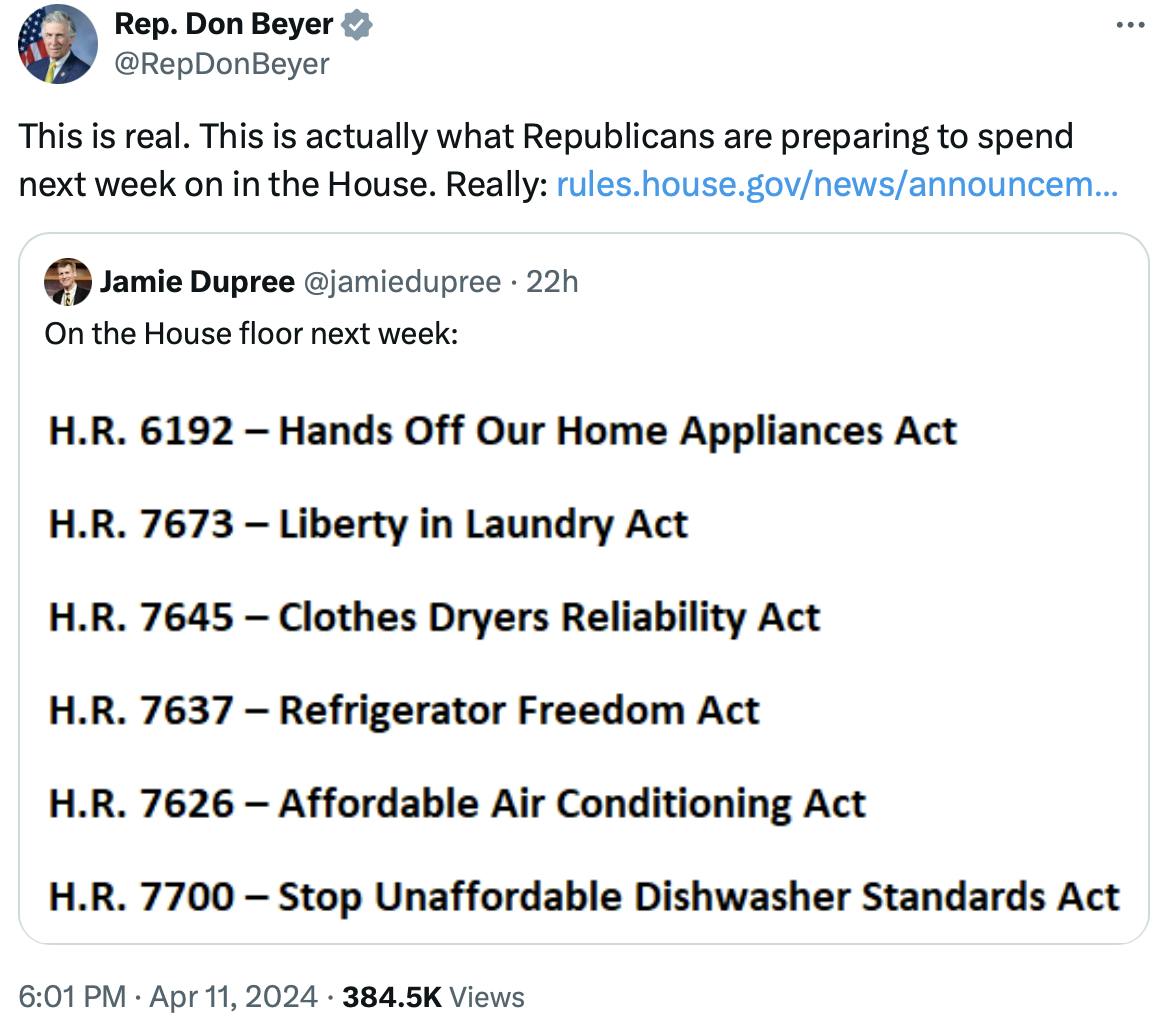
With all of the problems facing the country, House Republicans have decided that next week is the perfect time to do the laundry. And fix the air conditioning. And take a look at the fridge.

Seriously, that’s the focus of six bills the House Rules Committee put on its schedule for next week. The committee is usually the last place bills are reviewed before they go to the House floor for votes.

Screenshot of a tweet
Screenshot

Republicans fought hard last year to prevent the government from putting health and safety regulations on gas stoves. But why dishwashers and other home appliances are now the top priority is anyone’s guess. Spring cleaning, maybe? A distraction from House infighting? Trump’s use of the toilet to get rid of documents? House Democrats are trying to insert more important items into the bills, but they have no idea, either.

Some House Democrats decided to have some fun with the agenda, and one House Democratic amendment even proposed renaming one of the bills the “Make Appliances Great Again Act.”

In that spirit, here are a few bills that House Republicans could add to the list.

  • Hampering Progress Act
  • Free and Liberate the United States House Act (perhaps in November, or if Mike Johnson is removed)
  • Stop Ousted American Presidents Act (probably more for Democrats)
  • Toilet Regulation and Unqualified Master Plumber Act (because Donald Trump is obsessed with toilets)
  • Make Gas Stoves Great Again Act
  • Let Roombas Roam Free Act
  • Don’t Touch My Dyson Act
More on Republicans' concerns about appliances:

Court Allows Anti-Trans A.G. to Access Planned Parenthood Records

Missouri’s attorney general called the decision a “big day” for the state.

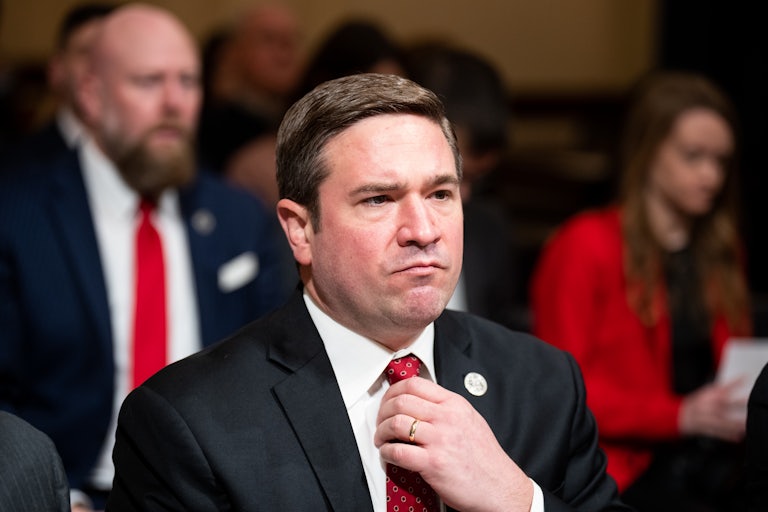
Andrew Bailey adjusts his tie
Bill Clark/CQ-Roll Call, Inc/Getty Images

A St. Louis judge has ruled that Missouri Attorney General Andrew Bailey can access some of Planned Parenthood’s care records, ordering the nonprofit to turn over certain files to the man who has built his unelected political career on restricting health care access for trans people.

In his Thursday decision, Circuit Judge Michael Stelzer wrote that Bailey can collect documents under Missouri’s consumer protection statute that aren’t protected under federal mandate, namely the Health Insurance Portability and Accountability Act, better known as HIPAA.

“It is clear from the statute that the Defendant has the broad investigative powers when the consumer is in possible need of protection and there is no dispute in this matter,” wrote Stelzer. “Therefore, the Defendant is entitled to some of the requested documents within his [Civil Investigative Demand].”

Bailey, who last year attempted to implement a ban on gender-affirming care for people of all ages, was quick to celebrate the decision, calling it a “big day” for the state.

“My team will get to the bottom of how this clandestine network of clinics has subjected children to puberty blockers and irreversible surgery, often without parental consent,” he wrote in a statement. “There is no more important fight than to ensure Missouri is the safest state in the nation for children. No stone will be left unturned in these investigations.”

In reality, providing trans and nonbinary children with gender-affirming care actually makes them safer. Gender-affirming care decreases the amount of depression and anxiety that trans and nonbinary teenagers feel, and it makes them less likely to consider suicide.

Planned Parenthood derided the decision for allowing Bailey to pursue his “sham investigation,” arguing in a statement that, like abortion access, transgender health care is being “systematically dismantled—little by little, starting with the most vulnerable, including young people.”

“To our patients: rest assured that your private medical records and information will not be disclosed,” wrote the group’s local interim president, Richard Muniz. “As we consider all of our legal options, we want you to know that Planned Parenthood will do everything possible to ensure your rights to privacy and health care are protected. We won’t back down.”

The group stressed that HIPAA will shield personal medical records, telling The New Republic that trans patients can continue to receive care without worry that their records will be “unnecessarily and illegally disclosed.”

But it’s not exactly clear yet which other documents Bailey will be able to access.

“I’m not incredibly optimistic, especially since the attorney general’s statement says that they’re looking into billing practices,” said Harvard Law Cyberlaw Clinic instructor Alejandra Caraballo. She explained that means that Bailey will be able to examine which services were rendered to whom and that, ultimately, “you need medical records for that.”

And even if this court order doesn’t provide instant access to all the medical records, it certainly opened up a legal door to obtaining them.

“The court doesn’t immediately give access to the attorney general to patient records,” Caraballo explained, but “if the attorney general continued to press, he may be able to obtain them.”

That precedent exists in other states, like in Tennessee, where last year the attorney general was able to access the last five years of Vanderbilt University Medical Center’s transgender patient medical records under the umbrella of a Medicaid billing fraud investigation.

In Caraballo’s opinion, the federal government needs to intervene here.

“I absolutely believe DOJ needs to get involved here along with [the Department of Health and Human Services] as well as the HIPAA office, and say, look, this is not a valid investigation,” Caraballo said. “This is clearly pretextual. And you’re targeting an entire group of people.

* This story has been amended to clarify that Andrew Bailey cannot access transgender people’s medical records.

Marjorie Taylor Greene Can’t Stop Pushing Russian Propaganda

The Georgia Republican continues to insist that Russian President Vladimir Putin isn’t so bad.

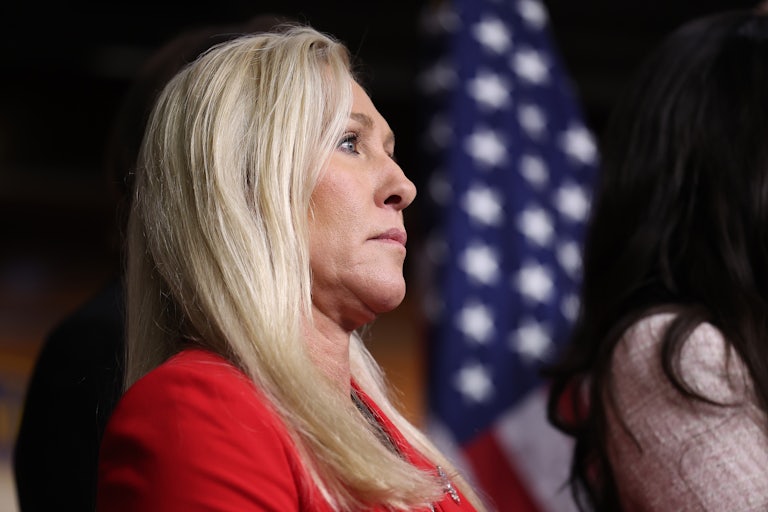
Marjorie Taylor Greene is seen in profile
Kevin Dietsch/Getty Images

Representative Marjorie Taylor Greene doesn’t think Russia’s military incursion into Ukraine is a threat to the rest of Europe, and she wishes everyone would shut up about it.

“This whole thing is the most repulsive, disgusting thing happening, and the American people are the ones writing the check,” the far-right Georgia congresswoman said Friday in an interview on Steve Bannon’s War Room program. “Vladimir Putin has not said he wants to go march across Europe and take Europe, and the reality is Ukraine is not even a NATO member nation.”

It’s quite a bold claim to make, considering that European countries in addition to Ukraine have made no secret that they fear Russia. For example, Germany, Poland, and France are discussing the revival of a decades-old alliance to strengthen their cooperation because of Russia. Sweden just joined NATO last month, following neighbor Finland’s accession to the alliance last year, over concerns Russia might try to invade them next.

So, is Greene simply echoing Russian talking points? Several of her Republican colleagues in Congress have warned that Russian propaganda is influencing their constituents and politicians like Greene, following revelations last week of a vast Russian-backed corruption network in Europe. Belgium is even investigating Russian interference in the European Parliament’s upcoming elections.

Former Colorado Representative Ken Buck even came up with a derisive nickname for Greene due to her pro-Russia stance.

“Moscow Marjorie is focused now on this Ukraine issue and getting her talking points from the Kremlin and making sure that she is popular, and she is getting a lot of coverage,” he said in an interview on CNN Monday.

Greene has turned her guns on Speaker Mike Johnson in recent weeks due to her opposition to any aid for Ukraine in its fight against Russia, with Republicans bitterly divided over the issue. The fight could cost Mike Johnson his speakership, which is held together by a razor-thin Republican margin in the House. Greene even put forth a motion to oust him last month, although it has not yet been brought for a vote.

More on Russia's influence on U.S. politics:

Louisiana High Court: It’s Priests’ “Right” Not to Be Sued for Abuse

The state Supreme Court ruled that priests have a “property right” not to be sued for sexually abusing children.

A front view of St. Martin de Tours, a church in St. Martinville, Louisiana
Annie Flanagan/Washington Post/Getty Images
The plaintiff in the lawsuit, Doug Bienvenu, says he was sexually abused by a priest at the St. Martin de Tours Catholic Church in St. Martinville, Louisiana.

The Louisiana Supreme Court has decided to strip sexual assault survivors of an avenue of justice, ruling 3–4 that it’s the due process rights of priests and their enablers to not be held accountable in instances of sexual assault.

The case, Bienvenu v. Diocese of Lafayette, was brought by Douglas Bienvenu and several other plaintiffs who claimed they were sexually molested by a Roman Catholic priest during the 1970s, when they were between the ages of 8 and 14. 

But in its majority opinion issued on March 22, the court argued that while the facts of the case were largely undisputed, the priest—and the religious institution he was a part of—was actually protected under the U.S. Constitution’s due process clause, which says that no one shall be “deprived of life, liberty or property without due process of law.”

“Given these constitutional limitations, the issue presented by this case turns on whether the revival provisions operate to disturb defendants’ vested rights,” wrote Louisiana Justice James Genovese, specifying that “we are constrained to find the statutory enactment is contrary to the due process protections enshrined in our constitution and must yield to that supreme law.”

The Louisiana Child Victims Act, according to the court, “cannot be retroactively applied to revive plaintiffs’ prescribed causes of action” on the basis that such an action would “divest defendants of their vested right to plead prescription.”

The Louisiana legislature passed the act in 2021 to establish a “look-back” window for sexual assault victims. The legislation provided victims of sexual abuse crimes from any period with an opportunity to pursue justice against their alleged abusers, so long as they filed their lawsuits before June 2024. But the  court effectively ruled that the look-back window was actually unconstitutional

Louisiana is not the only state to repeal such a law. Courts in Utah and Colorado also found similar look-back windows to be unconstitutional, and other windows across the country continue to be challenged due to the complications of prosecuting crimes with minimal evidence and which may have taken place decades in the past.