Breaking News
Breaking News
from Washington and beyond

That Guy Who Backed Trump’s Bond? He May Not Have the Money

New York Attorney General Letitia James doesn’t trust Don Hankey.

Letitia James speaks into a podium microphone
Michael M. Santiago/Getty Images

New York Attorney General Letitia James has some questions about Donald Trump’s $175 million bond insurer—mainly, if it can even guarantee the full amount if push comes to shove.

In a court filing on Thursday, Knight Speciality Insurance Company revealed that its liquid assets don’t meet the needs of Trump’s already minimized bond. According to a financial assessment, the company, owned by billionaire Don Hankey, has just $138 million in “surplus.” Knight would therefore need to spend 127 percent of its reserves in order to cover Trump’s bond—far more than the 10 percent of a state-regulated suretor’s surplus that’s allowed by New York law.

Lawyers for the attorney general’s office also noted that the insurance company was trying to operate “without a certificate of qualification” in the state.

But that was, apparently, the plan all along, according to Knight’s president, Amit Shah.

“Knight Specialty Insurance Company is not a New York domestic insurer, and New York surplus lines insurance laws do not regulate the solvency of non-New York excess lines insurers,” Shah told CBS.

Shah also claimed that his company had more than $1 billion in equity, despite financial statements—which were only obtained after New York court clerks rejected the company’s original bond posting and ordered it to refile—indicating the firm only held $26 million in “cash and bank deposits,” with $483 million in stocks and bonds.

James’s office has given Trump and his new financial bedfellows 10 days to “justify the surety.”

“At this venture, with so much at stake, to make these kinds of mistakes, it’s almost unthinkable. And it amps it up with the missing financial statement. That adds all the drama,” an attorney for Michael Cohen, Trump’s former fixer, told The Daily Beast.
Yet Another One of Trump’s 2020 Attorneys Could Be Disbarred

Jeffrey Clark was found to have broken legal ethics rules.

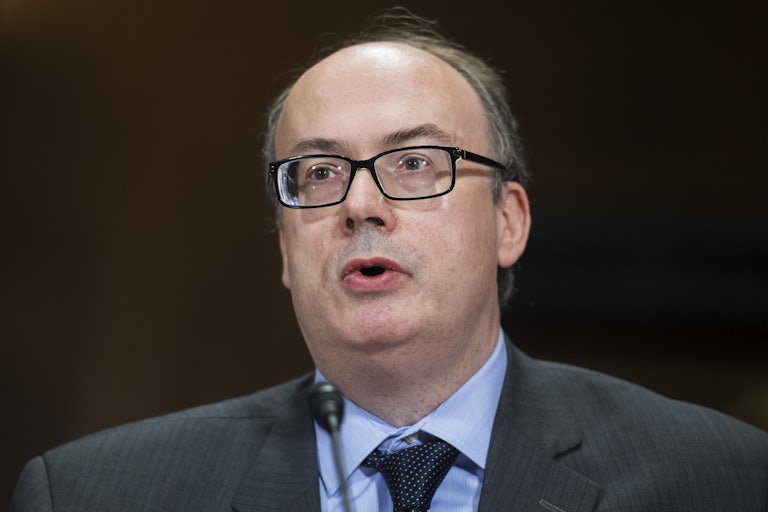
Jeffrey Clark speaks
Tom Williams/CQ Roll Call

Donald Trump’s lawyers, legal appointees, and advisers are finally having to face the music. Former Justice Department official Jeffrey Clark was found Thursday to have violated legal ethics rules, becoming the latest Trump legal aid to face consequences this week.

A disciplinary panel in Washington, D.C., found that Clark, who ​​was assistant attorney general for the Civil Division of the Justice Department in the Trump administration’s final days, broke ethics rules for lawyers. Clark had tried to pressure other leaders in the Justice Department to help prevent the transfer of power to Joe Biden after Trump lost the 2020 presidential election.

This ruling clears the way for steps toward suspending or even permanently removing Clark’s law license. Investigators who brought the charges forward say that is the course of action they intend to pursue, Politico reported.

Earlier in the disciplinary process, Clark slipped up in a hearing and admitted that he was thinking of Trump when he asserted attorney-client privilege while refusing to answer questions, prompting his attorney to urge him to plead the Fifth in an attempt to avoid further self-incrimination.

Clark also faces charges in Georgia for allegedly conspiring to overturn that state’s 2020 presidential election along with Trump, Giuliani, and more than a dozen others.

Clark’s legal career has been that of an elite Republican lawyer happy to do his part for the conservative movement’s work to reshape the legal system. He spent years working with other right-wing legal stalwarts at the same places that produced Kenneth Starr, John R. Bolton, Brett Kavanaugh, John Eastman, and many others. He had no problem working with Trump after the 2016 election, which eventually led him down the legally questionable path to where he finds himself today.

He is the latest Trump attorney to face repercussions for his actions after the 2020 election. Earlier this week, John Eastman was recommended for disbarment in California and can no longer practice law. Rudy Giuliani is also facing disbarment, and Sidney Powell could be kicked out of the legal profession too.

No Labels Pulls Out of 2024 Election for the Funniest Reason Ever

No Labels? More like No Candidates!

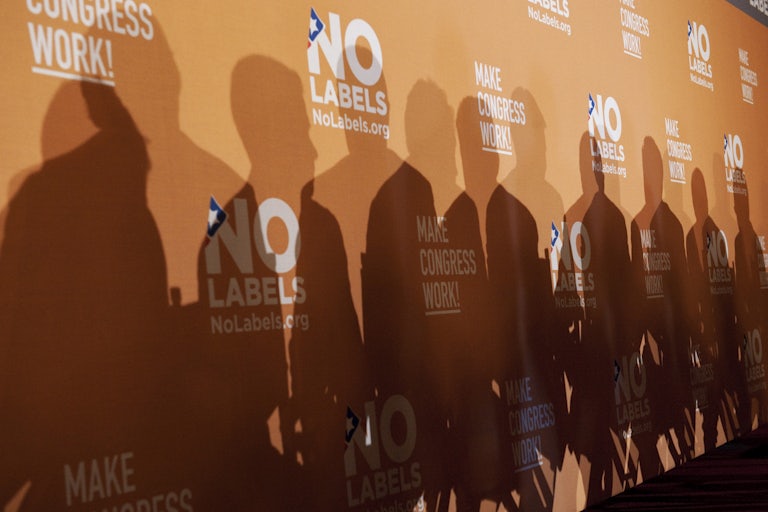
Shadows of several individuals cast on an orange background that reads "No Labels"
Tom Williams/CQ Roll Call

Less than a month after confirming it would run a third-party candidate and potentially spoil the presidential election, the centrist group No Labels has decided not to run a third-party “unity ticket” after all, The Wall Street Journal reported Thursday. Why? The group can’t find any credible candidates to run. 

No Labels founder CEO Nancy Jacobson told allies this week that the group planned to announce the news Monday, the Journal wrote, citing anonymous sources familiar with the plans. 

The news comes after Georgia’s former lieutenant governor, Republican Geoff Duncan, turned down the group’s offer to run for president on their ticket, saying he is “focused on healing and improving the Republican Party with a GOP 2.0 so we can elect more commonsense conservative candidates in the future.”

Failing to recruit the former lieutenant governor of Georgia left No Labels scraping the bottom of the barrel of potential candidates. Audio of a No Labels delegate vote leaked to The New Republic last month showed that the organization was clueless about how to move forward and didn’t know if it would find candidates. Regardless, the delegates still voted at the time to press ahead with their harebrained idea.

The group has faced constant criticism from Democrats and Democratic-aligned groups such as the Third Way and MoveOn, not just for potentially tipping the election to Donald Trump but also for the help No Labels was receiving from right-wing consultants and donors. Even some of its own donors expressed their frustration at the group’s third-party chicanery by filing a lawsuit in January. 

So farewell to what could have been a major spoiler in the 2024 elections. For those who are disappointed, there’s still Robert F. Kennedy Jr.  

Judge Cannon Promises She’ll Take Her Sweet Time With This Trump Case

The judge refused to dismiss the classified documents case.

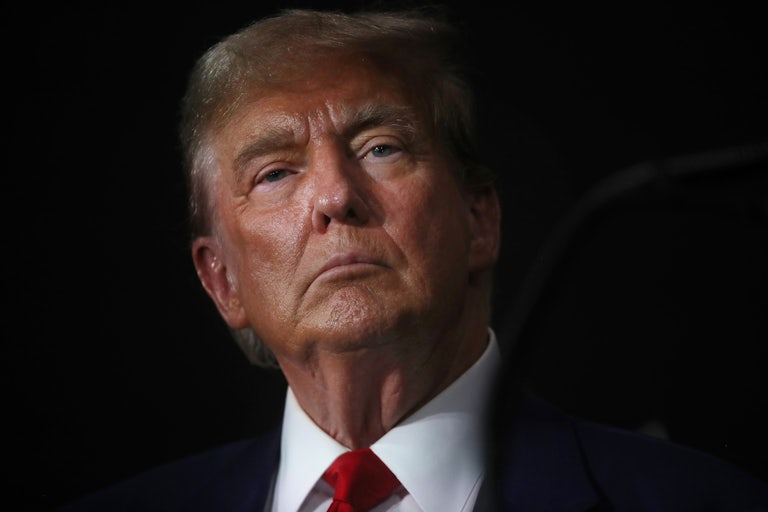
Donald Trump looks forward
Spencer Platt/Getty Images

Donald Trump got some good news and some bad news in his classified documents trial on Thursday.

U.S. District Judge Aileen Cannon rejected Trump’s effort to dismiss the case outright. Trump had claimed in a motion that the trove of national security secrets found at Mar-a-Lago during an FBI raid were actually his under the Presidential Records Act. But that is not adequate, Cannon said, noting that the “Presidential Records Act does not provide a pre-trial basis to dismiss.”

But Cannon also used the decision to hit back at special counsel Jack Smith, who effectively requested that she hurry up and make a decision on a motion that was presented last month.

“Separately, to the extent the Special Counsel demands an anticipatory finalization of jury instructions prior to trial, prior to a charge conference, and prior to the presentation of trial defenses and evidence, the Court declines that demand as unprecedented and unjust,” Cannon wrote. “The Court’s Order soliciting preliminary draft instructions on certain counts should not be misconstrued as declaring a final definition on any essential element or asserted defense in this case. Nor should it be interpreted as anything other than what it was: a genuine attempt, in the context of the upcoming trial, to better understand the parties’ competing positions and the questions to be submitted to the jury in this complex case of first impression.”

Legal analysts have worried that a strategy of continual delays could be the Trump-appointed judge’s way of surreptitiously dismissing the trial altogether.

Last month, Trump tried twice to get the case dismissed, arguing in separate motions that it wasn’t clear at the time he took the sensitive material if doing so was illegal and that the classified documents could be considered “personal materials” rather than presidential under the Presidential Records Act. The latter defense was roundly rejected by Smith’s office, which pointed to a transcript of Trump’s own words in which the former president acknowledged the records definitely were not personal.

“This totally wins my case, you know. Except it is, like, highly confidential. Secret. This is secret information,” Trump said in a 2021 recording.

Smith’s office also claimed that Trump’s “personal records” argument was suggestive that the GOP presidential nominee believes he’s beyond reproach and above the law.

“Trump’s claims rest on three fundamental errors, all of which reflect his view that, as a former President, the Nation’s laws and principles of accountability that govern every other citizen do not apply to him,” federal prosecutors wrote in a filing last month.

Trump seems to know this is the case. In a July 2021 recording, Trump confessed the obvious: that he actually couldn’t have declassified the “secret” documents as he said he did because he wasn’t president. And in a June interview with Fox News’s Bret Baier, Trump claimed he was too “busy” to give the boxes back to the federal government.

Trump has also taken to outright confessing that he took the sensitive records. In a prerecorded interview on Newsmax, Trump claimed point blank that he actually did take the classified documents, describing the process of shamelessly packing them away while leaving office.

“I took ’em very legally,” Trump said. “And I wasn’t hiding them.”

Ted Cruz Is in Panic Mode Over His Terrible Fundraising

The Texas senator has some serious competition on the campaign trail.

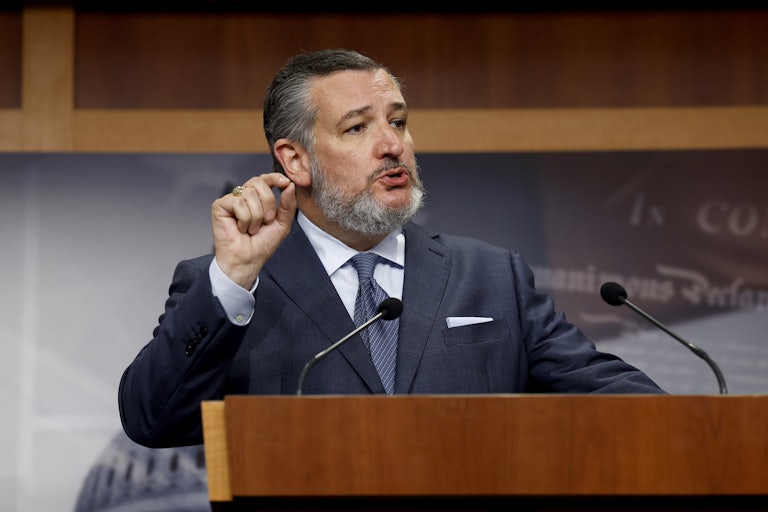
Ted Cruz talks at a podium and gestures with his hand
Anna Moneymaker/Getty Images

The jig is almost up for Senator Ted Cruz—and he knows it.

On Wednesday, the Texas Republican leveraged an interview with Fox News to beg for campaign donations after his opponent, NFL player and current Representative ​​Colin Allred, took Texas’s Democratic Senate primary in a landslide.

“The Democrats are coming after me, they are gonna spend more than $100 million this year, George Soros is already spending millions of dollars in the state of Texas,” Cruz said, leaning on the popular Republican and antisemitic talking point, billionaire George Soros.

“My opponent, a liberal Democrat named Colin Allred, is out-raising Beto O’Rourke, my last opponent, 3-to-1. They are flooding millions of dollars into Texas—and the reason is simple. You remember my last reelection, it was a three-point race. I won by 2.6 percent.”

That’s a pretty slim margin for someone who has had a strong hold on Texas politics for the last decade—even if he has been called “Lucifer in the flesh” by members of his own party and crowned the most “unpopular member of the U.S. Senate” by local papers.

Allred was originally predicted to be a long-shot candidate behind Cruz. After all, it’s been 33 years since a Democrat held a statewide position in the traditionally deep-red state. But Allred has quickly picked up steam in the race, trailing behind the incumbent by just 6 percent, according to a Marist College poll conducted in March. It would seem that 10 years in the Texas sun have led to some shortcomings in the Lone Star State, where Cruz has repeatedly showcased himself to be as spineless as he is self-interested.

Recall that, in the face of a devastating winter storm that wrecked Texas’s infrastructure, Cruz decided to skip town, opting to vacation in Cancun rather than help the state recover, leaving behind Texans and his dog. And Cruz rolled over and endorsed Donald Trump for president even after the latter insulted his wife ahead of the 2016 election.

Then, in January, Cruz endorsed Trump again, despite enduring months of ruthless mockery from the Trump campaign over his alleged need to wear heels to reach the podium. (On a side note, Cruz also made fun of then–Vice President Joe Biden on the eve of his son Beau’s funeral in 2015.)

Cruz’s rhetoric has also veered the state toward political extremes that don’t necessarily align with what the majority of Texans want: He backed Trump’s claim that the 2020 presidential election was rigged, supported a draconian abortion ban, and has done practically nothing to support IVF access within the state.

He has also vehemently opposed gun control measures in the state even after lone shooters killed 21 people at Robb Elementary School in Uvalde, 23 people in an El Paso Walmart, and 27 people at a church in Sutherland Springs, in separate shootings. The Sutherland Springs attack is the state’s deadliest mass shooting ever.

Cruz’s bid to keep his seat also flies in the face of legislation he introduced last year, proposing two-term limits in an effort to rid Congress of “permanently entrenched politicians.” Of course, Cruz admitted later he didn’t necessarily think the restrictions would apply to him.

Allred, meanwhile, has a completely different approach.

“My temperament is very different. I try to stay even-keel. I work in a bipartisan way. I don’t yell at people. I want to represent Texas in a way that’s sort of what I think a senator’s job should be, which is to introduce legislation that helps Texans—not to be a kind of media personality,” the 40-year-old told The New Republic in September.

That might be just what Texas is looking for.