Newsletter
Fighting Words
What got me steamed up this week

Democrats: “He Was Better Than the Debate” Is Not Remotely Good Enough

In Trump world, they’re thinking landslide. Democrats need to act and talk Biden into stepping aside, and soon.

Biden at his long-anticipated on news conference
Graeme Sloan/Bloomberg/Getty Images
Biden at his long-anticipated news conference on Thursday

Joe Biden had many lucid moments at his Thursday evening press conference, but the idea that we’re going to judge Biden day by day on the latest speech or press conference is terrifying, for two reasons. First, it sets a ludicrously low bar that is bound to favor standing pat with Biden as the nominee. This is because every one of these appearances is going to be judged on whether he was better than he was at the June 27 debate, and every time, the answer to that question is almost certain to be yes, because he can hardly be worse. But is “He was better than the debate” really the right standard here?

Second, this clock is ticking. It’s five weeks until the Democratic convention, which opens Monday, August 19. That’s time enough to act. Biden did open the door just a crack Thursday night to not being the nominee, but mainly he sounded very dug in, and if that’s the case, he can run out that clock by doing just enough interviews and speeches to be able to say he didn’t go into hiding, but without genuinely exposing himself to a risky public situation. One can predict the news cycles: three days of sensing that the dam may be about to burst and the Democrats are ready to take collective action, then Biden makes an appearance, does OK but only OK, but the momentum for replacing him is killed. 

So if that’s how we’re going to spend these next five weeks, Biden will be the nominee. Is there a chance he can win? There is. Lots of Americans really don’t like Donald Trump. In 10 long weeks between the end of the convention and Election Day, maybe the Democrats can succeed in making the race about Trump, and Biden can eke out a win. A poll came out Friday morning showing Biden ahead by two points.

But the odds are growing that Biden will lead his party to a defeat that will extend to both chambers of Congress. That means that Trump, armed with the radical proposals of Project 2025, a self-declared “Secretary of Retribution” who has a list of some 350 people who may be arrested in a new Trump term, and a fresh Supreme Court ruling that makes all this presumably legal, will return to the Oval Office with Republican majorities in the Senate and House, the latter of which Democrats had been confident of recapturing before the debate but where they now fear they could lose 20 seats.

More House Democrats, and one senator, have come out this week calling on Biden to step aside. Three, led by Connecticut’s Jim Himes, made their announcements after Biden’s press conference, meaning that it did not staunch the bleeding. And we’ve all been reading and hearing this week that privately, the percentage of Hill Democrats who want to see Biden step aside is in the neighborhood of 80 percent.

In Trump world, meanwhile, they’re salivating at the thought of running against this weakened Biden and this divided Democratic Party. The Atlantic’s Tim Alberta wrote a much-discussed article this week headlined, “Trump Is Planning for a Landslide Win.” The landslide is predicated on one fact: that the opponent is Biden. Alberta: “Biden quitting the race would necessitate a dramatic reset—not just for the Democratic Party, but for Trump’s campaign. [Trump aides Susie] Wiles and [Chris] LaCivita told me that any Democratic replacement would inherit the president’s deficiencies; that whether it’s Vice President Kamala Harris or California Governor Gavin Newsom or anyone else, Trump’s blueprint for victory would remain essentially unchanged. But they know that’s not true. They know their campaign has been engineered in every way—from the voters they target to the viral memes they create—to defeat Biden. And privately, they are all but praying that he remains their opponent.”

Even assuming that there is some spin there, there is no doubt that Trump himself has spent four years thinking about running against Biden and that the Trump campaign is planning on spending millions to attack Biden on his age and capacities.

Democrats can no longer ignore this. So next week, Chuck Schumer, Hakeem Jeffries, Nancy Pelosi, and other senior Democrats who are friends of Biden’s (ex-senator Chris Dodd has been mentioned) need to go to him and have the talk with him. They need to get him to withdraw.

And, I suppose, to release his delegates to Kamala Harris. I’d rather see an open process. It would be more democratic (for the party that’s supposedly fighting to save democracy). It wouldn’t have to be chaotic. It could be galvanizing. A handful of candidates would step forward. They’d campaign for a month. They’d give convention speeches. The delegates would vote, and the party would have a candidate, who would then have 10 weeks to campaign against Trump. If most voters pay no attention until Labor Day anyway, that’s time enough. The money and logistical questions are serious, but people who really want to figure those things out can do so.

But a Harris scenario seems more likely. Fine. Just choose a scenario, and go to Biden and explain to him the stakes of his staying in the race, for him personally and for his legacy. If he bows out soon, he goes down in history as the guy who saved the country from a second Trump term, had a surprisingly successful term as president, and graciously gave up power like none other than George Washington for the sake of his party and his country.

If he resists that, he risks dragging the Democratic Party into its biggest crisis in a century. A decisive loss that many people anticipated and feared to the hated Trump, with all the authoritarian ramifications thereof, could lead the party into a period of vicious recriminations and weakness. Is that really what Biden wants? We’re about to find out.
Is There a Good Reason Not to Panic? Well, No, Not Really.

The Democrats have always had three options. Sticking with Joe Biden always seemed like the least bad option. Last night, that changed.

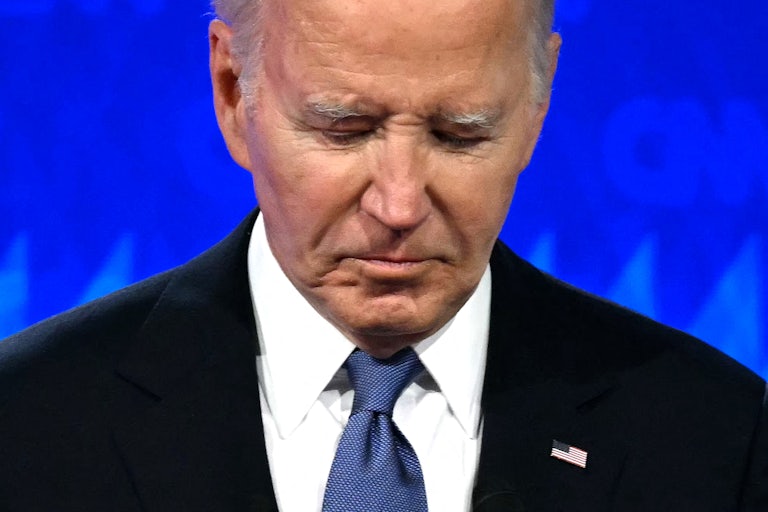
Joe Biden looks down at the debate.
ANDREW CABALLERO-REYNOLDS/AFP/Getty Images
President Joe Biden looks down as he participates in the first presidential debate of the 2024 elections with former president and Republican presidential candidate Donald Trump at CNN’s studios in Atlanta, on June 27.

Joe Biden had barely opened his mouth last night when I gasped and said to myself, “Oh God, this might be really bad.” His voice was thin and raspy and weak. His words, ostensibly about how badly Donald Trump botched the pandemic, were unfocused and constituted a huge missed opportunity. And that kept happening over and over and over again.

Trump lied like crazy, sure. Nobody’s aborting a fetus after it’s born. “Everyone” did not want Roe overturned. Millions of people from prisons or mental institutions have not crossed the border. Food prices haven’t “quadrupled.” It went on and on—CNN’s fact-checker said he counted at least 30 outright lies. Jake Tapper and Dana Bash never stepped in to fact-check Trump. All that is true. But none of that changes the overwhelming fact. Biden confirmed Democrats’ worst nightmares. “We finally beat Medicare”? Dear God.

CNN’s flash poll had respondents saying Trump won by 67 to 33 percent. Frankly, I’m not sure who those 33 were. The die-hardest of die-hard Democrats, I guess, or maybe single-issue voters who heard Biden say one thing they liked. But 33 percent means a ton of Democrats admitted that their guy lost, and the guy they really hate and rightly consider a direct threat to the country won. And probably half of that 33 were voting with their heart.

What happens now? Let’s talk about the people who have the power to go to Biden and tell him to step aside. What kinds of conversations is Barack Obama having today? Who’s Chuck Schumer talking to? Hakeem Jeffries? Nancy Pelosi? How about Bill and Hillary Clinton, and Al Gore? The big donors and bundlers? And perhaps most of all, there’s Jill and his family.

All these people have known for a long time that the Democrats had three options. The first has been sticking with Biden. People knew he was a risky proposition. But until this debate, Biden was, plausibly, the least bad option. Because the other two options are these.

Option two is that Biden steps down and hands it to Kamala Harris. She’s his vice president, and how in the world do you sidestep a sitting vice president?

That’s the most likely non-Biden option, but I know no one who’s excited about it. She’s just not a good politician. What’s the scenario where she beats Trump? Maybe she generates some higher enthusiasm among Black women, and theoretically among younger voters to some extent. Maybe she’d have more success making the race a referendum on abortion.

Harris, though, has a huge weakness. She has never really been able to make a strong economic argument. Even back when people were gushing about her in early 2019, when she announced her presidential candidacy, I noticed she had nothing to say about economic issues. And they’re kind of important in a presidential election. And then, of course, there are the racism and sexism you have to factor in here that would hurt her unfairly. My guess is that she runs three to five points worse than Biden against Trump, and that turns a margin-of-error race into a decisive loss—and one that probably affects control of the House and/or Senate.

The final option, therefore, is to throw the thing open and try to get the nomination to one of the governors, or someone else. This has always had a lot of theoretical appeal, because several of these people look like they’d be good candidates.

But the two perceived problems with this scenario are these. First, how much bad blood would start boiling within the party if Harris were pushed aside? The assumed answer has always been: a lot. If Biden were to step aside, pollsters would start asking questions about Harris, and if those polls showed that Black women will basically bolt, going around Harris could be a nonstarter.

And second, is there really any proof that Gretchen Whitmer or Gavin Newsom or Josh Shapiro or Jay Pritzker or anyone else would be a better candidate? Governors sometimes just don’t have it when it comes to running for president. Look at Ron DeSantis.

Those are real problems. But in this break-glass moment, they start to look like smaller problems than staying with Biden or just handing it to Harris.

We’ll see what the post-debate polls say. They’ll start coming out early to mid-next week. My guess is that Biden will lose four points on average, maybe five. It might be a little less. But the coverage of this fiasco over the next two days will only amplify how bad it was.

Politicians fear the unknown. They don’t want to cast votes whose political fallouts they can’t predict. They don’t want their districts redrawn. And they sure don’t want to change a presidential candidate in July.

But this is an undeniable crisis. I don’t know the convention rules. And remember—this is made even more complicated by the fact that Democrats have decided to nominate Biden via Zoom (or whatever) two weeks before the mid-August convention, because they need to have a nominee by early August for the nominee to appear on the ballot in Ohio.

So: Is an abbreviated, multicandidate campaign even possible? Here’s a scenario. Biden drops out next week, releasing the delegates he’s amassed during the primaries to do whatever. Candidates announce—Harris, the governors I named above (along with a few others, like Kentucky’s Andy Beshear), Pete Buttigieg, Cory Booker, maybe another senator or two. Throughout July, they have an intensive schedule of debates. Six or seven. Over the course of those debates, some will rise, some will fade. In early August, in time for Ohio, let the rank-and-file decide via electronic vote. Make all the contenders commit to supporting the process and standing 100 percent behind the winner.

Weirdly enough, that could actually end up working out pretty well. A new nominee would be fresh, providing a new story and a new start. He or she would trip up Trump. This nominee could arguably then roll into the Chicago convention generating a lot more enthusiasm than Biden will. (That’s another thing—think about the anxiety that will precede his convention speech!)

Then the nominee leaves Chicago with his or her well-chosen running mate, and they spend 10 days barnstorming the swing states so that by the end of the summer, the nominee will have galvanized the party. Then that nominee would have the fall to persuade swing voters, who don’t pay attention until October anyway.

Such a process might reinvigorate a party base that today is feeling pretty dispirited and disgusted and terrified. The conversations that happen this weekend in the high precincts of the Democratic Party will help determine the party’s—and the country’s—fate. It’s risky. Lots of unknown unknowns. But it’s worth remembering that with risk comes reward.

Is Aileen Cannon Seriously Going to Shut Jack Smith Down?

The Florida judge is hearing arguments on the constitutionality of the special counsel’s appointment. And we’ve seen what she’s capable of.

This picture shows a court house.
Joe Raedle/Getty Images
The Alto Lee Adams Sr. United States Courthouse, where U.S. District Judge Aileen Cannon has held hearings regarding former President Donald Trump, in Fort Pierce, Florida

Starting today in her Florida courtroom, Judge Aileen Cannon, whom Trump appointed to the bench during his waning months in office, is hearing arguments about whether Jack Smith’s appointment as special counsel is constitutional. It’s staggering that this is even happening, for a couple reasons.

First, Donald Trump’s legal team is arguing that Attorney General Merrick Garland had no legal authority to hire Smith. This is absurd. Attorneys general—and, sometimes, presidents and the D.C. Circuit Court—have been appointing special counsels since Ulysses Grant tabbed John Henderson to probe the Whiskey Ring. Since the 1970s, The New York Times reports, the courts have routinely rejected such challenges. The Supreme Court upheld the appointment—by Robert Bork, no less—of Leon Jaworski as special prosecutor for Watergate. Other similar challenges have been tossed.

Second, when courts have considered these petitions, they’ve usually done so on the basis of written arguments. To schedule a hearing that will extend over two days is … is what, exactly? A show of fealty to Dear Leader, probably. In addition, Cannon is allowing three lawyers who have filed amicus briefs to make 30-minute oral presentations. As one law professor told the Times: “The fact that Judge Cannon granted the amici request for oral argument seems to suggest that she is seriously considering the constitutional argument against the appointment of the special counsel.”

So, yes. Cannon is entirely capable of ruling that Smith’s appointment was unconstitutional. Lord knows, she has shocked us before. After the FBI Mar-a-Lago raid, she barred prosecutors from using any of the evidence collected there pending a review by a special master. Earlier this year, she issued an order asking both legal teams to submit preliminary jury instructions. The order seemed to embrace a key tenet of the Trump legal defense. There’s a lot more.

Next Monday or Tuesday, the arguments about Smith’s appointment will wrap up, and sometime thereafter, Cannon will render her decision. Can you imagine this relatively minor judge, one of 29 federal judges for the Southern District of Florida, who sits in the great metropolis of Fort Pierce, can hold the fate of the republic in her hands like this?

Well, she does.

And remember—if she decides that Smith’s appointment was unconstitutional, that deep-sixes not just the classified documents case over which she’s presiding but the even more important (in my view) January 6 insurrection case that’s supposed to be heard in Washington, pending the Supreme Court’s decision on presidential immunity. (The Justice Department would presumably appeal an adverse determination, so the Smith appointment matter may also end up at the Supreme Court one of these days.)

It’s just mind-boggling to think about this. It’s just never been more obvious that a judge is doing the bidding of the president who appointed her. It’s worth taking a look, by the way, at her confirmation vote before the Senate. It happened on November 12, 2020, five days after Joe Biden was finally declared the winner of the election. She was confirmed 56–21, with 12 Democrats joining the Republicans to elevate her. And 23 Democrats, including Judiciary Committee Chairman Dick Durbin, didn’t even vote.

So that’s the indifferent way she got to the bench in the first place. And now, she has the power to let a man who stole national security secrets and spent months ignoring polite requests from the FBI to come down to Palm Beach to see what he had, and who egged on a violent mob to break into the Capitol building and try to hang his own vice president get away with it all.

And of course there’s the Supreme Court too. Remember the high court’s timeline. The court announced that it would take up the immunity case on February 28. It heard the arguments almost exactly two months later, on April 25. And now here we are, creeping up on two months after that. And still no decision.

Why is all this being slow-walked? It’s obvious enough. They’re trying to help reelect Trump and hasten the arrival of the Christian nationalist post-democratic order. Federal judges and Supreme Court justices can read newspapers and polls. They’ve seen the polls showing Trump’s felony conviction in the Stormy Daniels case is hurting him, especially with independents, and they have no doubt seen this new crop of polls showing Biden creeping into the lead—Thursday, for the first time this year, Biden edged ahead of Trump on the FiveThirtyEight poll tracker. It’s 0.1 percent, but it’s a lead.

So this is what we’re going to see over these next months. The Trump campaign will be getting a push from corrupt right-wing judges, a right-wing propaganda network (actually, two, three, four, or five of them, depending on how you count), and a bunch of CEOs who want their next tax cut more than they value the continuing survival of the world’s oldest democracy. And Aileen Cannon is the most potent symbol of the whole corrupt network: She cares nothing about the law and the country’s best traditions, and there is no way for any of us to do anything about it.

Well, there’s one thing: Vote, in huge numbers. We’re still enough of a democracy that that matters.

There’s a New “Silent Majority” Out There—and It Is Not Conservative

Ever since Richard Nixon used the phrase, it’s been a Republican thing. But the Republicans are the extremists now, and the Silent Majority isn’t what it was in 1969.

A protester holds a sign reading "Abortion Access Everywhere!" in a group featuring a number of pro-abortion and pro-LGBTQ rights signs.
Scott Olson/Getty Images
Abortion rights protesters rally in Chicago in 2023.

Those of you of a certain age will recall the phrase “the Silent Majority,” made popular by Richard Nixon—and his crooked, cash-thirsty Vice President Spiro Agnew—in 1969 to refer to those middle-class Americans who weren’t out in the streets making noise about Vietnam or civil rights but sitting quietly at home seeking normalcy, law and order, and someone to save the country from extremism. Pat Buchanan, the old Nazi war criminal defender, has claimed that he placed the phrase before Nixon in a memo and the president seized on it.

Republicans have used it ever since. It was used by Ronald Reagan. It was employed by Rudy Giuliani and Mike Bloomberg (when he was running, as a Republican, for mayor of New York). Donald Trump gave it a spin in 2016. Overseas, Tory David Cameron and rightist leaders in Italy and Portugal have taken it up.

No candidate on the broad left has ever, to my knowledge, invoked the phrase. It’s high time that changed.

Earlier this week, you may have noticed, there was a special election in Ohio’s 6th congressional district, which runs from Youngstown to the West Virginia border. The Cook Political Report rates that district R+16, meaning a Democrat wins it about as often as Trump emits an untangled sentence. In 2020, Trump carried it by 29 points.

And Tuesday? The Republican still beat the Democrat—but by single digits. Michael Rulli, the Republican state senator who won the seat, spent $570,000. The Democratic candidate, an Air Force veteran who most recently worked as a waiter, spent $7,000.

What’s this have to do with the Silent Majority? I suspect maybe a lot.

If an amateur Democrat who couldn’t put two metaphorical nickels together can come within nine points of an experienced pol Republican in a district as scarlet-red as the Buckeyes’ jerseys, something is up. And this result is not an outlier. As Aaron Blake pointed out in The Washington Post, there have been six special congressional elections this cycle and the Democrat has outperformed in four of them, the Republican in just one. In the sixth race, Blake notes, the results (the Democrat won) closely mirrored the 2020 results, but “Democrats swung the results by double digits from the 2022 race for the same seat and flipped the seat blue.”

Simon Rosenberg, the high priest of Democratic optimism with his Hopium Chronicles Substack, constantly preaches: Don’t look at the polls; look at election results. We do not of course know whether his optimism about this November will be validated. We do, however, know that he (and pretty much he alone) was correct that the Democrats would hold their own in the 2022 midterms. He was right then, and he’s been right about most of these elections ever since.

So, a theory for you: Maybe, just maybe, there is an army of Americans out there who may not call themselves liberal or progressive but who are anywhere from sort of turned off to massively repulsed by MAGA. And while Trump and Fox News and Steve Bannon and Marjorie Taylor Greene and all the rest of them spend their days fulminating about America dying and hyping the authoritarian tsunami coming—talk that the mainstream media picks up and that dominates our discourse—there are in fact millions of Americans sitting quietly at home who detest these histrionic harbingers of hatemongering (a Safire-esque turn of phrase for you, since I mentioned Agnew).

They are out there. And they, I submit, are your new Silent Majority.

They’re not all liberal. But they definitely support abortion rights. They’re not rushing to join trans rights groups. But they want people to be treated with empathy and tolerance. They’re not reading gender-bending young adult fiction. But they recoil against censorship. They’re not socialists. But they want the government to do more for working- and middle-class people. They’re not Earth Firsters. But they believe climate change is real. They may still tell pollsters they’re wary of “big government.” But new interstates and bridges, and airport expansions, and new light-rail tracks, and expanded broadband access? They’re great with all that.

And most of all: They, just like Nixon’s old Silent Majority, seek normalcy, law and order, and someone to save the country from extremism. But in Nixon’s time, the extremism came from the left, while today it comes from the right. It’s the Trump right that attacks normalcy, on a daily and sometimes hourly basis. It’s the Trump right that is lawless, as evidenced most obviously by the fact that all these Republicans are tripping over themselves to support a convicted felon to be the president of the United States. And it’s the Trump right that is extremist on just about every issue, from health care to foreign policy.

So they sit at home, probably not watching much cable news, not marching in any marches, but just waiting until Election Day to register their opposition to MAGA. And in case you were wondering—yes, Michael Rulli, the Republican in that Ohio district, was MAGA all the way. He ran an ad in which the voiceover said: “On June 11, vote pro-gun. Pro-life. And pro-Trump.”

I would love to see the Democrats run with this idea that they are the new Silent Majority. It would infuriate the Republicans, who have assumed for 50 years that it is they who represent “regular America.” But with their slavish embrace of a sexual assaulting, classified document stealing, insurrection leading, twice impeached, quadruply indicted, and once (so far) convicted felon, they have waved goodbye to all that. They’re a noisy minority, and they’re alienating Americans by the millions.

It’s Simple: Trump Is Treated Like a Criminal Because He’s a Criminal

Trump’s life has been one long criminal enterprise. Democrats, make sure people remember.

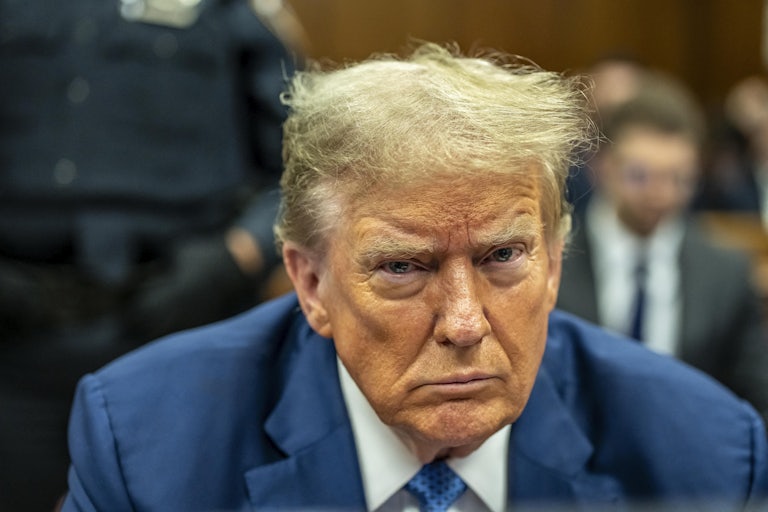
Trump in courtroom
MARK PETERSON/POOL/AFP/Getty Images

You are, I’m sure, familiar with Occam’s razor. It’s the old philosophical theorem that holds that the simplest explanation for an event, the one requiring the fewest assumptions, is probably the best explanation. If you wake up in the morning and there’s snow on the lawn, there are any number of possible explanations. Maybe some friends played a practical joke on you and dumped snow in your yard. Maybe space aliens visited during your slumber and dusted your lawn with the white stuff. Or—maybe it snowed last night.

Republicans keep asking, completely dishonestly, why so much criminal suspicion surrounds Donald Trump. They say it’s all being orchestrated by Joe Biden and Merrick Garland. They insist it’s an effort to interfere with his election campaign. They say a lot of things, but if ever there was a case where Occam’s razor applied, it’s this one. Trump is surrounded by criminal suspicion because he’s a criminal.

He’s been doing criminal things for decades. He just finally got cornered and caught on something. I’ve been writing recently that Democrats have to make sure every voter in the country remembers by Election Day, having heard it said thousands of times, that Donald Trump is a convicted felon. That’s true, and so far, Democrats and affiliated groups aren’t doing a terrible job of this. It’s a little sad that the best expression I’ve seen of this so far comes from a Republican—fiercely anti-Trump Republican Sarah Longwell’s group, Republican Voters Against Trump, has put up some blunt billboards around the country featuring photos of voters, with their names, under the statement: “I won’t vote for a convicted felon.”

But Democrats need to do more. Trump’s criminality, both past and future, should be central to the campaign. There’s a story to tell here, and it’s all true. No matter what the pollsters and the messaging gurus say, it’s impossible that all of this, taken together, doesn’t matter to swing voters.

To tell the story, you go through Trump’s record:

  • convicted on 34 felony counts
  • determined by a court to have raped a woman and ordered to pay her $83 million
  • found by a court to have overvalued his assets and ordered to pay $364 million
  • ordered to pay a $2 million settlement after admitting that he misused his charity, which the state of New York shut down
  • found by the Justice Department to have refused to rent apartments to Black applicants; settled out of court
  • sued by the Justice Department for violating proper procedures in the purchase of stock; paid $750,000 in civil fines
  • charged by the New York State Lobbying Commission with violating state lobbying laws while purchasing a casino; paid $250,000 to settle fines
  • found by the courts to have grossly defrauded students at the so-called Trump University and ordered to pay them $25 million in restitution

This list isn’t even the tip of the iceberg. It’s the tip of the tip. Trump has spent four decades being sued for something or other, typically not paying his bills, like those famous cases where he stiffed the poor vendors for his casinos, filing his own ridiculous countersuits and libel suits, and paying fines to make things go away. If indeed he actually paid the fines. I wonder if anyone has ever really gotten to the bottom of that. And I haven’t even mentioned the current charges around January 6 and the stolen classified documents because, so far, they’re just charges. But whatever the courts end up saying on those two matters, we’ve all seen with our own eyes the insurrection that he obviously incited (as of this January, 718 rioters had pleaded guilty to various federal charges, and 139 had been found guilty in court) and the photos of the boxes of documents at Mar-a-Lago that he refused for months to turn over to the FBI.

Another important point: The criminality around Trump isn’t limited to Trump. Eight Trump associates were sentenced to prison time: Steve Bannon, Michael Cohen (joined the good side but still served time), Rick Gates, Paul Manafort, Peter Navarro, George Papadopoulos, Roger Stone, and Allen Weisselberg. Others copped pleas: Michael Flynn, Sidney Powell, Kenneth Cheseboro, and Scott Hall, another Georgia defendant.

This is not a coincidence. As GOP strategist Rick Wilson said, “Everything Trump touches dies”; he corrupts everything and everyone around him. And does anyone seriously think that if he gets back to the Oval Office, the same thing isn’t going to happen again? It’s going to be worse.

It’s going to be far worse. First, he’s going to start, on that dictatorial day one, by pardoning himself. Joe Biden and the Democrats need to try to get voters focused on this. If it happens, people will be completely outraged. Yes, the 38 percent or so who are MAGA world will be fine with it, but majorities will be flabbergasted at such an act. Is it possible to get voters pre-outraged about something that hasn’t happened? The polls will say no. But as I’ve written over and over lately, polls can either be accepted—or they can be changed.

Right now, what’s most terrifying to me about the polls is that they tell us emphatically that people forget. They forget all the horrible things Trump did. That includes presidential actions, like his lies to the American people about the pandemic, but it also includes his history of criminality and the way that history guarantees he’ll keep behaving that way.

In sum: Trump’s criminal record hardly begins and ends with Stormy Daniels. Somebody needs to make sure that, by November 5, voters know the entire, sordid history.