Breaking News
Breaking News
from Washington and beyond

Trump Makes Russia Prisoner Swap All About Him in Bonkers Response

Donald Trump has weighed in on the prisoner exchange. You’ll wish he hadn’t.

Donald Trump holds his arms out while speaking at a campaign rally
Hannah Beier/Bloomberg/Getty Images

Donald Trump doesn’t seem the least bit happy about the release of three American citizens who were wrongfully imprisoned in Russia. Why? Probably because he had nothing to do with it.

The White House announced Thursday that “three American citizens and one American green-card holder who were unjustly imprisoned in Russia are finally coming home: Paul Whelan, Evan Gershkovich, Alsu Kurmasheva, and Vladimir Kara-Murza.”

In total, the exchange freed 16 people imprisoned in Russia, including five Germans and seven Russian citizens who had been political prisoners in their own country. The U.S. worked alongside Germany, Poland, Slovenia, Norway, and Turkey to secure the deal, according to the statement.

The Wall Street Journal, where Gershkovich works, has dubbed it “the largest and most complex East-West prisoner swap since the Cold War.” But rather than celebrate, Trump took to Truth Social Thursday to whine that he was not on the inside of brokering the gargantuan deal.

“So when are they going to release the details of the prisoner swap with Russia?” Trump wrote—the first of his many questions.

“How many people do we get versus them? Are we also paying them cash? Are they giving us cash (Please withdraw that question, because I’m sure the answer is NO)? Are we releasing murderers, killers, or thugs?”

“Just curious because we never make good deals, at anything, but especially hostage swaps. Our ‘negotiators’ are always an embarrassment to us! I got back many hostages, and gave the opposing Country NOTHING—and never any cash. To do so is bad precedent for the future. That’s the way it should be, or this situation will get worse and worse. They are extorting the United States of America. They’re calling the trade ‘complex’—That’s so nobody can figure out how bad it is,” Trump wrote.

Trump’s anti-diplomacy pearl-clutching is not only inane, it is also hypocritical. His own administration facilitated several prisoner swaps during his time in office.

In 2019, the Trump administration oversaw the release of three senior Taliban leaders imprisoned in Afghanistan, in exchange for one American, Kevin King, and Timothy Weeks, an Australian. One month later, the U.S. freed Masoud Soleimani, an Iranian scientist convicted of export violations, in exchange for the return of Xiyue Wang, a Princeton graduate student held in Iran.

In October 2020, one of Trump’s deputy assistants agreed to free 250 Houthi rebels being held in Oman, in exchange for two Americans, Sandra Loli and Mikael Gidada, who were held hostage by Iranian-backed militants in Yemen.

Two years later, Trump lied, bragging that, while in office, he’d secured the release of 58 hostages without giving anything in return.

It’s entirely likely that Trump is suffering from some kind of diplomatic FOMO. At CNN’s infamous presidential debate in June, Trump promised that he would free Gershkovich before he even took office.

“As soon as I win the election, I will have that reporter out,” he said, not referring to Gershkovich by name, instead calling him a “good guy.”

Trump alleged that Russian President Vladimir Putin had demanded “billions of dollars” for Gershkovich’s release but failed to produce any evidence to support that claim. Rather, Putin has repeatedly indicated that he wanted one person in particular: Vadim Krasikov, a former intelligence officer who had shot a rebel leader in Berlin in 2019.

Despite the fact that Trump never got the chance to follow through on his flimsy promise, that hasn’t stopped his sycophants from tossing him some credit anyway.
J.D. Vance Desperately Tries to Give Trump Credit for Prisoner Swap

Donald Trump’s team is pathetically trying to make the Russia prisoner exchange all about him.

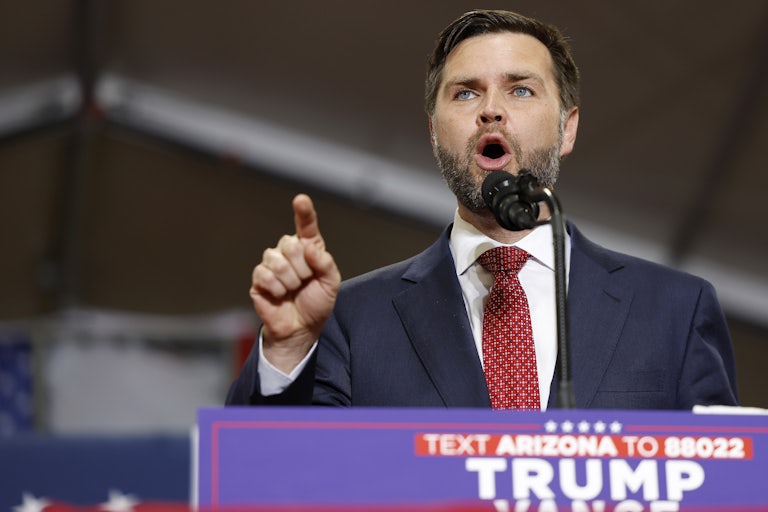
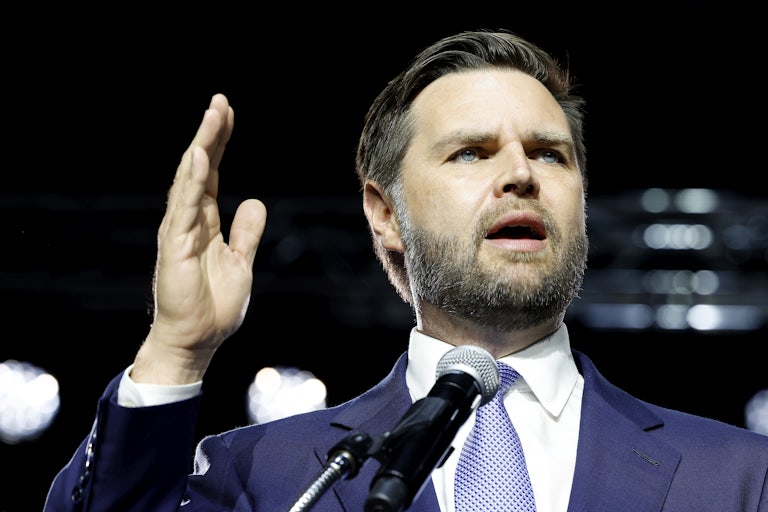
J.D. Vance speaks and raises a hand for emphasis
Anna Moneymaker/Getty Images

After President Joe Biden on Thursday announced a deal to free American hostages in Russia, J.D. Vance somehow tried to give Donald Trump the credit.

Vance’s initial reaction to the news began normally, in an interview with CNN’s Steve Contorno.

“Look, I think it’s great news, at least what little we know. We certainly want these Americans to come back home. It was ridiculous that they were in prison to begin with,” the Republican vice presidential nominee said, before going in a completely different direction.

“But we have to ask ourselves, why are they coming home? And I think it’s because bad guys all over the world recognize Donald Trump’s about to be back in office, so they’re cleaning house,” Vance said. “That’s a good thing. And I think it’s a testament to Donald Trump’s strength.”

The Ohio senator isn’t making any sense here. He appears to be echoing Trump’s comments from May that only he could free Wall Street Journal reporter Evan Gershkovich, claiming that “Vladimir Putin, President of Russia, will do that for me, but not for anyone else, and WE WILL BE PAYING NOTHING!”

But this was easily disproved Thursday after the release of the hostages, who also included Marine veteran Paul Whelan and Russian American radio journalist Alsu Kurmasheva. National security adviser Jake Sullivan was asked about Vance’s claim at a press conference Thursday, and he dismissed the idea.

“I don’t follow,” Sullivan replied.

A Shocking New Super PAC Is Trying to Buy Elections

This might explain why Donald Trump has been cozying up to the crypto industry lately.

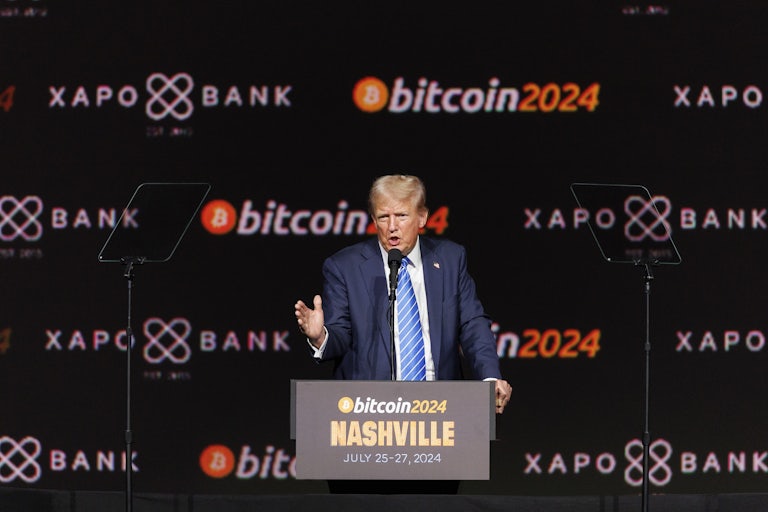
Donald Trump gestures while speaking at a Bitcoin conference
Brett Carlsen/Bloomberg/Getty Images

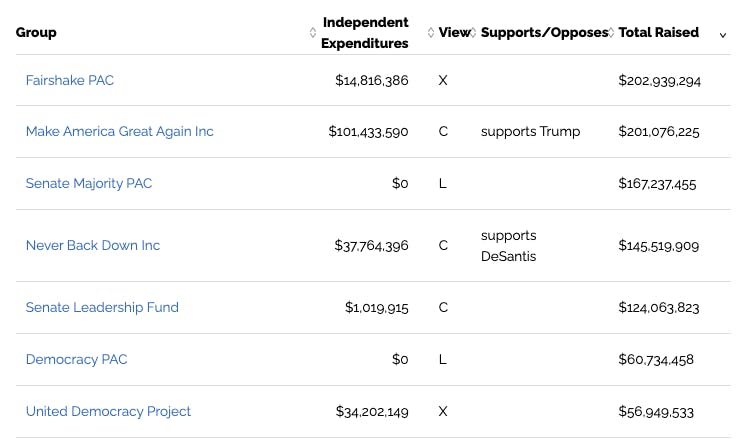
The super PAC with the highest amount of money raised is likely one you’ve never heard of: “Fairshake PAC.”

According to their website, the group “supports candidates committed to securing the United States as the home to innovators building the next generation of the internet.” In simpler terms, they are an “independent” cryptocurrency and blockchain industry group. According to OpenSecrets, they’ve raised $202,939,294 to influence upcoming elections.

Screenshot of OpenSecrets
Screenshot

The PAC has spent only a handful of millions so far, almost entirely attacking progressive Democratic candidates. That includes an ad attack against Representative Katie Porter’s California Democratic primary back in February. The group has also spent $2 million to push out progressive New York Representative Jamaal Bowman and $1 million against fellow Squad member Cori Bush’s upcoming primary in Missouri.

Given the PAC’s spending (or lack thereof, relative to how much money it has), it’s no wonder that both major presidential candidates have begun to vie for the cryptocurrency industry’s favor. On July 27, Donald Trump spoke at the national Bitcoin conference.

“You’re going to be very happy with me,” he said as he addressed the conference in Nashville, Tennessee. In his speech, the Republican presidential nominee promised to make the United States the “crypto capital of the planet.”

At the same time, Kamala Harris reached out to the blockchain world, reportedly having aides meet with industry officials to “reset” relations and strengthen the Democratic Party’s ties with cryptocurrency business interests. Harris is not likely to sway big donors and PACs such as Fairshake, however.

Cameron Winklevoss, co-founder of the cryptocurrency exchange Gemini and the venture capitalist firm Winklevoss Capital, already seems to have come out against her.

“Beware of the Big Bluff,” he wrote on X, speaking about Harris’s attempts to win over the industry.

The millions of dollars raised by Fairshake PAC come from Winklevoss and his twin brother Tyler, Coinbase, Ripple, and “techno-optimist” Marc Andreessen. This venture capitalist world has increasingly rallied around Trump following his pick of J.D. Vance for vice president, given Vance’s background in Silicon Valley and relationships with billionaires such as Peter Thiel.

As cryptocurrency researcher Molly White reported, Coinbase is alleged to have skirted campaign finance laws through its donations to Fairshake. If this is the case, this would be the “largest known illegal campaign contribution by a federal contractor,” according to White.

During the 2022 midterms, the crypto industry, led by Sam Bankman-Fried, had an outsize influence through massive campaign spending. At the time, Bankman-Fried spent millions collaborating with AIPAC and Trump to support billionaires and crush the electoral left in Democratic primaries.

As Bankman-Fried sits in prison, Fairshake PAC seems to be willing to take up the mantle in 2024.

J.D. Vance Says Abortion Is as Bad as Slavery in Stunning New Audio

Vance made the comparison during an interview on a right-wing radio show.

J.D. Vance gestures as he speaks at a Donald Trump rally
Anna Moneymaker/Getty Images

J.D. Vance once compared abortion to slavery while gushing about the demise of Roe v. Wade, in new audio unearthed by Media Matters.

Less than two weeks after the U.S. Supreme Court decided to undo the 1973 decision that decriminalized abortion, Vance appeared in an episode of The Bruce Hooley Show, hosted by the eponymous right-wing radio host.

During the conversation, Hooley cited the 1954 Supreme Court decision in Brown v. Board of Education, which found that “separate but equal” segregation was unconstitutional, although it had previously been allowed by Plessy v. Ferguson in 1896.

“I don’t think they wanna be in the business of advocating that anything that’s been in law for 50 years remains in law forever,” Hooley said.

Vance agreed, and took it another step further.

“Yeah. Of course. You know, Dred Scott, one of the famous pro-slavery decisions by the Supreme Court, I don’t think anybody wants that to remain law,” Vance said, referring to the 1857 case Dred Scott v. Sandford, which found that enslaved Black people were not American citizens and therefore not protected by the Constitution.

“So, I do think that we look at these decisions very often and we say, look, these things just don’t make any sense anymore. They haven’t held up very well. They haven’t solved the problem they were meant to solve. They don’t comport with the Constitution, obviously. That’s the most important thing that very few people talk about.”

“So, yeah, this is ultimately—this is a good thing,” said Vance, referring to Roe’s fall.

Media Matters found that this wasn’t the first time that Vance made that comparison.

In 2021, Vance had told The Catholic Current, an anti-abortion radio show, that “there’s something comparable between abortion and slavery, and that while the people who obviously suffer the most are those subjected to it, I think it has this morally distorting effect on the entire society.”

Vance’s harsh view on abortion is a particularly bad look for Donald Trump’s presidential campaign, which has attempted to present a more moderate approach on abortion in an attempt to capture a wider breadth of voters. The change in tone has inspired a huge shift in the Republican Party’s platform away from a federal abortion ban (and toward embracing the dozens of cruel state-level ones).

Vance previously advocated for a nationwide abortion ban, and called for a “federal response” to block women traveling out of state to get abortions.

More about Vance’s views on reproductive health:

Pelosi Shares Dire Warnings She Received on Trump’s Mental Health

The former House speaker has a new book in which she shares that she repeatedly got warnings about Donald Trump’s health when he was president.

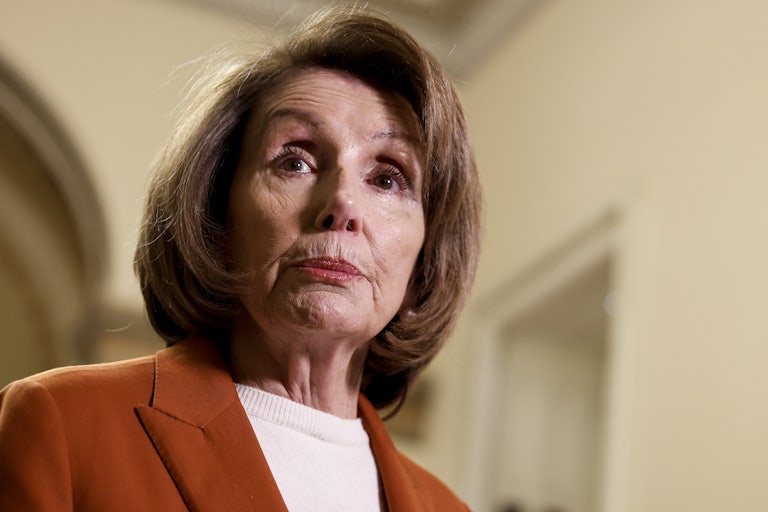
Nancy Pelosi raises her eyebrows and purses her lips
Anna Moneymaker/Getty Images

Former House Speaker Nancy Pelosi was warned by doctors and mental health professionals about Donald Trump’s mental health in 2019, according to her upcoming book.

The Guardian obtained an advance copy of Pelosi’s book The Art of Power: My Story as America’s First Woman Speaker of the House, which will be released next week. In the book, Pelosi recounted what she was told by several “doctors and other mental health professionals” at a memorial service for a psychiatrist.

They told her that they were “deeply concerned that there was something seriously wrong” with Trump, “and that his mental and psychological health was in decline.”

“I’m not a doctor,” Pelosi wrote, “but I did find his behaviors difficult to understand.”

The 2019 memorial was a service for Dr. David Hamburg, whom Pelosi refers to as “a distinguished psychiatrist who … served as the president of the Carnegie Corporation, where he had been a great voice for international peace.”

Pelosi elaborated further on her opinions of Trump’s mental health.

Before the Capitol riot of January 6, 2021, “I knew Donald Trump’s mental imbalance. I had seen it up close. His denial and then delays when the Covid pandemic struck, his penchant for repeatedly stomping out of meetings, his foul mouth, his pounding on tables, his temper tantrums, his disrespect for our nation’s patriots, and his total separation from reality and actual events. His repeated, ridiculous insistence that he was the greatest of all time,” Pelosi wrote.

Pelosi also described how Trump’s staff members, such as Mark Meadows, Trump’s final chief of staff, allowed Trump to listen in “surreptitiously” on private meetings with congressional leaders, causing Pelosi to ban cell phones from her meeting rooms on Capitol Hill.

She also wrote about Trump calling her on the phone, sometimes late at night, including one call where Trump told her that missile strikes he had just ordered against Syria were his predecessor Barack Obama’s fault. Pelosi told him “It’s midnight. I think you should go to sleep.”

On January 6, Pelosi said she was calm because she was “already deeply aware of how dangerous Donald Trump was.”

She wrote that she realized that she had “more respect for the office of president of the United States than Trump. “It was clear to me from the start that he was an imposter—and that on some level, he knew it.”

Pelosi’s remarks show that Trump’s ongoing cognitive decline isn’t something new and, in fact, was noticed by those around him years ago. In recent months, he’s confused members of Congress, fumbled during speeches, gone on incomprehensible rants, and made enough gaffes for critics to make brutal supercuts. Pelosi’s new revelations show just how much his mental state may have put the country in danger when he was president—and serve as a warning that another presidential term would likely be worse.