Breaking News
Breaking News
from Washington and beyond

Trump, Who Claimed He Knew Nothing About Project 2025, Reverses Course

Donald Trump wants a Project 2025 architect to play a starring role in his Cabinet.

Russ Vought
Stefani Reynolds/Bloomberg/Getty Images

Donald Trump repeatedly told America he had “nothing to do” with Project 2025. But now, he’s welcoming its architect into his Cabinet with open arms.

Russ Vought, who was deeply involved in the creation of Project 2025 and wrote an entire chapter in the right-wing playbook, is being strongly considered for an upcoming Cabinet position, according to several sources who spoke with ABC News. Vought has already begun the vetting process and has been seen at Mar-a-Lago meeting with Trump’s team.

Vought—a former lobbyist, self-described Christian nationalist, and director of the Office of Management and Budget in Trump’s first term—authored a chapter in the 922-page MAGA extremist master plan titled “Executive Office of the President” for Project 2025’s “Mandate for Leadership: The Conservative Promise” section. The chapter serves as “a comprehensive policy guide for the next conservative U.S. president.”

Vought isn’t the only Project 2025 alum being floated for a crucial role in the Trump Cabinet. Gene Hamilton, who wrote a chapter about how the Justice Department needed a “top to bottom overhaul” because it is “captured by an unaccountable bureaucratic managerial class and radical Left ideologues who have embedded themselves throughout its offices and components,” has been seriously floated for an important legal team position. Trump has also nominated Project 2025 contributor and free-speech “warrior” Brendan Carr to serve as Federal Communications Commission chair.

On the campaign trail, Trump had tried to distance himself from Project 2025, particularly after it became a focus point for Democrats. “This was a group of people that got together, they came up with some ideas, I guess some good, some bad, but it makes no difference. I have nothing to do [with it],” Trump stated during his nationally televised debate with Vice President Kamala Harris. His loyal transition team co-chair Howard Lutnick described the project as an “absolute zero” and “radioactive.”

And yet here we are, with Vought, Carr, and Hamilton cozying back up to the president-elect, who was surely lying to America throughout his campaign. The skeleton plan for the far-right takeover is coming alive.
Putin Lowers Nuclear Threshold—Just in Time for Trump to Take Office

Russian leader Vladimir Putin shows no signs of backing down in its war on Ukraine, regardless of what Donald Trump claims.

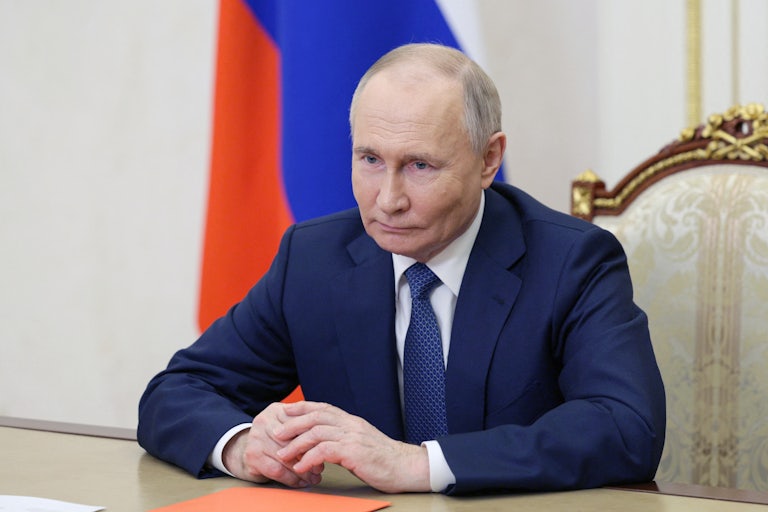
Russian leader Vladimir Putin at a table with several papers in front of him and the Russian flag in the background.
ALEXEI BABUSHKIN/POOL/AFP/Getty Images

Russian President Vladimir Putin lowered Russia’s threshold for the use of nuclear weapons, indicating an escalation in tensions President-elect Donald Trump promised to alleviate.

Putin’s decree on Tuesday revised Russia’s nuclear doctrine, now stating that Russia could use nuclear arms if attacked by a nation that is backed by a nuclear power, according to The New York Times. Any attack from Ukraine, would be seen as a “joint attack” with its allies, according to the doctrine.

Putin first announced plans to change this policy during an address in September, but its installation seems to be in response to President Joe Biden’s decision to allow Ukraine to fire American long-range missiles 190 miles into Russian territory. Biden’s decision came after North Korean troops were discovered fighting in Russia’s Western Kursk region last week.

On the campaign trail, Trump claimed that he would be able to end the war in Ukraine “within 24 hours” of being elected president—promising a deal that was far more favorable to his supposed ally Putin. Two weeks after Trump’s election victory, it seems that Russia is taking the news as permission to ramp up its assault against Ukraine, and its Western allies like NATO.

Within days of Trump winning the presidential election, Putin sent tens of thousands of soldiers to the Ukrainian war front after Trump told him not to escalate the situation.

During Trump’s debate against Biden in June, the now president-elect said, “If we had a real president, a president that knew—that was respected by Putin he would have never invaded Ukraine.”

More on election fallout:

Did President Biden Just Save the CHIPS Act From Trump?

The president just secured a $6.6 billion deal to build factories in Arizona—setting up a showdown when Trump, who is vehemently opposed to the key pillar of Biden’s economic program, takes office.

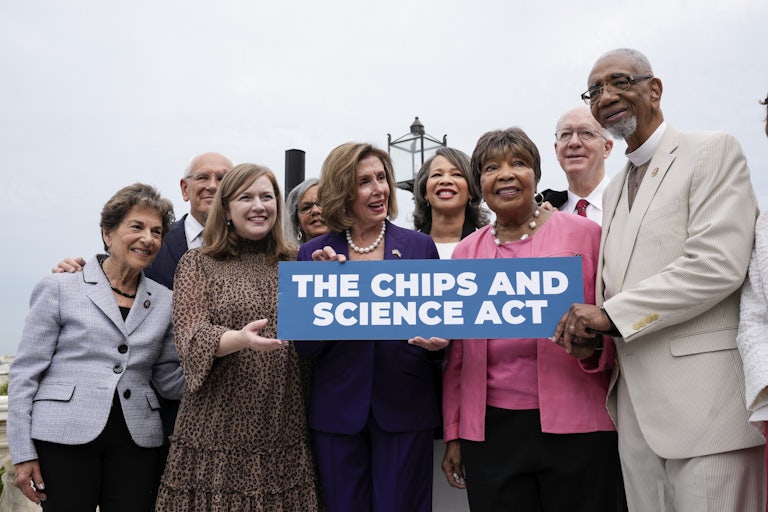
Nancy Pelosi and other members of Congress hold a sign celebrating the CHIPS Act.
Drew Angerer/Getty Images
Nancy Pelosi celebrates the passage of the CHIPS Act in July.

President Biden may have secured a government program that funds semiconductor manufacturing in the United States, critical for electronics companies. 

The Biden administration announced Friday that a $6.6 billion deal with the Taiwan Semiconductor Manufacturing Company to build three fabrication plants near Phoenix had been finalized, creating thousands of jobs in Arizona. Semiconductors are used in nearly every electronic device, including cell phones, airplanes, and cars. 

“This is a gigantic announcement,” Secretary of Commerce Gina Raimondo told reporters Friday. “This will be one of the most important investments that we make as a country to advance our economic and national security.”  

The deal was initially announced in April, with $6.6 billion in grants promised to the Taiwanese company along with $5 billion in loans. The funding comes from the CHIPS and Science Act, signed into law by Biden in 2022, which allots $52.7 billion for chip research, manufacturing, and workforce development. TSMC makes chips for leading tech companies such as Apple, NVIDIA, and AMDl.

President-elect Donald Trump has attacked the bill, claiming in April that the United States shouldn’t be “giving [Taiwan] billions of dollars to build chips.” Trump’s stance led to House Speaker Mike Johnson, who voted against the CHIPS Act, saying days before the 2024 election that he would try to repeal the bill if Trump was elected.

Later, Johnson was forced to backtrack after his fellow Republican Representative Brandon Williams pointed out that a new $100 billion chip-making factory was going to be built in Williams’s central New York district thanks to the bill.   

The Arizona deal is the biggest such foreign investment in U.S. history, according to the White House, and its finalization means that the government is obligated to follow through with its funding promises to TSMC, making it very hard, if not virtually impossible, for Trump to scuttle the CHIPS Act.

“It’s a binding contract,” said Ryan Harper, the White House CHIPS implementation coordinator. “The company, as long as it meets its milestones, has a contractual binding agreement from the government to move forward.”

In his first term as president, Trump backed then–Wisconsin Governor Scott Walker’s effort to bring Taiwanese manufacturing company Foxconn to the Badger State, with the Republican Walker offering the company $3 billion in subsidies in exchange for the promise of 10,000 new jobs and a $10 billion investment in the state.  

But the bill didn’t deliver the promised jobs, with government subsidies ballooning to over $4.5 billion, Foxconn reducing the size of the planned factory by half, and robots doing most of the work. Walker ultimately was voted out of office because of the deal, which his Democratic successor, Tony Evers, was forced to rework. Today, the factory that was actually built only employs 1,000 people, and Wisconsin now has its hopes on the CHIPS Act’s funding for something new. 

Biden’s completed Arizona deal likely means that he can leave office with the CHIPS Act as one of his signature achievements, a small silver lining in the face of Trump’s election victory. He can also point to the fact that, should everything in the contract unfold as planned, he succeeded where Trump and Republicans previously failed.  

The Trump-Musk Bromance Has Entered a New Phase

Everyone in Trump's orbit might hate the tech billionaire, but Trump is still going everywhere with him.

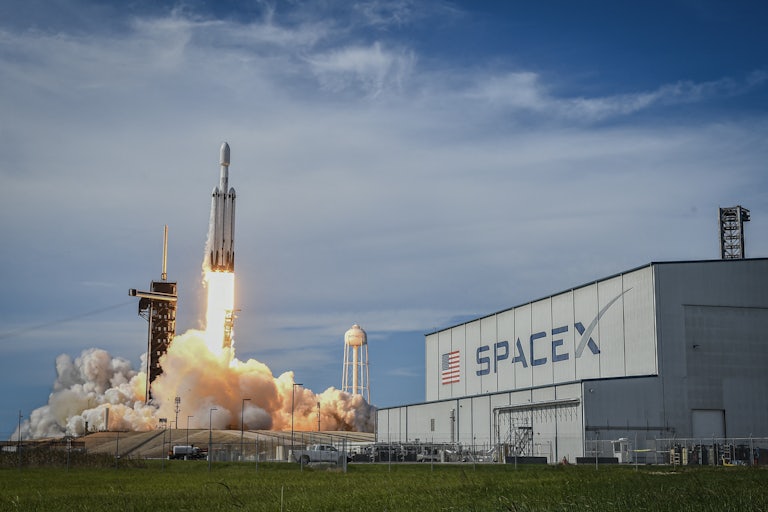
A SpaceX rocket blasts off
MIGUEL J. RODRIGUEZ CARRILLO/AFP/Getty Images
A SpaceX rocket blasts off.

From cageside at UFC309 to side by side at the upcoming SpaceX launch, the Trump-Musk bromance knows no bounds.

It’s been reported that Trump will be present at SpaceX’s Texas headquarters to watch a rocket shoot into the sky, before it ultimately crashes into the Indian Ocean on Tuesday. This was deduced after the Federal Aviation Administration issued flight restrictions for the president-elect at the same time and in the same area as Musk’s SpaceX launch. Neither Trump nor Musk have commented publicly yet. 

Musk has been a mainstay within the Trump team, spending countless days at Mar-a-Lago by the president-elect’s side. As Trump’s biggest and most enthusiastic donor he’s been rewarded with official leadership of the (mostly fake) Department of Government Efficiency and unofficial direct access to Trump. He has joined important diplomatic phone calls with Ukrainian President Volodymyr Zelenskiy and others. He’s also expected to have an outsize role in choosing the next Department of Transportation that will surely benefit his finances as an electric vehicle company CEO.  

This is all much to the chagrin of Trump’s inner circle, as the richest man in the world is constantly contradicting and circumventing them in Trump’s ear. While it’s unclear how long this honeymoon will last, we know that as long as Trump likes Elon, the billionaire can do whatever he wants.

Pennsylvania Supreme Court Throws Out Votes as Senate Recount Begins

The Pennsylvania state Supreme Court has ruled some votes cannot be counted.

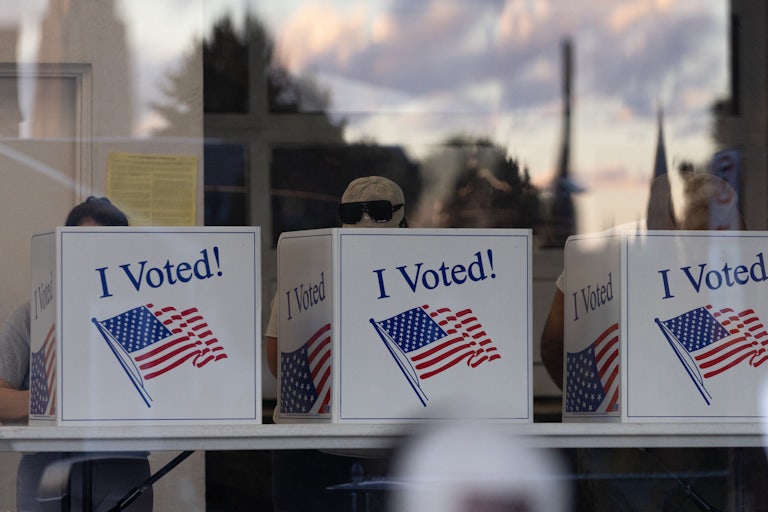
People vote at a polling station in Pittsburgh, Pennsylvania
Rebecca Droke/AFP/Getty Images

The recount for Pennsylvania’s U.S. Senate race won’t count undated or incorrectly dated mail-in ballots, a major blow to voting rights.

In an opinion filed Monday, the Pennsylvania Supreme Court ruled that ballots that failed to arrive with a correct handwritten date on the return envelope, and thereby failed to comply with the requirements of the state election code, would not be included in the final vote tally in the race between Senator Bob Casey and his Republican opponent, Dave McCormick.

McCormick was deemed the winner of the race nearly two weeks ago, nabbing 48.9 percent of the vote with 99 percent reporting compared to Casey’s 48.5 percent. As the week wore on and Pennsylvania’s various counties continued to tally their ballots, it became evident that the competitors were separated by fewer than 23,000 votes. By Monday, that number had dwindled to 17,000 out of almost seven million ballots that had already been recounted, reported the Associated Press.

Democratic-controlled election boards in three counties—Montgomery, Philadelphia, and Bucks Counties—had argued that an incorrect date said nothing about the voter’s eligibility to cast their ballot.

The Republican National Committee and the Pennsylvania Republican Party filed an emergency request on Thursday, asking the state Supreme Court for an immediate ruling on the case, contesting that the date was still a key component to ballot security.

The court ruled 4–3 in their favor on Monday, with Justices Kevin Brobson, Sallie Updyke Mundy, Kevin Dougherty, and David Wecht slamming some of the counties for considering the ballots.

“It is critical to the rule of law that individual counties and municipalities and their elected and appointed officials, like any other parties, obey the order of this court. As Justice Felix Frankfurter once wrote: ‘If one man can be allowed to determine for himself what is law, every man can,’” wrote Justice Wecht in a statement, joined by Justice Mundy. “‘That means first chaos, then tyranny.… The greater the power that defies law the less tolerant can this Court be of defiance.’”