Breaking News
Breaking News
from Washington and beyond

Nobody Asked For This: An Anthony Weiner Political Comeback

My dude, now is just not the time for this!

Former congressman Anthony Weiner seen on Times Sqaure promoting public art.\
Lev Radin/Getty Images
Former Congressman Anthony Weiner seen on Times Square promoting public art

On top of everything that’s gone wrong for Democrats in November, Anthony Weiner is mulling making a political comeback.

The New York Times is reporting that the registered sex offender and repeatedly-shamed former New York congressman has floated a return to his once thriving political career, despite the known existence of an incalculable number of New Yorkers who might currently be better suited to hold literally any elected office. Weiner used a recent barbershop interview with failed Republican state comptroller candidate Jonathan Trichter to test these waters. 

“I got removed from society. That happened. I was removed from society for 18 months and five days, and for years I have lived as a civilian in this neighborhood,” Weiner said, strategically deploying the passive voice as he discussed the matter during his haircut. “Maybe this campaign will be an opportunity for me to engage those people, even if they do not like what I did.”

A reminder: That whole “what Weiner did” thing was getting caught for sexting lewd images to women and an underage girl over and over again. In 2011 he accidentally posted his bulge showing through his underwear publicly on his Twitter timeline, and then denied doing that for days before finally resigning from Congress. More sexual messages to a 22-year-old woman were exposed during his New York City mayoral campaign in 2013. He was caught sexting another woman and a 15-year-old girl in 2016. Weiner surrendered to the FBI in 2017 and was found guilty of “transferring obscene materials to a minor.” He spent almost two years in prison.  

Weiner’s inability to keep his rampaging libido in check may have world-historical ramifications, as many argue that his sexting scandal was a critical domino to fall in Hillary Clinton’s 2016 email-server fallout. Emails regarding Hillary Clinton’s controversy were found on Weiner’s laptop that he used for sexting. Weiner’s wife, Huma Abedin, was vice chair of Clinton’s campaign, leading former FBI Director James Comey to reopen investigations into Clinton just days before the 2016 election. Many within the party blame Comey’s decision, initiated by Weiner’s own vile desires, for Clinton’s loss to Donald Trump. 

Today, Weiner is eyeing a seat back at where it all started—the New York City Council. But other candidates in his district, which covers Greenwich Village and the Lower East Side, aren’t exactly enthusiastic about Weiner’s triumphant return to politics. “Everyone deserves a second chance, but this guy has had third, fourth and fifth chances,” council candidate Sarah Batchu said. 

Another candidate, Andrea Gordillo, offered scathing remarks of her own. “Families in Lower Manhattan deserve better than failed New York and Washington politicians using our moment of need for their own political comeback.” 
The 15 Democrats Who Voted to Give Trump Insane New Powers

On Thursday, the House passed a bill that would allow the president to wipe out any nonprofit organizations he opposes with the flick of a pen. He had bipartisan support.

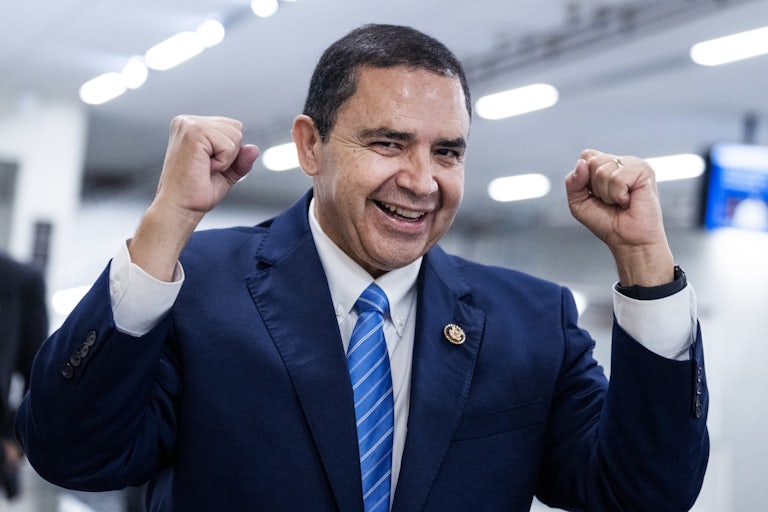
Texas Rep. Henry Cuellar was one of the 15 Democrats to vote on HR 9495 on Thursday.*
Tom Williams/Getty Images
Texas Representative Henry Cuellar was one of the 15 Democrats to vote on H.R. 9495 on Thursday.*

The Stop Terror-Financing and Tax Penalties on American Hostages Act would allow the secretary of the treasury, a Cabinet position appointed by the president, to revoke a nonprofit organization’s tax-exempt status by labeling it as “terrorist-supporting.” It passed by a vote of 219–184, mostly along party lines.

With the incoming Trump administration broadly vowing to take vengeance against “enemies within,” the successful passage of this bill would place a wide array of organizations vital to Democratic organizing and policymaking in the president-elect’s direct line of fire. It is supremely puzzling, then, that this bill received bipartisan support.

Last week, the same bill failed to advance out of the House because it failed to garner the two-thirds majority needed to pass during a suspension of the lower chamber’s rules. It was subsequently sent back to committee and retooled for a simple majority vote. While 52 Democrats voted for the bill previously, enormous pressure was applied to get those who backed the bill last week to come out against it on Thursday. This time, 15 of them voted along with every single Republican for the bill, which would have a chilling effect on free speech.

The bill’s original intention was to aid in the clamping down on pro-Palestinian protesters, particularly those on college campuses—a dubious undertaking given both the First Amendment rights enjoyed by all under the Constitution as well as a slew of other statutes that already make it illegal to provide material support to terrorist organizations.

However, the reelection of Trump casts this measure in a new light. His promise to turn the civil service into an engine of personal vengeance should be sufficient evidence that he’d likely abuse the powers granted under H.R. 9495, potentially allowing the president to target fairly well-known liberal organizations, such as the Center for American Progress, with punishing sanctions that would prevent such outfits from raising or banking money—penalties which, under the proposed law, such sanctioned organizations would be barred from pursuing legal recourse to plead their case. Moreover, in addition to activist groups, many universities and news outlets are nonprofit organizations.

While significantly lower than the 52 members who joined in last week’s vote to advance the bill, 15 Democrats is still a surprising number of representatives who seem to care more about wanting to neutralize irksome protesters than a fascist, authoritarian president targeting any nonprofit he doesn’t like.

Here’s a full list of Democrats who voted for the bill:

  • Colin Allred—Texas
  • Yadira D. Caraveo—Colorado
  • Ed Case—Hawaii
  • Henry Cuellar—Texas
  • Don Davis—North Carolina
  • Jared Golden—Maine
  • Vicente Gonzalez—Texas
  • Suzanne Marie Lee—Nevada
  • Jared Moskowitz—Florida
  • Jimmy Panetta—California
  • Marie Gluesenkamp Perez—Washington
  • Brad Schneider—Illinois
  • Tom Suozzi—New York
  • Norma Torres—California
  • Debbie Wasserman Schultz—Florida

It is obviously unlikely that President Joe Biden will sign this bill into law. The same cannot be said for the president-elect, who will have majorities in both chambers sufficient to bring this bill to his desk, barring a willingness among Senate Democrats to filibuster the measure. Whether these 15 Democrats will join a later effort to give Trump the power to eliminate nonprofits critical to the electoral success of their own party remains to be seen.

* This article originally identified Representative Ritchie Torres as one of the Democrats to vote “yes” on Thursday’s vote. He was one of the 52 to vote “yes” on the November 12 vote under suspension.

Matt Gaetz’s Venmo History Exposes Everyone He Allegedly Paid for Sex

A new report reveals how much Matt Gaetz’s allegedly paid two women.

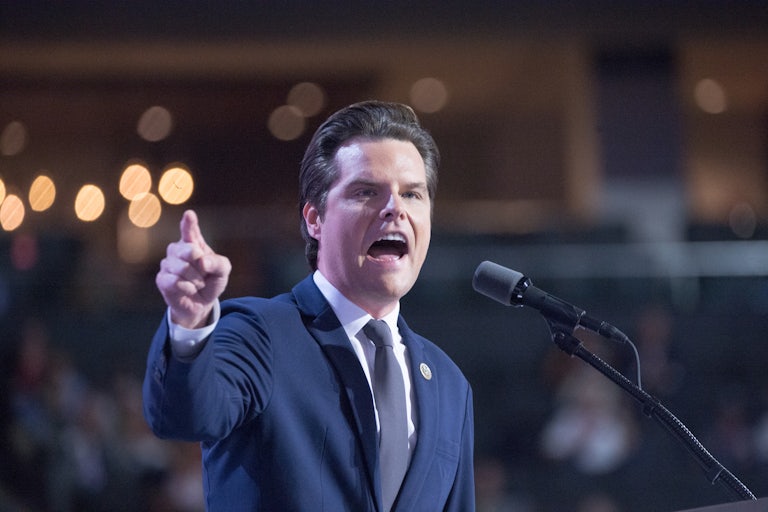
Matt Gaetz speaks into a microphone during the Republican National Convention
Jacek Boczarski/Anadolu/Getty Images

The Justice Department’s three-year investigation into Matt Gaetz uncovered a web of payments to women who testified they were paid for sex by the ex-Florida lawmaker.

Gaetz sent roughly $10,000 to at least two women who were involved in sex parties he attended between 2017 and 2020, according to the document obtained by The New York Times.

The 42-year-old Floridian—who on Thursday dropped out of the running as Donald Trump’s nominee for attorney general—has faced two federal investigations in recent years related to sex trafficking allegations as well as claims that he had sex with an underage girl. The Justice Department’s investigation fizzled out in 2023, resulting in no formal charges against Gaetz (although this does not indicate his innocence, as Gaetz has claimed). Meanwhile, a House Ethics Committee probe into the controversial politico was crushed last week when Gaetz suddenly resigned from his House position following his nomination to lead the Justice Department.

Among the individuals who indirectly received payments from Gaetz was a 17-year-old girl, according to the document.

An attorney representing the two women told lawmakers that Gaetz issued payments using Venmo, while one of the women testified that she personally saw Gaetz having sex with a minor at a party in 2017.

In February, a woman involved in the House Ethics Committee investigation said that she received payments to attend multiple sex parties with people in Gaetz’s circle. While testifying under subpoena to U.S. attorneys investigating Gaetz in 2021, the unidentified woman handed over texts, photographs, and other evidence, according to her attorney.

The woman’s name appeared across several Venmo transactions, tallying up nearly $2,500 between March and July 2017 through Gaetz’s former friend Joel Greenberg, who was later convicted of sex trafficking an underage girl.

The woman’s decision to speak out and come forward was an arduous and taxing one, according to her attorney. In the spring of 2021, a Gaetz associate allegedly berated her over whether she had spoken to anyone investigating the Floridian—a tactic that she interpreted as a pressure campaign to keep her quiet. Gaetz has repeatedly denied any wrongdoing.

The accusations against Gaetz came to light during a DOJ investigation into Greenberg, a former tax collector for Seminole County, Florida. The initial probe also named Gaetz, who Greenberg claimed had paid him via Venmo in order to have sex with an underage girl in 2017.

Eight months after Greenberg warned Gaetz to “steer clear” of the girl, the lawmaker Venmo’d Greenberg $900 in back-to-back payments, per The Daily Beast, telling the taxman to “hit up” the girl on his behalf. At that point, she was five months past her 18th birthday, while Gaetz had just turned 36.

“This purposeful leaking of classified investigative materials is the sort of politicized D.O.J. weaponization that Matt Gaetz will end,” Steven Cheung, Trump’s communications director, told the Times when asked about the payment chart. “The Justice Department investigated Gaetz for years, failed to find a crime and are now leaking material with false information to smear the next attorney general.”

This story has been updated.

Matt Gaetz Drops AG Nom—and May Accidentally Screw Himself in Process

Matt Gaetz has withdrawn his candidacy for Donald Trump’s attorney general.

Matt Gaetz is seen in profile while walking next to JD Vance
Tom Williams/CQ-Roll Call, Inc/Getty Images

Matt Gaetz rescinded his nomination to become Donald Trump’s attorney general on Thursday, writing in a statement that he believed his confirmation would become a “distraction” from Trump’s second administration.

“I had excellent meetings with Senators yesterday,” Gaetz wrote on X. “I appreciate their thoughtful feedback—and the incredible support of so many. While the momentum was strong, it is clear that my confirmation was unfairly becoming a distraction to the critical work of the Trump/Vance Transition.

“There is no time to waste on a needlessly protracted Washington scuffle, thus I’ll be withdrawing my name from consideration to serve as Attorney General. Trump’s DOJ must be in place and ready on Day 1,” Gaetz continued. “I remain fully committed to see that Donald J. Trump is the most successful President in history. I will forever be honored that President Trump nominated me to lead the Department of Justice and I’m certain he will Save America.”

Trump nominated the remarkably unpopular Florida politico to become the country’s attorney general last week, a decision that would have effectively handed the keys to the Justice Department to a man facing sex trafficking allegations.

But Gaetz’s confirmation seemed increasingly unlikely in the days since his nomination. He faced immense opposition from inside his own party at a time when any of Trump’s nominees for his upcoming Cabinet can only afford to lose three Republican votes during their Senate confirmation process.

By Friday, estimates from inside the upper chamber predicted that Gaetz could face anywhere from 12 Republican “no” votes to upward of 30, reported The Wall Street Journal.

Gaetz resigned from Congress last week after his nomination was announced, abruptly crushing a House Ethics Committee probe investigating reports that Gaetz had sex with an underage girl.

He reportedly pulled his nomination Thursday just minutes after CNN reached out to the ex-lawmaker for comment on a bombshell revelation that the Ethics Committee had been notified of a second sexual encounter between Gaetz and the same 17-year-old.

In a statement following Gaetz’s withdrawal, Trump said he had “much respect” for the Florida politician for minimizing the distraction and predicted Gaetz would have a “wonderful future.”

Gaetz’s withdrawal from consideration for attorney general now leaves him completely out of power. He could attempt to run in his district’s special election to recoup his lost seat in the House, though it’s unclear if doing so would reignite the Ethics investigation into his alleged misconduct.

This story has been updated.

MTG Gets Key New Role With Elon Musk and Vivek Ramaswamy’s Department

The worst person you know will head up a new House subcommittee.

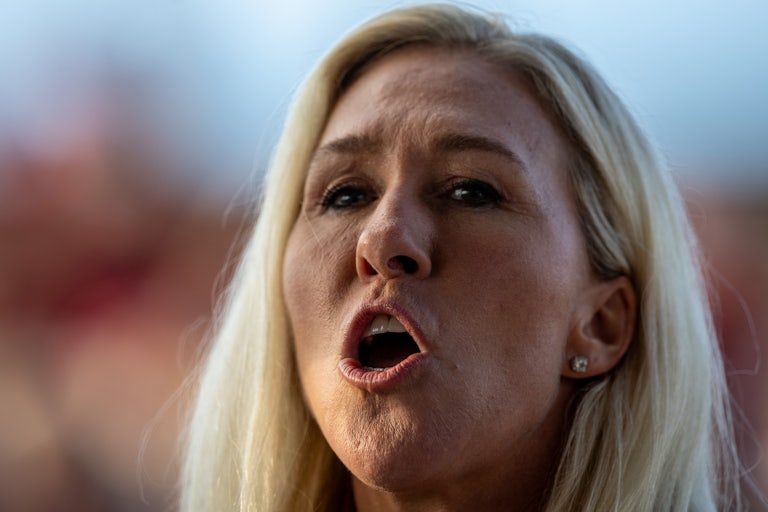
Marjorie Taylor Greene looks angry
John Moore/Getty Images

The Republican-led House Oversight Committee announced plans Thursday to form a new subcommittee to work alongside the Department of Government Efficiency, or DOGE, the meme-based advisory group led by right-wing propaganda czar Elon Musk and failed presidential candidate Vivek Ramaswamy.

The subcommittee will be headed by the person least interested in actually governing in all of Congress: Georgia Representative Marjorie Taylor Greene, a source familiar told Fox News Digital.

The proposed House subcommittee is expected to investigate government spending and organization in federal agencies, posturing as if it will slash bureaucratic “red tape” while actually making it much harder for the government to get anything done at all.

Ramaswamy confirmed to Fox News Digital that he had met with House Oversight Committee Chair James Comer and Greene to discuss the new subcommittee.

“Looking forward to working together with Congress,” Ramaswamy wrote in a post on X Wednesday. “Proper oversight of agencies & public transparency are critical.”

Musk and Ramaswamy published an op-ed about their plans for the department on Wednesday, outlining their scheme to slash the federal budget and the essential services it provides—such as public broadcasting, Planned Parenthood, and Medicare and Medicaid—with the hopes of cutting government spending by $2 trillion by July 2026 to make life more expensive and miserable for every single U.S. citizen, while private companies and billionaires get rich selling those products that were once provided by the government.