Breaking News
Breaking News
from Washington and beyond

New Details of Meta’s Rule Change Give Away Zuckerberg’s Whole Game

Mark Zuckerberg is only trying to please one person.

A photo of Mark Zuckerberg is seen behind a phone screen displaying Meta’s logo
Drew Angerer/AFP/Getty Images

Mark Zuckerberg’s decision to do away with Meta’s third-party fact-checking service was presented as a sweeping cultural change across the company’s platforms—but apparently, its new policy will apply only in the United States.

Globo, a Brazilian news outlet, reported Tuesday that Meta had responded to some concerns from Brazil’s Attorney General’s Office about whether the company’s rightward policy shift would comply with the country’s legal requirements to combat racism and homophobia. The change, among other things, will allow for the spread of misinformation and “opinions” on issues such as gender and immigration.

Meta assured Brazil’s lawyers that the company’s return to its “roots around free expression” was limited to its country of origin: the U.S. Seems like those roots didn’t go very far at all.

Meta’s third-party fact-checking program will continue in other countries, while the company tests its community notes system. The company said that it would continue to remove posts that contain misinformation when that misinformation might cause bodily harm or interfere in political processes such as elections. Meta insisted that it was “committed to respecting human rights” and “freedom of expression,” according to Globo.

This is all well and good but sure does make it seem like Zuckerberg’s sweeping announcement was meant to cater to a particular moment in America—specifically, Donald Trump’s return to the White House next week.

Zuckerberg’s spineless posturing seems to be working: He’s won himself a spot next to Trump’s Cabinet appointees, Elon Musk, and Jeff Bezos at the inauguration ceremony next Monday.
Trump Will Have a Shocking Entourage at His Inauguration

Donald Trump has fully embraced tech billionaires this presidency.

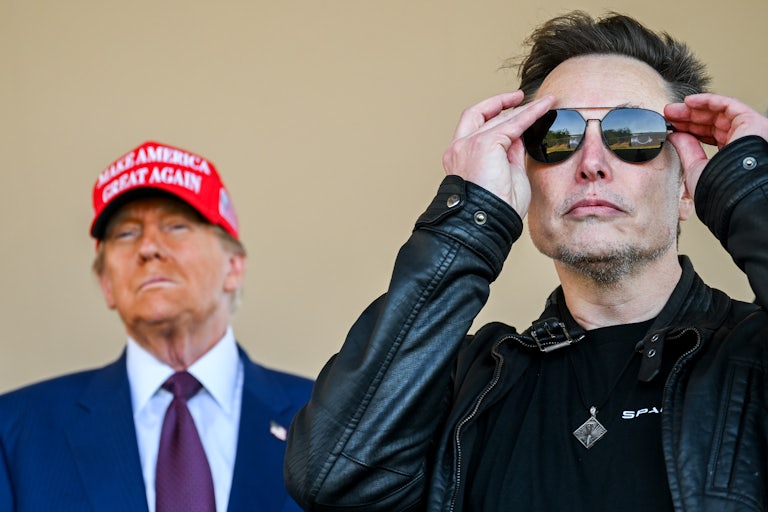
Musk and Trump
Brandon Bell/Getty Images

Silicon Valley is apparently all in on Donald Trump’s forthcoming presidency.

World’s-richest-man Elon Musk, Meta CEO Mark Zuckerberg, and Amazon chief Jeff Bezos are slated to attend the forty-seventh president’s inauguration next week, according to NBC News. The tech trio will be seated alongside elected officials and Trump’s Cabinet selections.

The industry leaders—and their respective companies—have opportunistically caved to the incoming president’s politics since he won in November, in an apparent bid to curry favor with the executive.

Trump’s second term could prove to be a new leaf for the tech industry, which faced heightened scrutiny under President Joe Biden’s administration. Meta, Google, Amazon, and several other tech giants have faced blowback from antitrust regulators critical of the industry’s biggest monopolies over the last four years. The government also sought to tighten regulations on a bubbling AI industry.

Rapid developments in tech are already proving to be a major strain on the nation’s infrastructure: In August, taxpayers in Texas paid Riot Platforms $31 million not to mine bitcoin in an effort to stave off rolling blackouts and spare the state’s electric grid.

The tech industry’s support has helped Trump best his 2017 inaugural fundraising records, raising more than $170 million ahead of next week’s presidential celebration. A coalition of top tech heads, including Zuckerberg, Bezos, Apple’s Tim Cook, Google’s Sundar Pichai, and OpenAI’s Sam Altman, all pledged $1 million to Trump’s inauguration fund.

Meanwhile, Musk has further ingratiated himself into Trump’s sphere, effectively bankrolling the 78-year-old’s pathway back to the White House with a $250 million donation. That earned Musk nearly unfettered access to Trump, as well as a not-yet-real position co-chairing the not-yet-authorized Department of Government Efficiency, or DOGE.

But the sudden ingratiation hasn’t come without issue in Trumpworld: Over the weekend, Trump’s former chief White House strategist Steve Bannon lambasted Musk as a “truly evil guy” whom he planned to force out of the MAGA leader’s sphere by Inauguration Day.

Read more about Trump’s new relationship with Silicon Valley:

Trump’s Defense Pick Embarrasses Himself in Basic Geography Question

Pete Hegseth quickly proved in his confirmation hearing how unqualified he is to be U.S. defense secretary.

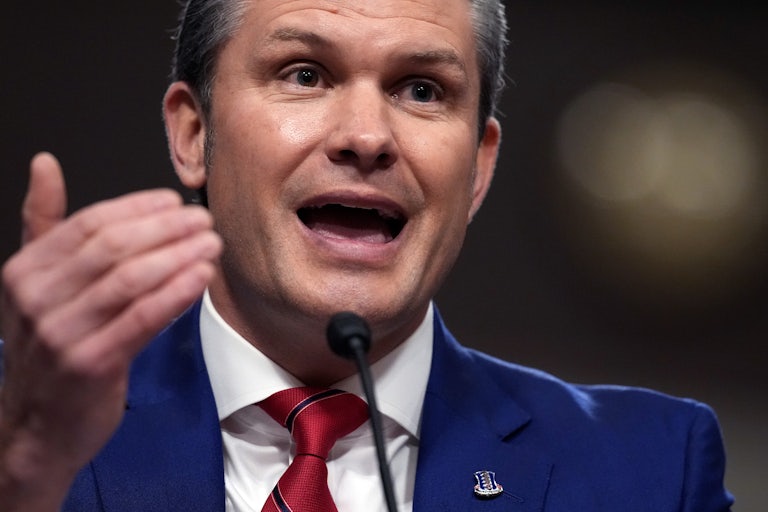
Pete Hegseth in his confirmation hearing
Andrew Harnik/Getty Images

Pete Hegseth, Donald Trump’s nominee for defense secretary, was unable to name a single country in the Association of Southeast Asian Nations during his confirmation hearing Tuesday—even naming Australia instead.

Senator Tammy Duckworth asked Hegseth to speak to the importance of the political and economic alliance, in an effort to make a point of how unqualified he was to lead the Pentagon and its massive workforce.

“You talked about the Indo-Pacific a little bit.… Can you name the importance of at least one of the nations in ASEAN, and what type of agreement we have with at least one of those nations? And how many nations are in ASEAN, by the way?

“I couldn’t tell you the exact amount of nations in that, but I know we have allies in South Korea, and Japan, and in AUKUS with Australia, [we] work on submarines with them …”

“Mr. Hegseth none of those countries are in ASEAN. None of those three countries that you’ve mentioned are in ASEAN,” Duckworth replied. “I suggest you do a little homework before you prepare for these types of negotiations.”

“This might seem like a small, embarrassing gotcha, but ASEAN is an acronym you encounter a lot if you do even very basic reading about the Pentagon’s strategy to counter China,” Yahoo’s Jordan Weissman wrote on X.

ASEAN consists of Brunei, Cambodia, Indonesia, Laos, Malaysia, Myanmar, the Philippines, Singapore, Thailand, and Vietnam. The United States regularly conducts joint military exercises with the member states.

Trump’s Defense Pick Proudly Admits the Rules Won’t Apply to Him

Pete Hegseth used his confirmation hearing to confess he’ll be as corrupt as it gets.

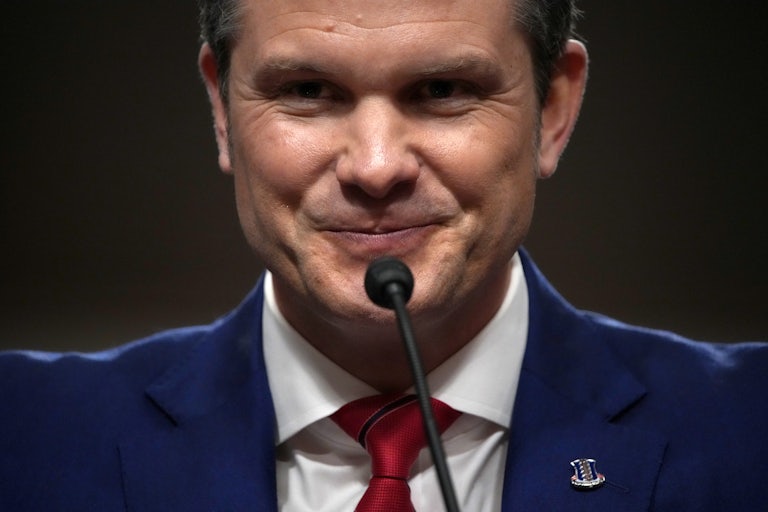
Pete Hegseth smiles in his confirmation hearing
Andrew Harnik/Getty Images

During his confirmation hearings for secretary of defense Tuesday, Pete Hegseth was asked about cashing in from the defense industry—and refused to give a straight answer.

Senator Elizabeth Warren pointed out that Hegseth had previously written that after generals retire from the military, they “should be banned from working for the defense industry for 10 years,” noting that she agrees with Hegseth “on the corrosive effects of the revolving door of the Pentagon and defense contractors.”

Warren then asked Hegseth, “Will you put your money where your mouth is and agree that when you leave this job you will not work for the defense industry for 10 years?”

At first, Hegseth tried to deflect, saying that “it’s not even a question I’ve thought about.” Warren pressed him further.

“My motivation for this job has never been about what could conceivably come next,” Hegseth replied, appearing to carefully weigh his words. Warren then asked point-blank for a yes or no answer, and Hegseth refused.

“I would consult with the president about what the policy should be at the Defense Department,” Hegseth said, and Warren was incredulous.

“In other words, you are quite sure that every general who serves should not go directly into the defense industry for 10 years. You’re not willing to make that same pledge?” the Massachusetts Democrat asked.

“I’m not a general, senator,” Hegseth replied, pointedly leaving the door open for a plum job from the defense industry in the future and drawing laughs in the hearing room.

“So you are saying, sauce for the goose but certainly not sauce for the gander?” Warren asked, with Hegseth again saying he’d have to see what the policy is, to which Warren replied, “Oh, I’ll bet you would.”

It’s a clear and obvious admission that Hegseth, now that he’s close to heading the Department of Defense, can see dollar signs down the road in the defense industry that he’s previously criticized. It’s another example of Hegseth backtracking on his earlier statements and writings in Tuesday’s hearing, but, in this case, on something that was actually a good idea.

Trump Makes Government More Efficient by Inventing Stupid New Agency

Make government efficient again.

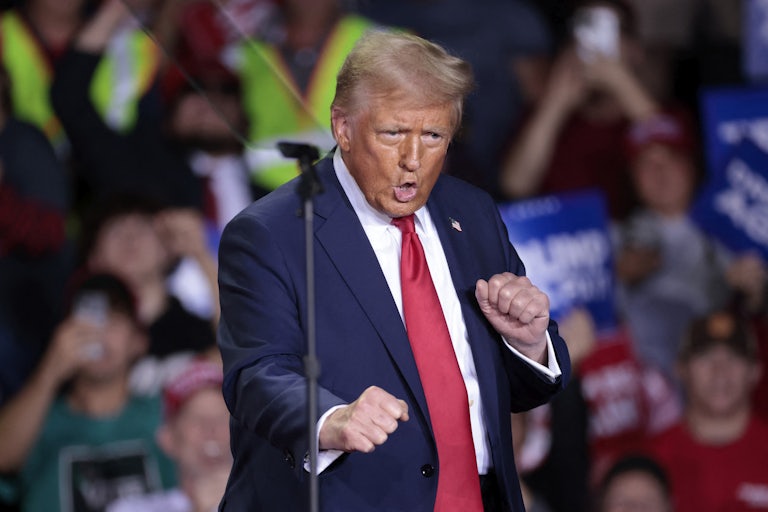
Donald Trump dances on stage
Jeff Kowalsky/AFP/Getty Images

Donald Trump announced Tuesday that he wants to invent a totally redundant federal statutory body.

“For far too long, we have relied on taxing our Great People using the Internal Revenue Service (IRS). Through soft and pathetically weak Trade agreements, the American Economy has delivered growth and prosperity to the World, while taxing ourselves. It is time for that to change,” Trump wrote in a post on Truth Social Tuesday.

“I am today announcing that I will create the EXTERNAL REVENUE SERVICE to collect our Tariffs, Duties, and all Revenue that come from Foreign sources. We will begin charging those that make money off of us with Trade, and they will start paying, FINALLY, their fair share. January 20, 2025, will be the birth date of the External Revenue Service. MAKE AMERICA GREAT AGAIN!”

For a guy interested in shrinking the size of government, Trump sure keeps adding to it. The U.S. already has a way of setting and collecting tariffs, but to Trump’s credit, it never had a stupid name before. After the secretary of the treasury establishes regulations, U.S. Customs and Border Protection—housed within the Department of Homeland Security—is responsible for administering the tariffs at U.S. ports of entry. The money is then deposited into the General Fund of the United States.

Trump has promised to enact 25 percent tariffs on all Mexican and Canadian goods on his first day in office—an economic show of force he clearly thinks could result in the annexation of Canada—and another 10 percent tariff on imports from China.

While Trump is at it, he could invent several other badly named governmental bodies to carry out his administration’s insipid agenda. Here are some humble suggestions:

  1. Consumer Product Danger Commission: Determines whether products are getting too woke.
  2. Environmental Defenselessness Agency: Ensures that the U.S. government can do whatever it wants to protected lands for the sake of endless production and accumulation of capital.
  3. Anti-Social Security Agency: Destabilize Social Security by cutting payroll taxes. Hell, maybe take the whole thing private?

In any case, this whole thing feels eerily similar to his pitch to rename the Gulf of Mexico the “Gulf of America.” A purely aesthetic change that Trump imagines will build his legacy as a powerful leader—and not a global laughingstock.