Breaking News
Breaking News
from Washington and beyond

These Two Planned Trump Pardons Are His Most Dangerous Yet

Donald Trump is planning to pardon a slew of January 6 protesters.

Oath Keepers leader Stewart Rhodes and Proud Boys leader Enrique Tarrio
Aaron C. Davis/Joe Raedle/Getty Images

President Donald Trump plans to pardon people convicted for participation in the January 6 Capitol riot, which may include two of its organizers: Stewart Rhodes, the founder of the Oath Keepers, and Enrique Tarrio, the former leader of the Proud Boys, ABC News reported Monday.

Rhodes and Tarrio were both convicted for seditious conspiracy, a Civil-War era charge, and were sentenced to 18 years and 22 years in prison, respectively. Tarrio’s sentence was the longest of any January 6 defendant.

Federal prosecutors previously described Tarrio as the driving force behind the masses of self-described “Western chauvinist” Proud Boys who arrived in Washington on January 6. Several of his organization’s leaders were the first to enter the U.S. Capitol. Earlier this month, Tarrio requested a pardon from prison via his lawyer.

In addition to pardoning those who have already been convicted, the Justice Department is also expected to dismiss cases that have not yet gone to trial, a Trump transition official told CNN.

This sets a disturbing precedent that the president could potentially push to dismiss any charges placed against his supporters—even the most dangerous.
Trump Uses His Real Inauguration Speech to Swear Revenge on Enemies

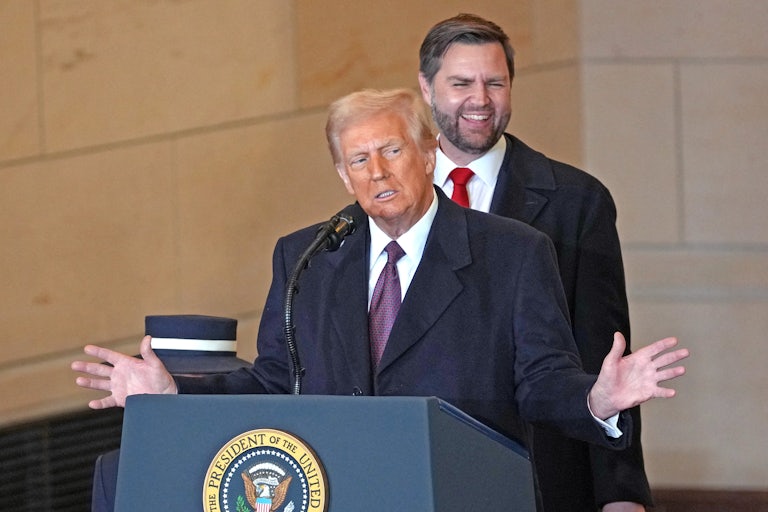
Donald Trump gave a dark, rambling speech after his official (and very dark) inaugural address.

Donald Trump gestures while speaking at a podium after his inauguration
Bonnie Cash/AFP/Getty Images

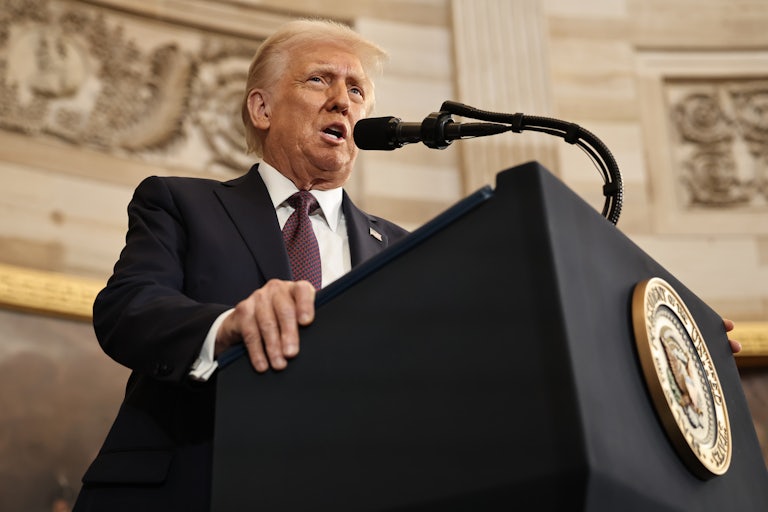
Donald Trump’s inaugural address Monday showcased an unusually refined version of the MAGA leader on the cusp of his presidency: it toiled over the economy and immigration, promising to bring America into a “golden age.”

But Trump’s unscripted second speech to a throng of his supporters served as his cutting room floor, sharing all the gripes that his script writers implored him not to dish. Seemingly unrehearsed and riddled with grammatical errors, Trump’s second speech of the day was remarkably more like him.

Trump ripped into a cohort of his so-called enemies, torching former House Speaker Nancy Pelosi for supposedly allowing his supporters to tear through the Capitol Building on January 6, 2021.

“She’s guilty as hell,” Trump said, claiming he had promised to send 10,000 soldiers to the complex that day—despite the fact that multiple witnesses said Trump watched TV and stood by doing nothing as his supporters hunted and chanted death threats for Pelosi and former Vice President Mike Pence. “Maybe she wanted that to happen,” Trump wondered aloud.

“If you did that civilly, that would be a criminal offense,” Trump continued, blaming the former House speaker for failing to thwart some of his most ardent and violent supporters. (You cannot be charged with a criminal offense in a civil case, though a civil case can launch a companion criminal investigation.)

Trump also complained about former Representative Liz Cheney and other members of the House January 6 investigative committee. “Why are we helping some of the people—why are we helping Liz Cheney? She’s a crying lunatic,” Trump rambled.

And minutes after Trump was sworn in, a portrait hanging in the Pentagon of former Joint Chiefs Chairman General Mark Milley—who refused Trump’s orders to send the military to crush protesters in Washington in the wake of George Floyd’s death, and who has since referred to Trump as a “fascist” and a “wannabe dictator”—was suddenly stripped from the wall. (President Joe Biden preemptively pardoned Milley on Monday, saving him from the Trump administration’s litigious ire.)

Trump has repeatedly promised to enact revenge on individuals he deemed to be “enemies of the state.” In the weeks leading up to the election, former Trump White House Deputy Press Secretary Sarah Matthews warned that the ex-reality TV star had morphed from someone with a vision for America into a vindictive far-right ideologue “hellbent on revenge and retribution.”

Trump Promises to Rename Gulf of Mexico on Day One as President

Donald Trump plans to sign the pettiest executive order.

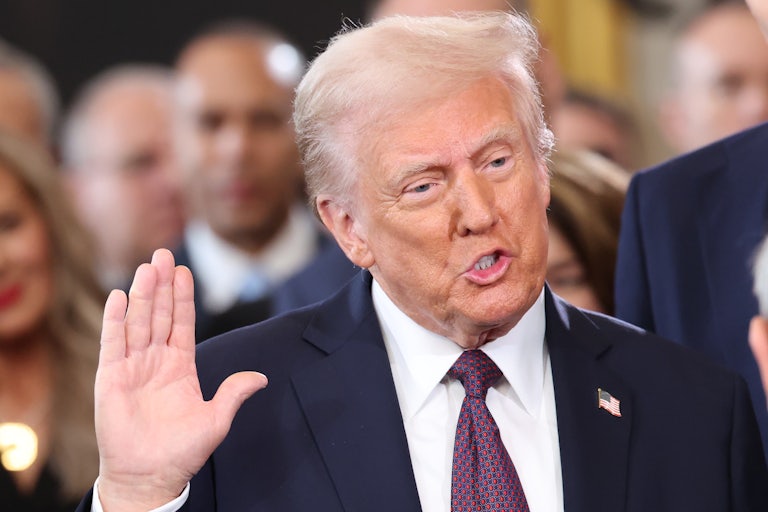
Donald Trump raises a hand as if swearing
Kevin Lamarque/Pool/Getty Images

Donald Trump will rename the Gulf of Mexico and Mount Denali by executive order in one of his first acts as president. 

The news broke shortly before he was sworn in Monday morning, and Trump confirmed it during his inaugural address. The order will rename the Gulf of Mexico to the Gulf of America, and Mount Denali to Mount McKinley, which was the official name recognized by the federal government from 1917 until 2015. 

Trump first announced his plans to rename the gulf nearly two weeks ago in a rambling press conference, saying, “We’re gonna be changing the name of the Gulf of Mexico to the Gulf of America…. What a beautiful name. And it’s appropriate…. Mexico has to stop allowing millions of people to pour into our country. They can stop them.”

Not long after that declaration, Mexican President Claudia Sheinbaum held a news conference of her own where she asked, “Why don’t we call it Mexican America? It sounds pretty, no?”

Denali is the tallest mountain in North America, and gained its name from the Koyukon Athabaskans, the original inhabitants of Alaska. A gold prospector gave it the name McKinley in 1896 as a show of support for William McKinley, who was running for president at the time, and the federal government made the name official in 1917. In 1975, the state of Alaska sought to have the name changed, only to be blocked by Ohio politicians supporting their native son McKinley. 

In 2015, President Obama officially renamed the mountain to what Alaska natives had called it for centuries. Last month, though, Trump told supporters in a speech in Arizona that he would  “bring back the name of Mount McKinley because I think he deserves it.”

Trump could also be making the move because he wants to stick it to Obama, or because he admires McKinley’s imperialism. In any case, changing both names will be costly to U.S. taxpayers, and serve no strategic purpose whatsoever. It’s the first of likely many more pointless moves in the new Trump administration.

Trump Uses Inauguration to Vow New Frontier in Manifest Destiny

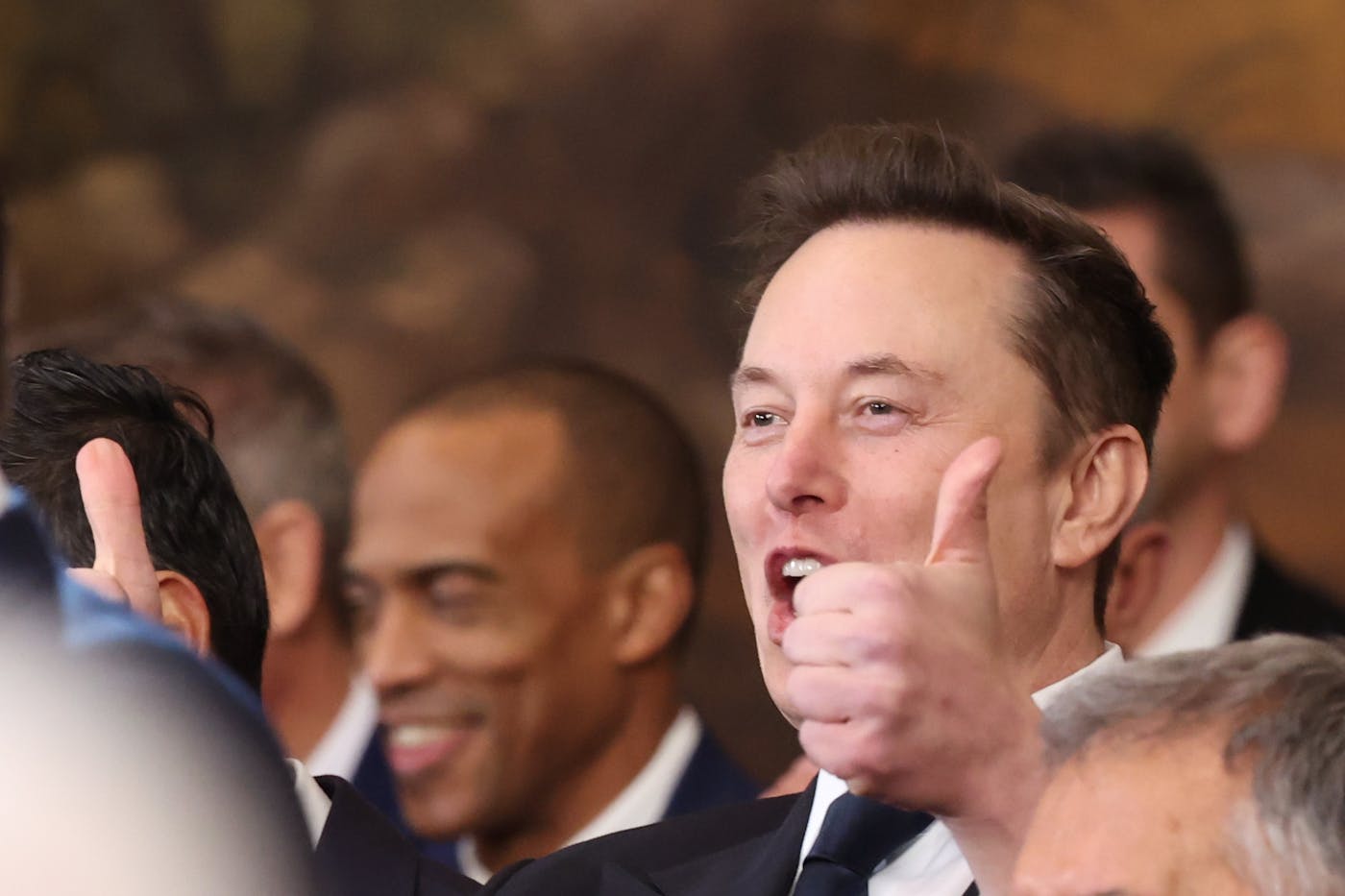
Elon Musk gave Donald Trump two thumbs up during this portion of his inauguration speech.

Elon Musk at the presidential podium on Inauguration Day
Chip Somodevilla/Getty Images

Trump wants to carry out another “manifest destiny” —but this time on Mars..

“We will pursue our manifest destiny into the stars, launching American astronauts to plant the stars and stripes on the planet Mars,” the newly inaugurated president said on Monday to the audience gathered in the Capitol Rotunda, who reacted to his comments with a standing ovation. “Ambition is the lifeblood of a great nation. And right now our nation is more ambitious than any other. There’s no nation like our nation.”

“Manifest destiny” was the violent, presumptuous 19th century idea that white American settlers had some religious obligation to seize Native land in the West, to convert Native Americans to Christianity, and to exploit the region’s ample resources.

Trump’s Mars pledge elicited a huge grin and enthusiastic double thumbs up from billionaire and top Mars colonization enthusiast Elon Musk, who has been pushing his Mars colony agenda for nearly a decade via his SpaceX company.

Elon Musk gives two thumbs up and cheers
Kevin Lamarque/Pool/Getty Images

Trump Reveals His True Priority in Weird Inauguration Speech Pivot

Donald Trump took a moment to reflect on the devastating impact of the Los Angeles fires.

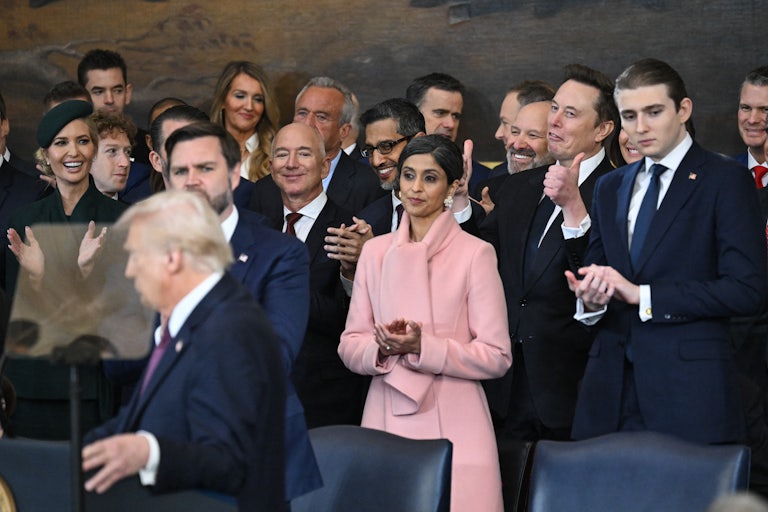
CEOs Jeff Bezos, Sundar Pichai, and Elon Musk stand behind Donald Trump as he speaks at his inauguration
Saul Loeb/AFP/Getty Images

Donald Trump used his inauguration speech to whine about tech billionaires’ homes being burnt down. 

During his address Monday, Trump whined about the federal government’s response to natural disasters. 

“Our country can no longer deliver basic services in times of emergency,” he groused. 

Trump cited people in North Carolina still struggling from the aftermath of Hurricane Helene. In Los Angeles, “we are watching fires still tragically burn from weeks ago without even a token of defense,” Trump said. 

“They’re raging through the houses and communities, even affecting some of the wealthiest and most powerful individuals in our country. Some of whom are sitting here right now,” Trump said, smiling slightly at the reminder of his Silicon Valley invites, Elon Musk, Mark Zuckerberg, Jeff Bezos, and Sundar Pichai. 

“They don’t have a home any longer,” Trump mused. “That’s interesting.”

In fact, not a single one of these men appear to have lost their home in the Los Angeles wildfires. 

Crucially, these aren’t the kinds of guys who can lose a lot by losing just one residence: each one owns an extensive property portfolio worth hundreds of million dollars. Bezos’s is worth $500 million, and Zuckerberg’s is $200 million. Meanwhile, Musk owns several properties, though his primary home is a $50,000 tiny home in Texas, near SpaceX’s headquarters. So maybe the president could save his tears for the people who have lost their actual homes.  

Rather than actually acknowledging the devastating and widespread impacts of natural disasters, Trump’s comment merely suggests his special affinity for tech billionaires. After all, it’s Trump and his fellow Republicans who are ensuring those affected by the wildfires stay struggling by insisting that no disaster aid will be provided to California until the state agrees to reinstall Trump-era policies.