Breaking News
Breaking News
from Washington and beyond

Tulsi Gabbard Torched for Claiming No Classified Intel Shared in Chat

Senators Mark Kelly and Angus King grilled Gabbard over what exactly was sent in the war plans group chat.

Tulsi Gabbard walks out of a Senate Intelligence Committee hearing
Kent Nishimura/Bloomberg/Getty Images

The Trump administration’s deny, deny, deny tactic to brush off its Signal chat scandal about airstriking another country is starting to make its own officials look wildly uninformed.

Members of Trump’s Cabinet accidentally added The Atlantic’s editor in chief, Jeffrey Goldberg, to a Signal chat regarding sensitive details of a plan to bomb Houthis in Yemen earlier this month.

And during a prescheduled Senate hearing Tuesday to discuss national security threats, National Intelligence Director Tulsi Gabbard’s repeated efforts to shirk the classified label only made the intelligence leader appear increasingly uninformed or blind to the core principles of her job.

Senator Angus King torched Gabbard for conducting such sensitive business on an unofficial channel via a private company, strongly disagreeing with the national intelligence leader’s definition of classified information.

“Secretary Hegseth put into this group text a detailed operation plan, including targets, the weapons we were going to be using, attack sequences, and timing, and yet you’ve testified that nothing in that chain was classified. Wouldn’t that be classified?” asked King, referring to Defense Secretary Pete Hegseth. “What if that had been made public that morning, before the attack took place?”

But Gabbard opted to dodge the question.

“Senator, I can attest to the fact there were no classified or intelligence equities that were included in that chat at any time,” Gabbard said.

“So the attack sequencing, and timing, and weapons, and targets, you don’t consider should have been classified?” King pressed.

“I defer to the secretary of defense and the National Security Council,” Gabbard answered.

“Well, you’re the head of the intelligence community,” King scoffed. “You’re supposed to know about classifications.”

King then argued that if the information is not classified, the entire text thread should be released to the American public so that they could draw their own conclusions about the Trump administration’s behavior.

In another heated exchange with Senator Mark Kelly, Gabbard refused to say that details regarding a potential strike on another country would constitute classified information. Instead, CIA Director John Ratcliffe threw Gabbard under the bus, capitulating that a “pre-decisional strike deliberation” should be conducted through “classified channels.”

Continuing to deny that the chat ever took place—or that a journalist that Trump officials have derided as “deceitful and highly discredited” was accidentally sent sensitive details—won’t do the administration any good. A spokesperson for the National Security Council, Brian Hughes, already confirmed to Goldberg that the chat was real.

The monumental slipup was a horrific omen for U.S. national security, whose weakest link is apparently a crew of Cabinet members who can’t accomplish the basic due diligence of double-checking who they’re adding to a group chat hosted by a private company.
CIA Head Has Shocking Answer When Asked if Group Chat Was “Mistake”

John Ratcliffe immediately panicked over his own answer to the question.

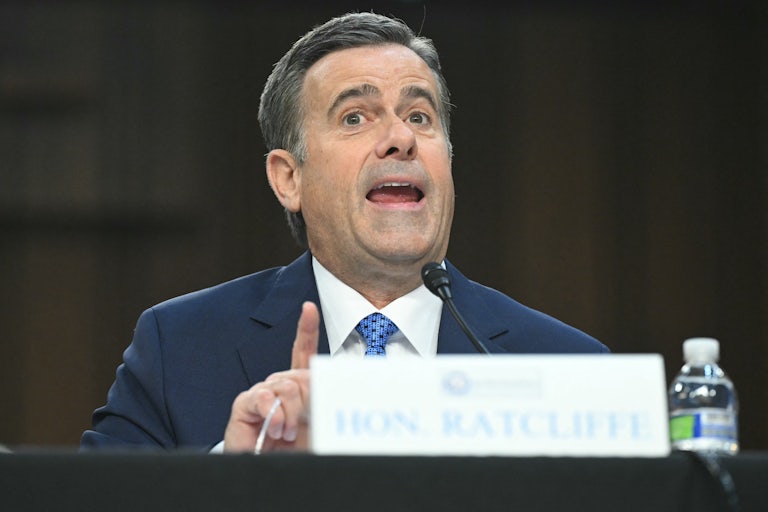
CIA Director John Ratcliffe holds up his finger while speaking during a Senate Intelligence Committee hearing
Saul Loeb/AFP/Getty Images

CIA Director John Ratcliffe flailed Tuesday when asked one simple question about the Trump administration’s major national security scandal.

During a Senate Intelligence Committee hearing, Ratcliffe and other intelligence officials faced tough questions about a Signal chat Cabinet members used to discuss sensitive details of a plan to bomb Houthis in Yemen earlier this month—which accidentally included The Atlantic’s editor in chief, Jeffrey Goldberg.

Unlike the more reticent Director of National Intelligence Tulsi Gabbard, Ratcliffe dove straight off a sinking ship and readily admitted to participating in the group chat. He insisted that the CIA was permitted to use Signal.

But Ratcliffe crumbled when asked a straightforward question by Senator Jon Ossoff.

“Director Ratcliffe, this was a huge mistake, correct?” the Georgia Democrat asked.

There was a silence before Ratcliffe responded, shaking his head. “No,” he said.

There was another long silence in the chamber as Ratcliffe’s answer started to sink in. It seemed Ratcliffe wanted so badly not to be in trouble that, somehow, including a journalist in sensitive discussions of strike plans wasn’t even a mistake? At once, Ossoff continued, and Ratcliffe attempted to make sense of his unbelievably poor response.

“A national political rep—no, no you hold on,” Ossoff said, over Ratcliffe’s pleas of, “Hold on, let me answer!”

“No, no Director Ratcliffe, I asked a simple yes or no question, and now you hold on,” Ossoff said. “A national political reporter was made privy to sensitive information about imminent military operations against a foreign terrorist organization, and that wasn’t a huge mistake? That wasn’t a huge mistake?”

As Ossoff spoke, Ratcliffe continued to limply defend himself. “You can characterize it how you want,” Ratcliffe said of the “inadvertent mistake of adding a reporter.”

“I think that they characterized it as a mistake,” Ratcliffe finally said, defeated.

“This is an embarrassment. This is utterly unprofessional. There’s been no apology. There has been no recognition of the gravity of this error. And by the way, we will get the full transcript of this chain, and your testimony will be measured carefully against its content,” Ossoff said.

During Thursday’s hearing, Gabbard insisted that there had been no classified information sent in the group chat, though Goldberg reported that there had been information that, if “read by an adversary of the United States, could conceivably have been used to harm American military and intelligence personnel, particularly in the broader Middle East, Central Command’s area of responsibility.”

CIA Director Panics When Asked Who Added Reporter to Group Chat

John Ratcliffe fell apart when asked in a Senate hearing why America’s CIA director couldn’t spot a reporter in his text messages.

CIA Director John Ratcliffe testifies in Congress.
Kent Nishimura/Bloomberg/Getty Images

Senator Michael Bennet and CIA Director John Ratcliffe got into an intense back-and-forth over how exactly the editor in chief of The Atlantic got added to a Signal chat in which top defense leaders were debating an attack on the Houthis in Yemen.

“Please answer the question, don’t … insult the intelligence of the American people,” Bennet said at a Senate hearing on security threats on Tuesday. “Did [Goldberg] invite himself to the Signal thread?”

“I don’t know how he was invited, but clearly—” Ratcliffe said before being interrupted.

“Clearly it was?” Bennet said. “Finish your sentence please.”

“Clearly he was added to the Signal group, your question is—”

“So you don’t know that the president’s national security adviser invited [Goldberg] to join the Signal thread? Everybody in America knows that. Does the CIA director not know that?”

“I’ve seen conflicting reports about who added the reporter to the Signal messaging group,” Ratfcliffe waffled.

“You think that it’s perfectly appropriate that there was a reporter added—especially one that the secretary of defense says is ‘deceitful, highly discredited, a so-called journalist who’s made a profession of peddling hoaxes over and over again’—is your testimony that it was appropriate that he was added to this Signal thread?”

“No, of course not,” Ratcliffe replied.

“Why did you not—”

“Now hold on Senator, you are mischaracterizing my testimony—”

“You answered the question, let me ask you. When he was added to the thread—you’re the CIA director! Why didn’t you call out that he was present on the Signal thread?”

“I don’t know if you use Signal messaging app—”

“I do! Not for classified information. Not for targeting.”

“Well neither do, I, Senator, neither do I, Senator.”

“Well that’s what your testimony is today!”

“It absolutely is not, Senator, were you not listening at the beginning when I said that I was using it as permitted, and it is permissible to use.”

Ratcliffe went on to insist that the contents of the Signal were not classified—which is hard to believe given the country’s leaders were discussing attack plans on a privately owned third-party messaging app that is not approved for defense officials to use. But apparently this is the story the Trump administration is going with.

Trump Officials Ignored Major Pentagon Warning in War Plans Group Chat

The Pentagon sent out a clear warning one week before that group chat disaster.

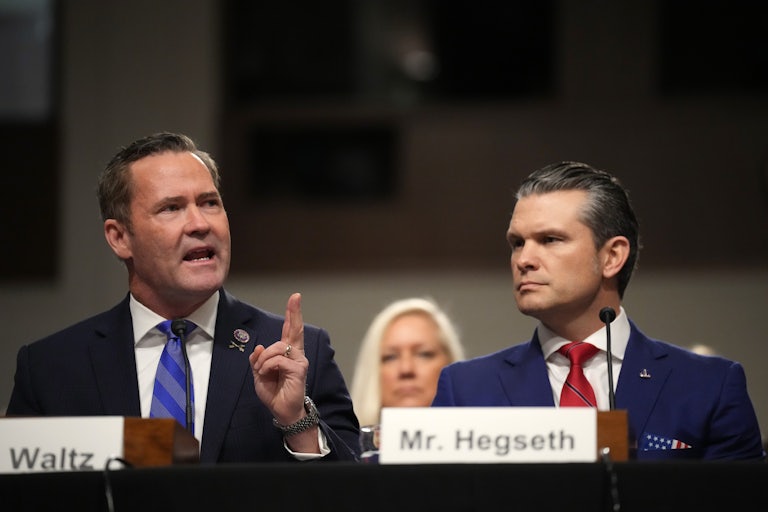
Trump national security adviser Mike Waltz and Defense Secretary Pete Hegseth testify in a congressional briefing.
Andrew Harnik/Getty Images

Secretary of Defense Pete Hegseth’s ill-advised Signal chat planning an attack on Yemen went against a Pentagon warning from last week, and even Department of Defense regulations.

According to NPR, a department-wide email went out last week warning everyone in the DOD that a vulnerability was detected in the Signal messaging app, which Hegseth, along with several other administration officials, including Vice President JD Vance, used to discuss bombing Houthi targets in Yemen.

Specifically, the email stated that “Russian professional hacking groups are employing the ‘linked devices’ features to spy on encrypted conversations,” and noted that Google identified Russian hacking groups “targeting Signal Messenger to spy on persons of interest.”

As head of the DOD, Hegseth would have undoubtedly received that email. Even if he missed it, or habitually lets his work emails pile up, he should have known that using Signal for government business is an explicit violation of DOD regulations. This raises the question as to whether Hegseth and other officials were using Signal to avoid leaving records of their communications.

“Unmanaged ‘messaging apps,’ including any app with a chat feature, regardless of the primary function, are not authorized to access, transmit, process non-public DoD information. This includes but is not limited to messaging, gaming, and social media apps. (i.e., iMessage, WhatsApps, Signal),” a 2023 department memo states.

Will Hegseth, or any of the other senior government officials in the chat group, who include Vance, Secretary of State Marco Rubio, CIA Director John Ratcliffe, and national security adviser Mike Waltz, face any accountability for using Signal to conduct national security operations, let alone any government business? Aside from violating DOD regulations, the chat may likely have been illegal.

Trump Is About to Be Pissed at Tulsi Gabbard’s Canada Admission

Gabbard struggled to defend one of Donald Trump’s main reasons for bullying Canada.

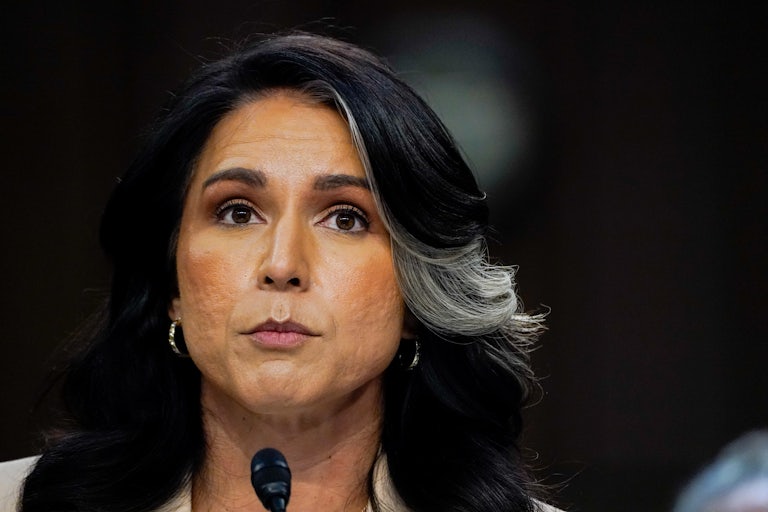
Tulsi Gabbard speaks during a Senate Intelligence Committee hearing
Kent Nishimura/Bloomberg/Getty Images

Director of National Intelligence Tulsi Gabbard absolutely—and accidentally—shredded Donald Trump’s phony reason for placing steep tariffs on Canada.

During a Senate Intelligence Committee hearing Tuesday, Gabbard presented the Annual Threat Assessment, or ATA, about the dangers state and nonstate actors pose to the United States. In her opening statement, Gabbard emphasized the presence of foreign cartels and illicit drug trafficking as the most dire threat to national security—but notably didn’t mention Canada at all.

Canada’s absence in the report presents a stark contradiction to the Trump administration’s insistence that drug trafficking across the northern border presents a major threat to Americans. Trump has cited this excuse as part of his rationale for levying 25 percent tariffs on Canadian exports.

Senator Martin Heinrich asked Gabbard to explain why she hadn’t mentioned Canada in her report.

“Is the [Intelligence Community] wrong in its omission of Canada as a source of illicit fentanyl in the ATA? I was surprised, given some of the rhetoric, that there is no mention of Canada in the ATA,” the New Mexico Democrat pressed.

“Senator, the focus in my opening and the ATA was really to focus on the most extreme threats in that area. And our assessment is that the most extreme threat related to fentanyl continues to come from and through Mexico,” Gabbard replied.

“So, the president has stated that the fentanyl coming through Canada is massive, and actually said it was an “unusual and extraordinary threat,” and that was the language that was used to justify putting tariffs on Canada,” Heinrich said. “I’m just trying to reconcile those two issues. Is it an “unusual and extraordinary threat,” or is it a minor threat that doesn’t even merit mention in the Annual Threat Assessment?”

Gabbard said she couldn’t speak to the “specifics” of the threat posed by Canadian fentanyl trafficking.

Heinrich assured her that it accounted for “less than 1 percent” of the fentanyl seized by the U.S. government. “But if you have different information, I would very much welcome that,” he said.

The Trump administration has repeatedly referred to a terrifying 2,000 percent increase in drug trafficking over the U.S.-Canada border in the last year. But the reality is much less thrilling.

In 2023, only two pounds of fentanyl were seized at the northern border, and a total of 43 pounds of fentanyl were seized in 2024, according to U.S. Customs and Border Protection. As one NBC News reporter pointed out, that’s still “less than a carry-on suitcase.”