Breaking News
Breaking News
from Washington and beyond

ICE Agents Abduct Tufts Student While Hiding Their Faces

A video shows how ICE kidnapped Tufts student Rumeysa Ozturk off the street.

Two students walk on Tufts University’s campus.
Suzanne Kreiter/The Boston Globe/Getty Images

The Trump administration is continuing its witch hunt of international students whose political views it disagrees with, this time at Tufts University.

On Tuesday evening, Rumeysa Ozturk, a Turkish Ph.D. student at Tufts University with a valid F-1 visa, was detained by Immigrations and Customs Enforcement officials while on her way to meet with friends to break her Ramadan fast, according to a statement from her lawyer.

A video of Ozturk’s kidnapping shows six ICE agents forcibly removing Ozturk’s backpack, placing her hands behind her back, and putting her in a dark-grey SUV, which then drives away. In a cowardly display of power, all of the agents covered their faces with masks.

“We are unaware of her whereabouts and have not been able to contact her,” said Ozturk’s lawyer, Mahsa Khanbabai. “No charges have been filed against Rumeysa to date that we are aware of.”

Tufts University said it was not made aware of Ozturk’s kidnapping before it happened but was later notified that her visa had been revoked.

U.S. District Court Judge Indira Talwani on Tuesday had ordered that Ozturk should not be moved out of Massachusetts “without providing advance notice of the intended move” providing reason in writing for why “such a movement is necessary.”

Last spring, Ozturk co-authored an opinion essay in the student newspaper that demanded Tufts “acknowledge the Palestinian genocide” and divest from companies tied to Israel.

“The university had no pre-knowledge of this incident and did not share any information with federal authorities prior to the event, and the location where this took place is not affiliated with Tufts University,” the statement reads. “We realize that tonight’s news will be distressing to some members of our community, particularly the members of our international community.”

Ozturk is just the latest valid visa holder to be targeted by the Trump administration for supporting Palestine. Earlier this month, Mahmoud Khalil, a graduate from Columbia University who participated in pro-Palestinian protests at the university, was unlawfully detained by ICE. DHS has since detained at least two more international students with visas for their protesting of Israel’s genocide in Gaza, a clear violation of First Amendment rights.
How Trump Snuck His Mass Deportations Past the Courts

Donald Trump’s administration has come under fire in the courts for its deportation policies.

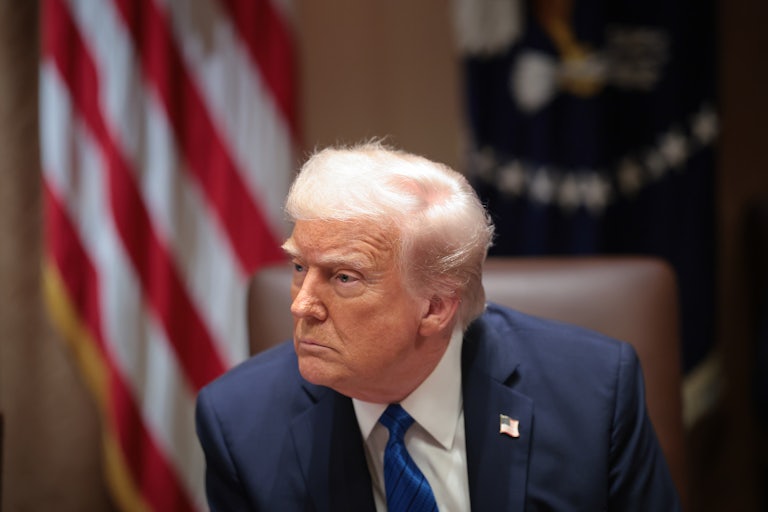
Donald Trump looks to the side while sitting in the White House
Win McNamee/Getty Images

Donald Trump’s sinister plan to deport noncitizens under the Alien Enemies Act included several steps specifically designed to help evade judicial review, Talking Points Memo reported Wednesday.

It all began weeks before the secretive deportations on March 15 took place, when Trump entered office and immediately signed an executive order labeling Venezuelan gang Tren de Aragua as a terrorist organization. This helped to set the stage for the president to invoke the Alien Enemies Act, suspending alleged members’ due process to deport them.

As soon as early February, Immigration and Customs Enforcement began arresting Venezuelan asylum-seekers. In several cases, individuals were detained at their regular check-ins with federal authorities and brought into ICE custody on the basis of their supposedly suspicious tattoos.

“From there, no further due process or examination to determine whether these people were actually TdA members appears to have taken place,” TPM reported.

The White House claimed that authorities had determined beyond a doubt that the more than 100 Venezuelans deported to El Salvador earlier were “terrorist” members of the TdA but refused to reveal operational details of how they were able to determine this. Trump’s border czar Tom Homan claimed that authorities had used social media, surveillance, sworn statements from gang members, and wire taps to determine supposed gang affiliation.

Over the course of the next month, the alleged members of TdA were slowly moved closer and closer to the airfield in South Texas where the flights to El Salvador departed, according to multiple immigration attorneys who spoke with TPM.

One soon-to-be deported Venezuelan missed an immigration court hearing in Elizabeth, New Jersey, because he had been inexplicably moved to a detention facility in South Texas. Others were moved from Pennsylvania, California, and Louisiana. Attorneys struggled to keep track of their clients as they were slowly arranged, ahead of Trump’s invocation of the AEA, like dominoes to fall.

The night before the flights took off, the Venezuelans received misleading information about where they were actually going. One group was placed on an aircraft and told they were going back to Venezuela.

Attorney Martin Rosenow was in disbelief when he received a tearful phone call from his client’s wife, saying her husband was being deported back to Venezuela.

“For me, it was impossible, because he still had an open asylum pending and you can’t be deported without being given due process. So at first I told her, ‘You know what? I think he’s just being transferred to another facility because his case is still ongoing,’” Rosenow told TPM. “It’s impossible that he’d be deported.”

Both Rosenow and the family were left confused and unprepared to challenge his client’s subsequent deportation to a torture prison in El Salvador.

Crucially, family members and attorneys were not made aware of the removal of their loved ones and clients, making it impossible to challenge their removal.

John Dutton, an attorney for one of the Venezuelan nationals, told TPM that it seemed to him that every move had been purposefully orchestrated. “They knew that what they were doing was wrong,” Dutton said. “The way they did it, how they did it, in the middle of the night, how they didn’t allow them to tell their families. They didn’t tell them. They didn’t tell us as attorneys.”

Still, rumors that Trump had invoked the AEA circulated, and at 2 a.m. on March 15, Lee Gelernt, an ACLU attorney, filed suit to block their removals. While the White House said the AEA order was signed on March 14, it did not appear on the government’s website until 3:53 p.m. the next day.

Within only hours of its posting, two flights departed, carrying more than 100 Venezuelans nationals, who had not been afforded their due process rights to a hearing, out of the country.

All of these measures indicate that the government took extensive steps to strip noncitizens of their rights ahead of their deportation. As Judge James Boasberg wrote in an order Monday, the speed at which the deportees were removed “implied a desire to circumvent judicial review.”

Democrat Forces Tulsi Gabbard to Make Crucial Confession on Group Chat

Representative Chrissy Houlahan tore into Tulsi Gabbard about the war plans chat.

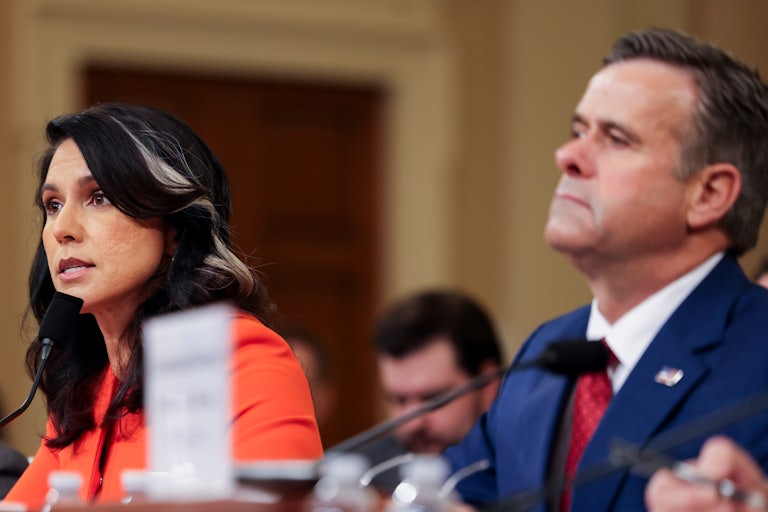
Tulsi Gabbard speaks while sitting next to CIA Director John Ratcliffe in a House Intelligence Committee meeting
Tierney L. Cross/Bloomberg/Getty Images

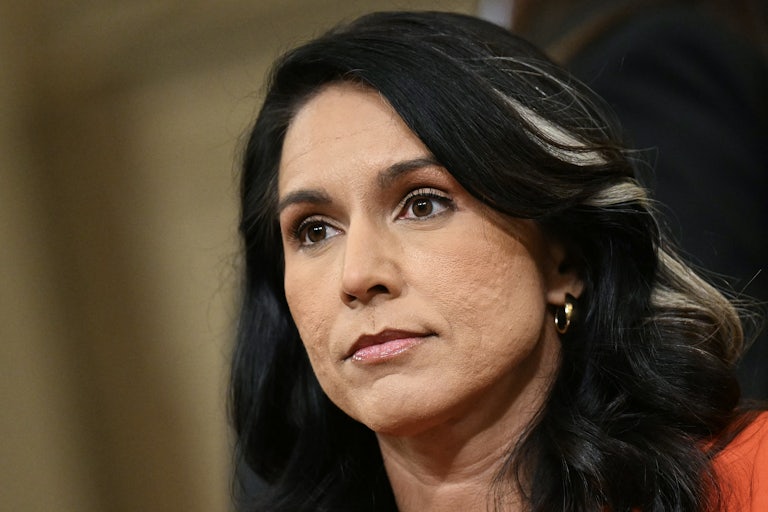
Representative Chrissy Houlahan cornered National Intelligence Director Tulsi Gabbard during a House Intelligence Committee hearing Wednesday, committing the intelligence chief to “follow the law” and investigate the Trump administration’s Signal leak regarding plans to attack Houthi targets in Yemen.

“This committee established something called 50 USC 3235a, and this committee—on a bipartisan, a-partisan basis—requires you, the DNI, to swiftly notify Congress and the Intelligence Committee if you’re aware of any sort of significant unauthorized disclosure or compromise of classified information, which I would argue has all the markings of being that,” Houlahan said. “And so, if you as the DNI chief see such a thing, anywhere within your organizations of purview, you have an obligation to report back to us on that.

“Would this qualify to you as something worthy of that investigation?” Houlahan pressed.

Gabbard deferred that responsibility to Defense Secretary Pete Hegseth, claiming that only he had the authority to classify Defense Department information.

“This chat did not have the auspice of being a DOD chat. There’s no such thing as labeling it as DOD. This was a chat among a great variety of people,” Houlahan retorted, pressing that Gabbard had a legal obligation to report and investigate leaked information.

“Do you not think it’s important to do such a thing?” Houlahan said.

“The National Security Council is investigating this inadvertent leak,” Gabbard said, referring to the probe fronted by national security adviser Mike Waltz, the Trump admin official responsible for creating the Signal chat room and adding The Atlantic’s editor in chief in the first place.

The former Democratic presidential candidate then proceeded to point her finger back at Hegseth, before Houlahan cut Gabbard off to argue that Hegseth should “walk his resignation in” and is “probably headed toward being relieved of his duty based on what I think are significant and illegal leaks.

“I would like it if you would please commit to this organization that you will follow the law, and I would like it if you would also investigate what is likely to be more than just this chat, because if there’s one, there’s more than one. If there’s smoke, there’s fire,” Houlahan continued. “Would you please commit yourself to that investigation?”

“Congresswoman, yes, I will follow the law,” Gabbard said.

Houlahan, a Pennsylvania Democrat, is an Air Force veteran and serves on the House Permanent Select Committee on Intelligence, as well as the House Armed Services Committee.

CIA Director Flips Out When Asked if Hegseth Was Drunk in Group Chat

The fallout from that disastrous war plans group chat continues after full text messages were released.

CIA Director John Ratcliffe yells at a congressional hearing.
Kayla Bartkowski/Getty Images

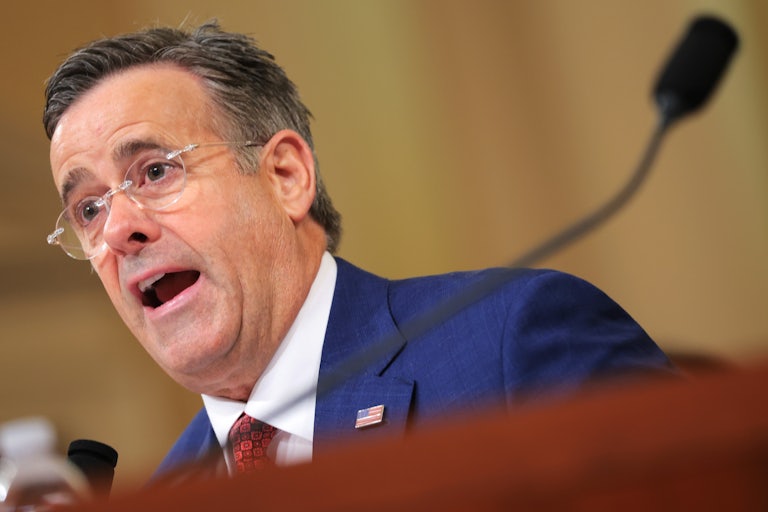
Representative Jimmy Gomez and CIA Director John Ratcliffe got into a fiery exchange on Wednesday as a House intel hearing turned to the topic of Defense Secretary Pete Hegseth’s drinking problem—and whether it played a part in Signalgate.

“The main person who was involved in this thread, that a lot of people want to talk to, is Secretary of Defense Hegseth, and a lot of questions were brought up regarding his drinking habits in his confirmation hearing” Gomez said, directed at Ratcliffe and National Intelligence Director Tulsi Gabbard. “To your knowledge, do you know whether Pete Hegseth had been drinking before he leaked classified information?”

“I don’t have any knowledge of Secretary Hegseth’s personal habits,” Gabbard responded, avoiding the question entirely.

“Director Ratcliffe, same question. Yes or no?”

“I think that’s an offensive line of questioning; the answer is no,” Ratcliffe replied, clearly perturbed. “I find it interesting that you want to—”

“Hey! I yield back—”

“You don’t want to focus on the good work that the CIA is doing, that the intelligence community is doing—”

“Director, I reclaim my time, director, I reclaim my time,” Gomez said. “I have huge respect for the CIA, huge respect for our men and women in uniform. But this was a question that’s at the top of the minds of every American. He stood in front of a podium in Europe holding a drink! So of course we want to know if his performance is compromised.”

“You want to talk about accepting responsibility? Do you think we accept a successful strike to make Americans safer?” Ratcliffe retorted.

“Here’s the thing. This is serious. We’ve been briefed in this committee about using Signal,” Gomez said. “We know that your people are—Russian, Chinese are on your phone.”

This back-and-forth comes on day two of the fallout from The Atlantic’s editor in chief, Jeffrey Goldberg, being added to a Signal chat with Vice President JD Vance and President Trump’s top Defense Cabinet members planning an attack on Yemen.

Tulsi Gabbard Suddenly Claims Amnesia About War Plans Group Chat

Tulsi Gabbard says she doesn’t remember anything that happened just a few weeks ago.

Tulsi Gabbard sits during a House Intelligence Committee hearing
Drew Angerer/AFP/Getty Images

If you ever find yourself caught in a clear lie about a group chat to plan an attack on Yemen, the solution is easy: Pretend you can’t remember a thing.

During a House Intelligence Committee hearing Wednesday, Director of National Intelligence Tulsi Gabbard attempted to walk back her previous claim that there had been “no classified information” shared in the Signal group chat used by officials to plot a bombing in Yemen.

Her defense? She claimed she hadn’t remembered.

“My answer yesterday was based on my recollection—or lack thereof—of the details that were posted there,” Gabbard said.

“I was not—and what was shared today reflects the fact that I was not—directly involved with that part of the Signal chat. And replied at the end reflecting the effects, the very brief effects that the national security adviser had shared,” she said.

Gabbard was referring to the one message she had sent in the chat on March 15, after the bombs had already dropped. “Great work and effects!” she wrote.

But Representative Jim Himes wasn’t buying it.

“So it’s your testimony that less than two weeks ago you were on a Signal chat that had all of this information about F18s and MQ9 reapers and targets on strike, and you, in that two-week period, simply forgot that that was there?” he asked.

“My testimony is I did not recall the exact details of what was included there,” Gabbard said.

“That was not your testimony,” the Connecticut Democrat replied, referring to Gabbard’s comments in a Senate Intelligence Committee hearing on Tuesday. “Your testimony was that you were not aware of anything related to weapons packages, targets, and timing.”

Gabbard claimed later in Wednesday’s hearing she had acknowledged that there were conversations about weapons—but she ironically claimed she couldn’t remember what she’d said even just one day earlier.

When asked Tuesday by Senator Mark Kelly whether the chat had mentioned timings, units, targets, or weapons involved in the strike on the Houthis, Gabbard had responded, “I don’t remember a mention of specific targets. I believe there was discussion around targets, in general.”

This wasn’t the only time Wednesday Gabbard claimed memory problems to evade a question. Representative Jason Crow asked Gabbard where she had been traveling during the discussion, and she had a similarly weak answer.

“I was traveling through the Asian Pacific region, I don’t recall which country I was in at that time,” Gabbard answered.

“You don’t remember the country?” the Colorado Democrat pressed.

“I’d have to go back and look at the schedule,” Gabbard said.

During the duration of the group chat, Gabbard reportedly traveled between Hawaii, Japan, and Thailand before visiting India, where she delivered a keynote address at the Raisina Dialogue on March 18.

There has been some concern that the chat could have been accessed by non-U.S. actors. Steve Witkoff, Trump’s special envoy to the Middle East, was in Russia while sensitive messages swirled in the group chat—but he claimed Wednesday that it was all OK because the messages were sent to his personal cell phone, not his work one, which he claims he did not access until he returned to the states. Though classified information sent to a personal cellphone isn’t much more comforting, is it?

Representative Jimmy Gomez slammed Gabbard’s weak attempts to feign ignorance about the group chat’s sensitive content.

“Deciding to use military force is something hard to imagine. So, the ‘do not recall’ doesn’t pass the smell test,” the California Democrat said. “It makes it—it’s unbelievable that was the case. So that’s what the American people don’t understand.

“And I know a lot of folks in this administration were saying that they were gonna take on the establishment, and drain the swamp. But you have become that swamp in a matter of days—not weeks, not months: days!” Gomez said.