Breaking News
Breaking News
from Washington and beyond

Trump Team’s Defense Explodes as Journalist Reveals Full Group Chat

Jeffrey Goldberg has released the complete war plans group chat, which Donald Trump’s administration has rushed to deny.

Donald Trump, Mike Waltz, JD Vance, and Pete Hegseth sit in the Oval Office
Andrew Harnik/Getty Images
The Atlantic on Wednesday published the complete messages of the Signal group chat used by senior officials in the Trump administration to discuss its plans to attack the Houthis, after the White House claimed that “no war plans” were discussed and “no classified information” was shared. Obviously, they lied.
Texts from Defense Secretary Pete Hegseth on March 15 reportedly included information about the timing and location of the missile strikes set to take place in Sanaa later that day.
“TIME NOW (1144et): Weather is FAVORABLE. Just CONFIRMED w/CENTCOM we are a GO for mission launch,” Hegseth wrote in one message.
Then, “1215et: F-18s LAUNCH (1st strike package)” and “1345: ‘Trigger Based’ F-18 1st Strike Window Starts (Target Terrorist is @ his Known Location so SHOULD BE ON TIME—also, Strike Drones Launch (MQ-9s),” he wrote.
Hegseth provided information in a non-secure group chat a full two hours before the strike was intended to take place. According to the director of intelligence’s guidance on classification, “information providing indication or advance warning that the U.S. or its allies are preparing an attack,” is considered top secret.
During a Senate Intelligence Committee hearing Tuesday, Director of National Intelligence Tulsi Gabbard refused to say whether she had participated in the chat, but insisted that there had been no classified information shared in the chat.
In the group chat, however, Hegseth continued to spill sensitive information in another series of texts, explaining the timing of subsequent attacks, including “WHEN THE FIRST BOMBS WILL DEFINITELY DROP.”
“1410: More F-18s LAUNCH (2nd strike package),” he wrote. “1415: Strike Drones on Target (THIS IS WHEN THE FIRST BOMBS WILL DEFINITELY DROP, pending earlier ‘Trigger Based’ targets).”
“1536 F-18 2nd Strike Starts—also, first sea-based Tomahawks launched,” and “MORE TO FOLLOW (per timeline)” Hegseth wrote.
“We are currently clean on OPSEC”—that is, operational security, the Defense Secretary added, though clearly it wasn’t entirely true. “Godspeed to our Warriors.”
The Signal user identified as Vice President JD Vance responded, “I will say a prayer for victory.”
Mike Waltz, Trump’s national security advisor reportedly responsible for inadvertently adding The Atlantic’s editor-in-chief Jeffrey Goldberg to the conversation, sent a message explaining that some targets had been identified in a building collapse.
“VP. Building collapsed. Had multiple positive ID. Pete, Kurilla, the IC, amazing job,” Waltz wrote, referring to General Michael E. Kurilla, the commander of Central Command.
Vance didn’t quite understand. “What?” he replied.
Shortly after, Waltz followed up. “Typing too fast. The first target—their top missile guy—we had positive ID of him walking into his girlfriend’s building and it’s now collapsed,” he wrote, being horrifyingly cavalier about potential civilian deaths.
A round of congratulatory texts went out, including Waltz’s now infamous “👊🇺🇸🔥”When asked whether the White House objected to the release of the full texts, Press Secretary Karoline Leavitt sent the following statement: “As we have repeatedly stated, there was no classified information transmitted in the group chat. However, as the CIA Director and National Security Advisor have both expressed today, that does not mean we encourage the release of the conversation. This was intended to be a an [sic] internal and private deliberation amongst high-level senior staff and sensitive information was discussed. So for those reason [sic]—yes, we object to the release,” she wrote.
Goldberg had initially published details about the sensitive information discussed in the group chat, leaving out the newly released sections over concerns that if “read by an adversary of the United States, could conceivably have been used to harm American military and intelligence personnel, particularly in the broader Middle East, Central Command’s area of responsibility.”
This story has been updated.

Republicans’ Defense of War Plans Group Chat Gets Even More Pathetic

Republicans are scrambling to defend the Trump administration on its group chat fiasco—and it’s getting more embarrassing by the minute.

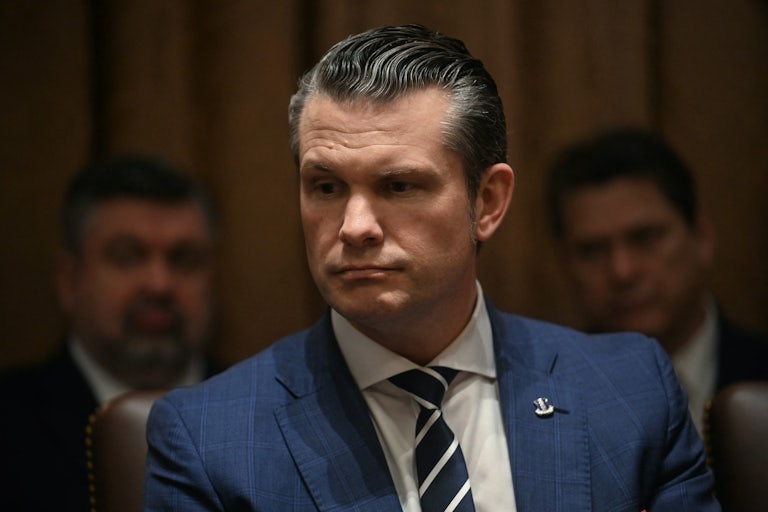
Defense Secretary Pete Hegseth
JIM WATSON/AFP/Getty Images
Defense Secretary Pete Hegseth

Republicans are struggling to defend the Signal group chat set up by Trump administration officials to discuss airstrikes against targets in Yemen. The chat, as the entire world now knows, mistakenly included the editor in chief of The Atlantic after a personal invite from Trump’s national security adviser, Mike Waltz.

The chat may have violated the law and certainly went against Department of Defense regulations, including a warning one week ago about security vulnerabilities within the Signal app that were being targeted by Russian hacking groups. But that hasn’t stopped leading Republicans in Congress from trying to put a positive spin on the colossal mistake.

Senator Ted Cruz said that the substance of the group’s discussion should have Americans feeling “very encouraged.”

“What the entire text thread is about is President Trump directed his national security team to take out the terrorists and open up the shipping lanes. That’s terrific,” Cruz told journalists on Tuesday.

Senator Josh Hawley also tried to put a positive spin on the fiasco. “It’s the president’s advisers discussing among themselves options they might recommend to the president,” Hawley told Fox News’s Laura Ingraham, “and nobody can deny the success of what the president is doing here.

“And this is what the leftist media is reduced to. They can’t argue with the policies, which the American people support. They can’t argue with this new demonstration of American strength that is keeping Americans safe at home and abroad, and so now we’re griping about who’s on a text message and who’s not. I mean, come on,” Hawley added.

Speaker of the House Mike Johnson tried to push the same message.

“What you did see, though, I think, was top-level officials doing their job, doing it well and executing on a plan with precision,” Johnson said Monday night. “That mission was a success. No one was jeopardized because of it. We’re grateful for that.”

Representative Dan Crenshaw told Fox Business that “it’s a mistake and we gotta move on.”

“If Secretary Hegseth says there was no classified information, I’ll take him at his word,” Crenshaw said to Maria Bartiromo Tuesday morning.

None of these Republicans addressed the fact that government officials were having a serious national security discussion on a private messaging app that could easily be used to evade mandated record keeping. This could be one of many chat groups where government business is being discussed, but only happened to see the light of day due to a journalist being added by accident. Will anyone involved be held accountable?

Trump Has Bizarre Defense for Advisers Making Group Chat on Signal

Donald Trump was asked whether he approved of his top advisers using the messaging platform to discuss war plans.

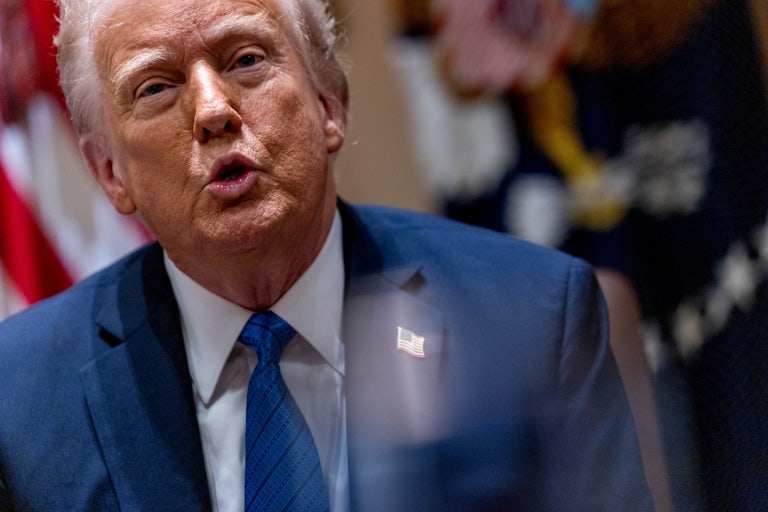
Donald Trump speaks during a meeting at the White House
Shawn Thew/EPA/Bloomberg/Getty Images

Donald Trump still doesn’t seem to know what Signal is, more than 24 hours after his administration was revealed to have discussed sensitive war details about bombing another country on the private app.

“So are you saying you’re OK with the continued use of Signal by administration officials?” asked a reporter at a White House press conference Tuesday afternoon.

“No, that’s not what I said,” Trump said. “I said we’ll look into it, but everybody else seems to be using it. It seems to be the number one–used device or app, whatever you want to call it.”

The president then continued to argue that there may be future circumstances under which the administration may be “forced” to use Signal, even though it’s an unofficial channel for information that was easily infiltrated by a journalist who, in Defense Secretary Pete Hegseth’s words, is “deceitful and highly discredited.”

“I don’t think it’s something we’re looking forward to use again, we may be forced to use it. We may be in a situation where you need speed as opposed to gross safety, and we may be forced to use it,” Trump added.

The president did not elaborate on what “gross safety” meant, but it’s unclear how his Cabinet’s reliance on Signal would be more efficient than the traditional and secure channels used by prior administrations.

Trump administration officials accidentally added The Atlantic’s editor in chief, Jeffrey Goldberg, to a Signal chat regarding sensitive details of a plan to bomb Houthis in Yemen earlier this month. Some of that information, shared by Hegseth in the chat, included a detailed operation plan, potential targets, weapons used, attack sequences, and timing of the airstrikes. The existence of the group chat was verified by a spokesperson for the National Security Council, Brian Hughes.

The monumental slipup was a horrific omen for U.S. national security, whose weakest link is apparently a crew of Cabinet members who can’t accomplish the basic due diligence of double-checking who they’re adding to a group chat hosted by a private company.

Trump officials repeatedly denied that they had disclosed confidential information in the immediate wake of the scandal. But National Intelligence Director Tulsi Gabbard and CIA Director John Ratcliffe began to fold during a Senate hearing Tuesday, with Gabbard claiming that she could not answer questions about the chat because of its sensitive nature, while Ratcliffe conceded that the conversation should have been conducted through “classified channels.”

Mike Johnson Has Terrifying Threat for Courts That Rule Against Trump

The House speaker has a plan to make sure Donald Trump always wins.

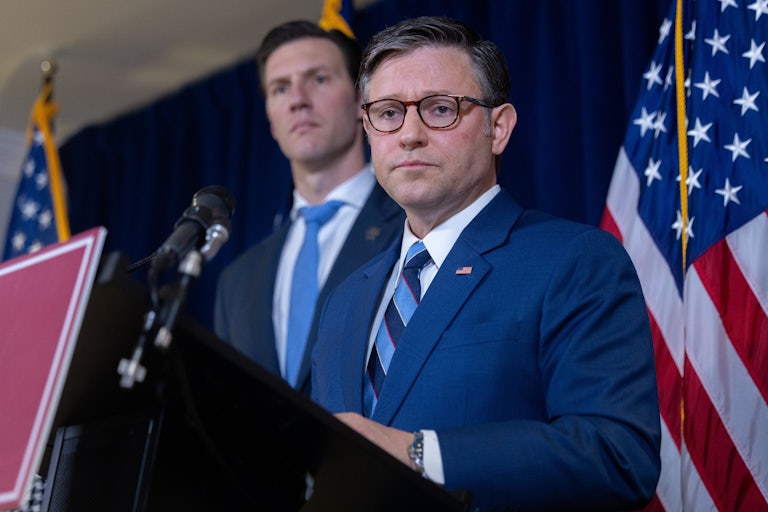
House Speaker Mike Johnson stands at a podium during a press conference
Nathan Posner/Anadolu/Getty Images

House Speaker Mike Johnson threatened Tuesday to outright eliminate district courts where judges rule against Donald Trump.

During a press conference, Johnson discussed how Congress was “working through” a “natural tension” between the branches of government, as courts across the nation have issued injunctions blocking a series of the Trump administration’s questionable actions.

Most recently, Trump and several members of his administration have attacked U.S. District Judge James Boasberg, who on Monday refused to lift his injunction blocking the administration’s expedited deportations under the Alien Enemies Act. 

Johnson issued a sinister warning that courts that stood against the president could see themselves wiped off the map. 

“We do have authority over the federal courts, as you know. We can, we can eliminate an entire district court. We have power of funding over the courts, and all these other things,” Johnson said. “But, um, desperate times call for desperate measures, and Congress is going to act.”

Johnson later clarified that he was making a point about the “broad authority” of Congress over the “creation, maintenance and the governance” of the courts. Congress eliminated two federal courts as recently as 1982, erecting two others. 

Johnson’s threat is both extreme and unlikely. Passing legislation defunding the courts now would require amazing cooperation among the Republicans’ narrow majority in the House—as well as total unanimity among Senate Republicans, who would need to convince seven Democrats to join them.  

Johnson also said that the Republican-led House Judiciary Committee was looking at alternative legislative moves, including his “favorite,” a bill from Representative Darrell Issa to “limit the scope of federal injunctions.” 

The bill would restrict the ability of federal judges to “abuse the system,” as Johnson put it, by preventing them from imposing nationwide injunctions—though that’s not quite abusing the system so much as using checks and balances the way they were designed. 

Earlier this month, an amendment was added to the bill that would allow broad orders brought by multiple states to stand in some instances, if they were heard and approved by a three-judge district court panel.

Trump Team Claims it Made Billions Off a Gold Card That Doesn’t Exist

Howard Lutnick bragged about selling U.S. residency.

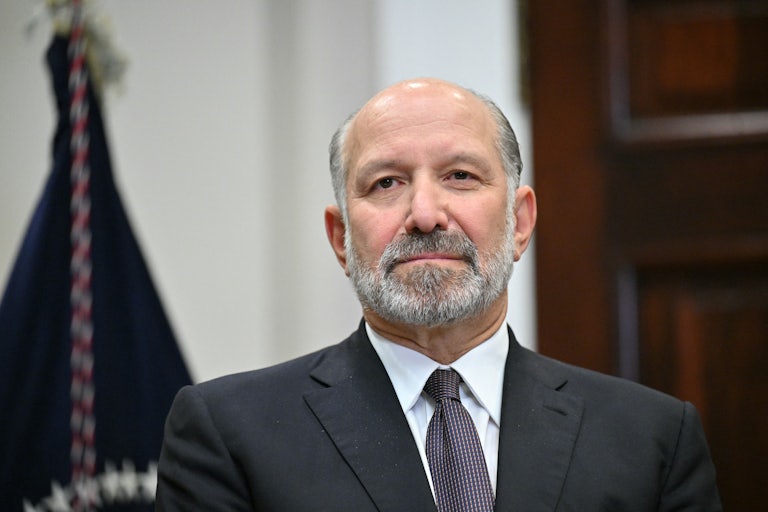
Commerce Secretary Howard Lutnick stands in the White House
Roberto Schmidt/AFP/Getty Images

The Trump administration is claiming that it’s made billions off its visa “gold card” program—even though the pay-to-play immigration alternative doesn’t exist yet.

Despite centering his campaign and presidency around deporting immigrants—documented or not—and limiting admission into the country, last month, Donald Trump pitched giving rich foreigners a new pathway to citizenship. The initiative, which the president has suggested calling the “Trump card,” would replace the EB-5 visa program.

Speaking with the All In podcast last week, Commerce Secretary Howard Lutnick claimed that the administration had made $5 billion by selling the EB-5 visa replacement for $5 million a pop.

“Yesterday I sold a thousand,” Lutnick said, saying that the program would launch in a couple of weeks and that Elon Musk was currently working on software to handle applications for the pricy legal papers.

Lutnick explained that American billionaire hedge fund manager John Paulson was the brains behind the visa replacement, sharing the details of the “gold card” with Trump over the phone. Since the card does not actually exist yet, Lutnick’s claim (if true) means that people are willing to pay Trump $5 million a pop for little more than a promise.

But Lutnick’s blank explanation for the gold card came with a casual, dual warning for green card recipients.

“If you have a green card, which used to be a green card now a go-card, you’re a permanent resident of America. You can be a citizen, but you don’t have to be, and none of them are going to choose to be,” Lutnick said, completely fabricating the last point.

“They have the right to be an American, as long as they’re good people, and they’re vetted,” he said. “We can always take it away if they’re evil or mean or bad or something.”

Some green card holders, including Columbia graduate student Mahmoud Khalil, have already been forcibly detained and had their green cards canceled by the Department of Homeland Security after they dared to protest the actions of the U.S. government. Others, like 21-year-old Yunseo Chung, are still evading ICE’s deportation efforts despite being legal permanent residents.

“The idea is, if I was not American, and I lived in any other country, I would buy six—one for me, one for my wife, one for my four kids—because God forbid something happens, I want to be able to go to America and I want to have the right to go to the airport to go to America,” Lutnick said of the gold card, plainly restricting the terms that used to be available to all refugees seeking shelter in the U.S. to just the ultrawealthy denizens of the world. “I don’t want to hear that I can’t come here when there’s a horrible war, a horrible whatever.”

Critics of Trump’s “gold card” program have claimed that the new visa is yet another sign that Trump is willing to sell American democracy to the “highest bidder” and would allow America’s longtime adversaries—including Russian oligarchs—to effectively buy their way into the country.