Breaking News
Breaking News
from Washington and beyond

Leaked Memo Reveals Insane Ban on Words Agriculture Department Can Say

The Department of Agriculture is no longer allowed to use the phrase “safe drinking water.”

Agriculture Secretary Brooke Rollins speaks at a podium while Donald Trump stands behind her
Michael M. Santiago/Getty Images
Agriculture Secretary Brooke Rollins speaks at a podium while Donald Trump stands behind her.

Forget DEI buzzwords—the Trump administration’s government censorship ordinance is now infringing on language that will make it nearly impossible for agencies to do their job.

A leaked memo from the U.S. Department of Agriculture’s Research Service division revealed Sunday that the agency has banned some key language from its vocabulary, including the words “climate” and “vulnerable,” as well as the phrase “safe drinking water.”

Other baffling entries on the memo’s banned language list are “greenhouse gas emissions,” “methane emissions,” “sustainable construction,” “solar energy,” and “geothermal,” as well as “nuclear energy,” “diesel,” “affordable housing,” “prefabricated housing,” “runoff,” “microplastics,” “water pollution,” “soil pollution,” “groundwater pollution,” “sediment remediation,” “water collection,” “water treatment,” “rural water,” and “clean water,” among dozens of others.

“When evaluating agreements, those entries that include these terms or similar terms cannot be submitted,” wrote Sharon Strickland, the USDA’s Northeast area financial management, travel and agreements section head, in an internal March 20 email. The review will “ensure that we maintain compliance with the Administration’s EOS.”

It’s unclear how the guidance would do anything other than completely hinder the department’s ability to monitor the health and edibility of crops, or aid America’s rural development—some of its primary functions. What is clear, however, is that purging such basic speech will stifle scientific research and discourse.

Donald Trump began censoring the government as soon as he returned to office. In January, the Office of Management and Budget held tens of billions in federal funding hostage, requiring executive branch agencies to purge language related to “environmental justice,” abortion, DEI initiatives, “woke gender ideology,” and “illegal aliens” in their reports and missions. Otherwise, they would forgo their congressionally appropriated funds, per an OMB memo.

That threat has since rolled its way through the American legal system. Last week, an appeals court upheld a block on the sweeping freeze, agreeing with a previous court’s ruling that the 22-state coalition that brought the lawsuit would “irreparably suffer” under Trump’s ordinance.

“These harms included the obligation of new debt; the inability to pay existing debt; impediments to planning, hiring, and operations; and disruptions to research projects by state universities,” wrote Chief Judge David Barron.

Barron’s ruling echoed a similar decision issued by Judge Loren AliKhan in February, in which the federal judge indefinitely blocked Trump’s effort.

“In the simplest terms, the freeze was ill-conceived from the beginning,” AliKhan wrote in her ruling. “Defendants either wanted to pause up to $3 trillion in federal spending practically overnight, or they expected each federal agency to review every single one of its grants, loans, and funds for compliance in less than twenty-four hours. The breadth of that command is almost unfathomable.”
Mike Waltz Used Signal for Plenty of Other Suspicious Group Chats

Trump’s national security adviser, of Signalgate fame, was in lots of sensitive group chats.

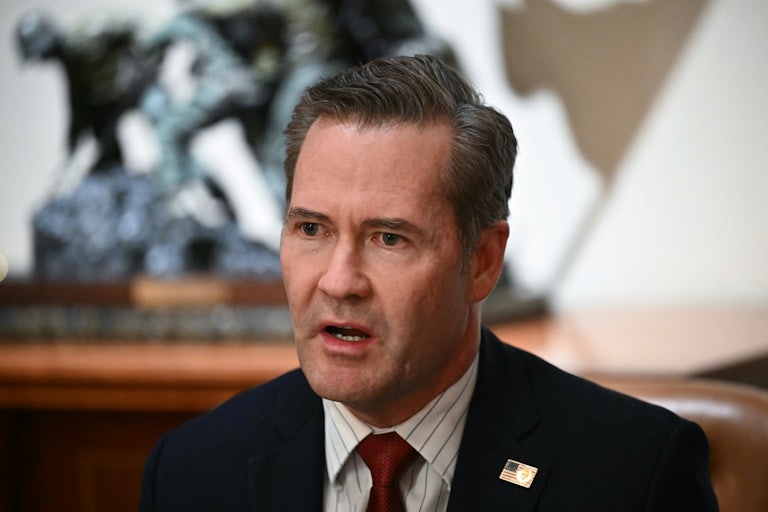
Trump's national security adviser Mike Waltz stares with his mouth open
MANDEL NGAN/AFP/Getty Images

Mike Waltz has multiple Signal group chats in addition to the now infamous “Houthi PC small group” that he added a reporter to earlier this month, according to a report from The Wall Street Journal.

Two officials close to the situation told the Journal that Waltz has started Signal chats with Cabinet members regarding a peace treaty between Russia and Ukraine as well as various other military activities.

While Trump has publicly stood behind Waltz, the president—and the rest of his inner circle—has castigated the national security adviser for the biggest blunder of Trump’s second term (so far). The Journal reports that Trump went on a few different expletive-filled rants about Waltz over the phone last week, and multiple staffers have made their discontent clear. Some noted that if a conservative outlet like Breitbart had broken the Signalgate story rather than The Atlantic, Waltz would be long gone. Others went so far as to spread past clips of Waltz being critical of Trump, alleging he is a neocon unfit to serve the MAGA agenda.

The administration has rejected reports of internal frustrations with Waltz. “The chattering of unnamed sources should be treated with the skepticism of gossip from people lacking the integrity to attach their names,” said National Security Council spokesman Brian Hughes.

MAGA’s Mad at JD Vance for Group Chat—But Not for the Reason You Think

JD Vance is catching heat for his actions in the Signal group chat.

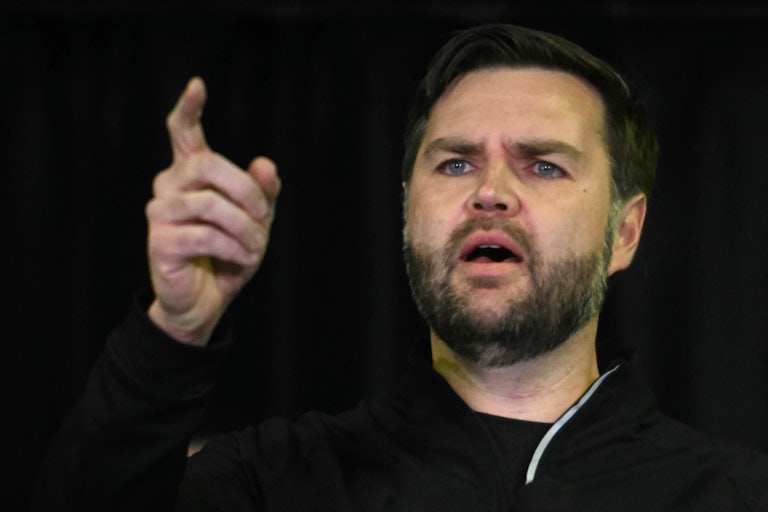
JD Vance raises his finger while speaking during a visit to a space base in Greenland
Jim Watson/AFP/Getty Images

Vice President JD Vance may have stepped in it with his fellow Republicans by questioning Donald Trump’s plan to strike the Houthis, NBC News reported Sunday.

Earlier this month, Vance, and other senior Trump officials discussed sensitive plans to strike the Houthis in Yemen in a Signal group chat that was widely publicized after Trump’s national security adviser Mike Waltz accidentally added a high-profile reporter. In the chat, Vance alone aired doubts about the plan, warning that the strike was not in alignment with Trump’s America First policies, because it would help Europe more than it would help the U.S.

“I am not sure the president is aware how inconsistent this is with his message on Europe right now,” Vance wrote. “There’s a further risk that we see a moderate to severe spike in oil prices. I am willing to support the consensus of the team and keep these concerns to myself. But there is a strong argument for delaying this a month, doing the messaging work on why this matters, seeing where the economy is, etc.”

When Defense Secretary Pete Hegseth insisted that the strike wasn’t about the Houthis at all but about safeguarding trade and reestablishing deterrence, Vance relented. “If you think we should do it let’s go. I just hate bailing Europe out again,” he wrote.

Hegseth agreed, and White House Deputy Chief of Staff Stephen Miller responded, “As I heard it, the president was clear: green light, but we soon make clear to Egypt and Europe what we expect in return.”

Vance distinguished himself as the most ideological member of the Signal chat, freely expressing his contempt for Europe and a profound lack of interest in preventing the disruption of trade routes. Vance’s reluctance to help another country was arguably the most MAGA position to take—but some of the more hawkish senior Republicans didn’t like that he didn’t mindlessly submit to Trump’s directive, NBC News reported.

“Capitol Hill Republicans still have their jaws on their floor with how actively the VP worked to try and undo a Trump decision,” one senior Republican official in Washington wrote in a text. “Thank goodness Miller stepped in and put him in his place.”

“It’s one thing to have a healthy interagency debate before a decision is made. It’s another to try and undo a Commander-in-Chief decision once Trump gives the execute order. This is the latter, and it’s very Bolton-esque,” the senior Republican official added, referring to John Bolton, Trump’s former national security adviser who has become an outspoken critic of the president.

Some Republicans even believed that Vance’s question was tantamount to obstruction.

“These are the president’s policies, and for JD Vance to question them like that is ridiculous. He is the commander in chief,” another Republican on Capitol Hill told NBC News. It seems that to many Republicans, the most MAGA thing a person can do is agree with Trump about anything.

On the flip side, others in the Trump administration are reportedly concerned that the strike against the Houthis could lead to messy, drawn-out conflict.

“It’s 2002 all over again,” said one current administration official who spoke with NBC News anonymously because he wasn’t permitted to speak to the press. Already, the Pentagon has begun directing aircraft carriers and resources to the region, indicating that the fight with the Houthis is far from over.

During a trip to Greenland last week, Vance was asked whether he had raised his concerns with Trump and what he meant when he wrote that the president “wasn’t aware that his directions for Yemen were inconsistent with his message for Europe.”

“Well I didn’t quite say that. I think that’s a slight misunderstanding of what I said,” Vance replied, though of course, that was exactly what he had said.

In the end, Vance didn’t answer either question but instead launched into a rant about what he’d learned from “Signalgate.”

“Sometimes we all agree, and sometimes we all disagree. But it’s important that we all have an honest conversation amongst ourselves, and with the president of the United States about what we think is in the best interest of the national security of the United States of America,” said Vance, who had readily shut down his own dissenting opinion.

Vance claimed that he had “always supported the president’s decision to strike the Houthis.”

Trump Insists Economy Not About to Explode as Banks Warn Differently

Donald Trump appears to be driving the U.S. right into a recession.

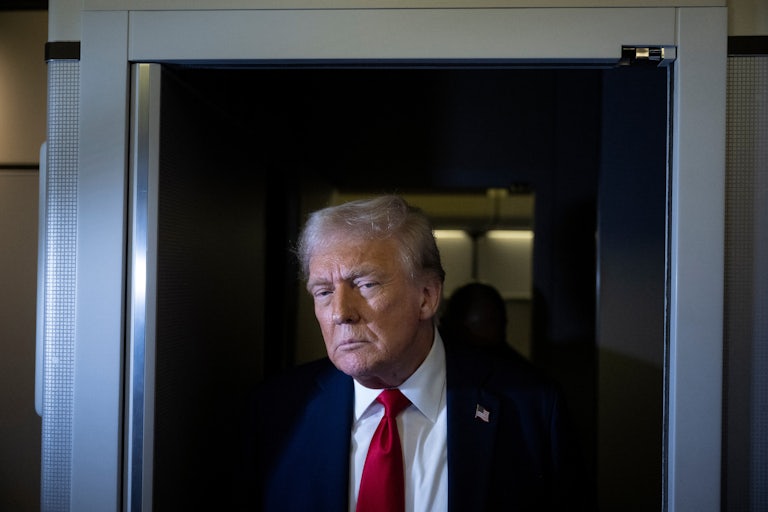
Donald Trump stands with reporters on Air Force One
Brendan Smialowski/AFP/Getty Images

Banks are predicting a downturn for the American economy.

Goldman Sachs raised its 12-month recession probability from 20 percent to 30 percent on Monday, reported Reuters. The banking giant also downgraded American gross domestic product growth forecast from 2 percent to 1.5 percent, and projected three interest rate cuts by the Federal Reserve.

In a Sunday note to its investors, Goldman speculated that the average U.S. tariff rate will rise 15 percent points over the next year, 5 percent higher than it previously predicted. That’s thanks to Donald Trump’s decision to spark a global trade war.

“Almost the entire [tariff rate] revision reflects a more aggressive assumption for ‘reciprocal’ tariffs,” the brokerage firm wrote in a memo obtained by Reuters.

Trump has driven a wedge in America’s trade and military alliances by suddenly imposing large tariffs on the nation’s longtime partners. On Thursday, Canadian Prime Minister Mark Carney announced that his country’s cozy relationship with the U.S. had come to an end and that they would wean themselves off American products and services “at speeds we haven’t seen in generations.”

The seismic diplomatic shift followed another tariff announcement by the Trump administration, this time imposing a 25 percent hike on auto imports. Carney called the levy—which will take effect on vehicle imports April 3 and vehicle parts in May—a “direct attack” on Canada, but the news also immediately hit America’s Big Three automakers, whose stock dropped multiple percentage points in reaction to the news.

Trump’s tariffs will have an even more significant effect on Europe, which Goldman warned could enter a “technical” recession by the end of the year, with “little” growth—as in, 0.0 percent growth in the third quarter.

“We estimate that our new tariff assumptions will lower euro area real GDP by an additional 0.25 percent compared to our previous baseline, for a total hit to the level of GDP of 0.7 percent compared to a no-tariff counterfactual by end-2026,” Goldman wrote in another note issued Sunday.

Trump, however, seemed completely unconcerned by the looming economic peril. Speaking with reporters aboard Air Force One on Sunday, Trump brushed off concerns about high unemployment and “stagflation,” which is when economic growth stagnates but inflation remains high. Instead, he insisted that “this country is going to be more successful than it ever was.”

“It’s going to boom,” the president said. “We’re gonna have boomtown USA. We’re gonna boom.”

Did Trump Just Break the Law on Deportations?

Secretary of State Marco Rubio announced another mass deportation to El Salvador.

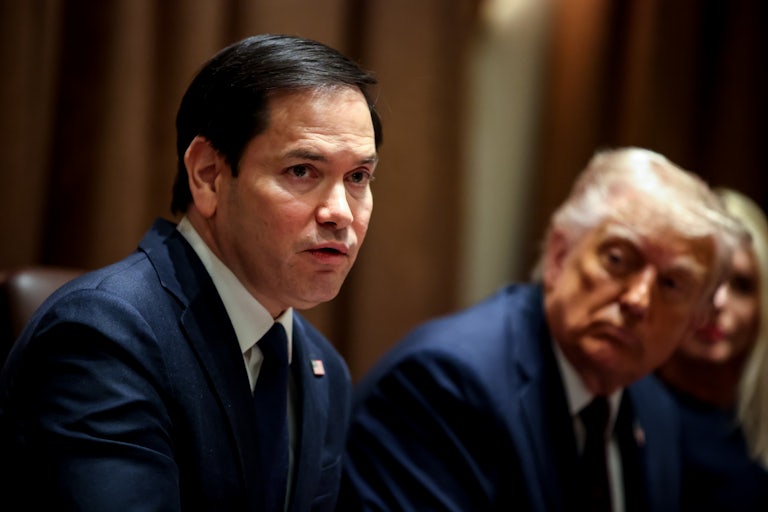
Secretary of State Marco Rubio speaks at a Cabinet meeting. Donald Trump can be seen in the background, seated beside him listening.
Samuel Corum/Sipa/Bloomberg/Getty Images

Secretary of State Marco Rubio may have just violated a court order stopping the Trump administration’s fast-tracked deportations.

Rubio announced that a group of alleged gang members had been deported Sunday night.

“Last night, in a successful counter-terrorism operation with our allies in El Salvador, the United States military transferred a group of 17 violent criminals from the Tren de Aragua and MS-13 organizations, including murderers and rapists,” Rubio wrote on X Monday morning. He noted that both TdA and MS-13 were considered foreign terrorist organizations, which implies that they could be subject to removal under the Alien Enemies Act, or AEA.

Rubio thanked the Salvadoran government and President Nayib Bukele for “their unparalleled partnership in making our countries safe against transnational crime and terrorism.”

Multiple judges have rebuked Donald Trump’s use of the AEA and filed injunctions against his administration—and Rubio’s latest deportations may have just violated one.

Last week, U.S. District Court Judge Brian Murphy issued a temporary restraining order requiring the government to provide written notice and an opportunity for detainees to apply for protection before deporting them to a third country.

It seems that with this latest round of deportations, the Trump administration has violated that court order, and continued to fast-track its removal of alleged gang members.

Earlier this month, Trump invoked the AEA, a wartime law that suspends due process. Under the act, the Trump administration swiftly deported 261 Venezuelan nationals to Centro de Confinamiento del Terrorismo, or CECOT, the prison in El Salvador that is notorious for human rights abuses. The U.S. government claimed that everyone deported was a terrorist.

The deportees were removed without notifying their family members or lawyers, and they were not provided with the opportunity to challenge their deportation or their designation as gang members. In many cases, the government seems to have rounded up immigrants for supposedly suspicious tattoos that ended up having nothing to do with TdA at all.

In another filing last week, Judge James Boasberg wrote that by sending the prisoners to CECOT, the Trump administration had likely violated the Foreign Affairs Reform and Restructuring Act of 1998, which states that “it shall be the policy of the United States not to expel … any person to a country in which there are substantial grounds for believing the person would be in danger of being subjected to torture.” Boasberg wrote that at CECOT, prisoners are reportedly abused, humiliated, and left to rot without their families knowing anything about their whereabouts or well-being.