Breaking News
Breaking News
from Washington and beyond

Trump Hits New Levels of Insanity With Fresh China Tariffs

Donald Trump wants to impose tariffs of more than 100 percent on Chinese goods.

Donald Trump gestures while speaking to reporters outside the White House
Andrew Harnik/Getty Images

Donald Trump threatened Monday to escalate his trade war with China by ratcheting up tariffs on exports to a staggering 104 percent.

In a post on Truth Social, Trump threatened to impose an additional 50 percent tariff on China if it did not rescind the retaliatory 34 percent tariffs on U.S. imports Beijing announced Friday.

These tariffs would be in addition to the 34 percent “reciprocal tariff” Trump announced last week, which was already added on top of two rounds of 10 percent tariffs that had been announced last month. The White House confirmed that Trump’s tariffs on China would be 104 percent.

Trump said that if China’s new tariffs weren’t withdrawn by Tuesday, his new tariffs could be imposed the following day.

“Additionally, all talks with China concerning their requested meetings with us will be terminated! Negotiations with other countries, which have also requested meetings, will begin taking place immediately,” he said.

Trump’s latest announcement is sure to send the already volatile stock market swinging. The Dow Jones plummeted more than 900 points at open Monday, after closing with 1,500-point losses for two consecutive days at the end of last week as investors reacted to China’s retaliatory tariffs.

Trump’s promise to once again increase the U.S. tariff rate on China is just the latest escalation in his ongoing mission to start a global trade war that he believes will send every world leader to his door, hoping to make a deal. In the meantime, major U.S. financial institutions predict an economic recession is on the horizon.
Trump Adviser Says Countries Offering Zero Tariffs Isn’t Good Enough

Peter Navarro is moving the goalposts on Trump’s “retaliatory” tariffs.

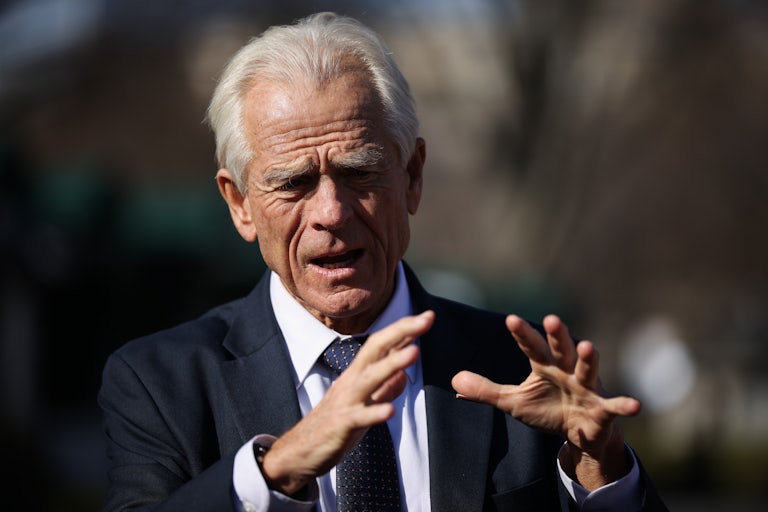
Trump adviser Peter Navarro speaks with his hands outside
Kayla Bartkowski/Getty Images

One of Donald Trump’s top economic advisers, Peter Navarro, is blowing off an offer from Vietnam to eliminate all of its tariffs on American goods.

In an interview on CNBC Monday, Navarro said that the country’s offer was not enough for the U.S. to lift its tariffs against Vietnam, saying that it “means nothing.”

“When they come to us and say, ‘We’ll go to zero tariffs,’ that means nothing to us because it’s the nontariff cheating that matters,” Navarro said, by which he meant the routing of Chinese products through Vietnam, intellectual property theft, and a value-added tax. Later, though, Navarro conceded that zero tariffs would be a “small first start.”

Navarro’s tone contradicts Trump’s post on Truth Social Friday where he bragged about Vietnam’s offer to cut tariffs to zero, showing that the Trump administration is not on the same page when it comes to the president’s tariffs, introduced last week on April 2 in an event Trump dubbed “Liberation Day.”

The chaos over the tariff plan has not only led to chaos in international markets but has spooked even officials within the Trump administration, such as Treasury Secretary Scott Bessent, who is reportedly eyeing the exits. But not Navarro: He’s staked his career and what little remains of his credibility on the idea.

The Harvard-educated economist, who also worked in the first Trump administration, has been pushing for tariffs for years, citing the work of economics expert “Ron Vara” in many of his books. The problem is that Ron Vara is actually a person Navarro made up to bolster his own ideas, and the name is even an anagram of Navarro.

After serving four months in prison for defying a subpoena from Congress’s January 6 committee, Navarro was given a lifeline by Trump, who tapped him to work in his administration. Now it seems that Navarro is the idea man for these tariffs, having successfully convinced the president of the plan’s (not at all) genius. When the promised economic boom doesn’t come, will he get the blame?

Measles Rates Hit New Record as RFK Jr. Keeps Waffling on Vaccines

The current measles outbreak is already the third-largest of this century.

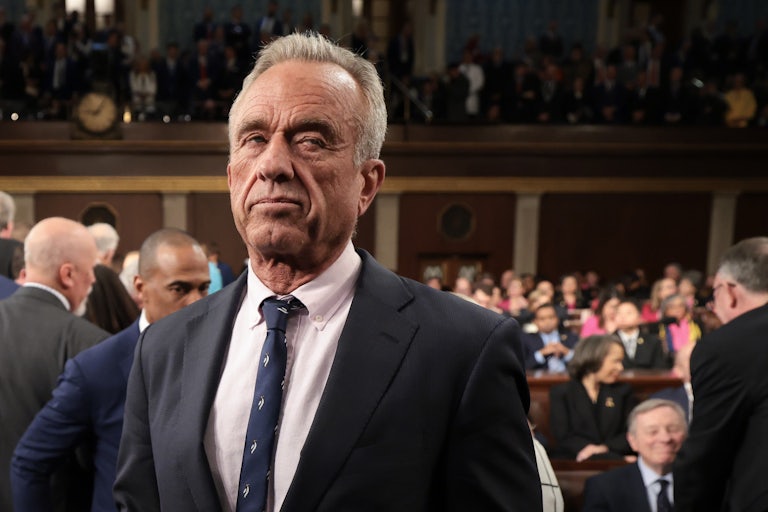
Robert F. Kennedy Jr. looks to the side while standing in Congress ahead of Donald Trump’s informal State of the Union
Win McNamee/Getty Images

Health Secretary Robert F. Kennedy Jr. has finally admitted vaccines are needed, as measles cases continue to skyrocket across the country.

As of Friday, more than 600 measles cases across 22 states have been recorded by the Centers for Disease Control and Prevention, marking the third-largest measles outbreak of the twenty-first century, less than halfway into the year.

More than 75 percent of the country’s cases have been recorded in Texas, which has seen almost 500 cases—nearly all of which have been among unvaccinated people. On Saturday, an unvaccinated 8-year-old girl died from the disease, marking the second death of a child from measles since February.

Kennedy, who traveled to West Texas on Sunday to meet the families of the two victims, seems to at last be realizing just how deadly the infection can be, after years of downplaying its effects and spreading baseless vaccine claims, including that the vaccine is as dangerous as the infection itself.

“I came to­ Gaines County, Texas, today to comfort the Hildebrand family after the loss of their 8-year-old daughter Daisy,” he wrote in a statement on X Sunday. “My intention was to come down here quietly to console the families and to be with the community in their moment of grief.

“The most effective way to prevent the spread of measles is the MMR vaccine,” Kennedy added, admitting to the benefits of the only evidence-based method proven to prevent measles infection.

But Kennedy hasn’t totally given up on his anti-vaccine agenda. Just hours after the Hildebrand family’s funeral, Kennedy posted on X praising two anti-vax doctors who he claimed had cured “300 measles-stricken Mennonite children” using “aerosolized budesonide and clarithromycin.” Budesonide is a corticosteroid used to treat asthma and inflammatory bowel disease, and clarithromycin is an antibacterial drug.

The health secretary has previously touted cod liver oil, which is rich in vitamin A, as a cure for the infection, despite there being little medical evidence to support the claim. In high doses, vitamin A can also lead to nausea, vomiting, blurred vision, and liver damage, which has been recorded in the lab work of some of the 50 children who have been hospitalized for measles in Texas.

In his statement, Kennedy said HHS is partnering with Texas health officials to better “control the measles outbreak,” as well as deploy CDC teams across the state. It’s a long-awaited response from the HHS, but it’s too little too late for some.

Trump Exposes Own Kindergarten-Level Understanding of Economics

Donald Trump has an absolutely ridiculous goal for his extreme tariffs.

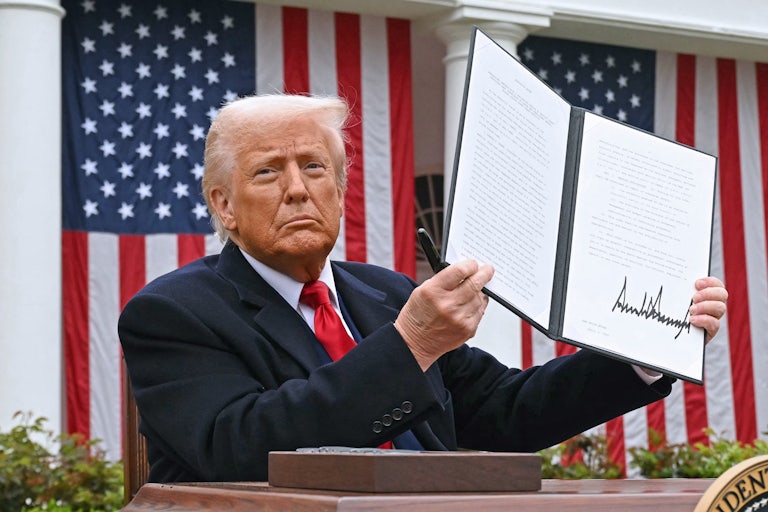
Donald Trump holds up a signed executive order while sitting at a table in the White House Rose Garden
Saul Loeb/AFP/Getty Images

President Donald Trump said that he hopes to erase the U.S. trade deficit with other countries—but anyone who understands economics knows that wouldn’t be a good thing. 

“I spoke to a lot of leaders—European, Asian—from all over the world. They are dying to make a deal, but I said, ‘We’re not gonna have deficits with your country,’” Trump told reporters on board Air Force One Sunday. “We’re not gonna do that, because to me a deficit is a loss. We’re gonna have surpluses or at worst we’re gonna be breaking even.”

A trade deficit isn’t a “loss,” regardless of what Trump thinks. A trade deficit simply means that one country spends more on goods from another country than that country spends on goods from them. 

Crucially, economists say that having a trade deficit is not an inherently bad thing at all, because the U.S. simply can’t and shouldn’t make everything. Trump’s insistence that the U.S. is being taken for a ride betrayed a fundamental misunderstanding of economics that is built on a dislike of other countries and a desire to be the dealmaker responsible for a new world order. 

Trump warned that it would be the “worst” for China. In 2024, the United States had a $295.4 billion trade deficit with China. Trump said that China would need to “solve their surplus” before he would be willing to make a deal on tariffs. 

The president predicted that his “reciprocal tariffs” would raise $1 trillion in the next year and that “thousands” of companies would relocate manufacturing to the U.S.  

China announced Friday that it would impose 34 percent tariffs on imports from the U.S. in response to Trump’s new “reciprocal” 34 percent tariff, which was added on top of two rounds of 10 percent tariffs that had been announced last month.

Trump’s announcement of “reciprocal tariffs” last week sent the U.S. stock market plummeting to its worst day since 2020, and major financial institutions updated their recession projections for 2025. But Trump merely compared the financial chaos to a sick patient taking their “medicine.”

Trump was widely mocked for his ridiculous plan to eliminate the trade deficit. 

Tahra Jirari, director of economic analysis at the Chamber of Progress, wrote on X Sunday that “a trade deficit isn’t a ‘loss,’ it just means we import more than we export. Countries run trade deficits for all kinds of healthy reasons (like strong consumer demand). ‘Breaking even’ isn’t how global trade works.”

Zeteo News’s editor in chief Mehdi Hasan wrote on X Sunday that Trump was “an ignoramus the like of which we have not seen in our lifetimes. Wharton must be so embarrassed.”

Jonah Goldberg, editor in chief of The Dispatch, wrote in a post on X Monday that “Trumpers slavishly defend one man unilaterally screwing up the economy and the America-led global order because he’s some kind of genius. And it turns out—as was apparent for decades—he just doesn’t know what he’s talking about.”

Fake News Story on Tariffs Pause Causes Mayhem in Stock Market

Here’s how a fake news story on Trump’s tariffs created mass volatility in the stock market.

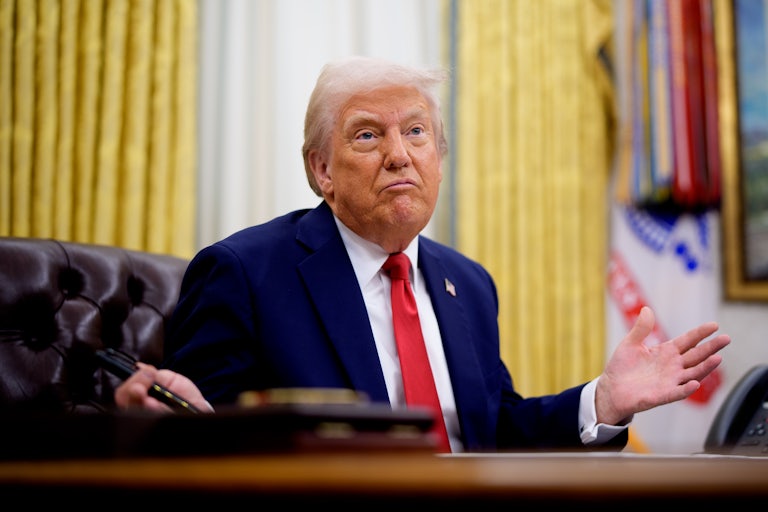
Donald Trump gestures while sitting at his desk in the Oval Office
Andrew Harnik/Getty Images

The stock market is in such a dire state that an inaccurate report of a 90-day pause on Trump’s global tariffs gave investors real confidence, making the market shoot up before it crashed back down.

On Monday morning, Trump economic adviser Kevin Hassett went on Fox News and was asked if the administration would consider such a pause.

“The president is going to decide what the president is going to decide. There are more than 50 countries in negotiation with the president…. I would urge everyone, especially Bill [Ackman], to ease up the rhetoric a little bit,” Hassett replied vaguely. “Even if you think that there will be some negative effect from the trade side, that’s still a small share of the GDP. This idea that it’s gonna be a nuclear winter or something like that is completely irresponsible.”

Verified X user Walter Bloomberg mistook this quote for a resounding yes and reported that the administration was indeed considering a 90-day tariff pause “FOR ALL COUNTRIES EXCEPT CHINA.” The news was soon read on CNBC, causing the stock market to move positively for the first time in days, by 7 to 10 percent.

“INSANE market action right now. Market exploded higher on a headline attributed to Kevin Hassett,” said Bloomberg’s Joe Weisenthal. “And now nobody can figure out where it came from and the markets are diving again. An 8% surge and then a 3.5% plunge in a matter of seconds.”

The White House denied all claims of the pause and Bloomberg deleted his X post, falsely attributing the report to Reuters.