Breaking News
Breaking News
from Washington and beyond

Elon Musk’s DOGE Gives Tesla Massive Helping Hand With Newest Purge

Elon Musk’s minions in the federal government have just fired key experts who regulate Tesla.

Elon Musk gives a speech in front of a massive Tesla logo.
Nora Tam/South China Morning Post/Getty Images

Elon Musk’s Department of Government Efficiency fired car safety experts in the National Highway Traffic Safety Administration who directly regulated Tesla.

The Financial Times reports that DOGE fired 30 employees from the agency back in February, including several from the office of vehicle automation safety, which is in charge of regulating self-driving vehicles, a key part of Musk’s car company.

The layoffs made up 4 percent of the agency’s 800-person staff, including employees who were due for promotions and workers who had just been hired. The automation safety staff were disproportionately affected because the office had only been formed in 2023 and was predominately made up of probationary hires.

In a Valentine’s Day email announcing the firings, poor performance was cited as the reason, although this was rejected by an unnamed senior employee still at NHTSA who spoke to the Times.

The NHTSA has eight active investigations against Tesla, including five focusing on Musk’s claims about the company’s Autopilot system and Full Self-Driving software, and has published over 10,000 complaints about the company from the public. The agency has also ordered multiple recalls of Tesla cars and delayed the rollout of the company’s self-driving and driver-assistance software.

Musk has promised to launch a driverless ride-hailing service in Austin, Texas, in June, and to start building a fleet of autonomous “cybercabs” next year, which would require an NHTSA exception because the cybercabs don’t have a steering wheel or pedals.

“Letting DOGE fire those in the autonomous division is sheer madness—we should be lobbying to add people to NHTSA,” one Tesla manager told the Times. They “need to be developing a national framework for [autonomous vehicles], otherwise Tesla doesn’t have a prayer for scale in FSD or robotaxis.”

And, much like DOGE’s other firings at agencies across the government that regulate or deal with Musk’s companies, the NHTSA layoffs have major ethical implications.

“There is a clear conflict of interest in allowing someone with a business interest influence over appointments and policy at the agency regulating them,” a former NHTSA employee told the Times.

Musk owes much of his wealth to government subsidies and contracts, and many of DOGE’s moves have squashed government oversight into his businesses. As long as Trump keeps giving him unprecedented power, the tech oligarch and fascism enthusiast will continue to keep serving his own interests.
Trump’s Dumbest Order Is Hiding His Most Dangerous Rule Change Yet

Donald Trump snuck an insidious change into an executive order on showerheads.

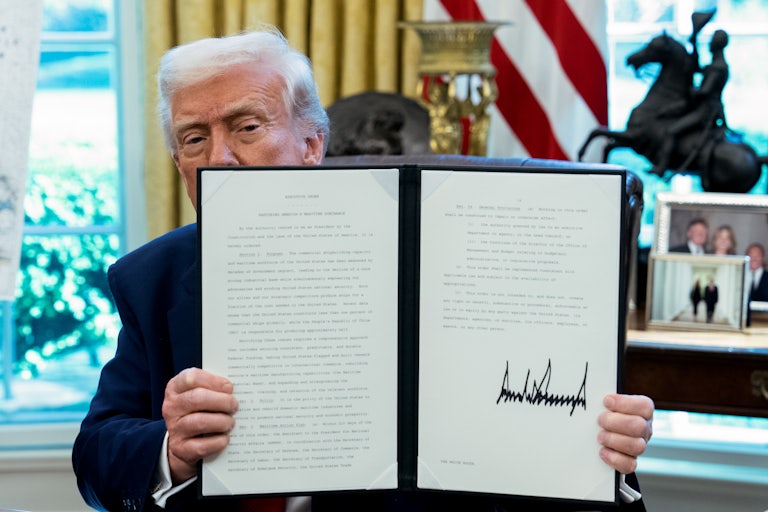
Donald Trump holds up a signed executive order while sitting in the Oval Office
Chris Kleponis/CNP/Bloomberg/Getty Images

Buried within Donald Trump’s executive order “undoing the left’s war on water pressure” was a shady phrase to help the president fast-track his deregulatory crusade.

In a section of the order signed Wednesday repealing a 13,000-word regulation defining “showerhead,” Trump noted that notice and comment on the recission would not be accepted. 

“Notice and comment is unnecessary because I am ordering the repeal,” the order stated.  

Notice-and-comment rulemaking, as outlined by the Administrative Procedure Act, or APA, requires federal agencies to give the public time to comment after presenting a new rule. The agency must then consider all relevant, timely submitted comments before publishing the final rule. 

But in his order, Trump implies that because he was the one rewriting the rule, the public would not be given the opportunity to comment, essentially fast-tracking any deregulation effort he pitches in the future. 

Legal experts were quick to challenge Trump’s rulemaking rule change. 

“This is so illegal. Just utterly, utterly unlawful,” wrote Aaron Reichlin-Melchick, a senior fellow at the American Immigration Council, in an X post Wednesday. “The President cannot overturn the commands of the APA by just declaring ‘because I said so.’”

“If President Biden could have written executive orders requiring rules just be written without comment, we’d have a whole helluva lot of new regulations on the books protecting consumers, workers, and the environment,” Todd Phillips, an assistant law professor at Robinson College of Business, wrote on X. 

In a separate post, Phillips warned that rescissions would be challenged “so, so, so quickly. And in the D.C. Circuit.”

In a separate executive order signed Wednesday, Trump ordered U.S. agencies to get moving on rescinding “unlawful” regulations under several Supreme Court decisions, including Loper Bright Enterprises v. Raimondo, by once again skipping the process of notice and comment—this time claiming a “good cause” exception. 

“In effectuating repeals of facially unlawful regulations, agency heads shall finalize rules without notice and comment, where doing so is consistent with the ‘good cause’ exception in the Administrative Procedure Act,” the order stated. “That exception allows agencies to dispense with notice-and-comment rulemaking when that process would be ‘impracticable, unnecessary, or contrary to the public interest.’”

In February, the Department of Health and Human Services issued a statement revoking its long-standing policy of using notice-and-comment rulemaking, which could potentially allow for expedited reforms to Medicaid programs. 

Trump Humiliated With Montage of Headlines About Caving on Tariffs

Donald Trump abruptly paused his tariffs after insisting they were here to stay.

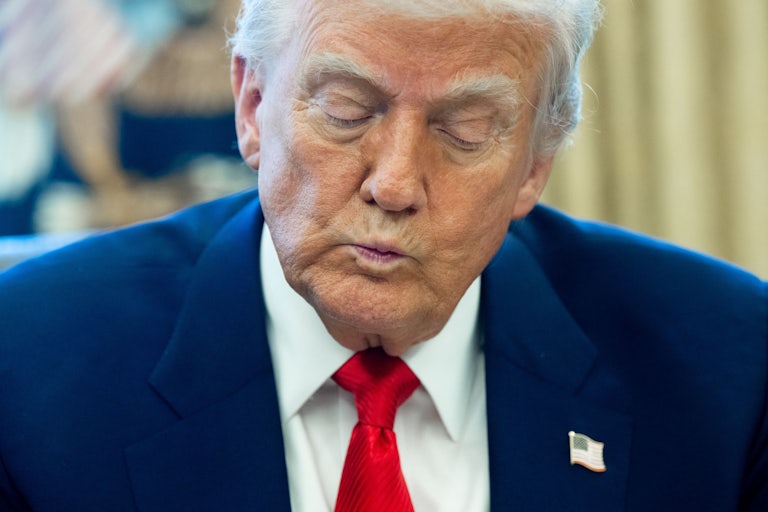
Donald Trump purses his lips while sitting in the Oval Office
Saul Loeb/AFP/Getty Images

The public reaction to Donald Trump’s tariff reversal has not been good.

CNN’s John Berman decided to spew off a list of headlines Thursday morning related to the market frenzy while introducing Republican strategist David Urban, who was left with little more than sticks and stones and some misdirection to defend the president’s whiplash tariff rollout and his subsequent cave.

“Let’s go over some of the headlines and leads in today’s papers,” Berman started. “The Washington Post, ‘Trump Blinked.’ Wall Street Journal opinion, ‘Trump Blinks.’ The New York Times lede says ‘Bond Yields cause Mr. Trump to blink.’ The Financial Times, ‘Why did Donald Trump buckle?’

“And just for the sugar on top here, Politico says, ‘Getting yippy with it,’ and Puck says, ‘Un-liberation Day,’” Berman continued.

“So David Urban, blink, blink, buckle,” Berman concluded, before asking Urban, “Was this all bungled?”

“No, John, I don’t think it was bungled. I think that the markets got a little skittish,” Urban said. “I think the House and Senate are working diligently to get this tax bill done and get some things pushed through.”

Urban then blamed the markets, claiming that if investors “were a bit more patient,” they would have seen the administration get “a lot of good things done.” The lobbyist then posited that a forthcoming “stablecoin bill” would make the U.S. dollar stronger again on a global scale.

“However, you know, the bond markets, as you noted there, really put a scare into the administration, I think, when the cost of borrowing for the federal government goes way, way up and the U.S. dollar doesn’t become the reserve currency, which was what it looks like when you have a bond market sell-off like it was happening,” Urban said. “I think that’s what caused the pause button to be pushed.”

But Urban conceded, ultimately, that no one can know how the markets will react.

Trump appeared to intentionally sow volatility last week, when he announced some 200 tariffs on countries around the world (whose rates were discovered to be founded on bad math). After a week of panicked investors and a tanking economy, as well as a midday trade war with China, Trump decided to undo it all, with the White House revealing that it would be pausing the majority of its tariffs (except on China) and lowering the tariffs to a universal baseline rate of 10 percent. That sent the market into a different kind of frenzy, whose biggest winners were the demographic already with the most money: billionaires.

White House Censoring Embarrassing Pool Reports of Trump

Trump is still continuing his war on the White House press pool.

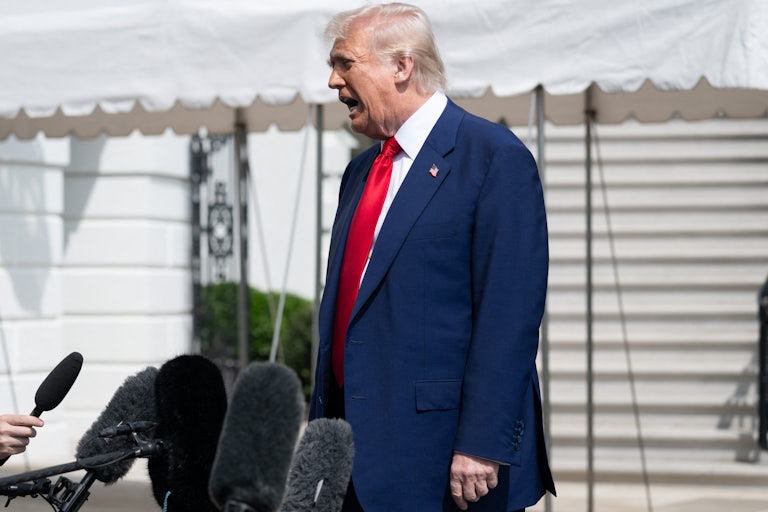
Donald Trump speaks to reporters outside the White House.
PAUL LOEB/AFP/Getty Images

In its latest attack on the free press, the Trump administration is withholding pool reports that make it look bad.

Two recent dispatches from White House pool reporters, a rotating group of reporters designated to cover the president and share information with the rest of the press corps, never made it public, Status reported Wednesday.

On Tuesday evening, Dallas Morning News reporter Joseph Gordon, who was in the pool that day, sent a standard email noting that reporters were following Trump to a dinner but that two photographers from the Associated Press were “turned away from joining the pool.” The pool report never made it to news outlets, Gordon later learned. In February, the Associated Press was banned from the White House press pool for refusing to adopt Trump’s renaming of the Gulf of Mexico to the Gulf of America, but a judge ordered the White House to lift the ban Tuesday.

Also earlier this week, Philip Wegman of RealClearPolitics sent a report noting the abrupt cancellation of a joint press conference with Trump and Israeli Prime Minister Benjamin Netanyahu. That report also never made it to press, Status reported.

The White House press pool is essential to distributing information to news outlets across the country, and the censorship of its reports marks yet another attempt by the Trump administration to control journalists. In February, White House press secretary Karoline Leavitt announced Trump’s press team would take over the press pool and determine which journalists get to travel with the president, declaring the job “a privilege, not a legal right.”

The announcement broke decades of historical precedent and marked the beginning of unparalleled hostility between the White House and reporters. Trump, Leavitt, and other MAGA members have since tried a number of ways to control the media and avoid being held accountable for their attack on democracy—it looks like censoring pool reports is their next attempt to do so.

Cognitive Decline? Trump Appears to Have No Clue What’s Happening

Donald Trump seemed confused about what was going on with the budget bill.

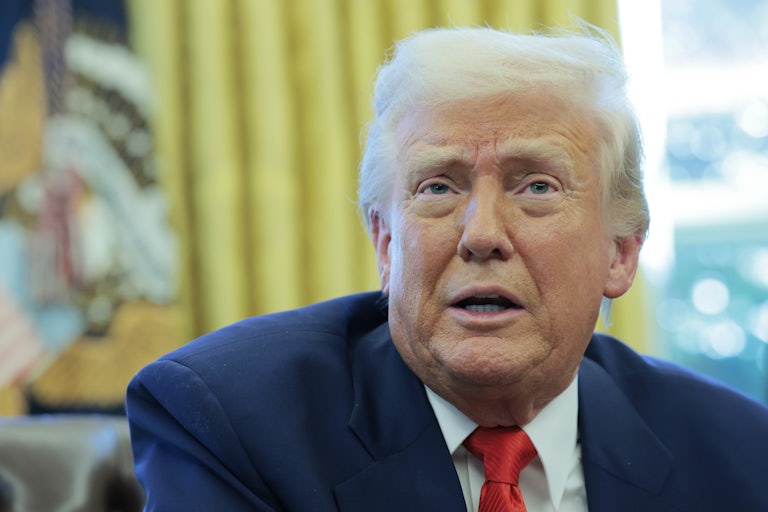
Donald Trump speaks to reporters in the Oval Office
Anna Moneymaker/Getty Images

Donald Trump claimed that his party was “working nicely together,” just hours after House Republicans’ infighting forced them to delay a vote on a multitrillion-dollar budget bill.

“Great News! ‘The Big, Beautiful Bill’ is coming along really well. Republicans are working together nicely. Biggest Tax Cuts in USA History!!! Getting close,” Trump wrote on Truth Social Thursday morning.

House GOP members were anything but united. The night before, Republican Representative Rich McCormick told CNN’s Manu Raju that there were still 15 Republican holdouts on the bill, which would provide the funding for Trump’s sweeping agenda, including tax cuts and bolstering immigration initiatives.

Representative Thomas Massie, who has become a regular holdout against Republican-backed government spending bills, said that a provision Republicans had added that would prevent efforts to roll back Trump’s tariffs was “illegal.”

“They used the Rules Committee resolution to circumvent U.S. law,” Massie told Raju.

On Wednesday night, House Speaker Mike Johnson said he hadn’t decided how best to rally Republican support behind the budget blueprint.

“We have a pretty well-developed playbook, and it’s got a number of plays in it, and I just haven’t made the call on which one it is yet,” he said.

House Republicans are expected to vote again on the bill at 10:20 a.m. before setting off on a two-week recess.