Breaking News
Breaking News
from Washington and beyond

House Republicans Want to Punish Single Parents

House Republicans have introduced a new rule that would make it harder for single parents to feed their kids.

A person pulls a wheeled basket behind them in a grocery store aisle
Artur Widak/NurPhoto/Getty Images

Republicans on the House Agriculture Committee may make it harder for single parents to access the Supplemental Nutrition Assistance Program, or SNAP.

A new provision in Republicans’ 97-page bill, rolled out Monday evening, allows for exceptions to the program’s work requirements for some able-bodied adults, including certain married parents, without making the same considerations for single parents.

The general work requirements for SNAP benefits include registering for work, participating in SNAP Employment and Training, or E&T, taking a suitable job if offered, and not voluntarily quitting or reducing work hours below 30 a week without a good reason, according to the USDA Food and Nutritional Service.

Republicans’ new bill includes a work-requirement exception for an individual who is “responsible for a dependent child 7 years of age or older and is married to, and resides with, an individual who is in compliance” with the work requirements, but contains no equivalent exception for single parents.

In 2022, children in single-parent families made up a 53 percent majority of SNAP recipients, according to a report from the Institute for Family Studies. A whopping 49 percent of those children are living with their mothers, 4 percent reside with their fathers, and 6 percent reside with relatives or foster parents.

On top of that, E&T requirements have created something of a catch-22 within the SNAP benefits program. Congress’s 2018 farm bill, which permitted paid training to be a component in E&T, inadvertently resulted in significant reduction or total loss of food assistance for beneficiaries because the earnings they made ended up counting against their eligibility.

The new legislation would tighten eligibility requirements for SNAP and place a greater financial burden on states instead of the federal government, which is looking to shed millions of dollars in spending as part of the Trump administration’s cost-cutting efforts. Republicans on the House Agriculture Committee have been directed to find $230 billion in potential cuts.
Trump Is Now Holding States’ Disaster Relief Hostage

Donald Trump is increasing pressure on states that refuse to join his war on immigrants.

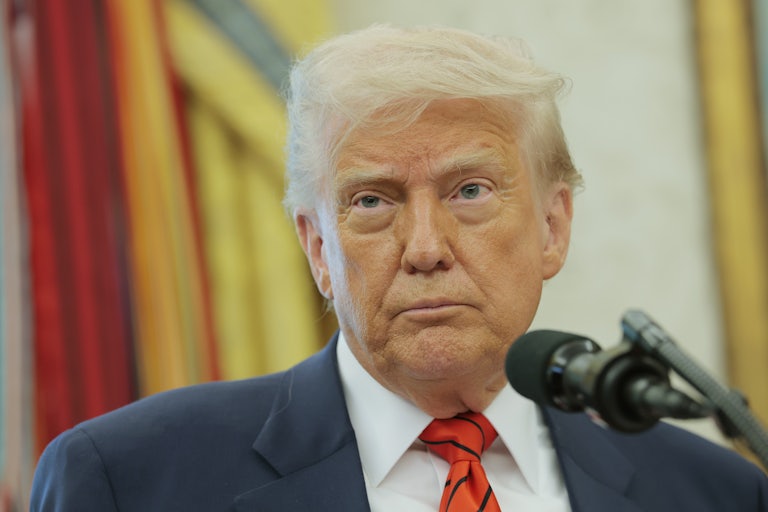
Donald Trump stands before a mic in the White House.
Anna Moneymaker/Getty Images

Trump is holding hostage the emergency disaster relief and transit funding of states that don’t agree with his immigration demands, according to two lawsuits filed by several states Tuesday.

The lawsuits claim that the White House is using cuts to federal aid to threaten states into supporting President Trump’s mass deportations, putting their infrastructure and emergency response abilities at risk.

“By hanging a halt in this critical funding over states like a sword of Damocles, defendants impose immense harm on states, forcing them to choose between readiness for disasters and emergencies, on one hand, and exercising their judgment about how to best use scarce resources to investigate and prosecute crimes on the other,” a draft of one of the complaints states.

One of the parties to the lawsuits, New York, claims that it could lose hundreds of millions of dollars in funding for bomb squads, hazmat units, emergency relief services, and SWAT teams that were vital in the state’s response to hurricanes and the Covid-19 pandemic.

Other states joining the lawsuit include California, Rhode Island, Illinois, and more than 12 others. In one of the complaints, they cite the Department of Homeland Security’s new “Standard Terms and Conditions,” which state that emergency relief grants to states depend on them providing help with deportation efforts and ending any program that “benefits illegal immigrants or incentivizes illegal immigration.”

The other lawsuit, filed by many of the same states, is directed at the Department of Transportation over the agency’s declaration last month that it would halt funding for any state that doesn’t cooperate with the Trump administration on immigration.

“On April 24, 2025, United States Secretary of Transportation Sean Duffy issued a letter to all recipients of U.S. DOT funding announcing its policy, for the first time, of imposing an immigration enforcement condition on all U.S. DOT funding,” the lawsuit draft states.

In both lawsuits, the states claim that their funding had already been approved by Congress without conditions, making the White House’s attempt to withhold funds illegal. It also seems to be an attempt by Trump to impound funds already appropriated by Congress, setting up a constitutional crisis.

But these two lawsuits aren’t even the first examples of Trump trying to withhold funds from states going against his deportation agenda: A federal judge found last month that the White House tried to secretly withhold disaster relief funds from states with immigration policies counter to Trump’s agenda. It seems that Trump is trying to strongarm state governments by using needed funding against them.

Trump Will Lift Sanctions on Syria After Massive Business Deal Offer

Donald Trump claimed he wanted to give Syria a chance to rebuild itself.

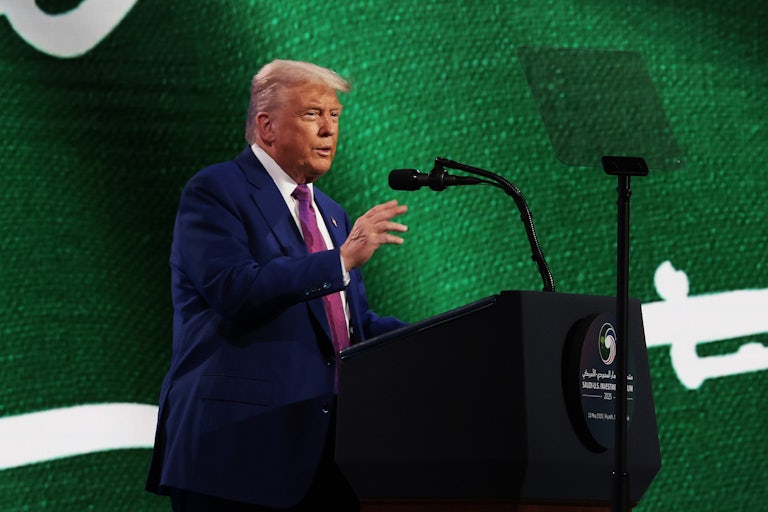
Donald Trump gestures while speaking at a podium onstage in Riyadh, Saudi Arabia
Win McNamee/Getty Images

Donald Trump announced Tuesday he will lift all U.S. sanctions on Syria, but the timing of the lifted international penalties was remarkably suspicious.

“I will be ordering the cessation of sanctions against Syria in order to give them a chance at greatness,” Trump told an auditorium in Riyadh, Saudi Arabia, describing the apparently unnecessary sanctions as “brutal and crippling.”

“In Syria, which has seen so much misery and death, there is a new government that will hopefully succeed in stabilizing the country and keeping peace. That’s what we want to see,” he continued. “In Syria, they’ve had their share of travesty, war, killing many years. That’s why my administration has already taken the first steps toward restoring normal relations between the United States and Syria for the first time in more than a decade.”

American caution toward Syria has spanned half a dozen administrations. Syria has been designated as a state sponsor of terrorism by the U.S. since 1979, when Syrian forces occupied Lebanon. The Bush administration slammed Syria with more sanctions in 2004, condemning Syria’s “pursuit of weapons of mass destruction” and its support for Hezbollah and Hamas, U.S.-designated terrorist organizations. The Obama administration imposed more sanctions on Syria in 2011, denouncing the country’s dictator, former President Bashar Al Assad, for human rights abuses against its protesting citizens.

“We’re taking them all off,” Trump said Tuesday.

But the decision to strip what had effectively become an embargo of Syrian goods followed another important development for the Trump family: the possibility of building a Trump Tower in Syria’s capital, Damascus.

“[Syrian leader Ahmed Al Sharaa] wants a business deal for the future of his country,” pro-Trump activist Jonathan Bass—who met with Sharaa for hours in late April—told Reuters Monday.

Sharaa is working to meet face-to-face with Trump, but his priorities include economic revival, regional stability, and healed relations with Israel, according to Bass.

“He told me he wants a Trump Tower in Damascus. He wants peace with his neighbors. What he told me is good for the region, good for Israel,” Bass told the newswire.

As a reminder, it’s actually unconstitutional for presidents to profit from or receive compensation from foreign governments—but that hasn’t stopped Trump one bit. The Trump family’s Middle East real estate plans include a Trump-branded golf course in Qatar (as part of a $5.5 billion development project), a $1 billion Trump hotel and residence in Dubai, and a $2 billion cryptocurrency investment by an Abu Dhabi firm into one of Trump’s cryptocurrency projects, the World Liberty Financial coin.

The family also revealed in December that it would be expanding its presence in Saudi Arabia, announcing Trump Tower Jeddah. The price tag for the building has not been made public, but one of the developers on the project, Dar Global, compared it to another $530 million Trump Tower in the city, reported Reuters.

Trump Spends Entire Speech in Saudi Arabia Sucking Up to Despot

Donald Trump heaped praise on Saudi Crown Prince Mohammed bin Salman.

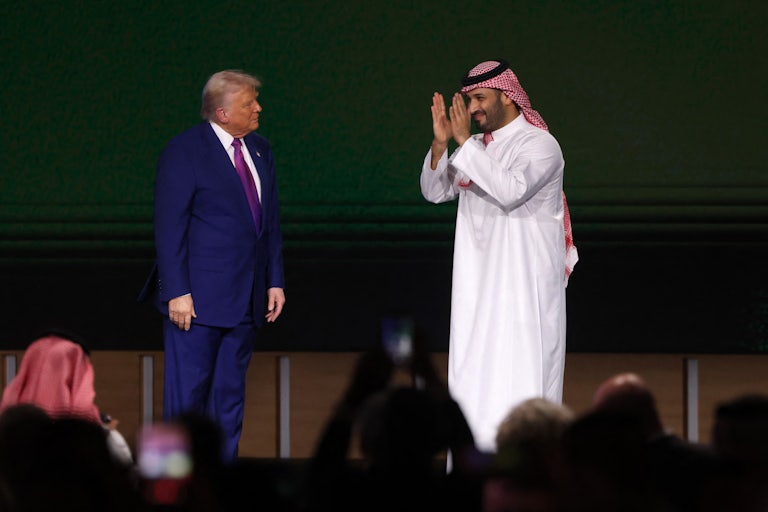
Donald Trump and Saudi Crown Prince Mohammed bin Salman stand next to each other on stage. MBS claps
Fayez Nureldine/AFP/Getty Images

Donald Trump got back into his hobby of sucking up to autocratic dictators Tuesday, when the U.S. president made several effusive comments about Saudi Arabia’s Crown Prince Mohammed bin Salman.

During a rambling address at a Saudi investment forum in Riyadh, the president showered the head of the country’s royal family with praise, touting the crown prince as an “incredible man.”

“We have great partners in the world, but we have none stronger, and nobody like the gentleman that’s right before me, he’s your greatest representative, your greatest representative,” Trump said, as MBS beamed up at him from the audience.

“And if I didn’t like him, I would get out of here so fast. You know that don’t you? He knows me well,” Trump said. “I do, I like him a lot. I like him too much, that’s why we give so much, you know? Too much. I like you too much!”

But who exactly does the president like so much? The 39-year-old prince rules over a modern surveillance state, where political dissent is not tolerated, and human rights standards are abysmal. MBS also serves as the chairman of Saudi Arabia’s massive sovereign wealth fund that has both facilitated and benefited from rights violations.

But still, a drowsy-sounding Trump couldn’t help from gushing over the kingdom.

“We are rockin’, the United States is the hottest country—with the exception of your country, I have to say, right?” Trump joked, addressing MBS in the crowd.

“I’m not going to take that on. No, Mohammed, I’m not gonna take that on. Wouldn’t that be a terrible thing if I made that full statement. I will not do it. You’re hotter! At least as long as I’m up here, you’re hotter.”

Trump also announced that he would be lifting sanctions against Syria to “give them a chase at greatness.” After the audience got through cheering, the president sighed, acknowledging that he’d just made a major U.S. policy shift at the behest of a foreign leader.

“Oh, what I do for the crown prince,” he said.

Republicans Slip Nonprofit Killer Bill Into Budget Plan

The “nonprofit killer bill” is hidden at the very end of Republicans’ massive 389-page budget package.

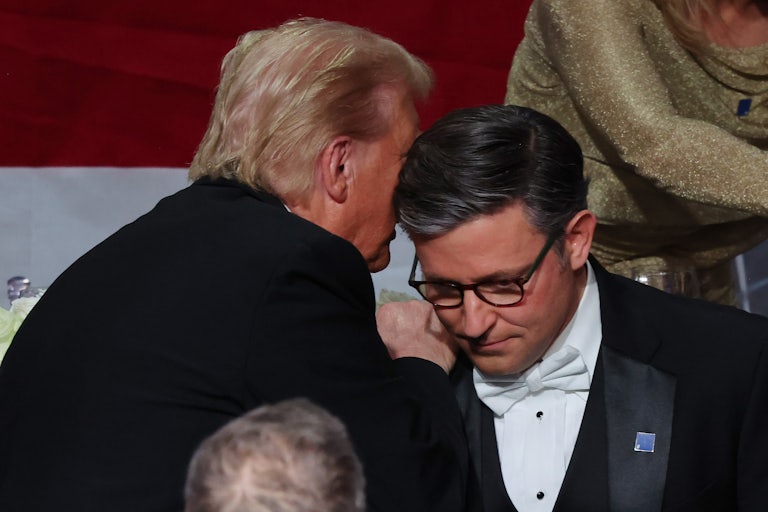
Donald Trump says something in Mike Johnson's ear. Others stand nearby.
Michael M. Santiago/Getty Images
Donald Trump and House Speaker Mike Johnson

House Republicans’ draft budget bill includes a clause to give Donald Trump the ability to revoke the tax-exempt status of any group the Treasury Department says is a supporter of terrorism. 

The move appears to be a revival of the Stop Terror-Financing and Tax Penalties on American Hostages Act, which the House passed in November under President Biden. The Senate had not taken up the measure, which drew criticism for granting dangerous powers to the president. Now those powers have resurfaced deep within the GOP’s “big beautiful bill”: on page 380, to be exact. 

Last year, 15 Democrats joined Republicans in the House to pass the anti–free speech bill, which was originally intended to help clamp down on pro-Palestinian protesters, particularly those on college campuses. Even though the bill has languished since then, Trump has still attempted to target nonprofit institutions that refuse to kowtow to him, including institutions such as Harvard University.

If the clause isn’t excised from the final bill and passes, Trump can target any nonprofit that he and the Republicans don’t like, whether they are focused on reproductive rights, climate change, refugee support, or anything else. The budget bill is going through the reconciliation process, meaning that it only requires a simple majority in the House and Senate to be passed. 

If party lines hold on this bill, the nonprofit clause can pass without a single Democratic vote. Will Democrats hold the line and try to mobilize to remove the anti-nonprofit clause? Or will the caucus once again be divided, with some Democrats supporting the measure?