Breaking News
Breaking News
from Washington and beyond

Republicans Slip Nonprofit Killer Bill Into Budget Plan

The “nonprofit killer bill” is hidden at the very end of Republicans’ massive 389-page budget package.

Donald Trump says something in Mike Johnson's ear. Others stand nearby.
Michael M. Santiago/Getty Images
Donald Trump and House Speaker Mike Johnson

House Republicans’ draft budget bill includes a clause to give Donald Trump the ability to revoke the tax-exempt status of any group the Treasury Department says is a supporter of terrorism. 

The move appears to be a revival of the Stop Terror-Financing and Tax Penalties on American Hostages Act, which the House passed in November under President Biden. The Senate had not taken up the measure, which drew criticism for granting dangerous powers to the president. Now those powers have resurfaced deep within the GOP’s “big beautiful bill”: on page 380, to be exact. 

Last year, 15 Democrats joined Republicans in the House to pass the anti–free speech bill, which was originally intended to help clamp down on pro-Palestinian protesters, particularly those on college campuses. Even though the bill has languished since then, Trump has still attempted to target nonprofit institutions that refuse to kowtow to him, including institutions such as Harvard University.

If the clause isn’t excised from the final bill and passes, Trump can target any nonprofit that he and the Republicans don’t like, whether they are focused on reproductive rights, climate change, refugee support, or anything else. The budget bill is going through the reconciliation process, meaning that it only requires a simple majority in the House and Senate to be passed. 

If party lines hold on this bill, the nonprofit clause can pass without a single Democratic vote. Will Democrats hold the line and try to mobilize to remove the anti-nonprofit clause? Or will the caucus once again be divided, with some Democrats supporting the measure? 
Elon Musk Just Hijacked Trump’s Saudi Visit to Land a Major Deal

Elon Musk also managed to promote every single one of his companies during a speech.

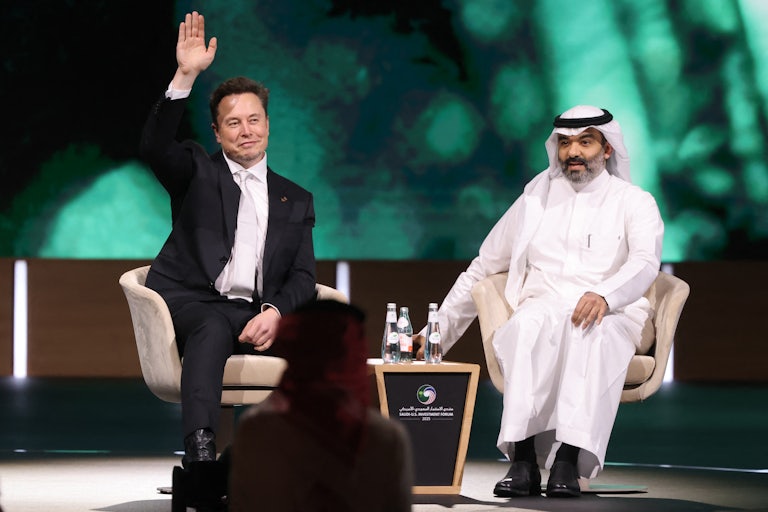
Elon Musk waves while sitting on stage in Riyadh, Saudi Arabia
Fayez Nureldine/AFP/Getty Images

Elon Musk announced Tuesday that Saudi Arabia had approved the use of Starlink, as part of his mounting efforts to use Donald Trump’s trip abroad to boost his many businesses. While speaking with Saudi Minister of Communications and Information Technology Abdullah Alswah on the White House–led trip, the billionaire bureaucrat thanked Crown Prince Mohammed bin Salman for approving his SpaceX–owned and operated satellite internet service for aviation and maritime use.

But Starlink wasn’t the only one of Musk’s businesses that got a plug to the president’s foreign friends. Musk said that he had shown Trump and MBS several of Tesla’s Optimus humanoid robots, which are still undergoing development. Musk warned last month that China’s suspension of rare earth metals exports, amid Trump’s slowly deescalating trade war, could potentially delay manufacturing.

Musk also discussed his ambitions to bring Tesla’s robotaxis to Saudi Arabia.

“I think it would be very exciting to have autonomous vehicles here in the kingdom, indeed, if you’re amenable,” Musk said. The U.S. National Highway Safety Administration is still probing Tesla on how well these autonomous vehicles will function in poor weather conditions, including sun glare and dust, which could potentially decrease their utility in a city like Riyadh, which experiences frequent sand storms.

But it seems Musk had a solution for this: He pitched that the Saudi government construct tunnels with the help of his Boring Company. “In order to solve traffic, you really need to go 3D with roads,” Musk said, describing tunnels as a novel kind of “wormhole” and not a classic feature of public infrastructure.

Musk began to plug his infrastructure and tunnel service after being prompted by Alswah to discuss yet another one of his companies, xAI. He described the goal of that project as to produce a “maximally truth-seeking” artificial intelligence.

“What questions do we not know to ask? Once you know the question, the answer is the easy part,” Musk said.

Alswah called Musk a “lifetime partner” to the kingdom, and said they were “joining hands” on “XAi, Starlink, robotics, and Tesla.”

Meanwhile, Trump’s first day in Saudi Arabia was off to a sleepy start. The president was filmed falling asleep during a briefing with MBS, shutting his eyes and jerking awake.

Old Man Trump Falls Asleep in Middle of Saudi Briefing on Arms Deal

Donald Trump appears to have dozed off in the middle of a key briefing.

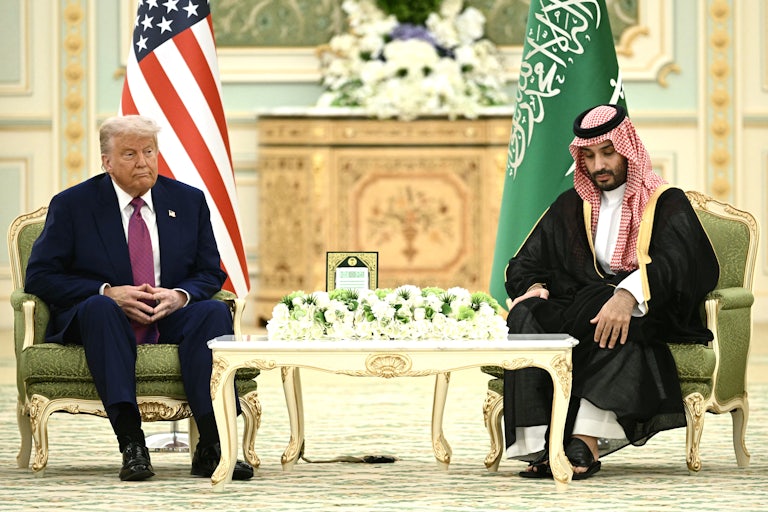
Donald Trump sits next to Saudi Crown Prince Mohammed bin Salman
Brendan Smialowski/AFP/Getty Images

The world record holder for oldest person to be sworn in as U.S. president can’t seem to keep up with the Saudis.

Donald Trump was filmed falling asleep during a briefing with Crown Prince Mohammed bin Salman in Riyadh, Saudi Arabia, Tuesday. Trump could be seen shutting his eyes and jerking awake.

The meeting consisted of signing more than a dozen agreements between the U.S. and Saudi Arabia, focusing on the governments’ economies, militaries, and cultural institutions, according to the Associated Press.

Podcaster Brian Allen torched the caught-on-camera faux pas as “surreal and frankly humiliating.”

“This isn’t jet lag—it’s a walking security risk with a nap schedule,” Allen posted on X.

The 78-year-old’s long-awaited medical report was released in April, describing Trump as being in “excellent health,” including neurological functioning.

“President Trump exhibits excellent cognitive and physical health and is fully fit to execute the duties of the Commander-in-Chief and Head of State,” the report read. Prior to the report’s release, the president said he took a cognitive exam and “got every answer right.”

Trump has an oddball history with reportedly “acing” cognitive exams. During the 2024 presidential election, Trump took several—but his recollections of the tests called into question whether he had actually taken them at all.

While bragging about his results to the press, Trump would invariably tweak the questions he allegedly received on the test, at times boasting that he had correctly recited five words and performed basic multiplication while at other times insisting that he had passed thanks to correctly identifying a whale. That is in spite of the fact that the test’s authors reported that none of the three versions in circulation actually had a whale on them.

And Trump has struggled with staying awake in public before—even when all eyes are on him. In April 2024, Trump was caught shutting his eyes during pretrial hearings for his criminal case involving porn star Stormy Daniels.

White Afrikaners Trash Trump’s Reason for Offering “Refugee” Status

Even white South Africans think Donald Trump’s offering them special immigration status is dumb.

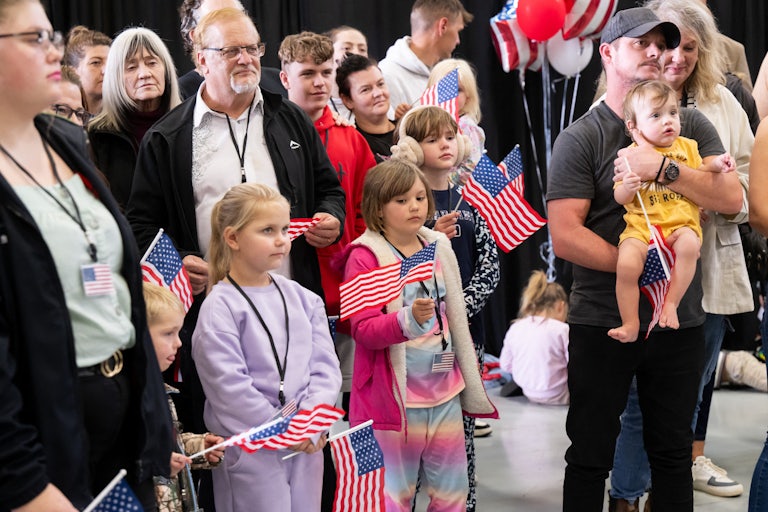
White Afrikaners stand and wave small American flags after arriving at Dulles Airport from South Africa
Saul Loeb/AFP/Getty Images

Donald Trump is paving the way for white South African “refugees” to come to the United States, but they’re not all that interested in taking him up on his offer, The Wall Street Journal reported Tuesday.

The U.S. president falsely claimed Monday that Afrikaners, the white descendants of mainly Dutch colonizers in South Africa, are facing a “genocide” in their home country. So then why don’t they actually want to leave?

Maritz Grobler, a tenth-generation South African on his father’s side who owns a sprawling 1,000-acre farm in Settlers, wasn’t interested in the offer to relocate. “This is my country,” Grobler told the Journal.

“But it’s good to know that [Trump] will back us … if shit happens,” he added.

While white South Africans are the target of horrific crimes, they are killed in significantly lower numbers than Black South Africans, according to the Journal.

White people account for roughly 7 percent of South Africa’s population of 63 million people, and of that number, Afrikaners make up about two-thirds, so roughly three million people in total. Despite having a vastly smaller population, white commercial farmers—the majority of whom are Afrikaners—still possess about half of the country’s land and produce a whopping 90 percent of its agricultural products. In 2024, South Africa’s agricultural exports were worth a record $13.7 billion.

Afrikaners have therefore maintained a hefty chunk of the nation’s wealth. Only 1 percent of white South Africans live in poverty, compared to nearly two-thirds of Black South Africans. This accumulated land and wealth is the direct result of systemic historical racial oppression under South African apartheid.

Despite one Trump official’s claim that white South Africans have been given an exception to Trump’s refugee ban because they would be supposedly easier to assimilate into the majority-white U.S. population than refugees from other countries, Grobler said that the cultural difference was still too great.

“I don’t want to speak English for the rest of my life,” Grobler said. White South Africans typically speak Afrikaans, not English. But it seems that language barrier likely won’t incense Vice President JD Vance the way it did when the hypothetical immigrant children he was mad at were brown.

Grobler told the Journal that politicians “seek power and money and get it through playing the race card and hammering on historic events.”

“South Africans on the ground will be able to move forward together if politicians get out of the way and go do their bloody jobs,” he added.

Trump’s Tariffs Are Good for One Thing: Saving Us From Podcast Bros

Donald Trump’s tariffs are having an unintended (but welcome) side effect.

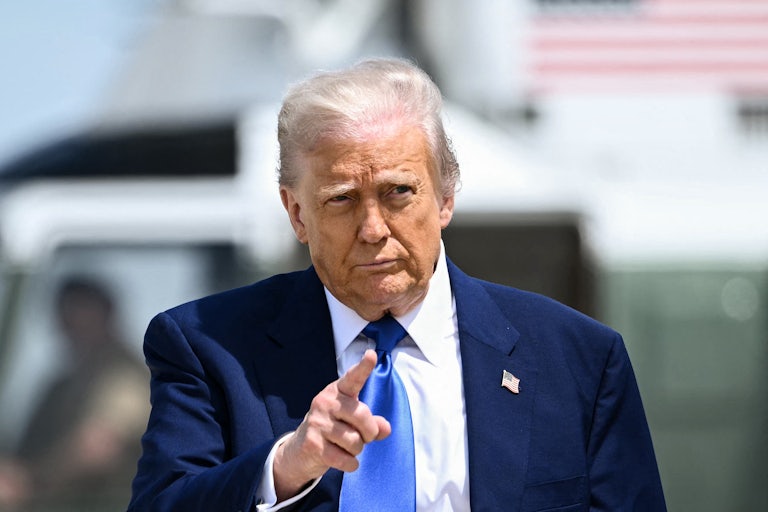
Donald Trump points while walking on an airport tarmac
Brendan Smialowski/AFP/Getty Images

Donald Trump’s appearances on several podcasts last summer helped him cinch important voting blocs, such as young male voters—but now the president’s economic plan could damage the audio industry.

All items on the consumer price index rose by at least 0.2 percent in April, according to data released Tuesday by the U.S. Bureau of Labor Statistics.

But some industries were hit even harder. Prices for audio equipment, for instance, rose by 8.8 percent, according to market columnist Sam Ro, who has a Substack called TKer.

“Podcasters are getting crushed,” Ro posted on X.

The president’s tariff rollout has been remarkably bad for business, sending investors on a roller-coaster ride since he first announced the plan in early April. As a result, working- and middle-class Americans have lost thousands of dollars in retirement savings, businesses have stalled on critical long-term decisions, and America has lost some of its most important international allies.

It was only the reversal of Trump’s corrosive tariffs on China—which on Monday dropped to 30 percent from 145 percent for the next 90 days—that rallied the markets.

The news also made the dollar flourish, surging 1.1 percent against several other currencies in the wake of the tariff pause to hit a one-month high. The dollar was still down 2.3 percent, however, since Trump first announced his sweeping plan.

“Now the conditions are falling into place for a deeper adjustment and a bigger recovery of the dollar to catch up with U.S. equities and bond yields,” Kenneth Broux, senior strategist at Societe Generale in London, told Reuters.

Still, market columnists have been quick to note that the 90-day truce between the two countries is “not a deal.” The Trump administration has promised sector-specific tariffs—something that could fundamentally undermine the fragile $600 billion trade agreement set in place over the weekend.

Trump has argued that tariffs are the best solution to closing the country’s trade deficits, which he has incorrectly likened to taxpayer-backed “subsidies” for other nations. He has claimed that without tariffs, the U.S. is transferring wealth to other countries while receiving nothing in exchange. He has also pitched that hiking tariffs on other nations would bring jobs and manufacturing opportunities back to American shores, but economists don’t agree with either point.

Instead, droves of financial and economic experts have insisted that tariffs on other nations will only serve to harm America and its markets, making products more expensive stateside and making American consumers less likely to spend their money (something that Trump doesn’t seem to have any problem with, actually). The Harvard Kennedy Business School even floated in April that America’s trade deficit basically doesn’t matter, writing that “Americans earn more from, or earn just about as much from, their total investments abroad as foreigners earn in the United States.”