Breaking News
Breaking News
from Washington and beyond

Sotomayor Rips SCOTUS for Causing Total “Chaos” in LGBTQ Books Case

Justice Sonia Sotomayor warned that the Supreme Court was actually enabling censorship.

Supreme Court Justice Sonia Sotomayor holds her glasses while standing in the royal palace in Madrid, Spain
Pablo Cuadra/Getty Images
Supreme Court Justice Sonia Sotomayor

Justice Sonia Sotomayor excoriated the nation’s highest judiciary Friday for ruling 63 to permit a group of Maryland parents to withdraw their children from LGBTQ+ exposure in the public school curriculum on the basis of religious freedom.

The progressive justice railed against the majority opinion, writing that the result of the decision will be “chaos” as school administrators are forced either to overextend themselves to accommodate parents’ newly constitutionalized authority or strip LGBTQ+ material from the curriculum entirely.

In a dissenting opinion, Sotomayor argued that the decision would “impose impossible administrative burdens on schools” by requiring them to provide advance notice to parents before they utilized or taught LGBTQ-related content, in order to give parents ample time to “opt out” of the lesson plan.

“The harm will not be borne by educators alone: Children will suffer too,” she said. “Classroom disruptions and absences may well inflict long-lasting harm on students’ learning and development.”

But worse still, according to Sotomayor, is the opening that the nation’s highest judiciary has handed to a vocal minority of parents to disrupt local democracies, allowing them to legally challenge the decisions of publicly elected school officials, sparking educational ramifications for all families whether they agree with the curricula or not.

“The majority closes its eyes to the inevitable chilling effects of its ruling,” she wrote. “Many school districts, and particularly the most resource strapped, cannot afford to engage in costly litigation over opt-out rights or to divert resources to tracking and managing student absences.

“Schools may instead censor their curricula, stripping material that risks generating religious objections,” Sotomayor continued. “The Court’s ruling, in effect, thus hands a subset of parents the right to veto curricular choices long left to locally elected school boards. Because I cannot countenance the Court’s contortion of our precedent and the untold harms that will follow, I dissent.”

The court’s decision Friday was the culmination of a three-year legal battle. In 2022, the Montgomery County school board approved the use of LGBTQ+ themed storybooks for elementary school–age children, including Uncle Bobby’s Wedding, in which a kid goes to her uncle’s same-sex wedding, as well as a book where a puppy gets lost in a Pride Parade. At the crux of Friday’s case was a decision made the following year by the Montgomery County school board, preventing parents from opting their kids out of the coursework.

The ruling is most likely to result in a reduction in LGBTQ-adjacent education across the country, as cash-strapped educators attempt to avoid ruinous lawsuits.

Legal experts analyzing the case were quick to point out other flaws riddled in the decision, arguing that the “level of subtlety” permitted by the court to constitute a religious liberty violation could cook up more lawsuits along other theologically contested lines.

“Case in point: arguably this would permit Christian Scientists to opt out of any book where a doctor heals someone,” posted American Immigration Council senior fellow Aaron Reichlin-Melnick.
Supreme Court Rules Homophobic Books Bans in Schools Are OK

The Supreme Court determined parents can “opt out” of letting their children see LGBTQ books in the classroom.

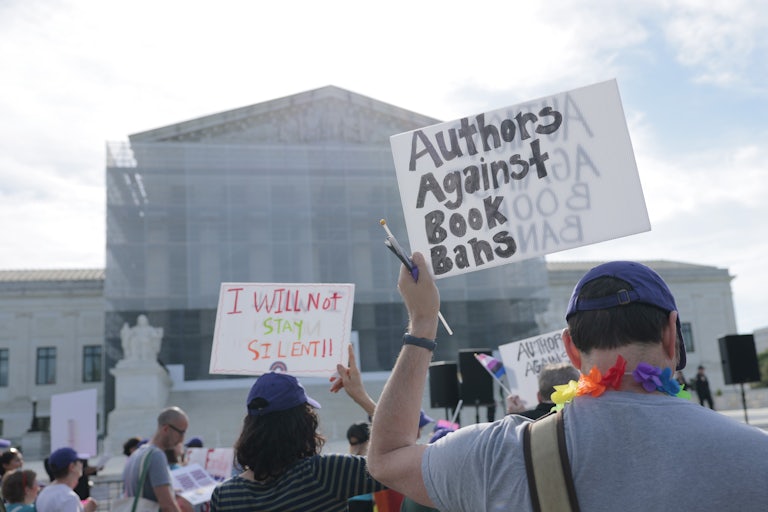
People protest against restrictions on access to LGBTQ books outside the Supreme Court in Washington, D.C.
Anna Moneymaker/Getty Images

Cue the book bans.

The Supreme Court sided Friday with a group of Maryland parents in Mahmoud v. Taylor, ruling 63 to allow them to pull their children from instruction that involves LGBTQ+ themes.

In 2022, the Montgomery County school board approved the use of LGBTQ+ themed storybooks for elementary school–age children, including a book in which a kid goes to her uncle’s same-sex wedding and a book where a puppy gets lost in a Pride Parade. At the crux of Friday’s case was a decision made the following year by the Montgomery County school board preventing parents from opting their kids out of the coursework.

The plaintiffs, who included a Muslim couple, two Roman Catholics, and a Ukrainian Orthodox individual, argued that the curriculum was violating their religious freedoms under the First Amendment and had stripped them of their right to teach gender and sexuality to their children under their own belief systems.

The majority of the justices viewed the issue as a relatively straightforward one, questioning if there would be any harm at all if the parents were allowed to keep their children away from the texts.

In a 135-page opinion, Justice Samuel Alito outlined that “the Board’s introduction of the ‘LGBTQ+-inclusive’ storybooks, along with its decision to withhold opt outs, places an unconstitutional burden on the parents’ rights to the free exercise of their religion.”

“We have long recognized,” Alito wrote, “the rights of parents to direct ‘the religious upbringing’ of their children. And we have held that those rights are violated by government policies that substantially interfere with the religious development of children.”

But not everyone was aligned.

“Today’s ruling threatens the very essence of public education,” wrote Justice Sonia Sotomayor in a dissenting opinion, chastizing the court’s decision to constitutionalize a parent’s veto power over decisions historically left to local administrators. “The reverberations of the Court’s error will be felt, I fear, for generations.”

The decision comes at an especially volatile time for the LGBTQ+ community, as conservatives place a target on transgender athletes and fearmonger over bathroom access, all while book bans surge around the country. The ruling and chipping away of LGBTQ+ freedoms also come on the heels of another Supreme Court decision.

Last week, the nation’s highest judiciary ruled along ideological lines in U.S. v. Skrmetti that states may ban minors from receiving gender-affirming care, such as hormone treatments and puberty blockers—ironically, denying parents the right to choose that Alito vaunted in Friday’s decision.

Trump Treasury Secretary Makes Humiliating Admission About Trade Deals

So much for 90 deals in 90 days

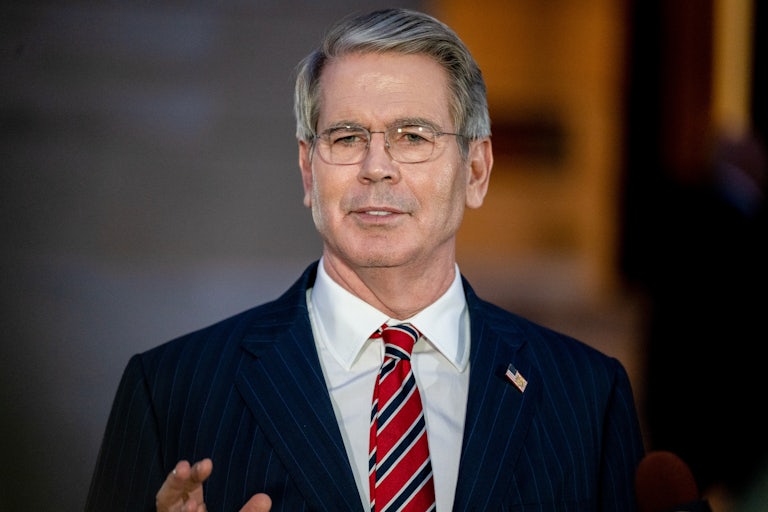
Treasury Secretary Scott Bessent gestures while speaking to reporters
Chris J. Ratcliffe/Bloomberg/Getty Images
Treasury Secretary Scott Bessent

Treasury Secretary Scott Bessent admitted Friday morning that Donald Trump’s trade negotiations will likely continue into September.

During an appearance on Fox Business’s Mornings With Maria, Bessent moved the goalposts for Trump’s flailing trade negotiations yet again, as he struggled to answer simple questions about progress with other countries.

“What is the next country we should expect a trade deal to do with the United States?” asked host Maria Bartiromo. “Are you gonna be able to get some deal announcements beyond just the U.K. before this August deadline, when we’re gonna hear from the Court of the International Appeals?”

It’s not entirely clear what August deadline Bartiromo is citing, but she may have been referring to early August, when an appeals decision is expected of the U.S. International Court of Trade’s decision to block Trump’s tariffs under the International Emergency Economic Powers Act.

Trump announced two weeks ago that he and the U.K. had finally signed a trade deal. Trump also claimed Thursday that China had signed a trade deal just the day before, although Bessent notably did not mention the Asian nation in his mealymouthed defense.

“Maria, you know with all things, they get done at the end. You have to put on a deadline. As you and I know, nothing gets done in Washington well in advance. So, I think a lot of the countries are feeling pressure,” Bessent replied.

Bessent insisted that Trump was ready to go back to the original “Liberation Day” tariff levels, if satisfactory agreements weren’t reached. Bessent said that there were only 18 truly important trading partners, and referred to Commerce Secretary Howard Lutnick’s claim that the U.S. had 10 imminent deals coming.

“So, you know, if we can ink 10 or 12 of the important 18, then there are another important 20 relationships, then I think we can have trade wrapped up by Labor Day,” Bessent said.

Even if the Trump administration did succeed in getting 10 new trade agreements by Labor Day, that wouldn’t constitute failing to complete deals “in advance”—it would be months after the initial July 8 deadline. It also falls far short of the administration’s “90 deals in 90 days” promise.

Bessent’s waffling comes just hours after White House press secretary Karoline Leavitt said the July 9 deadline for reimposing steep global tariffs was “not critical.”

Supreme Court Caves to Trump in Ominous Birthright Citizenship Ruling

The Supreme Court has just limited the ability of lower courts to rein in Donald Trump’s anti-constitutional orders.

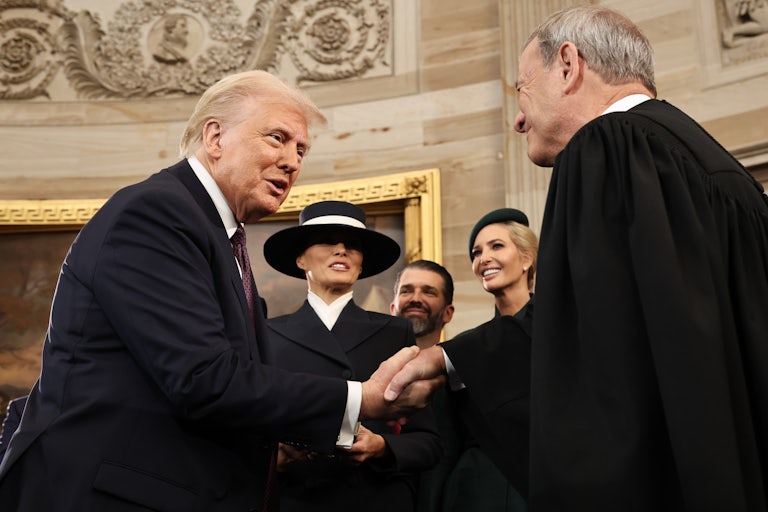
Donald Trump shakes hands with Chief Justice John Roberts during his inauguration as Melania Trump, Ivanka Trump, and Donald Trump, Jr. all look on and smile.
Chip Somodevilla/Getty Images
Donald Trump shakes hands with Chief Justice John Roberts during his inauguration on January 20.

The Supreme Court on Friday delivered Donald Trump a win in his ongoing war against birthright citizenship—limiting lower courts’ ability to issue nationwide injunctions, effectively eroding their ability to rein in anti-constitutional orders.

In a 6–3 decision, the court did not rule on the constitutionality of Trump’s January 20 executive order on birthright citizenship, which seeks to deny automatic citizenship to children born on U.S. soil to undocumented immigrants and those with temporary status.

However, the decision grants Trump’s request to do away with nationwide pauses on its enforcement. “Universal injunctions likely exceed the equitable authority that Congress has given to federal courts,” the court stated, in a decision written by Justice Amy Coney Barrett.

Joining Barrett were Chief Justice John Roberts and Justices Clarence Thomas, Samuel Alito, Neil Gorsuch, and Brett Kavanaugh. Liberal justices Sonia Sotomayor, Elena Kagan, and Ketanji Brown Jackson all dissented.

Sotomayor said that the “gamesmanship” in Trump’s request to stay the injunctions “is apparent and the Government makes no attempt to hide it. Yet, shamefully, this Court plays along.” Her dissent concludes: “With the stroke of a pen, the President has made a ‘solemn mockery’ of our Constitution. Rather than stand firm, the Court gives way. Because such complicity should know no place in our system of law, I dissent.”

Jackson filed a dissent agreeing with Sotomayor, but emphasizing that the court’s decision “is an existential threat to the rule of law.” The majority opinion, Jackson said, “gives the Executive the go-ahead to sometimes wield the kind of unchecked, arbitrary power the Founders crafted our Constitution to eradicate.”

Trump’s executive order was swiftly challenged in court—and rightly so, as it rides roughshod over the Fourteenth Amendment (and long-established Supreme Court precedent). Federal district courts in Massachusetts, Maryland, and Washington issued nationwide preliminary injunctions, preventing the government from enforcing a challenged policy not just against the parties involved in the lawsuit or people in a certain jurisdiction, but against everyone across the country.

This order blocks those universal injunctions—and gives Trump a powerful new tool to roll back civil liberties nationwide.

Republicans Forced to Remove Gun Deregulation From Budget Bill

Senate Republicans were blocked from using their sweeping budget bill to eliminate regulations on guns and gun silencers.

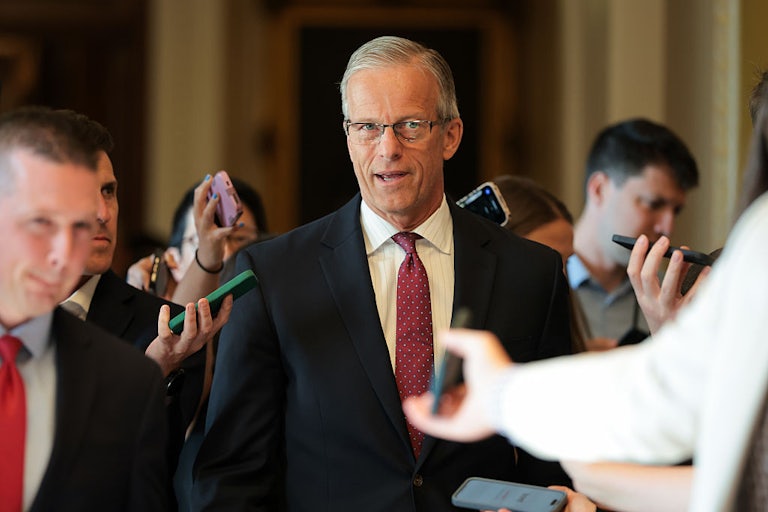
Senator John Thune speaks to reporters in the Capitol.
Kayla Bartkowski/Getty Images

The Senate parliamentarian has shot down another batch of provisions in Trump’s “big, beautiful bill”—this time including one that would’ve deregulated gun silencers and certain firearms.

Being a budget reconciliation, the Senate GOP’s bill can pass with a simple majority and elude a filibuster. However, it cannot contain non-budgetary provisions, and Parliamentarian Elizabeth MacDonough has in recent days been trimming away measures that run afoul of this rule.

According to a Friday press release from Senate Budget Committee Ranking Member Jeff Merkley, newly nixed provisions include one that would have eliminated a $200 tax—as well as certain background checks—to acquire gun silencers.

The provision also appeared in the version of the bill that passed the House in May, thanks to the efforts of Republican Representative Andrew Clyde, who owns a Georgia gun shop. But the Senate’s version went further than the House’s, as it would have eliminated the abovementioned hurdles for those purchasing sawed-off rifles and shotguns as well.

Now, in order for this and other rejected provisions to pass as written, the Senate would have to accomplish the unthinkable task of overcoming the 60-vote hurdle to overcome a filibuster.

MacDonough has dealt some significant blows to the Trump agenda in recent days, as GOP lawmakers are under the gun—with their self-imposed July 4 deadline to pass Trump’s tax and spending plan fast approaching. The parliamentarian’s cuts have rankled Republicans so much that some are calling for Senate Majority Leader John Thune to overrule or fire her, though Thune has expressed no interest in doing so.