Breaking News
Breaking News
from Washington and beyond

Corporation for Public Broadcasting Shuts Down Thanks to Trump’s Cuts

You’ll miss the CPB when it’s gone.

PBS building
Kayla Bartkowski/Getty Images

The Corporation for Public Broadcasting will be shutting down in response to federal funding cuts, it announced on Friday.

The closure marks a victory in Donald Trump’s war against public media. The CPB’s announcement cites the federal recissions package, which clawed back $1.1 billion in previously approved funding for the organization, and its exclusion from a fiscal spending bill for the first time in over five decades.

“Despite the extraordinary efforts of millions of Americans who called, wrote, and petitioned Congress to preserve federal funding for CPB, we now face the difficult reality of closing our operations,” said CPB president and CEO Patricia Harrison.

The company, which helps support more than 1,500 locally managed public television and radio stations nationwide, including NPR and PBS, will begin an “orderly wind-down” of its operations, including the termination of the majority of its employees by September 30.

Organizations like NPR and PBS have been the targets of Republican ire for years over alleged liberal bias. The national organizations will survive the CPB’s announcement, since they receive most of their funding through nongovernmental sources. But small, local news stations that serve rural areas will be seriously affected by these closures.

Some stations, like KCUW in Pendleton, Oregon; KUHB in St. Paul, Alaska; and WVLS in Monterey, Virginia; rely on CPB for 90 percent of their funding, according to Axios.

“Public media has been one of the most trusted institutions in American life, providing educational opportunity, emergency alerts, civil discourse, and cultural connection to every corner of the country,” Harrison said in the announcement. “We are deeply grateful to our partners across the system for their resilience, leadership, and unwavering dedication to serving the American people.”
Why Is Ghislaine Maxwell Being Transferred to a Nicer Prison?

Maxwell’s transfer to a minimum-security prison raises concerns that the Trump administration is preparing to pardon her in exchange for favorable testimony about the president’s long friendship with Jeffrey Epstein.

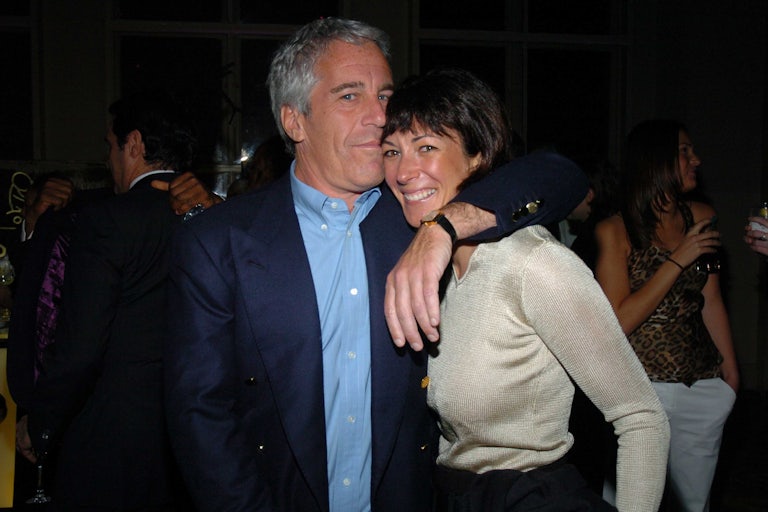
Jeffrey Epstein puts his arm around Ghislaine Maxwell's shoulder and his mouth near her forehead.
Joe Schildhorn/Patrick McMullan/Getty Images
Jeffrey Epstein and Ghislaine Maxwell

Ghislaine Maxwell has been moved to a minimum-security prison amid speculations that Donald Trump might pressure the Epstein co-conspirator to clear his name.

A spokesperson for the U.S. Bureau of Prisons confirmed that Maxwell had been moved to the Federal Prison Camp Bryan, a women-only, minimum-security prison in Bryan, Texas. She had previously been held at FCI Tallashassee, a low-security facility in Florida.

Just 24 hours earlier, a Trump administration official told CNN that the government had no such plans to go easy on Maxwell. “No leniency is being given or discussed. That’s just false,” the official said. “The president himself has said that clemency for Maxwell is not something he is even thinking about at this time.”

Maxwell’s sudden move arrives amid swirling rumors that the president may try to offer her a presidential pardon in exchange for helping him disperse the heightened scrutiny over his numerous mentions in the Epstein files, which the government had coincidentally decided not to release.

The family of Virginia Giuffre, the former Trump employee who claimed she was recruited by Maxwell at 16 to travel with the convicted sex offender, previously warned against giving Maxwell leniency and blasted Maxwell’s favorable treatment in a Friday statement

It is with horror and outrage that we object to the preferential treatment convicted sex trafficker Ghislaine Maxwell has received. Ghislaine Maxwell is a sexual predator who physically assaulted minor children on multiple occasions, and she should never be shown any leniency. Yet, without any notification to the Maxwell victims, the government overnight has moved Maxwell to a minimum security luxury prison in Texas. This is the justice system failing victims right before our eyes.  The American public should be enraged by the preferential treatment being given to a pedophile and a criminally charged child sex offender. The Trump administration should not credit a word Maxwell says, as the government itself sought charges against Maxwell for being a serial liar. This move smacks of a cover up. The victims deserve better.

Earlier this week, the president claimed that Epstein “stole” Giuffre, sparking widespread outrage and inviting even more questions about whether he had been aware of his old friend’s alleged sex trafficking.

Other high-profile inmates at the Maxwell’s new digs in the Lone Star State include fake-blood extractor Elizabeth Holmes and Jen Shah of Real Housewives of Salt Lake City infamy.

Trump Moves U.S. One Chilling Step Closer to War With Russia

Donald Trump says he is moving nuclear submarines to be positioned near Russia.

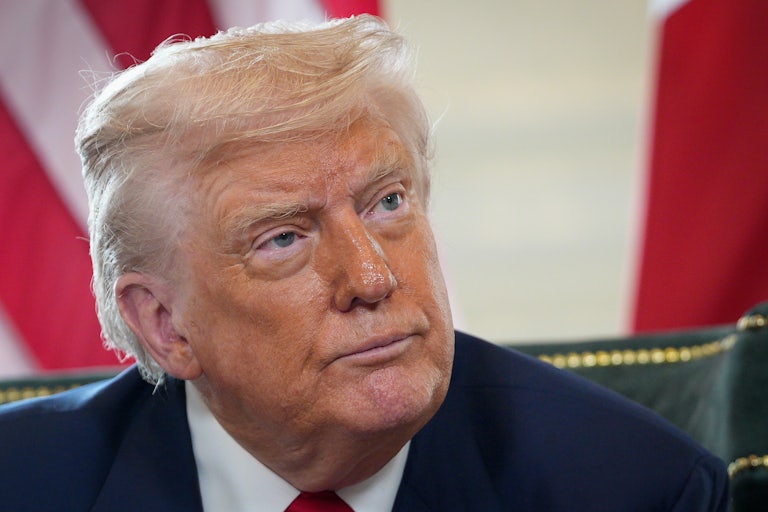
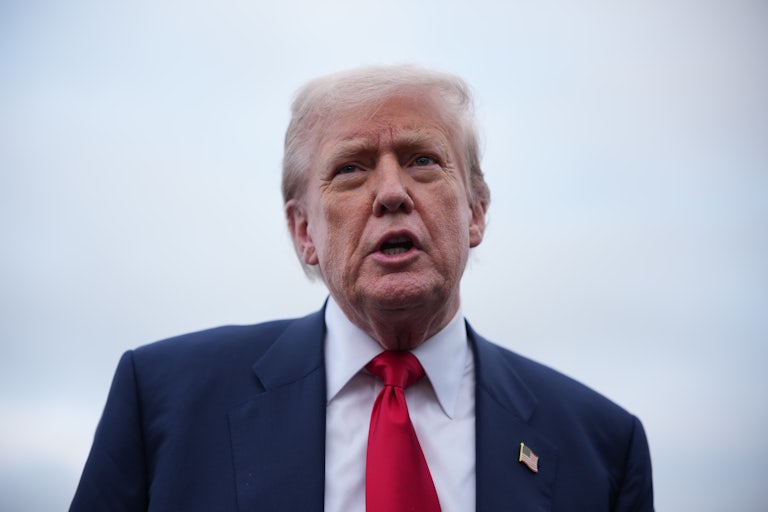
Donald Trump speaking
Andrew Harnik/Getty Images

Donald Trump has reportedly ordered two nuclear submarines to be positioned closer to Russia after escalating a war of words with former Russian President Dmitry Medvedev.

The president posted on Truth Social on Friday, saying, “I have ordered two Nuclear Submarines to be positioned in the appropriate regions, just in case these foolish and inflammatory statements are more than just that.”

Trump and Medvedev, the deputy chairman of Russia’s Security Council, have been sparring online since Trump shortened his deadline for Russia to reach a ceasefire with Ukraine, lest the country incur his famous tariffs. Medvedev wrote on Monday that “each new ultimatum is a threat and a step towards war” with the U.S.

Trump fired back, telling the chairman to “watch his words.” Then Medvedev responded, warning Trump about the “fabled ‘Dead Hand,’” Russia’s secretive nuclear missile system, set to fire automatically if Moscow’s leadership is taken out.

Now Trump has responded by sending nuclear submarines—which have the capacity to launch nuclear weapons but do not necessarily carry them—to the “appropriate regions.”

Known for his hawkishness, Medvedev is generally regarded as nothing more than a “social-media attack dog” by Russian President Vladimir Putin and his circle, according to The New York Times. But luckily for Medvedev, we have a social media president. If only he wasn’t armed with the nuclear codes.

Trump Is Now Running the Worst Economy Since His Last Term in Office

The last three months have been brutal.

Trump scowls
Christopher Furlong/Getty Images

The last time America’s job numbers were this bad—besides the pandemic—was during the Great Recession.

Revisions to the last three months of job reports have moved the three-month growth average to 35,000, a lag that hasn’t emerged since 2010, and which some economists have said could indicate a recession is on the horizon.

“The labor market is much weaker than originally reported the last two months. While payrolls grew 73k in July, May and June data were revised down a total of 258k to 19k and 14k, respectively,” wrote Economic Policy Institute economist Elise Gould.

The health care and social assistance industries supplied practically all the new jobs over the last three months, while other sectors—including manufacturing, professional and business services, warehouse, retail, and government—lost jobs, according to the new figures.  

“Without health care, the last three months of payroll gains look like this: -53,000 in May, -45,000 in June, and -300 in July,” reported Bloomberg U.S. economy editor Matthew Boesler.

EPI chief economist Josh Bivens posited that if the U.S. enters a recession in the coming months, the “rapid softening/deterioration in the labor market” over the last three months will likely be marked in retrospect as the start of the country’s economic decline.

Trump administration officials blamed the abysmal numbers on “seasonal adjustment quirks,” though they failed to provide rationale on what made this season so different. In light of that, economists had their own ideas, pointing directly at Donald Trump’s trade policies.

“I’ve been calling this a ‘Frozen’ job market for awhile. Now I would call it a red flag,” wrote Navy Federal chief economist Heather Long. “Companies do not want to hire or invest with this much uncertainty about tariffs, inflation, etc.”

Federal Judge Delivers Scathing Rebuke to Trump’s Deportation Regime

“In a world of bad options, they played by the rules,” wrote U.S. District Judge Jia Cobb of immigrants with parole status.

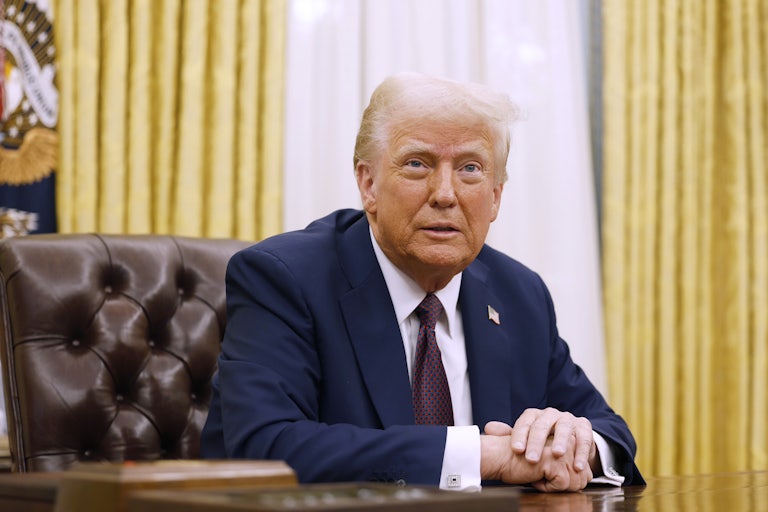
Trump folds his hands at the Resolute Desk
Anna Moneymaker/Getty Images

A federal judge offered a scathing rebuke of Donald Trump’s massive deportation scheme, while blocking the government’s attempts to remove immigrants who entered the country on parole.

U.S. District Court Judge Jia Cobb blocked three recent Department of Homeland Security actions that expanded the expedited removal of parolees, arguing that new policy changes were arbitrary and capricious and had exceeded its statutory authority.

In her 87-page ruling, Cobb slammed the Trump administration’s extrajudicial removals of immigrants who had been temporarily granted entry to the United States while awaiting admission application results, calling the case “a question of fair play.”

Plaintiffs who had followed the rules of their parole had suddenly been detained by immigration authorities. In some instances, their asylum cases had been abruptly dismissed, but in others they had not. Immigrants who had entered the country on parole were made subject to expedited removal, which provides minimal opportunities for immigrants to challenge their deportation.

“In a world of bad options, they played by the rules,” Cobb wrote. “Now, the Government has not only closed off those pathways for new arrivals but changed the game for parolees already here, restricting their ability to seek immigration relief and subjecting them to summary removal despite statutory law prohibiting the Executive Branch from doing so.”

“This case’s underlying question, then, asks whether parolees who escaped oppression will have the chance to plead their case within a system of rules. Or, alternatively, will they be summarily removed from a country that—as they are swept up at checkpoints and outside courtrooms, often by plainclothes officers without explanation or charges—may look to them more and more like the countries from which they tried to escape?”

Cobb determined that the parolees represented by the plaintiff nonprofit organizations, and the hundreds of thousands of immigrants like them who’d been paroled at a port of entry, faced “imminent, irreparable injury” that “outweighs any harm to the Government or the public from pressing pause.”

The government actions, including the termination of the Cuban, Haitian, Nicaraguan, and Venezuelan parole program in March, would be stayed until a final verdict is reached.