Breaking News
Breaking News
from Washington and beyond

ICE Is Going to Sinister Lengths to Avoid Accountability

Planes used for deportation flights are flying without tail numbers so they’re harder for activists and watchdogs to track.

A plane sits on a runway in front of several military videos
JUSTIN HAMEL/AFP/Getty Images
A military plane used for deportation flights

The Trump administration and the aviation companies working for it have been purposely hiding the tail numbers on immigration flights to avoid public scrutiny and accountability, CNN reports. This move comes as the Trump administration’s immigration crackdown ratchets up in frequency and aggression, as deportation flights are up 15 percent from last year.

A plane removing a tail number is the equivalent of a car removing a license plate. With the tail number, civilians, journalists, and immigration organizations alike can keep an eye on which deportation flights are leaving, and to where. It also helps loved ones track their deported family members.

The flights are run by multiple private charter companies and at least one commercial airline, each of which have lucrative contracts with ICE.

Flightradar24, one of the websites that covers immigration, noticed in March that those subcontractors requested that their tail numbers be hidden from public flight-tracking sites and records, making them extremely difficult to follow. The bulk of these flights are domestic, moving detainees from facility to facility.

“Flights operated on behalf of the United States government are often unidentified at the government’s request. As subcontractors to the United States government, we ask that you direct your questions to them,” said a spokesperson from Avelo Airlines, a company that has dedicated three of its planes to ICE deportations.

“This is vital information to be able to understand how ICE is conducting its enforcement and deportation activities,” ACLU National Prison Project senior counsel Eunice Cho told CNN. “Sometimes this is the only information that the public has with respect to where ICE is placing people because of a general lack of transparency around detention and deportation under this particular administration.”

The Department of Homeland Security has yet to comment.
Trump’s D.C. Takeover Means He Can Ignore City Laws, Border Czar Says

Tom Homan claimed that Washington, D.C., is no longer a sanctuary city.

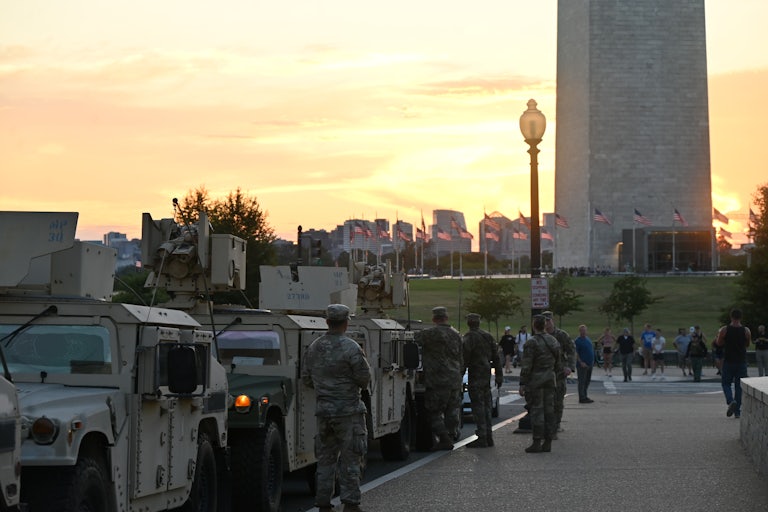
Members of the National Guard stand next to military vehicles parked by the Washington Monument
Kyle Mazza/Anadolu/Getty Images

Trump administration officials are offering blunt warnings for sanctuary cities: The democratically elected immigrant protection status does not matter.

Speaking with Fox News Wednesday, border czar Tom Homan spilled that Washington’s sanctuary city status was irrelevant now that the president had federalized the capital’s law enforcement.

“Does the fact that there’s National Guard now there—it’s a sanctuary city, like sanctuary cities across the country—but it’s unique in that it has federal control, and now you have the National Guard on the ground side by side with ICE. Does that combination basically negate the sanctuary city status in Washington, D.C.? At least for these 30 days, in terms of what you can do there, Tom?” asked host Martha MacCallum.

“Yes,” Homan said, plainly. “I think D.C. under federal control is not going to be a sanctuary city.

“We’re working with the police hand in hand, and when we encounter a criminal illegal alien, they will be turned over to ICE,” the former acting director of ICE continued. “And that’s the way it should be.

“I’m not saying every illegal alien in D.C. is a criminal. But many are,” Homan said. “There is no sanctuary for these people in the city of D.C.”

FOX: Does the National Guard and ICE being in DC negate its sanctuary city status? HOMAN: Yes ... there is no sanctuary for these people in the city of DC

[image or embed]

— Aaron Rupar (@atrupar.com) August 13, 2025 at 3:30 PM

Washington’s City Council unanimously approved the Sanctuary Values Amendment Act in 2019, and Mayor Muriel Bowser signed the act into law that same year. But Bowser has worked to undo that legacy since Trump returned to the White House, attempting to repeal Washington’s sanctuary status law in a 300-page budget bill. In June, the D.C. City Council erased the language in the budget that would have killed the sanctuary law in the board’s effort to retain the designation.

But Washington isn’t the only sanctuary city in the hot seat. In late May, the Department of Homeland Security released a list of some 35 regions, including 13 states, that it considered to be “deliberately obstructing the enforcement of federal immigration laws and endangering American citizens.” The states included California, Colorado, Connecticut, Delaware, Illinois, Minnesota, Nevada, New York, Oregon, Rhode Island, Vermont, and Washington, in addition to the nation’s capital.

During a press conference Monday announcing the imminent takeover, Trump warned that several of America’s liberal bastions could experience the same fate, specifically calling out New York City, Chicago, Los Angeles, Baltimore, and Oakland.

D.C. Officer on Trump’s Crackdown: It “Doesn’t Make a Lot of Sense”

D.C. Metropolitan Police Officer Daniel Hodges told MSNBC that putting troops in the nation’s capital will only make the job of actual law enforcement officers harder.

National Guard troops arrive in Washington D.C. on August 12
Anna Moneymaker/Getty Images
National Guard troops arrive in Washington, D.C., on August 12.

President Trump’s federal takeover of D.C. “doesn’t make a lot of sense” to D.C. Metropolitan Police Officer Daniel Hodges, he told MSNBC’s Chris Jansing on Wednesday. The interview highlights how the ongoing militarization of the nation’s capital is not only an authoritarian power grab but also a theatrical farce.

Hodges—who was attacked while defending the Capitol building on January 6, 2021—noted that the troops Trump has stationed in D.C. are not exactly cut out for the job.

The National Guardsmen patrolling the city’s streets are not “in their lane,” said Hodges, citing his six-year stint as a member of the Virginia National Guard. “I can tell you that this is not what they’re trained to do,” Hodges said. “Soldiers are trained to fight and win wars. We’re not in a war out here in D.C. There’s crime out here, but it’s not a war-torn hellscape like Trump has said. The troops are not trained to do law enforcement.”

As for the officers from various federal agencies now policing Washington, he said, “I don’t think this is really their specialization either. So many of these federal officers are investigators. They’re supposed to be behind a desk, you know, working that way.” Rather than helping local police in the harsher areas of the city, Hodges said, “you’re going to see [the federal agents] standing around in Chinatown or on the [National] Mall or walking around Georgetown.” (Social media footage from the first few days of Trump’s takeover shows them doing just that.)

In the event that President Trump actually wants to help local law enforcement, Hodges offered some advice. For one, he said, the president could “actually allow D.C. to spend its own money.” D.C., after all, is currently still “in the hole” by about $1 billion due to Republican cuts to the city’s budget. Further, Hodges suggested, the Federal Emergency Management Agency could undo its recent 44 percent cut in assistance to the city’s security funding.

“So there are things that they can do to help us out that they’re not doing, and I would love to know why,” he said.

There’s apparently much more of the nonsense Hodges describes to come. Trump on Wednesday announced plans to extend the D.C. occupation beyond 30 days, at which point—though he will require congressional approval under the Home Rule Act—he’s vowed to do so even without Congress’s green light. And the capital is apparently just a testing ground, as the president suggests he’ll bring similar crackdowns to cities across the country.

Trump Casually Lies About His Greatest Failure

The president claimed he had finished building a wall at the southern border on Wednesday.

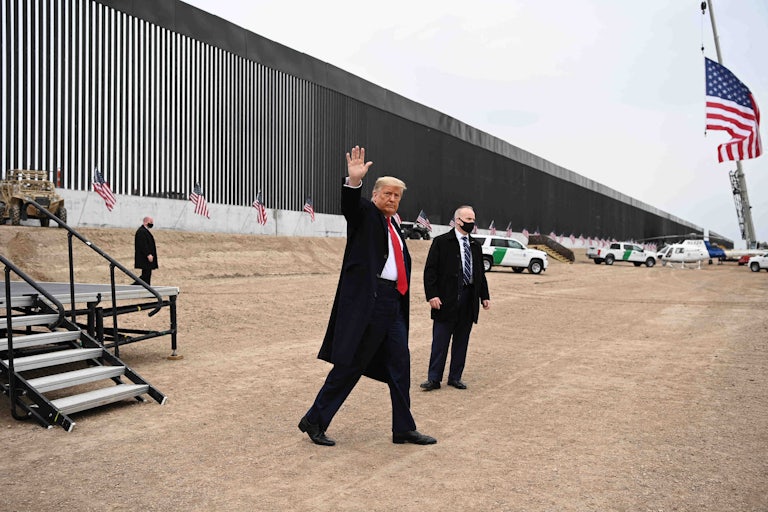
Trump waves in front of the border wall
MANDEL NGAN/AFP/Getty Images
Trump waves near a segment of the border wall he actually completed.

President Trump was accidentally caught in one of his favorite lies: that he finished the border wall between the U.S. and Mexico, one of the marquee promises of his first term.

“The Biden administration was auctioning off border wall materials, but we’re hearing now that … the auctioneer’s selling those materials back,” a reporter asked Trump while he took questions Wednesday at the Kennedy Center. “Are you finishing building the wall?”

“Well, I’ve built hundreds of miles of wall, and I was getting very close. I actually finished the wall, but then I added another 200 miles because when you do the original wall that I said I was gonna build—which I got built—and I got it to the specifications of the Border Patrol and ICE,” the president answered meanderingly. “They wanted steel, they wanted concrete inside, they wanted rebar inside that, they wanted it to have wires, the walls are wired for, you know, all of the internet stuff and security things.”

The president’s answer doesn’t make much sense. He said verbatim that he finished building the wall, but added on an extra 200 miles for the hell of it. How do you add 200 miles to a finished border wall without altering the border itself, which Trump never achieved?

He’s lying to avoid admitting that he failed at something. In reality, Trump only added 500 miles of border wall to a 2,000-mile border, and most of those wall pieces were for repair or reinforcement. And it wasn’t even a wall—it was a 30-foot fence.

The One Thing Trump Won’t Ask Putin During Ukraine Meeting

Donald Trump seemed unbothered by reports Russia allegedly hacked the U.S. federal court filing system.

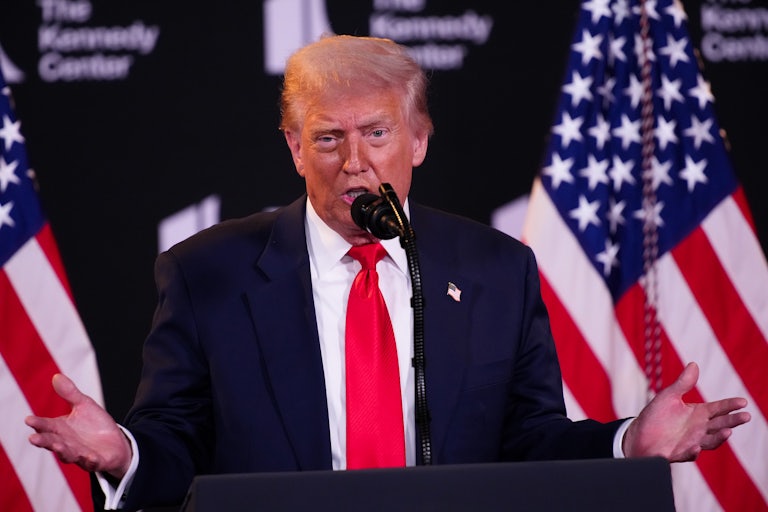
Donald Trump holds his hands out to the side while speaking at a podium at the Kennedy Center
Kevin Dietsch/Getty Images

For all his talk about Hillary Clinton and the Russia investigation, Donald Trump doesn’t seem to care that Russians hacked into sensitive government databases this year.

Answering questions outside the Kennedy Center Wednesday, the U.S. president appeared remarkably blasé about the foreign attack.

“There’s new reporting that the Russians have hacked into computer systems that manage U.S. federal court documents. I wonder if you’ve seen this report, and do you plan to bring it up with Putin when you see him later in the week?” asked one reporter.

“I guess I could. Are you surprised? Are you surprised? They hack in, that’s what they do,” Trump said. “They’re good at it, we’re good at it, we’re actually better at it.”

The New York Times reported Tuesday that a Russian entity had accessed the court case document system, as well as “recently compromised sealed records,” as part of a yearslong effort.

“Some of the searches included mid-level criminal cases in the New York City area and several other jurisdictions, with some cases involving people with Russian and Eastern European surnames,” the Times reported.

But the president’s shocking reaction to the attack also undercuts Republican efforts to reframe the 2016 Trump-Russia scandal against Clinton and former President Barack Obama: If he doesn’t care about Russian meddling under the nose of his administration, why would he care so deeply about reframing the narrative around the foreign power’s intervention nine years ago?

Trump is scheduled to meet with Russian President Vladimir Putin Friday in Alaska to discuss a potential resolution to the war in Ukraine. It will be the first time that the Russian leader has stepped foot on U.S. soil in over a decade.

Read more about Trump and Russia: