Breaking News
Breaking News
from Washington and beyond

“Worth It?”: Republicans Are Splitting Over Trump’s Redistricting War

Donald Trump’s redistricting efforts are freaking out his party.

Donald Trump speaks at a podium at the Kennedy Center
Andrew Harnik/Getty Images

Not all House Republicans are so keen on Donald Trump’s latest play to keep control of Congress in the upcoming midterm elections.

House GOP leadership have reportedly advised rank-and-file party members to keep their concerns about Trump’s blatant mid-decade gerrymandering scheme in Texas to themselves, Politico reported Tuesday.

House Speaker Mike Johnson and Republican leadership won’t put any bill on the floor that would contradict the Trump-driven efforts, despite some urging from party members, two people with direct knowledge of the matter told Politico. Johnson has publicly said that redistricting should be left up to the states.

But some Republican lawmakers, particularly those from blue states, have been more open about their distaste for Trump’s gerrymandering scheme.

New York Representative Mike Lawler, a swing-district Republican, said earlier this month that Trump’s redistricting campaign in Texas was “wrong,” and that gerrymandering needed to be banned altogether. Another New York Republican, Nicole Malliotakis, said that she was “not somebody who’s supportive of any type of gerrymandering.”

California Representative Doug LaMalfa warned that redistricting in Texas would “start a grass fire across the country.” Republicans in vulnerable seats should be concerned that redistricting elsewhere could come back to bite them, as voters attempt to even the score.

California-based GOP strategist Rob Stutzman told Politico that among vulnerable Republicans, there was a “growing private sentiment of ‘is this really worth it?’”

Other Republicans appeared reluctant to get on board with redrawing the maps at this particular moment. House Freedom Caucus Chair Andy Harris warned that Republicans should “shy away from mid-cycle redistricting,” and Florida’s newest Representative Randy Fine questioned whether it was even legal to redraw the maps in the Sunshine State (it’s not).
Trump Left Fuming After World Leaders Gang Up on Him Over Putin

Donald Trump did not appreciate being told not to immediately cave to his Russian counterpart.

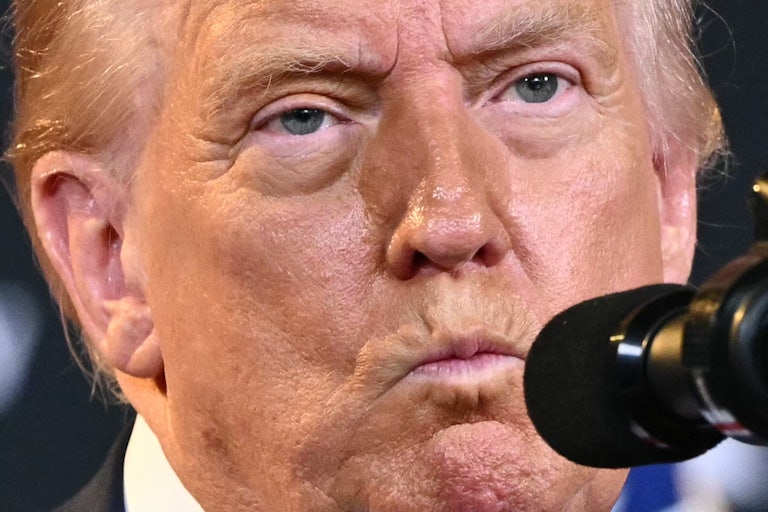
Donald Trump purses his lips while standing at a microphone
Mandel Ngan/AFP/Getty Images

The world stage is not happy with Donald Trump.

European leaders reportedly torched the U.S. president during a virtual call ahead of Russian President Vladimir Putin’s Friday trip to Alaska, two sources familiar with the call told Axios.

Trump downplayed the historic contact between the two superpowers as a “feel-out” meeting, though the Europeans disagreed, claiming in the Wednesday call that Trump was leveraging his time with Putin to coordinate a ceasefire arrangement in Ukraine without that country’s leader, President Volodymyr Zelenskiy, at the negotiating table.

The call lasted for more than an hour and featured several snipes at Trump from French President Emmanuel Macron, who took a “very tough” position on the meeting, according to a source on the call that spoke with Axios. Macron emphasized that “a meeting is a very big thing to give to Putin.” But Trump “didn’t like that,” the source said.

Zelenskiy offered his own blunt warning to Trump, underscoring to the U.S. leader that “Putin cannot be trusted.”

Polish President Karol Nawrocki “reminded Trump of the Battle of Warsaw, exactly 105 years ago, when Poland fought together with Ukrainians against the Bolsheviks in Russia,” reported Axios.

Putin’s visit will be the first time that the Russian leader has stepped foot on U.S. soil in more than a decade—but what sort of new ground Trump will be able to gain is not clear. Putin has remained adamant that any peace deal would require “international legal recognition” of Russia’s 2014 annexation of Crimea, an internationally recognized portion of Ukraine, along with four regions it has claimed in the three years since it first invaded Ukraine.

After the call with Trump, Zelenskiy appeared alongside German Chancellor Friedrich Merz, telling reporters in Berlin that the world needed to put more “pressure” on Russia. Zelenskiy said that he believed Russia was bluffing about the regional economic impact of more international sanctions.

At the same press conference, Merz claimed that Trump had “largely agreed” that Russia could not be granted legal recognition of the territories it had claimed during the war.

When pressed by reporters during a press conference later Wednesday as to whether he believed that he could use the meeting to convince Putin to stop targeting civilians in Ukraine, Trump responded in the negative.

“I guess the answer to that is no,” he said, “because I’ve had this conversation [with Putin].”

Leading Republican Pledges Trump Will Crack Down on More Blue Cities

Washington, D.C., is just the beginning, according to the influential Representative James Comer.

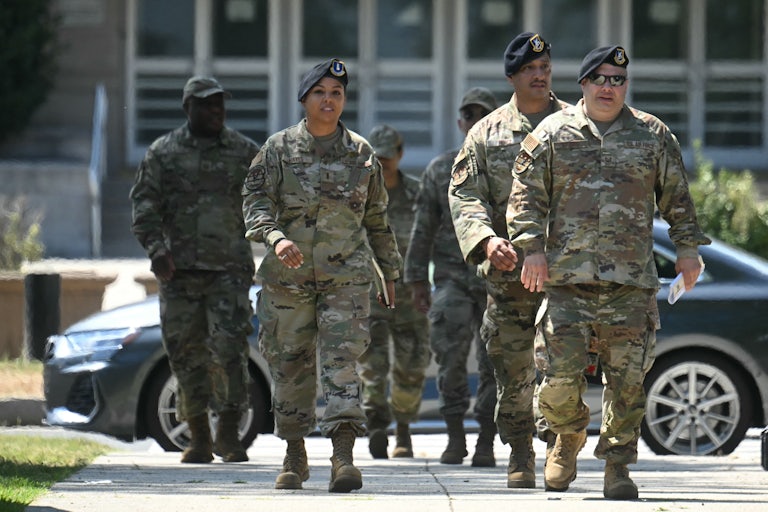
National Guard troops march through the streets of Washington D.C.
JIM WATSON/AFP/Getty Images
Troops in Washington, D.C., on Tuesday

A common left-wing slogan—which pithily summarizes theimperial boomerang” thesis—is that fascism is imperialism “at home” or “turned inward.” This is typically stated with an implied negative view of both of those things.

In an appearance on Newsmax, Republican Representative James Comer of Kentucky advanced—and endorsed—his own positive twist on that concept. Following Trump’s federal takeover of Washington, D.C., Comer said the military should be sent to Democratic-run cities to “reduce crime,” leveraging experiences from America’s numerous foreign entanglements since the 2000s.

“We’re gonna support doing this in other cities, if it works out in Washington, D.C.,” Comer said. “And, again, it’s unfortunate, but we spend a lot on our military. Our military has been in many countries around the world for the past two decades, walking the streets, trying to reduce crime in other countries. We need to focus on the big cities in America now, and that’s what the president is doing.”

“I think this is an experiment that’s probably needed in a lot of the Democrat-run cities in America,” Comer later added. The sentiment echoes Trump’s description of the capital as a testing ground for crackdowns on more cities.

Comer also expressed confidence that President Trump will garner the votes in Congress needed to extend the 30-day takeover. The president has vowed to do so with or without the legislative branch’s approval, but Comer dubiously predicted that Trump’s action in D.C. will be so popular that enough Senate Democrats will be swayed to extend it.

“I think people that represent big cities, which are the Democrats in Congress, they’re going to probably hear from their constituents: ‘Look, that worked in Washington, D.C. Why don’t you vote to allow President Trump to come into Chicago or New York City or Philadelphia and try to combat the criminal activity in their city?’”

Putin Is Buttering Trump Up Before Their Big Ukraine Summit

The Russian president is talking a lot about mineral deals and a potential Nobel Peace Prize—all to get Trump to throw Ukraine to the wolves.

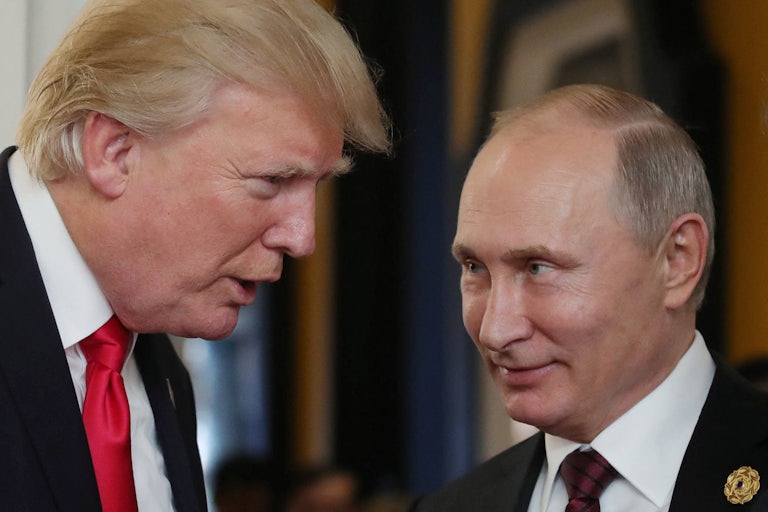
Vladimir Putin grins knowingly at Donald Trump
MIKHAIL KLIMENTYEV/SPUTNIK/AFP/Getty Images
Trump and Putin in 2017

On the eve of what President Trump calls a “feel-out meeting” in Alaska with Vladimir Putin, the Russian president seems well aware of a no-cost way to curry favor with Trump.

On Thursday, per the AFP, Putin said the United States is making “quite vigorous and sincere efforts to halt hostilities, end the crisis, and reach agreements that serve the interests of all parties involved in this conflict.” He also dangled the possibility of “long-term conditions for peace … if we reach agreements on strategic offensive arms control.”

Max Seddon of the Financial Times observed that, in buttering up Trump, Putin was seemingly appealing to the president’s long-standing yearning for a Nobel Peace Prize. Last month, press secretary Karoline Leavitt said a Trump Nobel Prize is “well past time,” while citing misleading claims about the president’s foreign policy. On Thursday, the influential Norwegian financial newspaper Dagens Naeringsliv reported that Trump recently called Norway’s finance minister, Jens Stoltenberg, “out of the blue” to say “he wanted the Nobel Prize—and to discuss tariffs.”

Lately, several world leaders have played to Trump’s apparent hankering for a Nobel. Leaders of countries such as Pakistan, Israel, Guinea-Bissau, Gabon, Azerbaijan, and Armenia have seemingly caught onto this easy route to the president’s heart.

At the Alaskan summit, Trump is hoping to set a Russia-Ukraine ceasefire in motion—though he’s managed expectations, saying, “I think it’ll be good, but it might be bad.” (The president’s promise to end the war on “day one” is now broken by nearly seven months.)

While, as Seddon noted, Putin appears to be dangling a gold Nobel medal before the president, Trump reportedly may offer rare earth minerals in return.

The Telegraph reports that, among other economic incentives, the president is considering giving Russia access to mineral deposits in Russian-occupied areas of Ukraine, which houses a sizable portion of Europe’s lithium supply. He is also weighing giving Russia opportunities to exploit Alaska’s natural resources, namely in the oil- and gas-rich Bering Strait.

Judge Torches Trump for Letting ICE Arrest People at Immigration Court

A judge called the strategy “detention roulette.”

Federal officers wait outside of immigration courtrooms in New York
Victor J. Blue/Bloomberg/Getty Images

A federal judge has ruled that the Trump administration’s targeting of immigrants attending immigration court violates their due process rights.

In a scathing opinion released Thursday, Judge Dale E. Ho wrote that Immigration and Customs Enforcement arrests in immigration court had turned the procedure into “detention roulette.”

Over the span of 31 pages, Ho wrote that Carlos Javier Lopez Benitez, a 27-year-old from Paraguay, had his constitutional rights violated when he attended court on July 16 in pursuit of asylum.

“Mr. Lopez Benitez appears to be far from alone,” Ho wrote. “His counsel assert that his treatment is part of a ‘nationwide campaign,’ as set forth in an ICE internal memo that has been described in various media reports, which suggests that millions could be swept up in the same way.”

Since May, ICE agents have been arresting immigrants immediately after their immigration court hearings. The strategy has gained nationwide attention in the wake of two high-profile consequences: the indictment of a judge in Wisconsin who allegedly helped an immigrant evade authorities outside her courtroom, and the detention of New York City Comptroller and then–mayoral hopeful Brad Lander, who was attempting to escort an immigrant out of the courthouse.

Ho noted that while the government could not confirm or deny the existence of that policy, they “appear to maintain that they must categorically detain all undocumented immigrants who they believe have entered the United States unlawfully—no matter how long they have been residing in the country since.”

Citing Velasco Lopez v. Decker, Ho further argued that the “suggestion that government agents may sweep up any person they wish” for no reason whatsoever, “so long as the person will, at some unknown point in time, be allowed to ask some other official for his or her release offends the ordered system of liberty that is the pillar of the Fifth Amendment.”

Lopez Benitez’s case may be the new normal in Trump’s America, but it is far from the historical standard. Immigration authorities used to stay away from courthouses, fearing that their presence could disengage people from following procedure and navigating the legal system. But White House deputy chief of staff Stephen Miller’s agenda has effectively unrooted that, tasking federal agents with arresting 3,000 undocumented immigrants per day—a quota so astronomical that it has forced the agency to find unconventional subjects of detention, including legal residents and even U.S. citizens.