Breaking News
Breaking News
from Washington and beyond

Democrat Reveals Epstein File That Blows Huge Hole in Trump’s Story

Democratic Representative Dan Goldman shared a previously redacted email that contradicts Trump’s story on how he stopped being friends with the sexual predator.

Jeffrey Epstein and Donald Trump smile while standing next to one another. Trump places his hand on Epstein's shoulder.
Davidoff Studios/Getty Images
Jeffrey Epstein and Donald Trump at the Mar-a-Lago estate in Palm Beach, Florida, on February 22, 1997

Democratic Representative Dan Goldman revealed an unredacted document from the Epstein files on the House floor Wednesday, saying that it directly contradicts Donald Trump’s account of his relationship with the billionaire sex offender.

The document is an October 2009 email containing information about a conversation between one of Epstein’s attorneys, Jack Goldberger, and an attorney for Trump, Alan Garten. The email was initially released to the public in redacted form. In the unredacted version, as Goldman highlighted, Goldberger wrote that Garten said Epstein was never asked to leave Trump’s Mar-a-Lago country club in Florida as he was not a member, but may have been a guest.

Screenshot Boston Smalls @smalls2672 EFTA00740636 Unveiled Unredacted on House Floor by Dan Goldman. Trump never threw Epstein out of Mar-a-Lago like he claims and has been reported on.

This directly contradicts Trump’s claim that he kicked Epstein out of the resort in 2004 due to his poaching of Mar-a-Lago employees. Goldman claimed that the document was being deliberately withheld by the Department of Justice, violating the Epstein Files Transparency Act that Trump signed into law in November.

“This document here was redacted to the public. It was unredacted to Congress and it completely disputes everything that Donald Trump has said about Jeffrey Epstein,” Goldman said, displaying a blown-up poster of the email. “Now, why is this important? Because if the attorney general is covering up this information that she then reveals to Congress, what else is she covering up about Donald Trump’s involvement in the Epstein files?”

Bondi is already under fire for allegedly mismanaging the release of the Epstein files, and has been subpoenaed by the Republican-led House Oversight Committee to appear for a deposition on April 14. This latest revelation is only going to make her seem more guilty of slow-walking and covering up damning information about Trump and Epstein.
JD Vance Admits Gas Prices Are About to Get Ugly: “Rough Road Ahead”

The Trump administration doesn’t know how to respond to skyrocketing gas prices thanks to the Iran war.

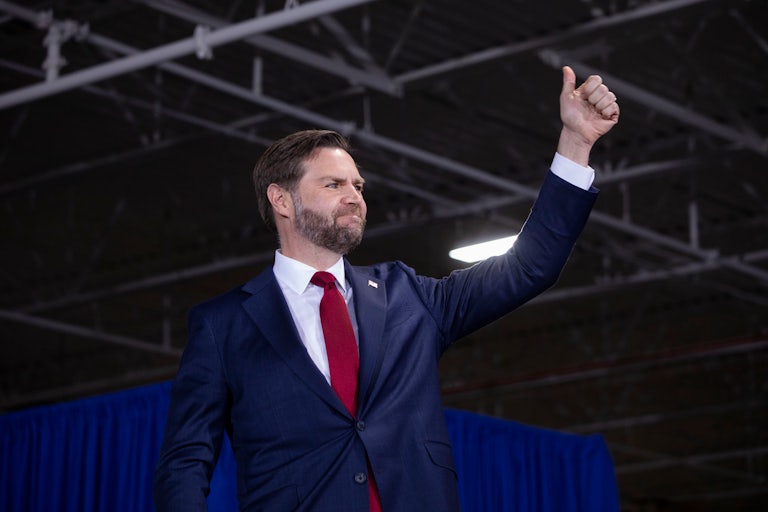
JD Vance gives a big thumbs up and smiles
Bill Pugliano/Getty Images
Vice President JD Vance walks onstage before delivering remarks at a manufacturing plant on March 18.

Vice President JD Vance admitted there’s a “rough road ahead” with regard to skyrocketing gas prices caused by the war on Iran, which still has no clear end in sight.

“We’re seeing gas prices here climbing at home, in particular here in metro Detroit with what’s going on in Iran and the impacts on the Strait of Hormuz,” a reporter asked Vance at a Wednesday press conference in Michigan. “What is the administration doing to help keep gas prices down, and where do you see gas prices going in the near future?”

“Well, the president of the United States has been crystal clear about this. Look, gas prices are up. And we know they’re up. And we know that people are hurting because of it. And we’re doing everything we can to make sure they stay lower,” Vance replied. “The president said this, and I certainly agree with it. This is a temporary blip, OK?”

Vance then went on to blame former President Joe Biden rather than elaborate on how exactly the Trump administration would be bringing gas prices down.

“Frankly, [gas prices] aren’t even as high as they were during certain parts of the Biden administration because of what’s going on in the Middle East. It’s not gonna last forever. We’re gonna take care of business, we’re gonna come back home. And when that happens, you’re gonna see energy prices come back down.… But yeah, we’ve got a rough road ahead of us for the next few weeks, but it’s temporary.”

This comes just one day after Ken Hassett, the director of the National Economic Council, proudly declared that the Iran war’s negative impact on the average U.S. consumer is “the last” of the administration’s concerns.

Trump Team Spirals Over Bombshell Report Exposing Cuba Plans

The Trump administration is pissed about a New York Times story that details a plan to target the Cuban president.

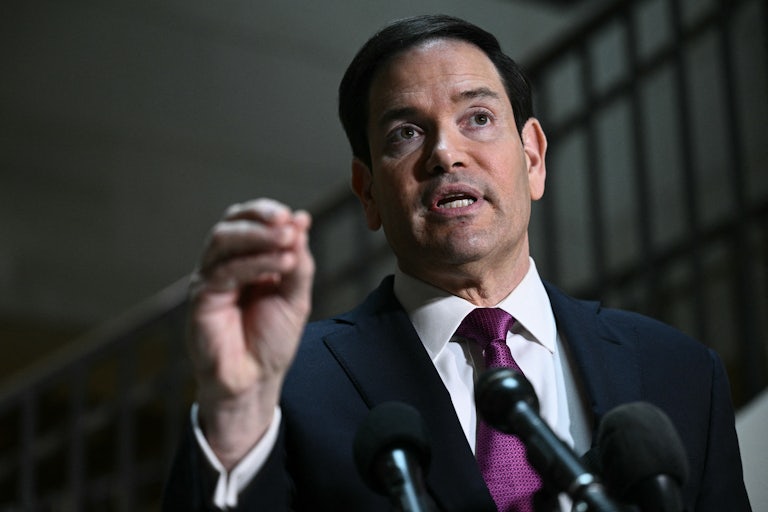
Secretary of State Marco Rubio
Brendan SMIALOWSKI/AFP/Getty Images
Secretary of State Marco Rubio

The Trump administration is spiraling over a New York Times story that says it is pushing Cuban President Miguel Díaz-Canel to step down as a requirement for negotiations between the U.S. and Cuba to move forward.

The Times reported Monday, citing four anonymous sources, that U.S. negotiators want economic hard-liner Díaz-Canel to go in order to open up the country’s economy. The report has infuriated Trump administration officials, who are disputing the reporting.

Secretary of State Marco Rubio, who is personally handling Cuba, said Tuesday night on X, “The reason so many in US media keep putting out fake stories like this one is because they continue to rely on charlatans & liars claiming to be in the know as their sources.”

Charlie Stadtlander, a spokesperson for the newspaper, responded to Rubio Wednesday morning, saying that the Times reached out to the State Department “well before publication and received no disagreement with the information we were bringing to light.”

“Neither you nor anyone else has presented a factual dispute to the reporting,” Stadtlander stated. “Our reporting is real, and accurate.”

X screenshot NYT Communications “Secretary Rubio: As our article states, this reporting is based on conversations with four people familiar with the U.S. talks with Cuba. Our journalists reached out to your State Department for comment well before publication and received no disagreement with the information we were bringing to light. Neither you nor anyone else has presented a factual dispute to the reporting. Our reporting is real, and accurate.” — Charlie Stadtlander, a spokesperson for The New York Times

Hours later, White House communications director Steven Cheung jumped in and insulted the Times on X, saying, “The only people who are privy to Cuba are President Trump and Marco Rubio. Your lazy reporters relied on uninformed sources who know nothing about what’s going on.”

What Rubio and Cheung are mad about is unclear. Trump told reporters last month that he thinks that there could be a “friendly takeover” of Cuba, and, unprompted, told CNN just a week later that “Cuba is going to fall pretty soon.” Maybe Rubio and Cheung, amid the administration’s various regime change plots, are mad that the Times got inside information that they didn’t want revealed to the public.

Kash Patel Brags That the FBI Is Buying Your Location Data

The FBI director said the gross invasion of privacy had led to “valuable intelligence.”

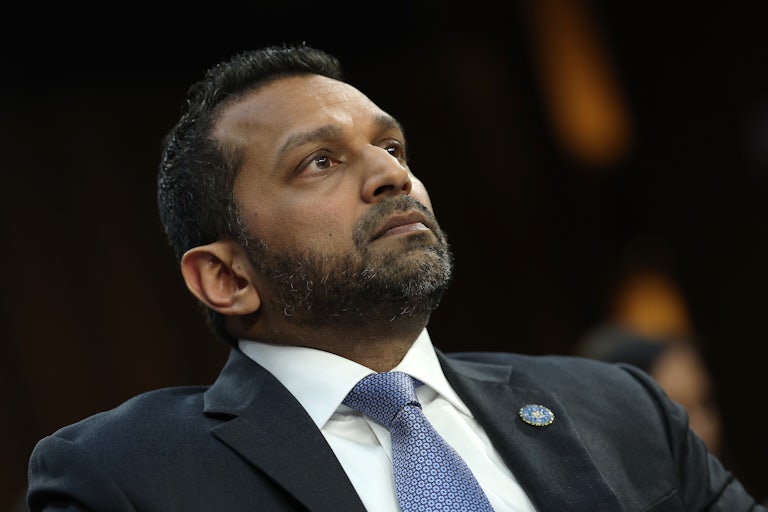
FBI Director Kash Patel leans back while sitting in a Senate hearing
Kevin Dietsch/Getty Images

The leader of the FBI admitted Wednesday to unconstitutionally buying location data monitoring the general public.

The confession emerged during a heated exchange with Democrat Senator Ron Wyden, who asked FBI Director Kash Patel if he would pledge to refrain from such purchases.

“Can you commit this morning to not buying Americans’ location data?” asked Wyden.

“The FBI uses all tools … to do our mission,” Patel said. “We do purchase commercially available information that’s consistent with the Constitution and the laws under the Electronic Communications Privacy Act. It’s led to some valuable intelligence for us to be utilized with our private and partner sectors.”

“So you’re saying that the agency will buy Americans’ location data?” Wyden said. “I believe that’s what you’ve said in some kind of intelligence lingo.”

“Doing that without a warrant is an outrageous end run around of the Fourth Amendment. It’s particularly dangerous given the use of artificial intelligence to comb through massive amounts of private information,” the Oregon lawmaker noted.

The Fourth Amendment protects people in America from unlawful search and seizures by the government, mandating that law enforcement officials obtain search warrants, which require a legal standard of probable cause. That standard remains true for any attempted information collection by government agencies, which typically have to convince a judge to authorize a search warrant before they can access such details from tech or phone companies.

Patel’s tacit approval of his administration’s intrusions into the personal details of everyday Americans illustrates that the agency not only failed to meet that standard—but also that the current leader appears to not understand the gravity of the violation.

Wyden was one of four lawmakers who last week introduced the bipartisan Government Surveillance Reform Act, which among other things would explicitly require surveillance agencies to seek judicial warrants from data brokers. It would also prohibit “warrantless backdoor searches,” would prohibit the targeting of foreigners as “a pretext for spying on the Americans with whom they are communicating,” and “prohibits the collection of domestic communications.”

In a statement, Representative Warren Davidson noted that Section 702 of the Foreign Intelligence Surveillance Act had been “stretched far beyond its original purpose” to the point that it effectively permits “unconstitutional warrantless searches of American citizens and their private communications.”

“The bipartisan Government Surveillance Reform Act counters these abuses by requiring a warrant to search Americans’ data and by closing the data broker loophole that allows the federal government to spy on citizens by purchasing private data that would otherwise require a warrant or subpoena,” the Ohio Republican wrote.

Tulsi Gabbard Refuses to Say Whether Iran Was Imminent Nuclear Threat

The director of national intelligence backed herself into a corner over the supposed threat.

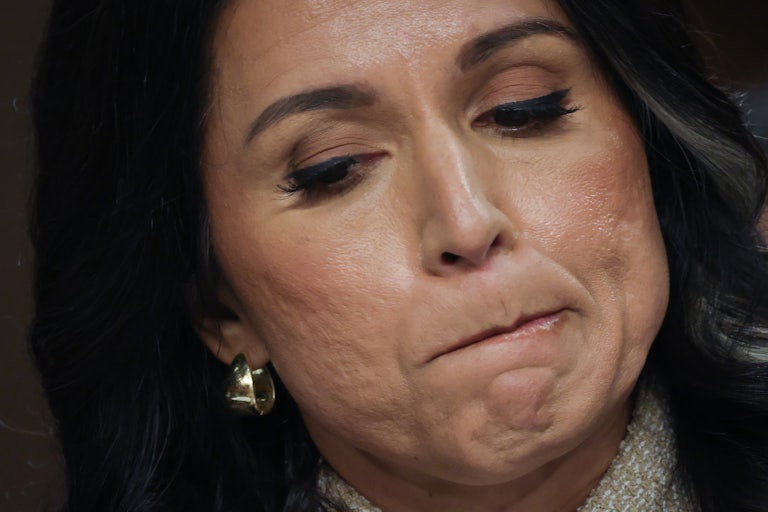
Director of National Intelligence Tulsi Gabbard presses her lips together and looks down during a Senate hearing
Win McNamee/Getty Images

Tulsi Gabbard wouldn’t say Wednesday that Iran presented an “imminent threat,” claiming it wasn’t the director of national intelligence’s job to actually assess threats.

During a hearing before the Senate Intelligence Committee to discuss the intelligence community’s annual threat assessment report, Georgia Senator Jon Ossoff questioned Gabbard about the White House’s claim that Donald Trump’s illegal war in Iran was “a military campaign to eliminate the imminent nuclear threat posed by the Iranian regime.”

“Was it the assessment of the intelligence community that there was an imminent nuclear threat posed by the Iranian regime?” Ossoff asked.

“The intelligence community assessed that Iran maintained the intention to rebuild and to continue to grow their nuclear enrichment capability,” Gabbard replied.

The Georgia Democrat repeated his question, and Gabbard pivoted.

“Senator, the only person who can determine what is and is not an imminent threat is the president—” Gabbard said.

“False,” Ossoff said, before reminding Gabbard that the hearing on worldwide threats was her opportunity to present intelligence that was “timely, objective, and independent of political considerations.”

Intelligence officials, including Gabbard, are charged with determining the credibility and severity of national security threats and passing that information to the president, who then has the power to declare a national emergency, according to U.S. law. The intelligence community’s actual findings, however, directly contradicted Trump’s determination of an imminent threat, as well as his administration’s inexplicable claims that Iran had the capability to build multiple nuclear weapons.

Gabbard would have Americans believe it is a matter of opinion whether a threat is imminent. Evidence of any actual danger is not required.

“You’ve stated today that the Intelligence Community’s assessment is that Iran’s nuclear enrichment program was ‘obliterated’ and that ‘there were no efforts since then to try and rebuild their enrichment capability,’” Ossoff continued, referring to Gabbard’s written remarks (during the start of the hearing, she tried to omit this portion).

“Was it the intelligence community’s assessment that, nevertheless, despite this ‘obliteration,’ there was an ‘imminent nuclear threat posed by the Iranian regime?’ Yes or no?” he repeated.

“It is not the intelligence community’s responsibility to determine what is and is not an imminent threat. It is up to the president based on a volume of information that he receives,” Gabbard replied.

“It is precisely your responsibility,” Ossoff said, pointing back to her own opening statement, where she’d promised to represent the intelligence community’s “assessment of threats.” How had she become so unqualified within the course of a day?

Gabbard retreated into word salad. “Once again, senator, the intelligence community has provided the inputs that make up this threat assessment. It is the nature of the imminent threat that the president has to make that determination,” and so on.

Ossoff accused Gabbard of evading the question, “because to provide a candid response to the committee would contradict a statement from the White House.”

Meanwhile, Gabbard couldn’t explain why Trump appeared not to understand the actual stakes of the conflict he started—Iran’s retaliation, or the closure of the Strait of Hormuz.