Breaking News
Breaking News
from Washington and beyond

Republicans Want to Gut Health Care to Pay for Trump’s Iran War

Republicans continue to find new ways to make you pay more for the sake of Donald Trump’s vanity projects.

Representative Jodey Arrington speaks into a microphone during a House Budget Committee meeting
Tom Williams/CQ-Roll Call, Inc/Getty Images
Representative Jodey Arrington

Republicans are eyeing massive cuts to health care spending in order to scrounge up $200 billion for Donald Trump’s reckless war in Iran.

Top Republicans are looking for ways to offset the massive price tag the Pentagon has requested in order to pass the additional funding for U.S. military operations in Iran through a budget reconciliation bill, Axios reported Monday.

House Budget Committee Chairman Jodey Arrington is looking to revive cost-sharing reductions, programs that can assist low-income Americans in paying high deductibles, that were passed as part of Trump’s behemoth budget bill in July.

The Congressional Budget Office previously estimated that funding these reductions would save the federal government $30 billion but would increase out-of-pocket premium costs and drive up the number of people without health insurance by 300,000 through 2034. Arrington is selling the move as “fraud prevention.”

The discussions over cuts are in the early stages, but are likely to face opposition from moderate Republicans, who won’t support health care spending cuts in an election year.

Arrington suggested that the budget reconciliation bill would target fraud across a range of means-tested programs that assist low-income families, Roll Call reported. He pointed to the earned income tax credit, a refundable tax credit that boosts the income of low-income, working parents who claim a child. Arrington claimed that one of the most popular tax credits “loses 30 cents on the dollar.”

“You’ve got low-income housing tax credits, for example, another sort of welfare program within the tax code that doesn’t prohibit illegals from siphoning money off that and jeopardizing the sustainability of that program,” he said.

The reconciliation effort should target “widespread fraud, there is a boatload of waste and fraud,” Arrington said in the House.

Republicans seemed content to make struggling Americans suffer in the service of Trump’s increasingly expensive vanity war that has no clear objectives.
Trump Used Untested Weapon to Bomb Another School in Iran

The Precision Strike Missile had never been tested in combat.

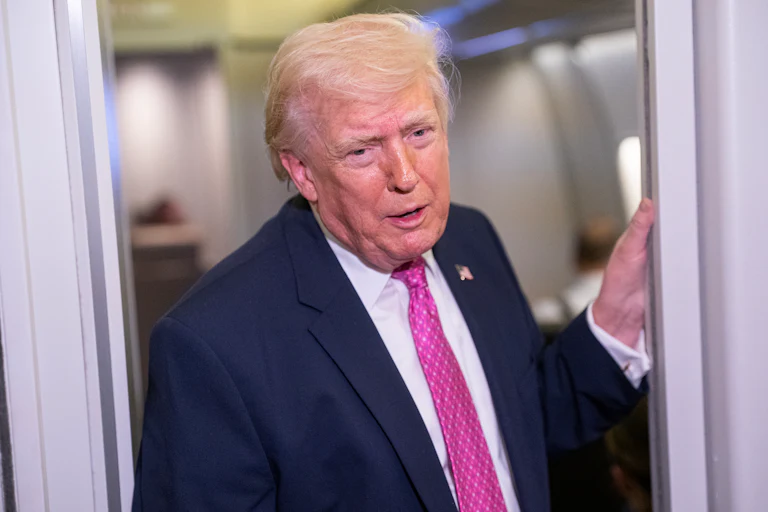
President Donald Trump
Nathan Howard/Getty Images

The Trump administration used untested weapons in a strike in Iran that hit a school and sports hall on February 28.

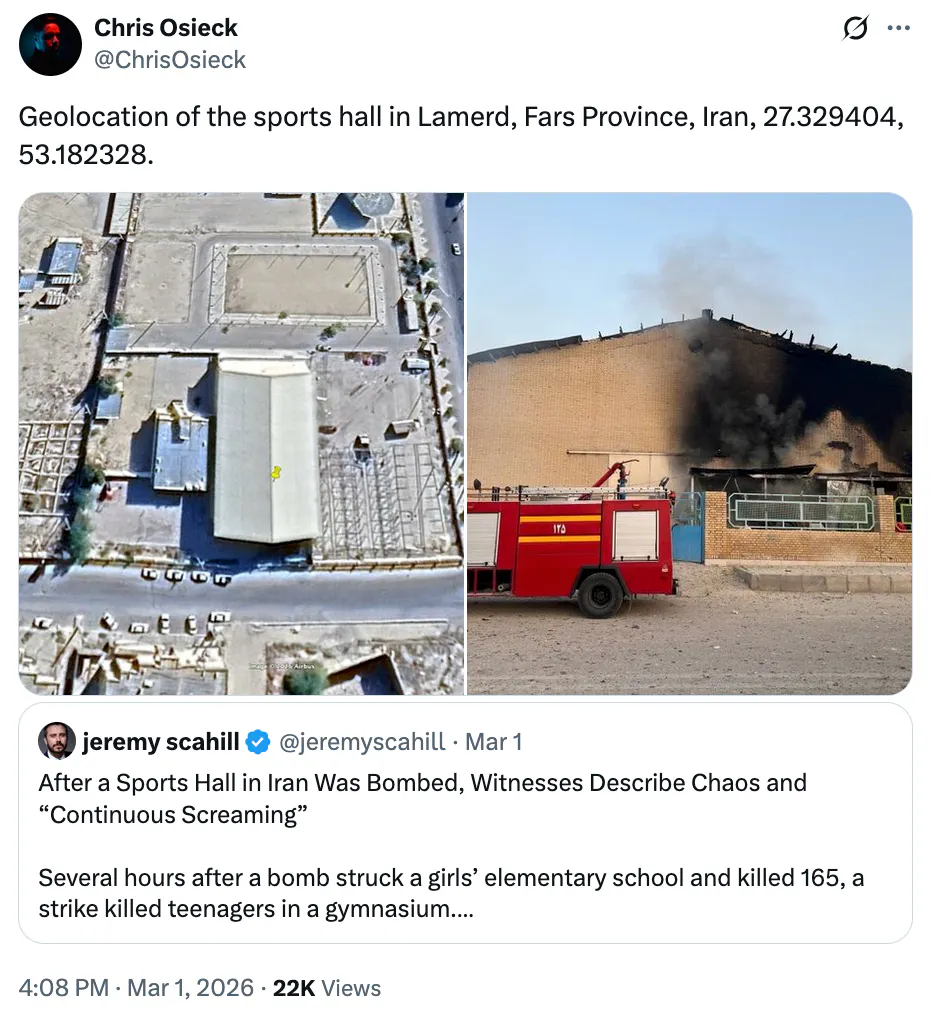
The New York Times reports that the United States launched a newly designed ballistic missile at a school in the city of Lamerd on the first day of the war—the same day that the U.S. bombed a girls’ school in Minab, hundreds of miles away. The strike and others nearby in Lamerd killed 21 people, according to the Times, which cited Iranian media.

Times analysts concluded the strike involved a Precision Strike Missile, or PrSM, a short-range ballistic missile that detonates just above its target and blasts tungsten pellets outward. A local video from Lamerd showed one strike about 900 feet away from the sports hall with the weapon exploding in a midair fireball.

Another video captured from a security camera across from the school and sports hall shows the structure being hit, with an explosion directly above it. Photos from both sites after the strikes show dozens of tiny holes apparently made by the tungsten pellets. At the school and sports hall, footage shows scorch marks, a partially collapsed roof, blown-out windows, fire damage, and blood spatters.

X screenshot Chris Osieck @ChrisOsieck: Geolocation of the sports hall in Lamerd, Fars Province, Iran, 27.329404, 53.182328.

The PrSM only completed prototype testing last year, an Army press release from July states, but had been untested in combat until the strikes. U.S. Central Command posted a video on March 1 capturing a PrSM strike from the first day of the war. The leader of CENTCOM, Admiral Brad Cooper, said days later that the PrSM was used in combat for the first time during the war, and another post from CENTCOM on March 4 touted the system.

It’s not clear whether the strike was deliberate. The school and sports hall are close to an IRGC military compound but have been walled off from the compound for at least 15 years. The sports hall is identified as a facility for civilians on public map platforms including Apple Maps, Wikimapia, and Google Maps. An Instagram account linked to the school shows children regularly using the site, and Iran’s representative to the United Nations Amir Saeid Iravani said the sports hall was being used by a women’s volleyball team at the time of the strike.

The strike occurred on the same day as a U.S. attack on a girls’ school in Minab, which killed 175 people, an apparent war crime. Using an untested weapon on an elementary school and sports hall, without clear knowledge of its effects, would seem to fit the bill of a war crime, as well. Does that matter to the Trump administration?

Trump Threatens Multiple War Crimes If Iran Doesn’t Change Regimes

Donald Trump is finally admitting the Iran war is about regime change.

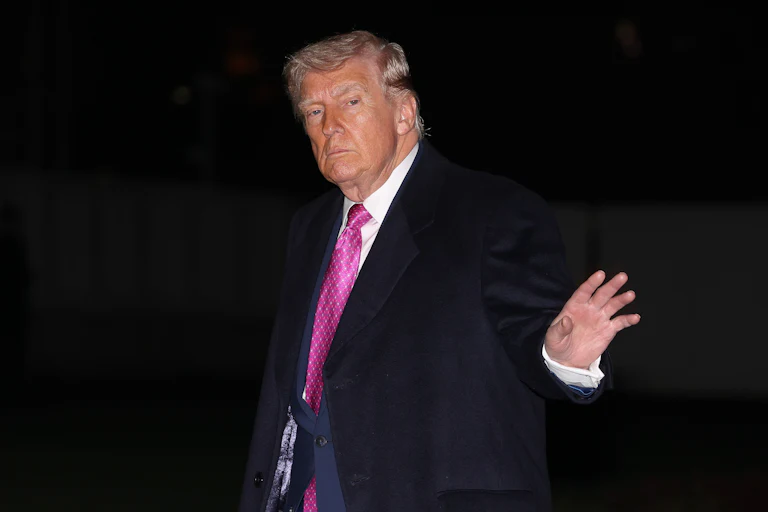
Donald Trump waves while walking outside the White House
Tasos Katopodis/Getty Images

Donald Trump has finally come clean about his objective for Iran—and threatened to launch a series of war crimes if he doesn’t get what he wants.

“The United States of America is in serious discussions with A NEW, AND MORE REASONABLE, REGIME to end our Military Operations in Iran,” he wrote in a post on Truth Social Monday.

Perhaps the Trump administration has finally given up pushing its original war rationale, based on unsubstantiated claims that Iran had obtained the materials to make nuclear weapons. There’s just one problem: Last week, Trump claimed that regime change had already been achieved in Iran, and the White House doubled down in a similarly nonsensical fashion.

It wasn’t true. After Ayatollah Ali Khamenei was killed earlier this month, his son Mojtaba Khamenei, a hard-line cleric, was tapped to replace him. At the same time, the Iranian Revolutionary Guard Corps has only further consolidated power.

Trump’s supposedly “serious discussion” for a new regime may be marred by his administration’s childish tactics: Just last week, they tried to start a rumor that the new ayatollah was a closeted gay man.

Trump claimed Monday that “great progress” had already been made, but if a deal did not materialize soon to open the Strait of Hormuz, the U.S. military would attack “all of their Electric Generating Plants, Oil Wells and Kharg Island (and possibly all desalinization plants!), which we have purposefully not yet ‘touched.’”

“This will be in retribution for our many soldiers, and others, that Iran has butchered and killed over the old Regime’s 47 year ‘Reign of Terror,’” the president added. Of course, extensive destruction not justified by a military necessity is a war crime. It wouldn’t be the first the U.S. military has committed in Trump’s reckless war.

Last week, the Pentagon ordered some 2,000 troops from the 82nd Airborne division to be dispatched to aid the war effort in the Middle East. The move has driven speculation that the U.S. military intends to seize Kharg Island, which handles 90 percent of Iran’s oil exports.

WTF Was Elon Musk Doing on a Phone Call With Trump About Iran?

Musk has made his return to the president’s side at the worst possible time—the middle of a war.

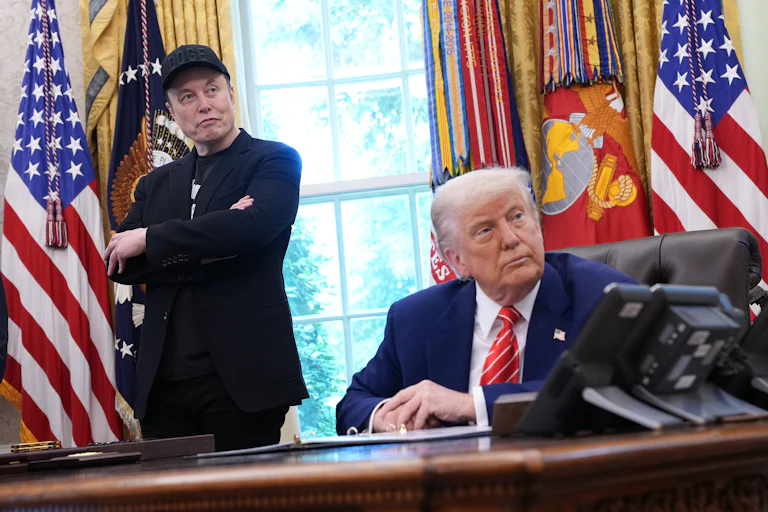
Elon Musk, wearing a black DOGE cap, stands and crosses his arms while Donald Trump sits at this desk in the Oval Office of the White House.
Kevin Dietsch/Getty Images
Tesla CEO Elon Musk and President Donald Trump speak to reporters in the Oval Office of the White House, on May 30, 2025.

President Donald Trump and Indian Prime Minister Nahendra Modi had a phone call on Tuesday to discuss the war in Iran. For no apparent reason, they were joined by billionaire Elon Musk.

Musk—who is a private citizen with no present involvement in government—sat in on the discussion between the two heads of states, though it is unclear if he spoke, The New York Times reported Friday. The call was primarily to discuss Trump’s increasingly out-of-reach goal to reopen the Strait of Hormuz.

There is literally no rational justification for including the world’s richest man on a call between two national leaders during a global crisis.

Neither the White House nor the Indian government disclosed Musk’s presence on the call.

Several of the billionaire’s companies have been funded by state-owned investment entities in the Middle East, and global financial instability stemming from the war could possibly put those investments at risk. In February, Saudi Arabia’s intelligence company invested $3 million in Musk’s xAI. The company also received funding from Qatar and Abu Dhabi. Musk’s StarLink has signed deals with two of India’s biggest telecom companies, and he’s long sought to get a foothold for Tesla in the Indian markets.

Musk’s presence on Tuesday’s call likely indicates that he and the president are finally getting over their dramatic fallout this summer, sparked by a fight over Trump’s signature “big, beautiful bill.” During his stint as head of the Department of Government Efficiency before that, Musk fired thousands of federal workers, hijacked and dismantled major federal agencies, and waged war on the federal safety net.

It looks like the billionaire may be making his way back into government at the worst possible time.

Republicans Panicking Over Trump Sending Ground Troops to Iran

Some of the president’s biggest supporters are publicly stating their concerns.

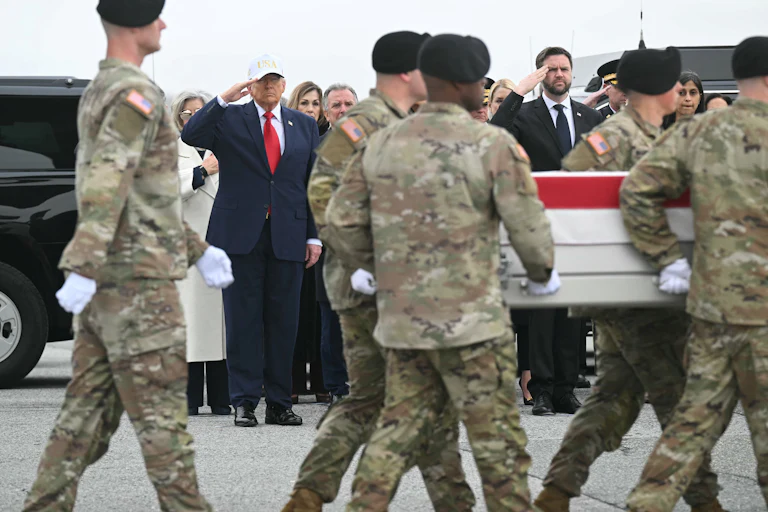
Donald Trump and JD Vance stand as military servicemembers escort the remains of fallen soldiers in front of them.
SAUL LOEB/AFP/Getty Images
President Donald Trump and Vice President JD Vance salute during a dignified transfer solemn event at Dover Air Force Base, in Dover, Delaware, on March 7.

A growing contingent of House Republicans is voicing opposition to Donald Trump potentially deploying ground troops to the Persian Gulf, Politico reported Friday.

As the deadline for Iran to respond to Trump’s 15-point peace plan approached Friday, the president was reportedly leaning toward ordering a ground operation in Iran. Some House Republicans urged the president to hold back.

Arizona Representative Eli Crane, a former Navy Seal who served five deployments, told Politico that members of Congress and supporters had grown “very concerned.”

“I’m really, really hopeful this doesn’t turn into a boots-on-the-ground situation,” he said. “My biggest concern this whole time is that this would turn into another long Middle Eastern war.

“Though I don’t want to try and take away any of the president’s ability to carry out this operation, I know a lot of our supporters and a lot of members of Congress are very concerned” about the possibility, he added.

“We lose 60 to 70 seats,” said another House Republican, who was granted anonymity by Politico, referring to November’s midterm elections.

Wisconsin Representative Derrick Van Orden, also a retired Navy Seal, said that he’d been “very clear” that he doesn’t support a ground operation in Iran, and believes Trump has “learned” from past presidents who’d been trapped in forever wars.

South Carolina Representative Nancy Mace said that she could break with Republicans to join the Democrat-led war powers measure next month.

“If we’re in this phase where there are troops on the ground, then we’re in a different phase of the conflict, which requires Congress’s input,” Mace said.

Earlier this week, the Pentagon ordered some 2,000 troops from the 82nd Airborne division, comprised of elite, rapid-response paratroopers, to be dispatched to aid the war effort in the Middle East, driving speculation that the U.S. military intends to seize Kharg Island, which handles 90 percent of Iran’s oil exports.

Independent journalist Ken Klippenstein pushed back on the panic that a ground invasion of Iran is imminent in a report Thursday, arguing that the 82nd Airborne wasn’t an ideal group to lead a ground invasion and that U.S. military forces weren’t aligned for a major operation.