Breaking News
Breaking News
from Washington and beyond

Bondi Ordered to Testify on Epstein, Democrats File Contempt Charges

Former Attorney General Pam Bondi will still be forced to testify on the Epstein files.

Attorney General Pam Bondi
Alex Wong/Getty Images

Pam Bondi may think that being fired as attorney general gets her out of a congressional subpoena, but the House Committee on Oversight and Government Reform disagrees.

After missing her scheduled deposition April 14, Bondi will now testify before the committee on May 29, the committee announced Wednesday. At the same time, Democrats on the committee announced that they have filed contempt of Congress charges against Bondi, saying that she has “illegally defied our committee, skipped her deposition, and has refused to cooperate.”

“Bondi has extensive personal knowledge about the Trump Administration’s handling of the Epstein files, and regardless of her job title, her testimony and cooperation are crucial,” the committee’s ranking member, Representative Robert Garcia, said in a statement.

X screenshot Oversight Dems @OversightDems Pam Bondi has illegally defied our committee, skipped her deposition, and refused to cooperate. Today, we have filed contempt charges. Read Ranking Member @RepRobertGarcia ’s statement. ⬇️

The Republican majority on the committee called the charges “theater and completely unnecessary” in a post on X, but stuck by its order to Bondi to testify.

“They were happy giving the Clintons a free pass for months,” the committee said, although President Bill Clinton and former Secretary of State Hillary Clinton have already testified before the committee. “We have secured Bondi’s appearance for May 29. Today, we’re marking up legislation to tackle fraud at the federal level and all Democrats can talk about is Epstein.”

Earlier this month, after President Trump fired Bondi, a spokesperson for the committee said Bondi would not appear for her April 14 deposition “since she is no longer Attorney General and was subpoenaed in her capacity as Attorney General.”

Until Wednesday, Republican Oversight Chair James Comer had drawn the ire of the committee’s Democrats for remaining silent on whether Bondi would testify, as well as for making drastic changes to the hearing process. It seems that he either was putting off the announcement until the last minute or was forced to announce a date after Democrats filed charges.

In either case, Bondi has a lot to answer for considering how the DOJ mishandled its files on Jeffrey Epstein on her watch. The DOJ’s Inspector General’s Office and the Government Accountability Office are both investigating the department’s rollout of the files. On Monday, journalist Katie Phang sued the DOJ for a “brazen, shocking, and ongoing violation” of the Epstein Files Transparency Act by failing to publish all of the government’s files on the convicted sex offender.
Kagan Rips Supreme Court for Destroying Right to Racial Equality

Supreme Court Justice Elena Kagan warned that her colleagues have demolished a foundational right with their attack on the Voting Rights Act.

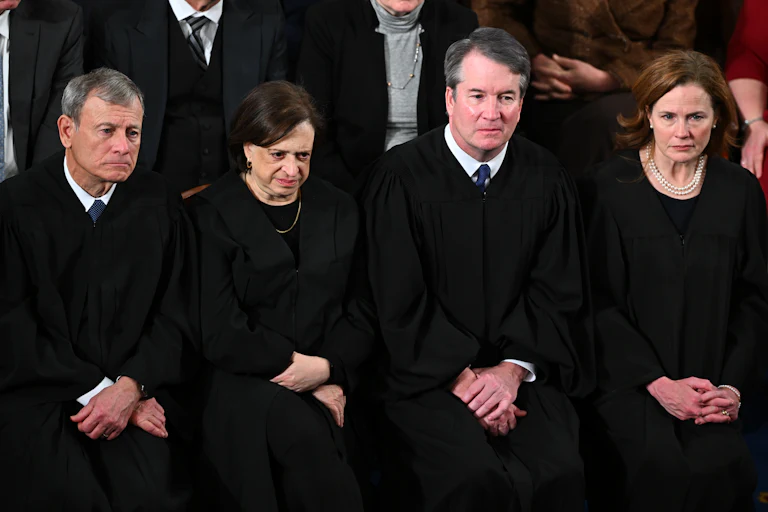
Supreme Court Justices John Roberts, Elena Kagan, Brett Kavanaugh, and Amy Coney Barrett sit side by side at Trump's State of the Union address in the Capitol.
Graeme Sloan/Bloomberg/Getty Images
From left: Supreme Court Chief Justice John Roberts and Justices Elena Kagan, Brett Kavanaugh, and Amy Coney Barrett listen to Trump’s State of the Union address, on February 24.

On Wednesday, the Supreme Court ruled 6–3 to render the Voting Rights Act obsolete.

Louisiana v. Callais was first brought to the court in 2025 by a group of white voters, who argued that a congressional map drawn to create a Black-majority district in Louisiana was unconstitutional. The conservative judges ruled that while Section 2 of the 1965 Voting Rights Act outlaws race-based gerrymandering, Louisiana’s map did not fit the bill, and in fact unnecessarily employed racial statistics when drawing borders.

Justices Elena Kagan, Ketanji Brown Jackson, and Sonia Sotomayor all dissented. In a scathing 48-page opinion, Kagan, joined by her fellow liberal justices, warned the ruling “demolishes the foundational right Congress granted of racial equality in electoral opportunity.”

“The Voting Rights Act is—or, now more accurately, was—‘one of the most consequential, efficacious, and amply justified exercises of federal legislative power in our Nation’s history,’” Kagan wrote. “It was born of the literal blood of Union soldiers and civil rights marchers. It ushered in awe-inspiring change, bringing this Nation closer to fulfilling the ideals of democracy and racial equality. And it has been repeatedly, and overwhelmingly, reauthorized by the people’s representatives in Congress. Only they have the right to say it is no longer needed—not the Members of this Court.”

Kagan noted the ruling functionally eliminates Section 2 of the Voting Rights Act, and allows legislators to wipe out minority districts whenever they feel like it.

“Under the Court’s new view of Section 2, a State can, without legal consequence, systematically dilute minority citizens’ voting power,” Kagan wrote. “Of course, the majority does not announce today’s holding that way. Its opinion is understated, even antiseptic. The majority claims only to be ‘updat[ing]’ our Section 2 law, as though through a few technical tweaks.… But in fact, those ‘updates’ eviscerate the law.”

Kagan continued: “A plaintiff will have to show—contrary to Section 2’s clear text and design—that the legislators were ‘motivated by a discriminatory purpose.’ That, as Section 2’s drafters knew, is well-nigh impossible.”

She concluded: “I dissent because Congress elected otherwise. I dissent because the Court betrays its duty to faithfully implement the great statute Congress wrote. I dissent because the Court’s decision will set back the foundational right Congress granted of racial equality in electoral opportunity. I dissent.”

Pentagon Reveals Total Cost of Iran War—and It Will Blow Your Mind

The assistant Defense secretary said they plan to ask for even more money.

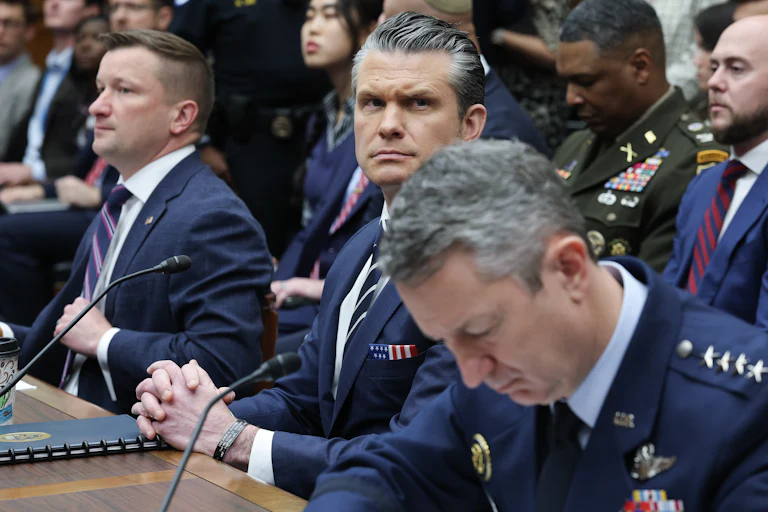
Assistant Defense Secretary Jules Hurst, Defense Secretary Pete Hegseth, and Chairman of the Joint Chiefs of Staff Dan Caine sit in a House committee hearing
Win McNamee/Getty Images
(From L-R) Assistant Defense Secretary Jules Hurst, Defense Secretary Pete Hegseth, and Chairman of the Joint Chiefs of Staff Dan Caine

Assistant Secretary of Defense Jules Hurst finally revealed the Pentagon’s estimated price tag for the U.S. military onslaught in Iran—and it’s a doozy.

“We’re spending about $25 billion on Operation Epic Fury,” Hurst said during a hearing before the House Armed Services Committee Wednesday. “Most of that is in munitions, there’s part of that obviously is [Operations and Maintenance] and equipment replacement.”

Hurst confirmed the Pentagon planned to develop a supplemental funding request through the White House once they had made a “full assessment of the cost of the conflict.” The Department of Defense has previously asked the White House for $200 billion for the war.

Washington state Democrat and Ranking Member Adam Smith, who’d asked the Pentagon representatives to eventually provide an estimate, appeared surprised to get such an immediate response. “I’m glad you’ve answered that question because we’ve been asking for a hell of a long time and no one’s given us that number,” he said.

As Trump’s military campaign in Iran has neared the 60-day mark, the Pentagon has neglected to deliver real cost estimates since it claimed to have spent more than $11.3 billion in the first six days alone. Every dollar spent on Trump’s war has come from American taxpayers, and was spent without congressional approval.

The American Center for Progress previously estimated that the war had reached a $25 billion price tag at the end of March. For context, the group estimated that with that amount of money, the U.S. government could for one entire year pay for Medicare coverage for 3,106,000 people, or provide 29,614,000 children with free school lunches, or shelter 3,147,000 people in Section 8 housing.

Instead, Trump chose to spend it on weapons, all while telling Americans there wasn’t enough money for childcare, Medicaid, or Medicare. For the amount of money the Pentagon has spent on this war, the government could have provided 1,780,000 children with free childcare for a year.

In the words of Dwight D. Eisenhower: “Every gun that is made, every warship launched, every rocket fired signifies, in the final sense, a theft from those who hunger and are not fed, those who are cold and are not clothed.”

Ex-Official Warns of Mass Exodus as Trump Weaponizes DOJ

Donald Trump is causing the rule of law to be “eroded.”

The Justice Department seal
Tom Williams/CQ-Roll Call, Inc/Getty Images

Justice Department attorneys are decamping from the Trump administration, leaving behind an enormous staffing void within the nation’s top law enforcement agency.

Thousands of experienced attorneys and staff have left the DOJ since Donald Trump returned to office, choosing a hasty exit over the possibility of being forced to prosecute unconstitutional cases at the president’s behest.

“What’s happening is long-term prosecutors are resigning because they’re refusing to go along with vindictive prosecutions, which are by their nature unconstitutional,” Stacey Young, an 18-year veteran of the agency, told MeidasTouch’s Scott MacFarlane. “In some cases, when prosecutors say no, they’re fired from their jobs for doing so, illegally.”

“And we’re also seeing people resign because of the culture those types of prosecutions create. So, the effect, the consequences, are devastating. The DOJ is losing countless lawyers because of it, the rule of law is being eroded, and the reputation of the department has really disintegrated,” Young said.

There were an estimated 10,000 attorneys working across the Justice Department before Trump returned to the White House. By September 2025, that number had been nearly halved: Justice Connection, an advocacy group that tracks DOJ departures, estimated that around 5,500 people (not all of them attorneys) had left the department, either by their own volition, by accepting the Trump administration’s buyout, or by being fired.

Just a fraction of those experienced employees have been replaced, causing a massive backlog of work. The immigration court system—which has been placed under tremendous pressure as a high priority within Trump’s second-term agenda—had a backlog of more than 3.3 million cases by the end of February 2026, according to data from the Transactional Records Access Clearinghouse. In reality, that means that the lives of more than three million people are effectively on pause as they await legal decisions that determine their future, either in or out of the United States.

The Justice Department’s hard-right shift into the MAGA agenda has sparked concern among those in the legal community, who have argued that the agency’s recent politicization has undermined public confidence in the country’s legal system.

Supreme Court Smothers Voting Rights Act, Hands GOP a Massive Win

The Supreme Court ruled along ideological lines against Louisiana’s congressional map.

Supreme Court
Heather Diehl/Getty Images
Supreme Court

The Supreme Court just threw out Louisiana’s redrawn congressional map in a huge blow to the Voting Rights Act, an essential pillar of the Civil Rights Movement.

In a 6–3 decision along ideological lines, the Supreme Court ruled Wednesday that Louisiana’s redrawn congressional map, which was redrawn with considerations of race thanks to a group of Black voters who had challenged the state’s original version, was unconstitutional.

“Because the Voting Rights Act did not require Louisiana to create an additional majority-minority district, no compelling interest justified the State’s use of race in creating SB8, and that map is an unconstitutional racial gerrymander,” the court wrote in its decision for Louisiana v. Callais.

Justice Samuel Alito delivered the majority decision, joined by the five other conservative justices, while Justice Elena Kagan filed her dissent, joined by the other two liberal justices.

Following the 2020 census, Louisiana’s state legislature drew a new voting map, which produced one majority Black district. A group of Black voters sued, arguing that the map had violated Section 2 of the Voting Rights Act, which prohibits discrimination based on race. A federal district court sided with the voters, and the conservative U.S. Court of Appeals for the Fifth Circuit upheld the decision, ordering the state to draw a new map. A new map was created that had two congressional districts that were majority Black.

But then, a group of voters who described themselves as “non-African-American” challenged the new congressional map, arguing that because it had been drawn to consider race, it was unconstitutional gerrymandering, in violation of the equal protections clause of the U.S. Constitution. While a panel of federal judges initially blocked Louisiana from using the new map, the Supreme Court paused that decision, allowing the state to temporarily use it.

The Supreme Court’s decision will not only affect election results in conservative-led Louisiana for years to come, but it has severely undermined the ability of voters to challenge discrimination under the Voting Rights Act, which prohibits “discrimination against the minority group, such as unusually large election districts,” according to a 1982 report from the the Senate Committee on the Judiciary.

This story has been updated.