Breaking News
Breaking News
from Washington and beyond

Trump Brags About Ballroom in First Speech Since GOP Election Wreckage

Republicans were just obliterated this election. Donald Trump doesn’t care.

President Donald Trump signs a large piece of steel, which includes other signatures as well.
President Donald Trump signs the last piece of steel to be used in construction of the White House ballroom during an event on November 4, one day after Republicans lost Congress in the midterm election.
Andrew Harnik/Getty Images
President Donald Trump signs the last piece of steel to be used in construction of the White House ballroom during an event on November 4, one day after Republicans lost Congress in the midterm election.

President Trump’s first public speech after a disastrous, resounding midterm election defeat was about the White House ballroom, as he offered the American people deranged ramblings about the only thing he actually seems to care about.

“I doubt there’s a ballroom in the country [with] a 50-foot ceiling,” Trump said outside the construction site of his ballroom on Wednesday, just barely more than 12 hours after Democrats took control of both the House and the Senate in a resounding rejection of his administration’s policies and ideology.

You’d think a president would offer words of encouragement to his party or righteous anger in such a desperate moment. Instead, Trump went full lame duck mode. “There has never been anything built like this, and it’s for the country, and it’s free, we got it free of charge, thank you very much.... When it’s completed it’ll be the best anywhere in the world.”

The president appeared with Interior Secretary Doug Burgum.

“Why does Trump spend time on the White House? Well first of all, it’s very little time. Second of all, I like it. It’s good. For me it’s relaxing.... I love construction,” Trump continued. “That’s what I do, I like beautiful things.”

Trump went on to speak about the ballroom’s kitchen, staircase, roof, and marble veining.

It’s incredible that Trump—who seemed particularly calm at the event—can simply act like nothing happened, after his own unpopular decisions in office resulted in a midterm sweep that could cripple the Republican Party for the next decade. His own vice president, JD Vance, admitted that their war on Iran, the cost of living, inflation, and the administration’s close relationship with Israel lost them the election. But rather than address any of that, the president would prefer to talk about buttresses.
JD Vance Throws Trump Under the Bus for Republicans’ Election Wipeout

Vance is doing his best to break from Trump after Republicans’ devastating losses this election.

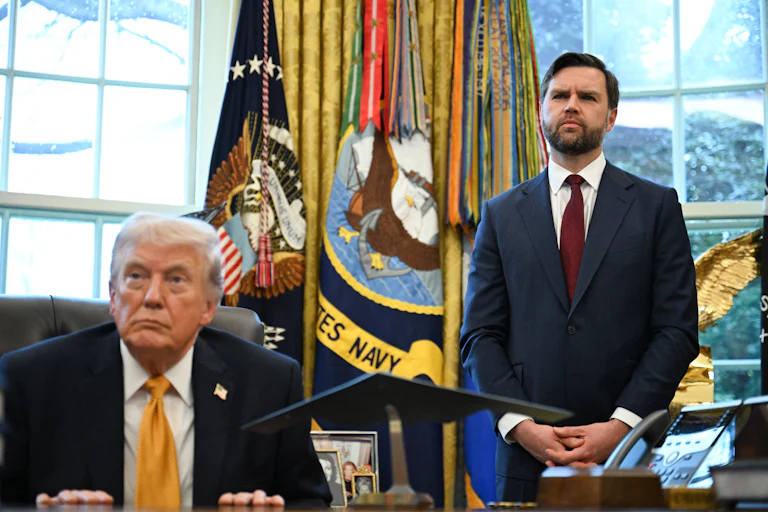
Donald Trump sits at his desk in the Oval Office of the White House as JD Vance stands next to him
ANNABELLE GORDON/AFP/Getty Images

Vice President JD Vance is desperate to save himself from the blue wave—even if that means letting President Donald Trump drown.

Just hours after Democrats seized control of Congress and swept state elections across the country, Vance promptly threw the president under the bus.

“The reason we lost is the war. The president himself said so last night,” Vance wrote in a lengthy post on X Wednesday, blaming the Iran war without mentioning Trump by name.

“If you’d like to argue it was worth it, that losing the Senate for the next 6 years was worth it, then do so. Argue it was a worthwhile cost to pay. Agree or disagree, that’s at least honest,” he wrote. “But everyone knows why we lost. And any honest conversation about where we go from here must start there.”

In the early days of Trump’s military onslaught, Vance had expressed some reluctance about the president’s war plans. But that quickly gave way to the spineless sycophantism we’ve come to expect from the vice president.

In his post on Wednesday, Vance claimed that Republicans’ main problem is that many people who supported Trump in the 2024 presidential election had flipped to support Democratic candidates.

Vance claimed that a pollster—”one of the smartest people I know in politics”—found that voters would return to supporting the GOP if they ended the war in the Middle East, focused on the cost of living and inflation, “put America First,” and changed the U.S. relationship with Israel.

Trump’s eight-month-long “six week war” in Iran has proven to be a major political liability. His military campaign has resulted in the deaths of 22 U.S. service members, and hundreds more injured. Trump’s war is responsible for the deaths of thousands of Iranian civilians, including 120 schoolchildren. The president also oversaw the destruction of multiple U.S bases in the Middle East, a series of deadly military morale issues, and the depletion of the U.S. weapons stockpile, leaving the country more vulnerable to foreign threats.

The war effort has already cost American taxpayers an estimated $47.1 billion. That’s enough to pay for one year of Medicare coverage for 5.84 million people, based on previous figures from the Center for American Progress. That doesn’t include the skyrocketing price of gas and consumer goods thanks to the war.

In the words of Dwight D. Eisenhower: “Every gun that is made, every warship launched, every rocket fired signifies, in the final sense, a theft from those who hunger and are not fed, those who are cold and are not clothed.” It seems that Vance is finally catching on to just how damaging this war has been.

Democrats Take Over Total Control in Four States With Trifecta Power

Democrats have secured a trifecta in four states this election—winning both chambers of the state legislature and the governor’s seat.

Wisconsin State Capitol
Jordan McAlister/Getty Images

Democratic candidates flipped control of multiple state legislatures on Tuesday, clinching electoral trifectas in Wisconsin, Minnesota, Michigan, and Pennsylvania.

It was a wildly successful night for Democratic candidates in Congress, but Americans also voted to install Democrats in their state governments across the country.

In Wisconsin, Democrats flipped both the state’s Assembly and Senate. In the state’s Senate, Democrats flipped to an 18–15 majority, an exact inverse of the chamber’s current makeup. In the state Assembly, Democrats secured a 53–46 majority. And Democratic candidate David Crowley was elected to the governor’s office, securing the party an electoral trifecta for the first time in 16 years.

In Minnesota, Democrats clinched majorities in both chambers of the state legislature. In the House, the Democratic-Farmer-Labor Party has won 72 of 134 seats thus far, surpassing the 68-seat majority. In the state’s Senate, the DFL party held onto its 34-seat majority. When coupled with DFL nominee Senator Amy Klobuchar’s victory in Minnesota’s gubernatorial race, Democrats have achieved trifecta control of the state’s government.

In Michigan, Democrats flipped the state’s House of Representatives. In the 110-seat House, Democrats ousted at least five Republican incumbents to secure at least 50 seats. In the 38-member state Senate, Democrats ousted two GOP incumbents, growing their majority from 20 to 23 seats. Democratic candidate Jocelyn Benson was elected to the governor’s office, securing the Democrats’ electoral trifecta in the state.

In Pennsylvania, Democrats also achieved a trifecta by flipping the state’s Senate for the first time since 1993. Ahead of the election on Tuesday, Republicans held a 27–23 majority in the 50-seat state Senate. Democrats flipped three seats on election night. Democrats also increased their majority in the state’s House of Representatives from 103 to 111 seats.

In North Carolina, Democrats flipped control of the state’s House of Representatives for the first time since 2010. As of Wednesday morning, Democrats held 66 seats in the 120-seat House. They needed to flip 12 seats to retake a majority, and by the time all the votes are counted, it’s possible they will have flipped 20. Going into the election, Republicans were just one seat short of a supermajority in the chamber.

As if that wasn’t enough, a few other states appeared to still be on their way to turning their state legislatures blue.

In Texas, the House races remained too close to call on Wednesday morning, but the Democrats were closing in on control of the lowest chamber for the first time since 2003. As of Wednesday morning, Democrats needed to flip at least 14 seats but had already flipped six seats, and they were leading in at least a dozen more Republican-held districts. Meanwhile, Republicans maintained control of the state Senate.

In Arizona, Democrats were poised to take control of the state legislatures for the first time in 60 years and potentially achieve yet another electoral trifecta for the Democratic Party.

Every DSA Candidate Who Won a National Race This Election

The Democratic Socialists of America had a good night this election.

State Representative Donavan McKinney, Representative Alexandria Ocasio-Cortez, Senate candidate Abdul El-Sayed, Senator Bernie Sanders, United Auto Workers (UAW) President Shawn Fain, and Representative Rashida Tlaib hold each others' hands and raise them in victory while standig on a stage.
State Representative Donavan McKinney, Representative Alexandria Ocasio-Cortez, Senate candidate Abdul El-Sayed, Senator Bernie Sanders, United Auto Workers President Shawn Fain, and Representative Rashida Tlaib during the “People v. The Powerful” campaign event in Detroit, on July 18
Nic Antaya/Bloomberg/Getty Images
State Representative Donavan McKinney, Representative Alexandria Ocasio-Cortez, Senate candidate Abdul El-Sayed, Senator Bernie Sanders, United Auto Workers President Shawn Fain, and Representative Rashida Tlaib during the “People v. The Powerful” campaign event in Detroit, on July 18

The Democratic Socialists of America are here to stay. One of the most contentious—and misunderstood—political groups in the country rode a wave of popular support to groundbreaking victories this election.

First reanimated by the 2016 Bernie Sanders campaign and reaffirmed since then by a lack of imagination and initiative from the Democratic Party’s center, the DSA left wing is now firmly entrenched within the Democratic machine. Ten DSA House and mayoral candidates won on Tuesday after running on platforms emphasizing affordability, ending U.S. aid to Israel, and expanding access to health care. As a whole, with down ballot races included, DSA-endorsed candidates won 127 of the 294 races they ran in, with 70 races still undecided. Seven of them will be in the U.S. Congress next year. Here are the biggest victors:

Nithya Raman — Mayor of Los Angeles

Nithya Raman raises both hands in the air in victory
Robert Gauthier/Los Angeles Times/Getty Images

Janeese Lewis George — Mayor of Washington, D.C.

Janeese Lewis George raises both hands in the air in victory as her supporters cheer around her
Maxine Wallace/The Washington Post/Getty Images

David Morales — Mayor of Providence, Rhode Island

David Morales leans his arm on a railing and smiles
Suzanne Kreiter/The Boston Globe/Getty Images

Melat Kiros — House of Representatives, Colorado

Representative-elect Melat Kiros smiles at a podium.
Aaron Ontiveroz/The Denver Post

Donavan McKinney — House of Representatives, Michigan

Donavan McKinnely smiles at a podium while lookin over his shoulder
Sarah Rice/Bloomberg/Getty Images

Darializa Avila Chevalier — House of Representatives, New York

Darializa Avila Chevalier smiles and holds up her "I Voted" sticker
Angelina Katsanis/Bloomberg/Getty Images

Claire Valdez — House of Representatives, New York

Claire Valdez smile and clasps her hands together in front of a campaign backdrop
Michael M. Santiago/Getty Images

Chris Rabb — House of Representatives, Pennsylvania

Chris Rabb puts his hand on his chest
Matthew Hatcher/Getty Images

Rashida Tlaib — House of Representatives, Michigan

Rashida Tlaib sits on the floor smiling while protesting for Gaza
Adam J. Dewey/Anadolu/Getty Images

Alexandria Ocasio-Cortez — House of Representatives, New York

Alexandria Ocasio-Cortez walks down a street
Adam Gray/Pool/Getty Images

Democrats Won Control of Congress. Here’s What They Can Do Now.

Democrats have a real chance to do something with their victory this election.

Capitol building
Kevin Carter/Getty Images

A blue wave has washed over the nation, as Democrats retake both the House and the Senate and voters across the country offer a resounding rebuke of President Donald Trump and his far-right administration. Democrats have flipped both the House and Senate, and New York Representative Hakeem Jeffries will become the first Black House speaker. Meanwhile, Democratic Senate candidates flipped seven seats previously carried by Trump and the GOP. But now that the Democrats will control Congress in January, what can they do? And will they actually do it?

Impeachment

Let’s start here first, since it’s at the top of everyone’s mind.

Democrats now have the numbers to impeach Trump or any of his Cabinet members. Defense Secretary Pete Hegseth, who has headed the disastrous, destructive, and expensive war on Iran, is reportedly the Democratic majority’s top target.

The impeachment process can begin in the House of Representatives with a simple majority, which Democrats now have. The trial then moves to the Senate. To actually convict and remove, they will need a two-thirds majority in the Senate, which means the Democrats will need some Republican votes.

While impeachment of Trump is certainly a possibility, there is a greater likelihood that Democrats will be able to convict and remove someone like Hegseth, who has been losing Republican allies over the course of the Iran war.

Investigations

The Democrats could also open a wide array of investigations into the Trump administration, much like they did last time they controlled the House in 2018.

This is certainly the most corrupt administration in modern history. Some top investigation targets could include:

The Epstein Files

This issue won’t be going anywhere, especially with a Democratic-controlled Congress. The party has called for a renewed push to reopen investigations into the world of infamous sex predator Jeffrey Epstein—and the Trump administration’s botched rollout of the files. Just last week, House Judiciary Democrats released a report on the cover-up, noting that “DOJ and FBI shut down investigations and withheld evidence while claiming no basis to prosecute or even investigate any additional Epstein co-conspirators.”

The UAE chips affair

In May, a firm of Emirati royal Sheikh Tahnoon bin Zayed Al Nahyan gave $2 billion to World Liberty Financial Group, a crypto company controlled by the families of Trump and his Middle East envoy Steve Witkoff. Two weeks later, the Trump administration completed a deal to give the United Arab Emirates hundreds of thousands of the world’s most valuable AI chips—in an extremely questionable display of ethics.

Jared Kushner

Last month, a new book reported that the president’s son-in-law had his phone hacked during the first Trump administration, which revealed Kushner’s control of foreign slush funds filled by the leaders of the UAE, Saudi Arabia, and Israel. The report exposed how Kushner appeared to make deals with those governments to violently transform Palestine, Iran, Lebanon, and the greater Middle East region.

Trump selling early access to Truth Social

Trump and his aide Natalie Harp were sued in September over the “Truth API” program, which offers Truth Social users early access to posts from government officials in exchange for $100,000 a month. Watchdog groups alleged that Trump is using the media company that he uses as a personal bulletin board to run a pay-to-play scheme, offering crucial information that affects global markets and policy decisions to whoever can afford it.

Heavily Impede the Trump Agenda While Pushing Their Own

At a bare minimum, any Republican bill or policy is all but guaranteed to die in Congress, as Republicans will need Democratic votes every time to pass anything. The Democrats’ majority allows them to go on the offensive, and it has been reported that they have a “First 100 Hours” agenda focused on ending Trump’s antagonistic and expensive foreign tariffs, reviving expired Affordable Care Act health care premium subsidies, and reversing almost $1 trillion in Medicaid cuts. They could also make efforts to impede the Iran war.

Unfortunately, to make their bill veto-proof, Democrats will need a two-thirds vote in both the House and Senate, meaning they will need Republicans to join them. Whether Trump will veto will depend on his own temperament, as he may be likely to reject legislation from a Democratic Congress in his lame-duck era, regardless of how popular or bipartisan it is.