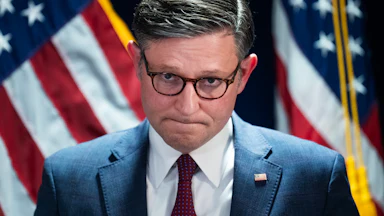
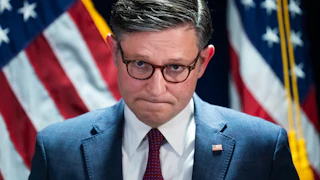
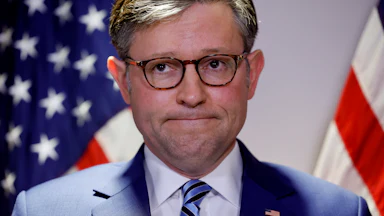
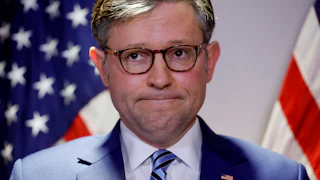
When all non-essential government services were suspended at the beginning of October, that also seemed to include the House Speaker Mike Johnson’s brain-processing power. But unlike the rest of the government, the Louisiana Republican has no intention of turning it back on.
Take for instance, Johnson’s recent non-response to the mounting calls that the Pentagon turn over footage of the U.S. military issuing a second strike on an alleged drug trafficking vessel. When asked directly on December 2 whether he believed the Defense Department should release the unedited video, Johnson replied that he wouldn’t “prejudge” whether the strikes had violated any laws. He then noted that he was “pretty busy yesterday” and “didn’t follow a lot of the news.”
This peculiar tic first became noticeable when Johnson started to deliver daily press conferences about the so-called “Democrat Shutdown” in October. The issue wasn’t just that the speaker claimed not to know anything about his own government, but that he insisted on answering questions anyway. After shamelessly purporting his own ignorance, Johnson would then proceed to pull political discourse away from reality.
There were several times when Johnson seemed to think he could get away with simply pretending not to read the news—specifically when it came to turning a blind eye to the abuses of Donald Trump’s sweeping immigration crackdown.
In late October, Johnson claimed he couldn’t comment on a Presbyterian minister whom federal immigration agents shot in the face with a pepper ball during an anti-ICE protest near Chicago. “I haven’t seen or heard any of those videos,” Johnson said—despite the fact that just two weeks earlier, he’d been asked directly about the incident. At the time, Johnson replied, “I’ve not seen them cross the line yet,” quickly moving on to accuse protesters of violence.
Johnson had a similarly outlandish response when asked in mid-October about a ProPublica report that found 170 U.S. citizens had been unlawfully detained by ICE, including 20 children. “I’m not—I don’t know what you’re talking about with the children,” Johnson replied.
While Johnson may have been content to claim that the Trump administration’s abuses were not in his purview, there were also several instances when the leader of the House Republicans claimed he had no idea what was happening with, well, House Republicans.
After a series of Nazi-ish incidents in his party, including a Hitler-loving group chat of Young Republican leadership and a report that there was a swastika hanging in a Republican congressman’s office, a reporter asked Johnson if he was concerned about the “extremist pro-Hitler sentiment” among members of his party. “No. Look, obviously we roundly condemn any of that nonsense and the Young Republican or the organization—I don’t know who any of these people are. I never heard of them,” Johnson replied.
While Johnson could reasonably argue he had never met any leaders of Young Republicans chapters from around the country, it’s a little harder to believe he wasn’t aware of the existence of one of his own colleagues. During that same press conference, Johnson was asked about Representative Marjorie Taylor Greene’s criticism over his failure to address the protective order against Representative Cory Mills for allegedly threatening to release sexually explicit materials of his ex-girlfriend.
“I don’t know what Marjorie’s talking about,” Johnson claimed, adding that he’d wait for the legal procedures against Mills to play out. (Johnson had dismissed a question earlier that week about the Mills allegations as not “really serious.”)
To be fair, Johnson didn’t seem to know what was going on with Democrats, either. When the speaker was asked in late October about the plot to assassinate House Minority Leader Hakeem Jeffries at a New York City Economic Club event, he inexplicably claimed he was hearing about it for the first time. “Terrible. That’s the first I’ve heard of that. I don’t know anything about it,” Johnson replied. “But anybody who threatens to kill any political official, we denounce it, absolutely.” Later, when given the chance to elaborate on his statement, Johnson chose to throw the responsibility back at America’s ideological left, smearing attendees at the No Kings Day protest that month for supposedly encouraging violence.
But that’s where Johnson’s outrage at political violence appeared to end. Days after the alleged wannabe assassin’s arrest, Jeffries said he still hadn’t heard a word from his Republican counterpart.
And for one of Trump’s closest allies, Johnson regularly claimed he wasn’t aware of what the president was up to. He claimed not to “know the details” of Trump’s request for a $230 million reimbursement from the Department of Justice and said he wasn’t privy to “the latest developments” on Trump’s talks to buy beef from Argentina. Johnson even insisted he “didn’t know anything about” Trump’s revelation he had no idea he’d granted a presidential pardon to Changpeng Zhao, just months after the former Binance CEO did the president’s family’s cryptocurrency a $2 billion favor.
It’s true that the breaking news cycle has grown increasingly overwhelming during Trump’s first year since returning to office—apparently even for the president’s happiest warriors. But when it comes to being speaker of the House, that’s no excuse for playing dumb. Johnson’s “See No Evil, Hear No Evil” approach to governance will only allow the president to continue to run amok in the New Year—if the speaker doesn’t alienate his fellow Republicans into an all-out revolt first.