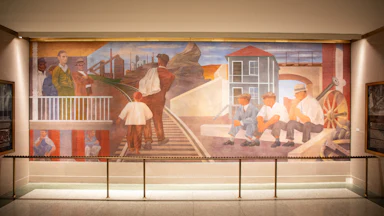
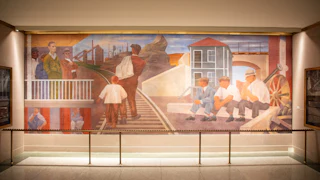
Nearly two years after an unnoticed amendment to a water resources bill mandated the sale of the Wilbur J. Cohen Federal Building—a government structure facing the National Mall that contains precious murals by Ben Shahn, Philip Guston, and others, which has been called by a leading preservationist “a kind of Sistine Chapel of the New Deal”—a House committee approved Tuesday a bill that would allow the Cohen to remain in government hands. It’s the first such legislation to make any headway at all. (I’m a little obsessed with the Cohen. For my earlier pieces about it, click here, here, here, here, and here.)
The Cohen building’s plight has conjured some strange bedfellows. The sponsor of the bill to save it is Representative Scott Perry, Republican of Pennsylvania and former chairman of the hard-right Freedom Caucus, whose mission statement expressing support for “limited government” is the very antithesis of the social welfare programs celebrated in the Cohen building’s artworks.
Perry is a sworn enemy of the Cohen building’s chief tenants, the Voice of America and its parent agency, the United States Agency for Global Media, or USAGM. In 2022, Perry wrote that VOA had “abandoned its sacred mission to authentically promote our Nation’s interests,” and that this was “a dereliction of duty.”
Then, in 2023, Perry introduced a bill that he described as requiring federal agencies “to use at least 60 percent of their office space or sell it.” The bill cleared the House but stalled in the Senate. Perry’s 2023 bill was not good news for the Cohen building. The Cohen’s average daily use was reported last year to be about 30 percent of pre-pandemic levels, so the 2023 bill would have forced the Cohen’s sale even if Republican Senator Joni Ernst hadn’t gotten around to doing so in her 2025 amendment to the water bill. The Cohen building has been lightly occupied in recent years in large part because the first Trump administration ordered VOA to move into new quarters. That decision was reversed at the start of the second Trump administration by Trump’s senior adviser to USAGM, the clueless blowhard Kari Lake. (More on that here.) By then Trump was laying off VOA and USAGM workers left and right in an illegal attempt to shut VOA down.
Now Perry is reversing himself and trying to save the Cohen. I don’t know why—my efforts to contact a spokesperson were unavailing—but I’ll take it. The measure was passed without opposition by the House Committee on Transportation and Infrastructure. Perry is chairman of its Subcommittee on Economic Development, Public Buildings, and Emergency Management.
I think I can guess why Perry changed his mind. Ben Peters of The Washington Business Journal, who broke the story Wednesday, observed that Rich Butterworth, senior analyst and adviser with the Office of Real Property Utilization and Disposal within the General Services Administration (the executive branch agency that manages federal real estate) told the Public Buildings Reform Board in June that selling the Cohen would require “extremely expensive” construction work to separate the Cohen’s heating and other infrastructure from its sister federal building across C Street. The sister building, the Mary E. Switzer Memorial Federal Building, was built at the same time as the Cohen and by the same architect. It’s in use by the Health and Human Services Department, and the federal government has no interest in selling it. One month after Butterworth brought this news to the Public Buildings Reform Board, the GSA de-listed the Cohen building as a property for sale.
Perry’s bill will help save the Cohen, but it’s not ideal. The House should remove the troublesome parts if (I’m tempted to say “when”) the Democrats retake the chamber in January. The troublesome parts are a series of conditions placed on the Cohen remaining in federal hands. The Cohen must be used as a “swing space to facilitate the sale or major renovation of other federal buildings.” The Trump administration and the District of Columbia government are trying to create a retail and residential district in D.C.’s Southwest quadrant between the National Mall and the Potomac River, which will require the sale of other federal properties in that area (including, possibly, the Cohen if this bill doesn’t pass). I’m not sure the planning of these sales, or of renovating other federal buildings, requires a space quite so vast as the 1.2 million-square-foot Cohen, but so be it.
It would be great if the Cohen’s swing space could be used to renovate the Cohen building itself, which the GSA estimated in 2025 (in a report later suppressed by the Trump administration) to cost about $1 billion. But Perry’s bill stipulates that expenditures on retaining the Cohen may “not exceed any savings realized by the sale or major renovation of any other Federal building.” Savings from building sales aren’t likely to be large. Earlier this year, the GSA sold two Southwest D.C. properties at prices so embarrassingly low—in one instance, for less than one-tenth market value—that the Public Buildings Reform Board suggested all Southwest sales be suspended. And I’m skeptical that any federal building renovation can be shown to save an amount even approaching $1 billion (though the $2.5 billion cost of renovating the Fed, about which Trump is famously apoplectic, well exceeds the proposed cost of renovating the Cohen). The Perry bill thus effectively blocks renovating the Cohen, which needs renovating pretty desperately.
“Living New Deal welcomes news of preservation of the Cohen federal building for future generations,” said Mary Okin, assistant director of the Berkeley-based Living New Deal, a preservation group that’s been fighting to save the building. “We maintain that we would like the modernization feasibility study that charted a future for the Cohen building, which taxpayers paid for, to be released.” If the GSA makes the study public, maybe Congress will approve not just saving the Cohen but repairing it. Still, any movement on a bill to save the Cohen is excellent news.