Breaking News
Breaking News
from Washington and beyond

Watch: Mike Johnson Desperately Tries to Avoid Talking About IVF

The House speaker all but ran away when asked about his stance on the procedure.

Mike Johnson looks forward
Anna Moneymaker/Getty Images

Please don’t ask House Speaker Mike Johnson about his stance on IVF. It’s hard for him to give a comprehensible answer.

The far-right speaker struggled Thursday to answer a question about in vitro fertilization, which has taken center stage following an Alabama Supreme Court ruling earlier this month that determined frozen embryos can in fact be considered children.

“On IVF, do you favor a bill to protect IVF and do you believe discarding embryos is murder?” a reporter asked Johnson.

“Look, I believe in the sanctity of every human life. I always have. And because of that, I support IVF and its availability,” Johnson began.

“If you look at the statistics, it’s really an amazing thing. Since the technology became available in I think the ’70s, maybe the mid-’70s, an estimated eight million births in the U.S. have been brought about because of that technology,” he continued. “So it needs to be readily available, it needs to be something that every American supports, and it needs to be handled in an ethical manner.”

“I don’t think there’s a single person in the Republican conference who disagrees with that statement, and there’s a lot of misunderstanding about it, but it’s something I think we ought to support.”

Well, there’s at least one person who disagrees with that statement: Mike Johnson.

Like many other anti-abortion lawmakers, Johnson has a long record of arguing that life begins “from the moment of fertilization.” And that’s the exact same logic the Alabama Supreme Court used when ruling that even embryos created through in vitro fertilization are protected under the Wrongful Death of a Minor Act.

Johnson has used this logic to oppose nearly every form of reproductive rights, including contraception. Along with most other Republicans in the House, Johnson has also co-sponsored the Life at Conception Act, which would grant legal personhood to fertilized eggs.

The Alabama ruling has already pushed at least three fertility clinics in the state to put a pause on IVF. A major embryo shipping company has also paused business, making it harder for Alabamans who’ve already started the IVF process to now seek that care out of state. The Life at Conception Act would give legal personhood to every fertilized egg much like the Alabama ruling, and thus it would have a very similar effect on restricting IVF—but on a national scale.

Shortly after becoming House speaker in November, Johnson was asked about his previous records on legislation against fertility treatments.

“I’m not sure what they’re talking about,” Johnson conveniently replied. “I don’t really remember any of those measures.”

Similarly, when the reporter tried to ask Johnson on Thursday whether he supports any legislation to protect the right to IVF, he quickly ended the press conference.

Senate Republicans, meanwhile, blocked a bill to protect IVF treatment late Wednesday.
Here’s How Long the Supreme Court Could Delay Trump’s Jan. 6 Trial

The Supreme Court’s decision to hear Donald Trump’s immunity case is slowing everything down.

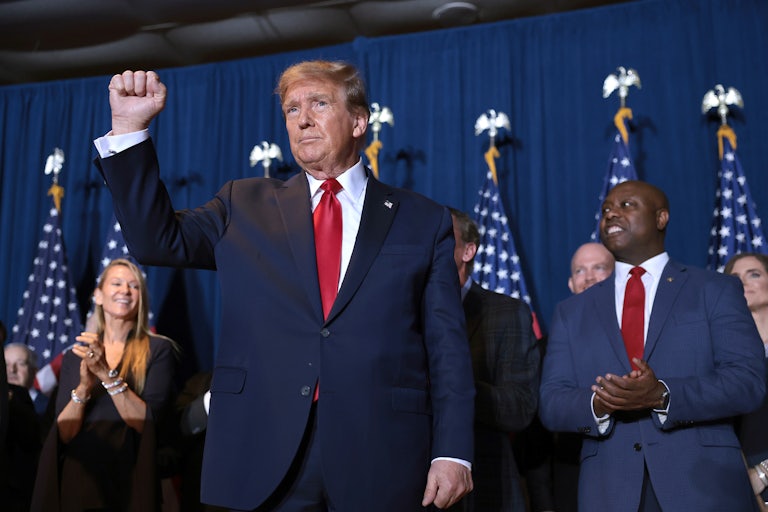
Donald Trump stands while holding his fist in the air
Win McNamee/Getty Images

The Supreme Court has said it will hear the case on whether former President Donald Trump can claim presidential immunity to get out of his federal election interference trial.

But that announcement, which came Wednesday, has legal experts concerned about how this could just be a delay tactic by the Supreme Court and its three Trump-appointed justices.

Until the Supreme Court issues its final decision on Trump’s immunity claim, the federal trial over Trump’s efforts to overthrow the 2020 election—overseen by Judge Tanya Chutkan and originally scheduled to begin next week—will remain on hold.

Legal analyst Lisa Rubin explained on MSNBC Thursday just how much the Supreme Court’s decision shifts back the timeline for when Trump could finally be in a courtroom and potentially face justice over his actions around the 2020 election.

“When Donald Trump’s case was paused to allow for further consideration of the immunity issue, there were 88 days left till trial,” Rubin said. “Judge Chutkan has publicly committed herself to giving Donald Trump around seven months to prepare for trial. So we have to assume that she takes that 88 day remainder fairly seriously. She has also said … that this is a trial that will take around three months. So you have to build into the calendar that 88 days plus 90 days to try the case, if you think that this is going to happen before the election.”

“And that’s why folks like me are asking the Supreme Court, why didn’t you write like you’re running out of time?” she continued. “Because time is quickly elapsing here.”

The Supreme Court has said it will hear arguments beginning the week of April 22.

While many legal experts agree that the Supreme Court will likely strike down Trump’s presidential immunity claim, as Rubin explained, they have different opinions on how quickly they think the Supreme Court will actually issue that decision after hearing the case.

Neal Katyal, the former acting U.S. solicitor general, thinks the decision will come pretty quickly, perhaps by early May. But if we consider Rubin’s math, even in the most sped-up version of the timeline, Trump wouldn’t face a decision in the federal election interference trial until early November. The 2024 election is on November 5.

The Supreme Court’s term usually ends at the end of June or early July. If the court waits until then to issue its ruling, the timeline looks even worse.

Former appeals court Judge Michael Luttig predicted that it is “unimaginable” that Trump will be tried in special counsel Jack Smith’s federal election interference trial before the 2024 election.

Harvard Law professor Laurence Tribe also warned that the delay we’ve seen thus far “is just the beginning.”

“If [the Supreme Court] really had any interest in expedition, any interest in satisfying the public need to get this trial going and to have a verdict one way or the other before the election, they would have asked a narrower question,” Tribe told MSNBC Wednesday night. “They would have simply asked whether a president charged with criminally seeking to remain in office beyond the end of his term has absolute immunity from prosecution or crimes committed in that vein. That would have been the right question to ask, and it could have only had one answer.”

Of course, the Supreme Court’s scope in hearing the case is much broader—and it won’t even begin considering the many questions of immunity until April.

As a reminder, Trump’s immunity claim is so outlandish that it has been struck down by two courts already. At one point, his lawyers even tried to argue that a president would be immune from criminal prosecution if he ordered the assassination of a political rival, so long as Congress did not vote to impeach him first.

Guess Which Crooked GOPer Didn’t Even Listen to Hunter Biden’s Testimony?

Hunter Biden’s testimony did not appear to go as planned.

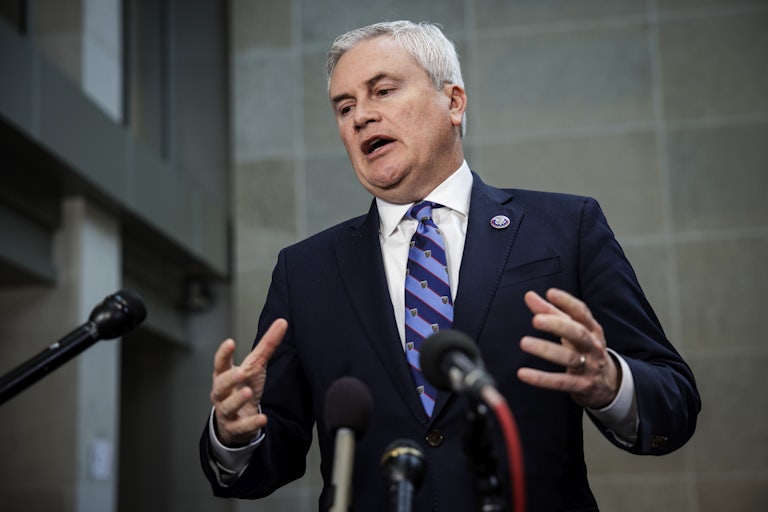
James Comer speaks into microphones
Samuel Corum/Getty Images

Moments after the end of Hunter Biden’s closed-door deposition, Republicans signaled that the seemingly endless impeachment inquiry into President Joe Biden had finally started to wrap up.

By all means, Wednesday did not look like a success for Republicans, who were roundly accused of ignoring evidence supporting the president’s innocence and pushing a double standard by refusing to examine the term-specific financial gains of former President Donald Trump, who “openly pocketed” money from his son-in-law Jared Kushner’s business dealings—including a $2 billion deal with a Saudi crown prince and Trump ally.

But none of that seemed to linger on the minds of the Republicans leading the probe, who hours later could only seem to remember that the hearing had proved extremely damaging for the Biden family—which, frankly, makes sense considering they hardly attended.

In an interview on Fox News’s Hannity, House Oversight Chair James Comer, Judiciary Chair Jim Jordan, and Ways and Means Chair Jason Smith—who have led the charge against the Biden family—refused to acknowledge the startling truth.

“On a scale of one through 10, how damaging was today’s testimony—or deposition—to Hunter Biden?” asked Hannity.

“Well I would say that they’re pretty good at not recalling many things so I’d say an eight,” said Smith.

Oversight Democrats Communications Director Nelly Decker later pointed out that Smith was not present for the deposition.

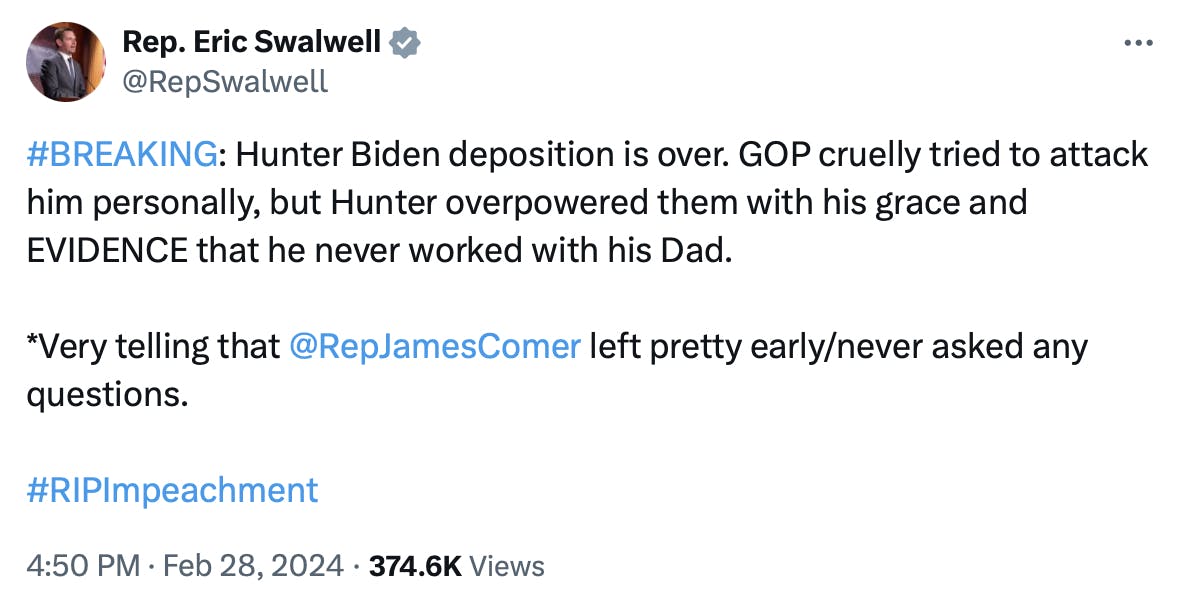
“I’d say an eight,” Comer replied curtly, failing to admit that he had left the deposition early and didn’t ask a single question of the witness at the very center of their impeachment probe.

Tweet from Eric Swalwell

“Sean, Sean, I think it was very good for us,” Jordan said. “As I said I think we got a lot of information that we can use if in fact we have a public hearing as Chairman Comer has talked about.”

Republicans are preparing for a public hearing with Hunter Biden—though that was the format that the president’s son has demanded since at least December, when he risked a contempt of Congress charge by refusing the first closed-door invitation. Now we can see why.

Radical Freedom Caucus Torches McConnell After Retirement Announcement

The far-right wing of the House is overjoyed Mitch McConnell is stepping down from Senate leadership.

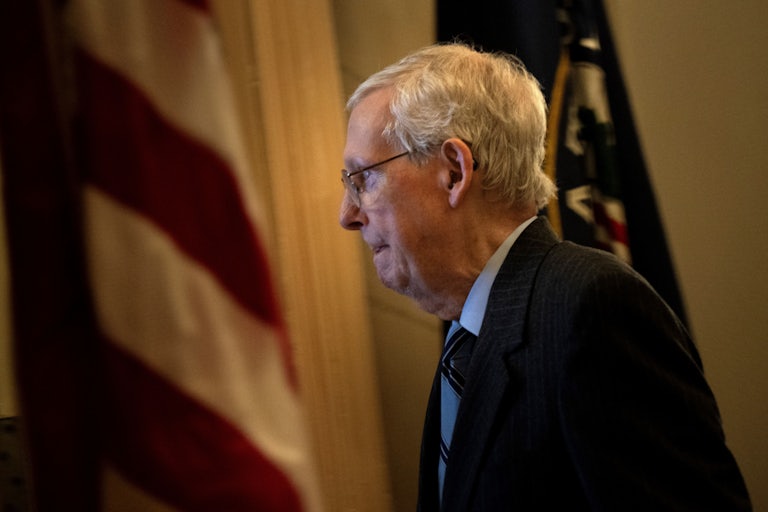
Mitch McConnell stands in profile next to an American flag
BRENDAN SMIALOWSKI/AFP/Getty Images

The far-right House Freedom Caucus couldn’t hide its glee after Mitch McConnell announced that he’ll step down as Senate minority leader by the end of the year.

The 82-year-old Kentucky Republican said Wednesday he’ll resign from his leadership position by November, and the Freedom Caucus responded by calling him a RINO.

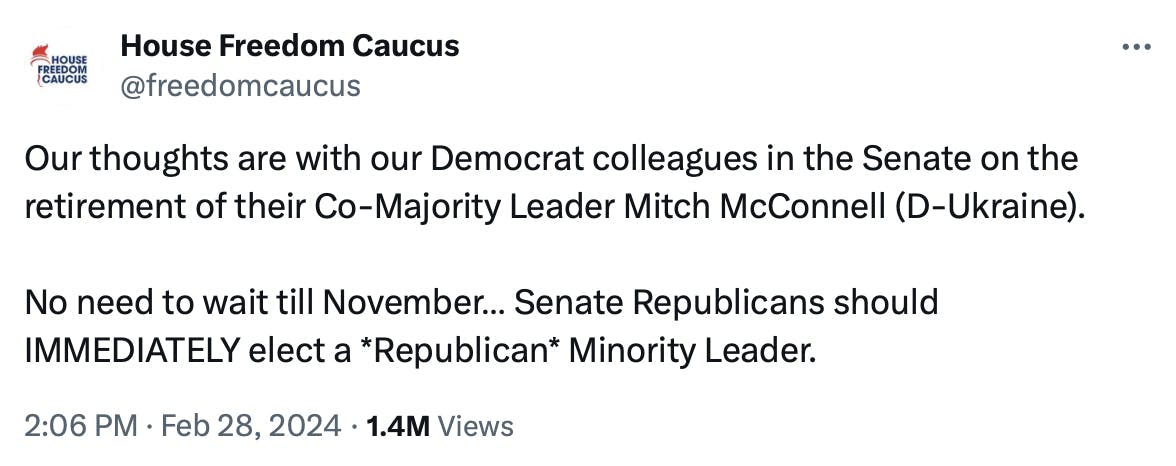
“Our thoughts are with our Democrat colleagues in the Senate on the retirement of their Co-Majority Leader Mitch McConnell (D-Ukraine),” the caucus wrote in a statement on X, formerly Twitter, clearly labeling McConnell a Democrat.

“No need to wait till November,” the statement continued. “Senate Republicans should IMMEDIATELY elect a *Republican* Minority Leader.”

A tweet from the House Freedom Caucus

Perhaps this statement shouldn’t be a huge surprise from the far-right caucus, which has bullied House Republicans into adopting more extreme stances at every turn. Most of the members who blocked former Representative Kevin McCarthy’s first bid for the speakership in January 2023 were members of the Freedom Caucus. And seven of the so-called “Gaetz Eight” representatives who successfully kicked out McCarthy just nine months later were also members of the caucus.

More recently, the group has pressured House Speaker Mike Johnson to resist voting on the border deal and on Ukraine aid, in line with the wishes of former President Donald Trump. McConnell, meanwhile, had tried to rally Senate Republicans in support of the legislation.

All this to say: It makes sense that the Freedom Caucus is excited by McConnell’s departure. But calling McConnell—the man who blocked campaign finance reform and helped Donald Trump appoint conservative judges and reshape the courts for decades to come—a RINO is truly next level.

McConnell’s decision to step down, and the Freedom Caucus’s immediate response, is a sign of where the Republican Party is headed. And it’s not looking good.

“Believe me, I know the politics within my party at this particular moment in time,” McConnell said during his resignation speech Wednesday. “I have many faults. Misunderstanding politics is not one of them.”

Want Some Good News? Another State Has Booted Trump From the Ballot

A third state has determined Trump committed insurrection.

Donald Trump leans towards a microphone
Kent Nishimura/Bloomberg/Getty Images

Donald Trump could be about to get kicked off another state’s 2024 ballot.

An Illinois judge ruled Wednesday that Trump’s name should be removed from the ballot because he engaged in insurrection on January 6, 2021. Illinois is now the third state to try to punish Trump for trying to overthrow the 2020 election, following similar decisions in Colorado and Maine.

“Based on engaging in insurrection on January 6, 2021 ... his name should be removed from the ballot,” Cook County Circuit Judge Tracie Porter wrote in her ruling.

For now, Trump hasn’t actually been removed from Illinois’s ballot. Porter put her ruling on hold until Friday, knowing that Trump’s legal team would likely try to appeal the decision to the Illinois appellate or the Supreme Court. That means Trump will appear on the ballot at least until then.

Porter also said her ruling would remain on hold if the Supreme Court hands down a ruling “inconsistent” with hers in the Colorado case it is currently hearing.

Another important note: Early voting in Illinois’s March 19 primary has already started. And Trump is still on that primary ballot. So for now, no real changes have occurred at the ballot box, and voters can cast their vote for Trump.

Trump, of course, has promised to appeal this decision as soon as possible.

“Today, an activist Democrat judge in Illinois summarily overruled the state’s Board of Elections and contradicted earlier decisions from dozens of other state and federal jurisdictions,” Trump campaign spokesman Steven Cheung said in a statement Wednesday.

With the decision in Illinois, that makes three states that have ruled that Trump violated the Fourteenth Amendment when he tried to overthrow our democracy. We’ll see if other states choose to follow that path and whether the rest of America agrees in November.