Breaking News
Breaking News
from Washington and beyond

Hunter Biden Drags Republicans for Double Standard on Jared Kushner

Hunter Biden pointed out Republicans’ apparent indifference about Jared Kushner’s foreign business dealings.

Hunter Biden walks while flanked by two men
Kent Nishimura/Bloomberg/Getty Images

Hunter Biden brilliantly exposed Republican hypocrisy during his closed-door deposition on Wednesday with one simple question.

“How come they’re not curious about the $2 billion Jared Kushner got from the Saudis?” the younger Biden reportedly asked House lawmakers.

Democratic Representative Dan Goldman explained during a break in testimony that Biden was highlighting the difference “between what he has done in a business world with independent businessmen, versus foreign governments, which he did not do any business with—unlike Jared Kushner.”

Representative Jamie Raskin also said the questioning was largely cordial Wednesday morning, but Hunter Biden became more “assertive” when discussing the Kushner double standard.

“He may be a little bit frustrated by some of the double standards relating to Jared Kushner and money that’s just been openly pocketed by Donald Trump in office,” Raskin said. “And Jared Kushner of course brought back $2 billion from Saudi Arabia. And all of that has been a part of the conversation, and he was assertive about that.”

It’s a smart point to bring up, and one that begs repeating as we get closer to November. Shortly after he left the White House, Jared Kushner, the son-in-law of former President Trump, accepted at least $2 billion from Saudi Arabia’s sovereign wealth fund, which is chaired by Crown Prince Mohammed bin Salman. That money went directly to Kushner’s new private equity firm, Affinity Partners. According to the original documents, The New York Times reported, in return for their hefty investment, the Saudis would receive at least a 28 percent stake in Kushner’s firm and be recognized as a “cornerstone” investor.

If that wasn’t concerning enough, a later report from The Intercept revealed that the pitch from Affinity Partners focused almost entirely on Kushner’s official roles in the Trump administration and the potential political connections he could offer the Saudi investors in return for their investment. Perhaps none of this is a huge surprise, given that during the Trump years, MBS reportedly bragged about having Kushner “in his pocket.”

The whole thing reeks so badly of corruption that even House Oversight Chair James Comer warned last year that Kushner “crossed the line of ethics,” before he suddenly renewed his focus on supposed Biden corruption and the GOP impeachment crusade that’s going nowhere.

On Wednesday, that fruitless impeachment quest hit another dead end with Hunter Biden’s deposition, as Republicans seemed to come up with virtually no new evidence.

“Hunter Biden is being defiant and also dishonest,” Republican Representative Nancy Mace told reporters in the middle of Biden’s deposition. “I would tell you that his testimony is in direct conflict with other witnesses that so far the House Oversight has interviewed.”

After a reporter asked which witnesses Mace exactly was referring to, she quickly ended her impromptu press conference.

“You’ll read the transcript. I’m not going to go into details,” Mace replied before walking away. She declined to specify whether Hunter’s testimony conflicted with statements from the indicted Chinese foreign agent or the man who reportedly confessed to spreading Russian disinformation.

Republicans' progress on the Biden investigation:

You Won’t Believe Mike Johnson’s Wild Plan to Avoid a Government Shutdown

The House speaker seems to think one week is enough time to get Democrats and Republicans to agree.

Mike Johnson walks away from the White House
Roberto Schmidt/Getty Images

Lawmakers had until Friday to do their primary job and coordinate a spending package to continue funding the government and avoid a partial shutdown. But now, that’s next week’s problem.

House leadership have indicated that they plan to vote Thursday on a one-week continuing resolution, and will use next week to vote on a combined five to seven appropriation bills, according to Fox News’s White House correspondent Jacqui Heinrich.

But have no fear: Despite wasting the better part of nearly six months on in-party bickering, holding foreign aid measures hostage in exchange for a more aggressive border deal, and subsequently nixing that too, at the behest of Donald Trump, Republicans seem incredibly confident that they can get it done on time.

“We are not going to shut the government down,” House Speaker Mike Johnson told Fox News reporter Chad Pergram on Wednesday.

“We’re going to keep it moving forward with all the good work of all the committees and everyone who has been engaged with this for weeks will come together in due course,” he continued.

“Is there enough time to get this done?” asked Pergram.

“Yeah. There’s enough time,” Johnson said briskly.

A stopgap bill “would be part of a larger agreement to finish a number of appropriations bills, ensuring adequate time for drafting text and for members to review prior to casting votes,” a spokeswoman for Johnson told The New York Times.

Meanwhile, Senate Democrats appeared optimistic at the relative progress, claiming the parties were on the verge of a deal for a budget that was supposed to close in October.

“We continue to make very good progress on an agreement, and we are very close to getting it done,” Senate Majority Leader Chuck Schumer said Wednesday morning, following an “intense” three-on-one meeting at the White House in which Schumer, Senate Minority Leader Mitch McConnell, and House Minority Leader Hakeem Jeffries ganged up on the freshman speaker. Schumer, McConnell, and Jeffries urged Johnson to find some sort of solution to avoid a shutdown.

“I’m hopeful that the four leaders can reach this agreement very soon so we can not only avoid a shutdown on Friday, but get closer to finishing the appropriations process altogether,” he added later.

Billionaire Donald Trump Can’t Post His New York Fraud Bond

The former president’s lawyers offered an 1,800-page explanation for why he shouldn’t have to pay up.

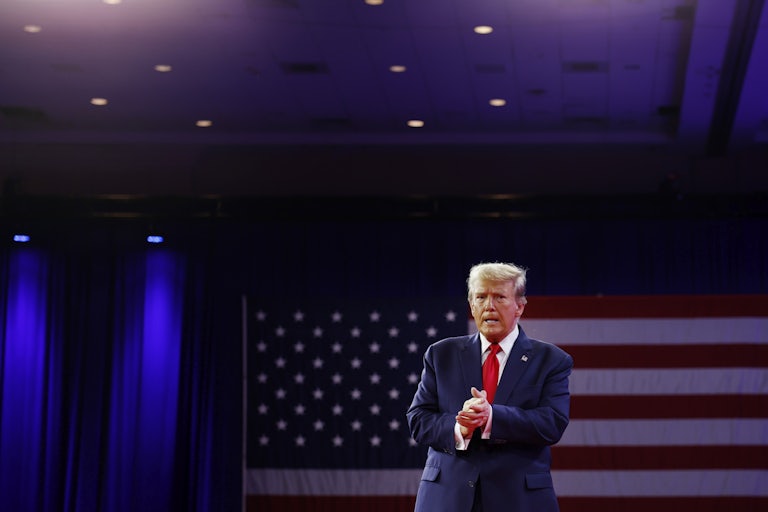
Donald Trump stands in front of a large American flag
Anna Moneymaker/Getty Images

For all his bravado about his fabulous wealth, Donald Trump clearly doesn’t have the cash to handle his legal comeuppance.

On Wednesday, the former president counter-offered his now $454 million penalty in his New York civil fraud trial, suggesting instead that he could post a $100 million bond until his appeal concludes.

In a nearly 1,800-page court filing, Trump’s attorneys argued that it would be “impossible” to secure a bond covering the full amount of the multimillion-dollar ruling.

“The exorbitant and punitive amount of the Judgment coupled with an unlawful and unconstitutional blanket prohibition on lending transactions would make it impossible to secure and post a complete bond,” Trump’s lawyers wrote, instead suggesting that Trump’s New York real estate could be used as collateral should he lose his appeal.

It’s unclear why Trump—who reportedly holds roughly $600 million in liquid assets—is struggling to pay off his legal debts, especially with all the help from his newly launched sneaker campaign and a fan-funded GoFundMe. Whatever the reason, it doesn’t matter. New York Attorney General Letitia James has said that she would seize some of his assets if he can’t muster the moolah.

“If he does not have funds to pay off the judgment, then we will seek judgment enforcement mechanisms in court, and we will ask the judge to seize his assets,” James told ABC last week.

Justice Arthur Engoron had originally slapped a $354 million fine on Trump for committing real estate–related fraud in New York, but by last week, that sum had grown to $454.2 million thanks to added interest, which is tacking on an additional $112,000 with each passing day.

The penalty also came with an addendum that Trump cannot serve as an officer or director of a New York company for three years, including his own Trump Organization. His two adult sons were also penalized by the ruling: They’ll have to stay out of New York business for two years. All in all, Trump will owe roughly $354 million for the real estate–related fraud. His two sons will owe $4 million each.

They will also be prevented from obtaining loans from any New York financial institutes for three years.

Alabama Republicans Suddenly Have an IVF Bill. It’s Worse Than It Seems.

Alabama Republicans have proposed a bill to protect IVF...but only temporarily.

Culture dishes are prepared for egg collection after egg retrieval
Jens Kalaene/Picture Alliance/Getty Images

In a transparent attempt to salvage votes, Alabama Republicans have introduced a bill that would save in vitro fertilization across the state—but only until after the upcoming election.

On Tuesday, the Alabama legislature introduced Senate Bill 159, which would grant third-party fertility clinics immunity from IVF lawsuits. The measure follows a devastating ruling issued by the all-conservative Alabama Supreme Court earlier this month that classified single-celled, fertilized eggs as children, and which effectively stalled IVF access across the state.

The new bill would offer a great solution for a decision that affects roughly one in five married couples—if it weren’t for the fact that a 2025 automatic repeal date is baked into it.

Republicans have been roundly slammed for the restrictive ruling, with critics deriding it as the Handmaid’s Tale–esque outcome of the party’s decades-long crusade on reproductive rights across the country. As a result, the party has been on a tear in an attempt to save its “pro-family” branding.

The Senate Republican campaign arm recently issued a memo urging its political candidates to “clearly and concisely reject efforts by the government to restrict IVF.” But the effort casually glosses over the fact that many GOP lawmakers (including 166 House Republicans) supported the 2021 Life at Conception Act, which sought to recognize fertilized eggs as children at the federal level.

Republicans’ recent promises will be put to the test as early as Wednesday, when Democratic Senator Tammy Duckworth will introduce legislation to protect IVF at the federal level.

On Tuesday, Duckworth told NPR’s All Things Considered that she wasn’t happy to see the Republican-led effort to protect IVF in Alabama, claiming the party was only “covering their butts.”

“This is not just about one state and one Republican state politician who wants to try to cover his butt on this,” Duckworth said. “This is about the fact that Republicans across the nation have for decades now worked as hard as they can to give rights to a fertilized egg that are far greater than a living, breathing human being and to take away women’s access to reproductive health care.”

Duckworth’s bill is seeking unanimous consent to pass, calling the method the “fastest way to move forward”—assuming Republicans actually put their money where their mouths are. “And if they truly believe it and support IVF, then they won’t show up to object,” Duckworth said.

Read more about Republican hypocrisy:

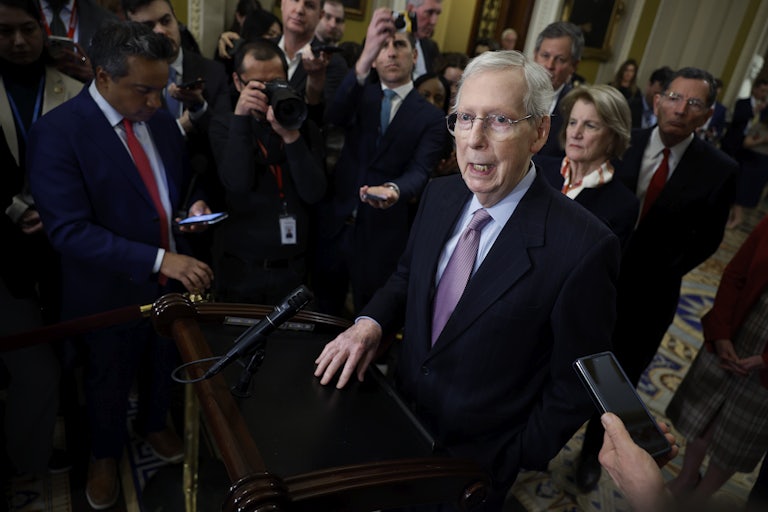
Goodbye and Good Riddance to Mitch McConnell

Mitch McConnell had two passions. Both totally sucked for America.

Mitch McConnell speaks to reporters
Chip Somodevilla/Getty Images

Republican Senate Minority Leader Mitch McConnell announced Wednesday that he is stepping down as GOP leader this November. The Kentucky Republican is the longest-serving Senate leader, and has served in Republican Senate leadership for nearly two decades.

McConnell, who is now 82 years old, will be leaving the post after a series of episodes last year where he seemed to freeze and shut down entirely in front of the press. The news comes as a wave of longtime members of Congress (especially Republicans) are also announcing their retirements, many of them exhausted by the infighting in recent years. McConnell will serve the remainder of his Senate term, which ends in 2027.

“I think back to my first days in the Senate with deep appreciation for the time that helped shape my view of the world,” McConnell said on the Senate floor Wednesday. “I’m unconflicted about the good within our country and the irreplaceable role we play as the leader of the free world.”

“Believe me, I know the politics within my party at this particular moment in time. I have many faults. Misunderstanding politics is not one of them.”

“One of life’s most underappreciated talents is to know when it’s time to move on to life’s next chapter,” McConnell concluded. “So I stand before you today...to say that this will be my last term as Republican leader of the Senate. I’m not going anywhere anytime soon. However, I’ll complete my job my colleagues have given me until we select a new leader in November and they take the helm next January.”

Republican senators were shocked by McConnell’s announcement, reportedly not having been informed of his resignation beforehand.

As Senate leader, McConnell had two main objectives in the role. First, he wanted to completely block campaign finance reform. Second, he wanted to stack the courts with conservative reactionaries.

McConnell’s main goal as Senate leader seemed to be to encourage more money in politics, welcoming the role of corporate America in U.S. democracy. It’s impossible to go through the full history of how he has blocked campaign finance reform efforts over his nearly 20 years in leadership, but he has opposed any real change at virtually every turn.

A big reason for his decades-long fight with former Senator John McCain, for example, was over McCain’s signature campaign finance law.

In 2002, the Bipartisan Campaign Reform Act, commonly known as the McCain-Feingold Act, aimed to limit the role of “soft money” in political campaigns as well as the political advertising of corporations and nonprofit organizations in elections. Almost immediately after it became law, McConnnell took the law to court, challenging its constitutionality. By 2010, the Supreme Court weighed in with Citizens United v. Federal Election Commission, overturning key aspects of the law and effectively freeing corporations to spend money directly advocating for the election or defeat of specific candidates.

This was a recurring theme for McConnell during his leadership. More recently, in 2021, he helped kill Democrats’ sweeping voting rights and election overhaul bill, which would have required additional disclosures on funding and stiffened campaign law enforcement. McConnell at the time called the bill, which would have also expanded voter registration and vote by mail options, “jaw-droppingly audacious.”

On the courts, McConnell was just as cruel in his leadership.

He single-handedly held up the appointment of Merrick Garland to the Supreme Court during President Barack Obama’s tenure—arguing that the president couldn’t appoint a Supreme Court justice in an election year. But when it came to President Donald Trump’s term, McConnell suddenly sang a very different tune.

He helped Trump appoint three Supreme Court justices, including Amy Coney Barrett in 2020. That Supreme Court, of course, overturned Roe v. Wade and repealed the right to abortion just two years later.

And it wasn’t only the Supreme Court. McConnell helped Trump completely reshape our judiciary, allowing Trump to appoint 54 appeals court judges during his 4-year tenure. For comparison, President Barack Obama appointed only 55 appeals court judges over his eight years in the White House. The court of appeals, it’s critical to note, handles tens of thousands of cases annually and is reshaping laws in ways that don’t get nearly as much attention as what the Supreme Court is doing.

All this to say, McConnell did nothing good for this country as Senate leader. He used his position in power to help only himself and his party.

This story has been updated.

Who might succeed McConnell?