Breaking News
Breaking News
from Washington and beyond

Southern Baptists’ Vote on IVF Is Terrifying Sign of What’s to Come

The anti-IVF movement is not a fringe idea on the right anymore.

An embryologist at her IVF station
David L. Ryan/The Boston Globe/Getty Images

The Southern Baptist Convention voted Wednesday to oppose in vitro fertilization, signaling a dangerous shift in conservative stances on the procedure.

The move by the country’s largest and most powerful Protestant denomination, passed by 11,000 “messengers” at its annual convention, declared that IVF “most often participates in the destruction of embryonic human life” and calls on the denomination to “only utilize reproductive technologies” taking into account “the unconditional value and right to life of every human being.”

The resolution also included a clause decrying the creation of surplus embryos and their destruction in the course of treatment. Instead, it called for the adoption of “frozen embryos in order to rescue those who are eventually to be destroyed.”

The vote is an indication of how accepted it has become on the right to pursue restrictions and outright bans on IVF. Millions of Americans who have trouble conceiving children rely on the procedure each year, including many conservatives, and polls show it to be supported by most Americans overall. But most evangelicals and anti-abortion activists, if not all, believe that life begins at conception, and IVF often results in fertilized eggs being discarded.

In February, the Alabama Supreme Court issued a shocking decision that ruled frozen embryos were people under state law, effectively making IVF procedures tantamount to murder in the state. Alabama Republicans as well as Republicans across the country then scrambled to reassure the public that the procedure would not be banned or restricted. Ever since then, Democrats have sought to legally protect IVF, while Republicans have waffled, including Donald Trump.

As it happens, Democrats in Congress are seeking to hold a vote on such legislation, hoping to deal a political blow to the GOP and divide the party even further as some Republicans pursue piecemeal efforts of their own. It seems the issue of IVF may soon join the polarized issue of abortion rights, with Democrats and Republicans taking a side and fighting it out over elections and in the courts.
Only One Republican Voted Against Holding Merrick Garland in Contempt

Here’s the only Republican brave enough to call out the rest of this party on the political ploy.

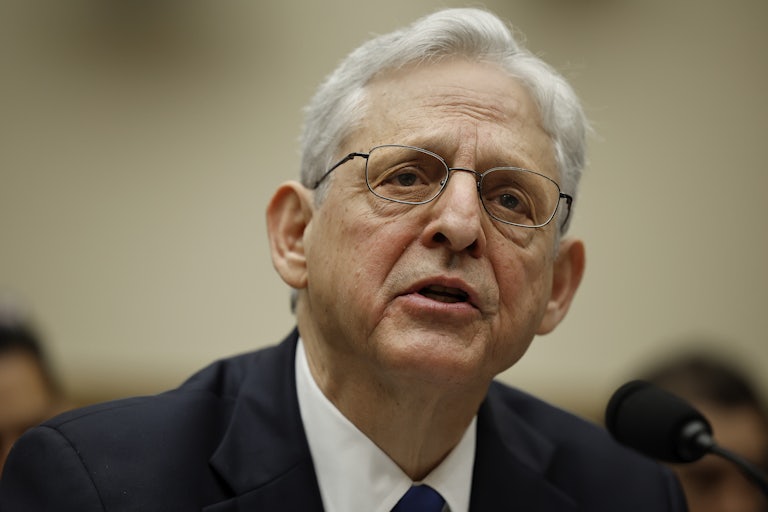
U.S. Attorney General Merrick Garland speaking
Chip Somodevilla/Getty Images

The House voted on Wednesday to hold U.S. Attorney General Merrick Garland in contempt of Congress in a 216-207 vote on party lines. Only one Republican was brave enough to vote against the conservative-fueled order of contempt: Representative Dave Joyce.

“As a former prosecutor, I cannot in good conscience support a resolution that would further politicize our judicial system to score political points,” a statement from the Ohio representative reads. “The American people expect Congress to work for them, solve policy problems, and prioritize good governance. Enough is enough.”

The contempt vote was held after Garland refused to hand over audio of a privileged interview between Biden and special counsel Robert Hur regarding a classified documents case against Biden. Republicans have pursued audio of the interview unsuccessfully as part of their ongoing efforts to catch Biden in a snare.

Biden asserted executive privilege over the recordings, a move which reportedly came at the request of Garland himself. The Justice Department had earlier expressed concerns that releasing the audio would provoke a “frenzy” of deepfakes, or audio recordings falsely attributed to Biden’s interview with Hur used to disseminate false information.

Congress already has transcripts of the audio in question—making this just the latest example of Republicans’ attempt to drum up attacks on Garland and the Biden administration more broadly. Only one GOP representative spotted the obvious political ploy.

Oklahoma Court Shuts Down Tulsa Race Massacre Lawsuit on Reparations

Oklahoma Supreme Court has ruled that the deadly white supremacist riot was not a “public muisance.”

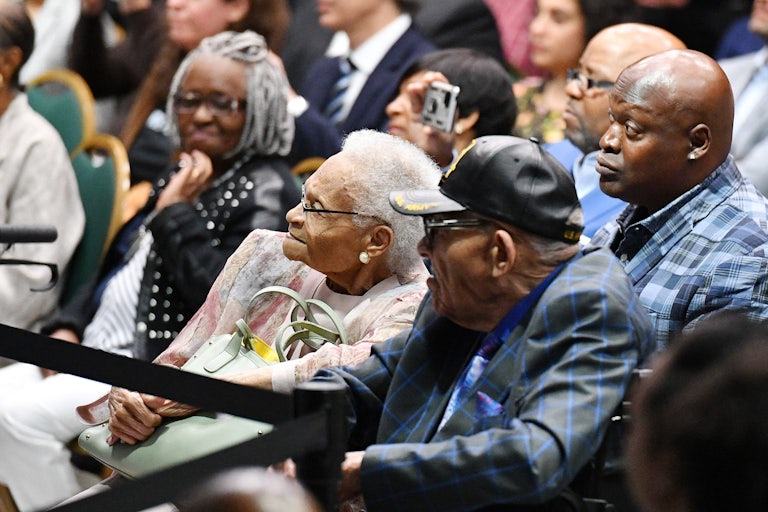
Tulsa race massacre survivors Viola Fletcher and Hughes Van Ellis sit in a crowd with other Black people
MANDEL NGAN/AFP/Getty Images
Tulsa race massacre survivors Viola Fletcher and Hughes Van Ellis, June 2021

The Oklahoma Supreme Court on Wednesday dismissed a case seeking reparations for the Tulsa Race Massacre, the last remaining option for survivors and their family to secure recompense for the deadly attack that continues to haunt the Greenwood community of Tulsa. The court ruled that the last two survivors of the deadly massacre failed to prove that the city of Tulsa—both during and after the white supremacist riot in 1921 in which a racist mob destroyed their neighborhood and murdered more than 100 Black people—violated Oklahoma’s “public nuisance” laws.

In their original filing, survivors Hughes Van Ellis, Viola Fletcher, and Lessie Benningfield claimed the city of Tulsa’s response to the Tulsa Race Massacre caused them to “continue to face racially disparate treatment and City-created barriers to basic human needs, including jobs, financial security, education, housing, justice, and health.” The survivors’ complaint also condemned the city for using the Tulsa Race Massacre, specifically the phrase “Black Wall Street,” to entice tourism to the area. Profits from massacre-related tourism, survivors allege, was not passed on to the community of Greenwood, instead using branding and recognition of the Tulsa Race Massacre to fill the city of Tulsa’s coffers. (Since the original filing, Ellis died at the age of 102.)

Oklahoma law defines a nuisance as “unlawfully doing an act, or omitting to perform a duty, which…annoys, injures, or endangers the comfort, repose, health, or safety of others.” The law also defines a nuisance as an act that “offends decency” or “renders other persons insecure in life or in the use of their property.” According to Oklahoma law, a public nuisance is all of that, but simultaneously impacts an entire community or “any considerable number of persons.”

According to the dismissal issued by Oklahoma Supreme Court judge Caroline Wall, the survivors of the Tulsa Race Massacre failed to “state a justiciable public nuisance claim under Oklahoma law.” The court also argued that the survivors didn’t have standing for their complaint because the people in charge of Tulsa during the massacre had all “long since passed away,” claiming it was an overreach to extend liability to city officials today for the actions of their predecessors.

“Expanding public nuisance liability to include lingering social inequities from historical tragedies and injustices runs the risk of creating a new ‘unlimited and unprincipled’ form of liability wherein both State and non-State actors could be held liable for their predecessors’ wrongdoing,” the ruling reads.

In a statement to News 9, the City of Tulsa touted policies and development projects undertaken in Greenwood, the site of the Tulsa Race Massacre:

The City of Tulsa respects the court’s decision and affirms the significance of the work the City continues to do in the North Tulsa and Greenwood communities. Through economic development and policy projects, the 1921 Graves Investigation, and a renewed community vision for the Kirkpatrick Heights & Greenwood Master Plan, the City remains committed to working with residents and providing resources to support the North Tulsa and Greenwood communities.

Prior to Wednesday’s dismissal, legal representation for survivors told CNN in April that this appeal was their last shot at possible recompense for surviving the atrocities of the Tulsa Race Massacre. “There is no going to the United States Supreme Court. There is no going to the federal court system,” said Attorney Damario Solomon-Simmons. “This is it.”

Mitch McConnell Doesn’t Care Too Much if Trump Leads Another January 6

The Senate minority leader is reminding everyone that he’s a coward when it comes to Donald Trump.

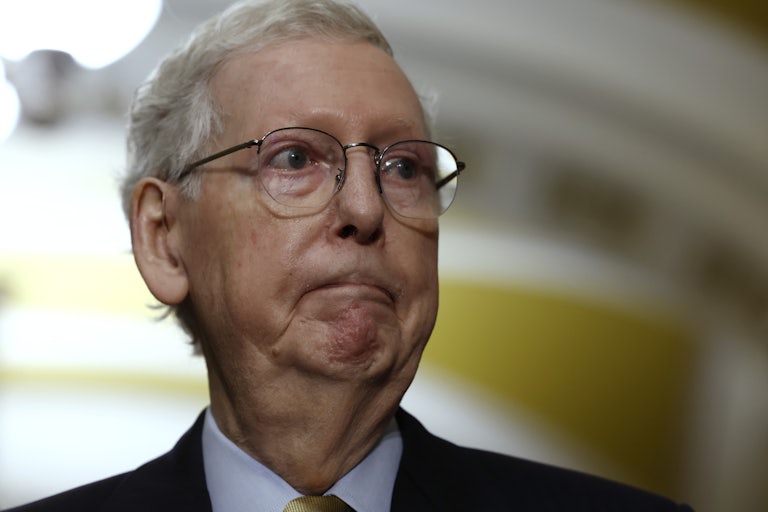
Senator Mitch McConnell makes a weird frowning face
Anna Moneymaker/Getty Images

Senator Mitch McConnell still doesn’t have the courage to confront Donald Trump for his actions on January 6, 2021.

In the Capitol Wednesday, CNN’s Manu Raju asked the Senate minority leader if he planned to confront the convicted felon and presumptive Republican presidential nominee regarding issues between the two over the Capitol insurrection, in a planned meeting with congressional Republicans Thursday. McConnell made it clear that he would not.

“I said three years ago, right after the Capitol was attacked, that I would support our nominee, regardless of who it was, including him,” McConnell said. “I said earlier this year I support him. He’s earned the nomination by the voters all across the country. And of course I’ll be at the meeting tomorrow.”

It’s quite telling that McConnell didn’t mention Trump’s name in his answer. In March, McConnell broke his silence and finally endorsed Trump for president—but only after his last opponent, Nikki Haley, dropped out of the race. Less than two weeks after the Capitol insurrection, McConnell criticized Trump on the Senate floor and accused him of instigating the riot.

“The mob was fed lies,” McConnell said. “They were provoked by the president and other powerful people, and they tried to use fear and violence to stop a specific proceeding of the first branch of the federal government, which they did not like.”

But McConnell still didn’t vote to impeach Donald Trump in February 2021, saying that a former president could not face trial in the Senate. In a speech after the vote, he called Trump “morally responsible” for the January 6 riot, called Trump’s actions “a disgraceful, disgraceful dereliction of duty,” and noted that Trump was still subject to the country’s laws while out of office.

All of this adds up to a pattern of inaction from McConnell regarding January 6 as well as Trump. McConnell, who plans to step down as minority leader in November, has joined the rest of the GOP in dismissing and ignoring the Capitol riot. McConnell has many personal reasons to turn against Trump, from the former president calling him a “dumb son of a b----” to Trump making racist attacks against his Asian American wife, Elaine Chao, despite Chao serving as Trump’s secretary of transportation. But that would mean McConnell would have to make a moral stand and put politics aside, which is not in his character.

Ron DeSantis’s Latest Pathetic Attempt to Mimic Trump Fails Miserably

A Florida appeals court slapped down DeSantis’s effort to invoke executive privilege.

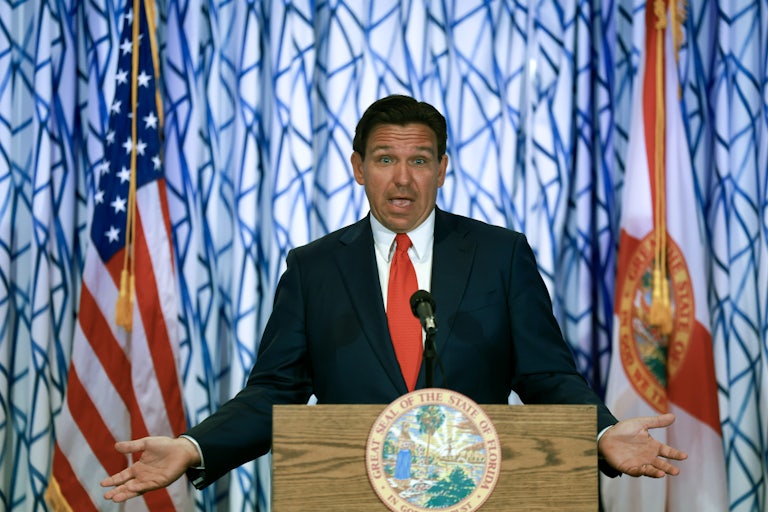
Ron DeSantis gestures as he stands at a podium
Joe Raedle/Getty Images

As much as Governor Ron DeSantis would like to be the unquestioned ruler of the Sunshine State, he just doesn’t have that privilege. Executive privilege, that is.

A panel of judges from Florida’s 1st District Court of Appeals ruled Wednesday that DeSantis cannot invoke executive privilege to avoid releasing records on his judge selectionsnot unlike his idol, former President Donald Trump, who has been banking on executive privilege and presidential immunity to shield him from an array of lawsuits

DeSantis had mentioned in August 2022 that a group of “six or seven pretty big legal conservative heavyweights” had helped him select state Supreme Court justices. When DeSantis refused to name names, someone filed a records request with his office. His office denied the request, citing executive privilege, so the person anonymously filed a lawsuit to have the records released. 

There is no law establishing executive privilege in Florida, but Leon County Circuit Judge Angela Dempsey still ruled in DeSantis’s favor in February 2023. The plaintiff appealed the court’s decision, and a panel of three appellate judges heard the case last month. Lawyers for the Florida governor again argued that the information was protected under executive privilege, as it related to his constitutional duty to appoint judges, a line of argumentation that could have had major repercussions on the efficacy of public records requests.  

But the panel of judges found that the governor was majorly overplaying his hand. 

“After denying the petition for procedural reasons, the (lower) court unnecessarily considered the merits of the petition and ruled the identities of the legal conservative heavyweights are protected by executive privilege,” wrote Judge Clay Roberts in Wednesday’s ruling. “We expressly decline to rule on the propriety of this ruling as it was irrelevant and unnecessary.” 

Judges Stephanie Ray and Susan Kelsey joined Roberts in his opinion. 

This doesn’t mean, however, that DeSantis will have to comply with the records request. The judges found that the plaintiff’s reason for remaining anonymous was too “vague” and their records request was not specific enough. 

“Appellant broadly requested records between many people during an unspecified period of time. While the records custodian could possibly intuit some contextual parameters, the core information Appellant sought was a list of names Governor DeSantis referenced in a particular interview,” the ruling said. 

The silver lining remains that someone has finally put a check on DeSantis’s power, while he continues to manufacture his voter suppression machine and transform Florida state law into a banner for his culture war