Breaking News
Breaking News
from Washington and beyond

J.D. Vance Doesn’t Mind That Tucker Carlson Hosted a Nazi Apologist

Here’s just how little J.D. Vance cares that Tucker Carlson hosted a Nazi apologist.

J.D. Vance surrounded by reporters
Andrew Harnik/Getty Images

J.D. Vance won’t change who he is in order to win the election in November. And that means aligning with frightening far-right weirdos unapologetically—even if they’re pushing pro-Nazi propaganda.

On Thursday, Vance sat down for a recorded interview with Tucker Carlson as the former Fox News host continues facing backlash for platforming a pro-Nazi podcaster. In fact, Vance joined Carlson just hours after the White House condemned the “Nazi propaganda” interview.

Carlson came under fire after inviting Darryl Cooper, host of The MartyrMade podcast, as a guest on his show—whereupon Cooper proceeded to call Winston Churchill the “chief villain” of World War II, not Adolf Hitler.

In platforming Cooper on the “Tucker Carlson Show,” the former Fox host helped MartyrMade shoot to the top of the podcast charts. This was no red flag for Vance, who still appeared at his scheduled pre-recorded interview with Carlson following this news.

“Not ideal timing. But it is what it is,” a Trump campaign official said.

It makes sense that Vance doesn’t seem to care about Cooper’s revisionist history, considering that he still follows the Hitler apologist on X.

Besides boosting white supremacists, Carlson continues to regularly promoting “the great replacement theory” and spreads election lies. Meanwhile, Vance is still set to appear alongside Carlson during a live speaking tour. They’ll be joined by the likes of Alex Jones, Donald Trump Jr., and Representative Marjorie Taylor Greene.

On Friday at the U.S.-Mexico border, Vance was asked if Carlson “should be interviewing those kinds of people months before the election.”

“Tucker Carlson isn’t affiliated with the campaign,” Vance replied. “He’s going to do what he wants to do.” And so too will Vance it seems.

This story has been updated.
Internal Documents Expose How Trump Fooled Investors on Truth Social

Donald Trump promised potential investors in his media company that they would see massive revenue. He has not delivered.

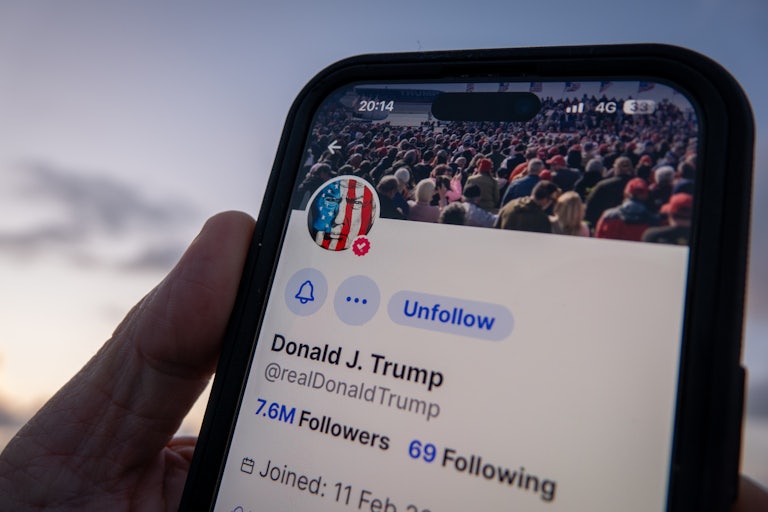
A phone screen shows Donald Trump’s Truth Social account
Matt Cardy/Getty Images

Donald Trump’s media company initially presented some grandiose projections to attract potential shareholders. Cut to two years later, and those projections have proved to be completely misleading, according to a Meidas Touch report published Friday. 

The original pitch deck that Trump Media & Technology Group showed to its investors in 2022, including “hundreds of thousands of retail shareholders,” per CEO Devin Nunes, contained some pretty fantastical numbers. The company projected revenue of $114 million in 2023, which would then balloon to $835 million in 2024. 

The reality of Trump’s struggling stock couldn’t live up to the fantasy that was promised.

In 2023, TMTG’s revenue was only $4.1 million, and the company reported a loss of more than $58 million. The projection fed to investors was off by a whopping $110 million—and that was before the election cycle had even really begun. Since then, things have become even more dire.  

Since spiking around the Republican National Convention, the value of Truth Social stock has steadily declined. Shares of Trump’s media stock have often corresponded with how well investors think Trump’s presidential campaign is going, according to The New York Times

The company’s current state is a far cry from the massive jump it was projected to make this year. By the end of the second quarter of 2024, TMTG had only taken in $836,000 and reported losses of $343 million. 

Trump’s majority stake in the company, which is 115 million shares, a roughly 60 percent stake, was once worth a whopping $6 billion. Now it’s worth only $2 billion.

TMTG stock has continued to crater this week, as it hit its lowest value since it became publicly traded, closing beneath $17 on Wednesday. 

Trump Says He Doesn’t Need Votes Again—With a Weird New Twist

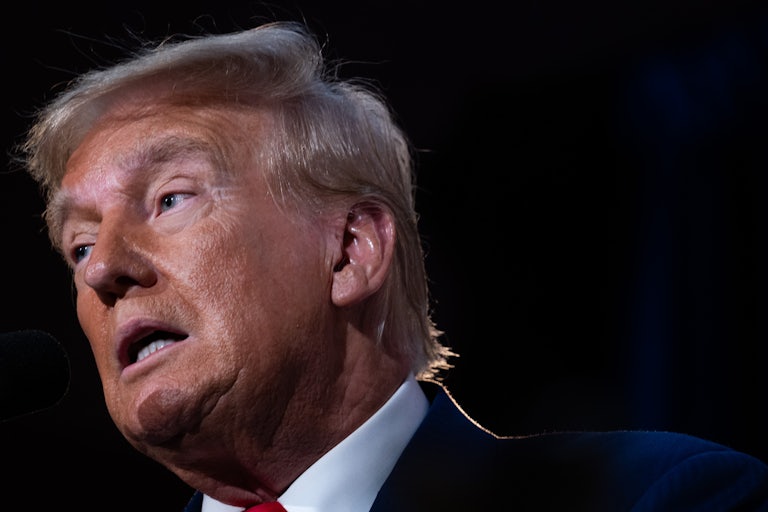
Donald Trump indicated he only wants loyalists in his camp.

Donald Trump speaks to the Economic Club of New York
Spencer Platt/Getty Images

Donald Trump apparently doesn’t care whether or not he wins in November anymore.

At a Fox News town hall on Thursday, the Republican presidential nominee revealed that his 2024 campaign strategy excludes anyone who he doesn’t believe supported him in the last election cycles.

Responding to a question from Sean Hannity about the economy, Trump spun a thread about a would-be supporter in the Republican primary who hadn’t voted for him before.

“One person who didn’t support me—he said, ‘I must admit I had the most successful four years of my life but I’m gonna vote for some—’ and now that person came back to me. I don’t want that person,” Trump said to muffled applause. “I don’t want that person.

“You know, they say you should take everybody, but that’s not the way I’m built. It’s one of those little problems,” he added.

It’s not the first time Trump has attempted to wash his hands of the labor required to win a fair election. Speaking in Detroit in June, Trump said of his campaign, “We don’t need [the] votes,” and “We got more votes than anybody’s ever had.” Instead, he argued that the campaign needed to “guard the vote” in anticipation of a “steal.”

Failing to draw more voters to his cause would, frankly, prove to be a huge problem for Trump, who finally admitted earlier this week that he actually did lose the 2020 election. The former president lost to President Joe Biden by more than seven million votes.

Neglecting to court those voters would surely spell disaster for his chances in November, especially during a fresher election season that has drawn renewed energy since Vice President Kamala Harris has taken over the Democratic ticket—though Trump may not understand the depth of the problem. While Trump’s support levels have held steady, Harris’s have slowly grown, indicating that she is picking up crucial undecided voters.

Later in the town hall, Trump made an outlandishly hyperbolic statement about his support around the country while discussing the September 10 debate on ABC News, arguing that the network better “be fair” to him or else it would alienate “75, 80 percent of the country.”

Watch: Marco Rubio Brushes Off MAGA Role in Huge Russian Disinfo Plot

The Florida senator says that massive Russian propaganda scheme wasn’t a big deal, actually.

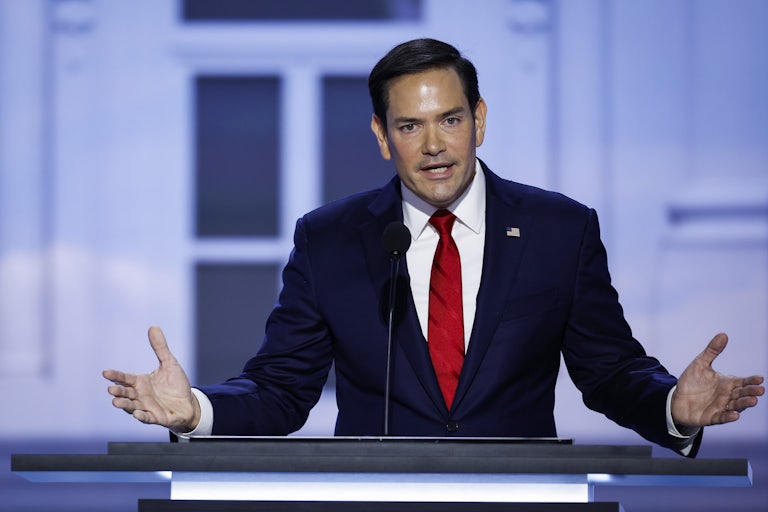
Marco Rubio speaks on a stage
Chip Somodevilla/Getty Images

Senator Marco Rubio doesn’t think that Russia paying off right-wing influencers is a big deal.

The ranking member of the Senate Foreign Relations Committee was asked on Fox News Thursday about the Justice Department revelation that several conservative commentators were paid by assets of the Russian government to produce propaganda and disinformation. Rubio defended the influencers, calling them “victims.”

“We are talking about preexisting political opinions in the United States. These are preexisting political opinions that have existed well before any Russian engagement or involvement or what have you,” Rubio said to Sean Hannity. “These people that they say that were being funded by the secret donor that was hiding their true identity, they already had these opinions, they already believed in these things.”

“They legitimately believe in the views that they’re espousing,” Rubio added. “They were victims, they were targets of a fraud in which someone posing as just a regular investor had Russian money behind them.”

Rubio is joining his fellow conservatives in defending the commentators at Tenet Media, which the DOJ revealed Wednesday was secretly funded by Russian state media employees in “a scheme to create and distribute content to U.S. audiences with hidden Russian government messaging.” These influencers included Tim Pool, Dave Rubin, Lauren Chen, and Benny Johnson. One right-wing media organization, Blaze Media, has already fired Chen as a result of the indictment.

Not surprisingly, these commentators described themselves as victims in the scheme, a point that was not only echoed by Rubio, but also by MAGA Republicans like Representative Matt Gaetz, pundit Ben Shapiro, and even Donald Trump. But, how do they explain that these “preexisting ideas” popular among Republicans right now seem to be exactly what Vladimir Putin’s government wanted to fund?

Previous Russian operations in the United States appear to have been aimed at promoting conflict and discord to undermine faith in the country’s institutions, such as the electoral process, and promote foreign policy favorable to Russia. It stands to reason that funding conservative influencers had similar aims. Right-wing figures like Rubio, Trump (whose political rise has been very useful to Putin), and Gaetz have to ask themselves if the ideas they’re espousing can really be good for America if Putin himself wants to put money behind them.

Unsealed FBI Doc Exposes Terrifying Depth of Russian Disinfo Scheme

New court documents reveal that Russia is keeping a very, very long list of influencers to spread its propaganda.

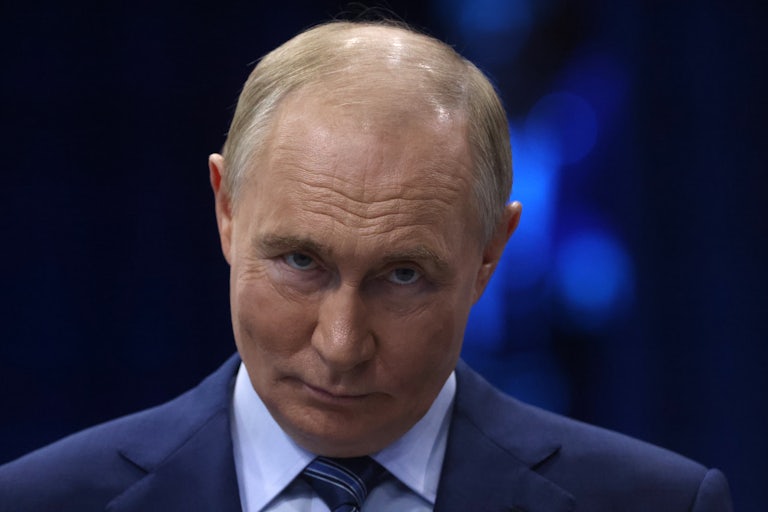
Vladimir Putin smiles and raises his eyebrows, chin tucked in, at the camera
Contributor/Getty Images

The Russian disinformation plot revealed in a Justice Department indictment this week may just be the tip of the iceberg, according to newly unsealed court documents.

On Wednesday, the DOJ announced it would seize 32 internet domains linked to a larger Kremlin scheme to promote disinformation and influence the 2024 election. The Russian campaign, known as Doppelganger, uses AI-generated content to create “fake news” boosted through social media with the aim of electing Donald Trump.

“Today’s announcement exposes the scope of the Russian government’s influence operations and their reliance on cutting-edge AI to sow disinformation,” FBI Director Christopher Wray said in a statement about the charges. According to records, the plan was well known at even the highest levels of the Russian government—and Russian President Vladimir Putin himself may have been aware of the campaign.

Of particular note, the documents released Wednesday included an affidavit that noted a Russian company is keeping a list of more than 2,800 influencers world wide, about one-fifth of whom are based in the United States, to monitor and potentially groom to spread Russian propaganda. The affidavit does not mention the full list of influencers, but is still a terrifying indicator of how deep the Russian plot to interfere in U.S. politics really goes.

The Doppelganger program and its “Good Old USA Project” aimed to mimic mainstream media outlets to push pro-Russian policies through fake social media accounts. Documents show that the Kremlin specifically targeted Trump supporters, minorities, gamers, and swing-state voters by spreading far-right conspiracies and capitalizing on existing divisions in U.S. politics.

​​”They are afraid of losing the American way of life and the ‘American dream,’” Ilya Gambashidze, an architect of the project, wrote, outlining his scheme. “It is these sentiments that should be exploited in the course of an information campaign in/for the United States.” To do so, the Russian government would emphasize that Republicans are “victims of discrimination of people of color” and promote conspiracies that white middle-class people are being discriminated against.

The “guerrilla media” plan needed to not only plant falsehoods, but also spread them far and wide. They targeted gamers and chatroom users, who they described as the “backbone of the right-wing trends in the US segment of the Internet,” and monitored social media influencers. The Russians planned to build relationships with prolific posters who were “proponents of traditional values, who stand up for ending the war in Ukraine and peaceful relations between the US and Russia, and who are ready to get involved in the promotion of the project narratives.”

“We need influencers! A lot of them and everywhere. We are ready to wine and dine them,” wrote Gambashidze in a note from a meeting with Russian government officials.

Though this specific campaign has no official link with recent findings about Tenet Media’s work with Russian state media network RT, the goals are the same: “To secure victory for [Donald Trump].”