Breaking News
Breaking News
from Washington and beyond

In Massive Twist, Trump’s Georgia Case Might Not Be Dead Yet

Donald Trump could still face consequences in Georgia for election interference.

Donald Trump sits in a courtroom
Michael M. Santiago/Getty Images

Donald Trump’s forthcoming presidency might not hinder the proceedings surrounding his Georgia election interference charges, according to an attorney for Fulton County District Attorney Fani Willis.

In documents filed to the court on Wednesday, Willis’s office urged an appeals court to reject the president-elect’s request to throw out the case in light of the Supreme Court’s July ruling on presidential immunity. But the filing also suggested that state prosecution isn’t necessarily beholden to federal statute. The lawyer argued that Trump’s legal representation had failed to demonstrate why state prosecution should be subject to a Justice Department mandate preventing the prosecution of sitting presidents, reported ABC News.

“Appellant does not specify or articulate how the appeal—or indeed, any other aspect of this case—will constitutionally impede or interfere with his duties once he assumes office,” Fulton County Chief Senior Assistant District Attorney F. McDonald Wakeford wrote.

“The notice makes mention of these concepts without actually examining them or applying them to the present circumstances,” Wakeford continued in the filing. “In other words, Appellant has not done the work but would very much like for this Court to do so.”

Willis’s office believes they have wiggle room to proceed, due to a lack of legal precedent related to court proceedings against sitting presidents.

“Given these vague statements, to simply invoke the phrase ‘federalism and comity concerns,’ without more, offers nothing of substance,” the filing said.

Trump and 18 of his allies face racketeering charges in Georgia for their participation in the fake elector conspiracy, including ex-Trump attorney Rudy Giuliani and former white House Chief of Staff Mark Meadows. Four individuals have already pleaded guilty, including the architect of the scheme Kenneth Chesebro, though he has since attempted to withdraw his plea.
SCOTUS Takes Case That Could End Planned Parenthood as We Know It

The Supreme Court has agreed to hear a case that could kick Planned Parenthood off Medicaid.

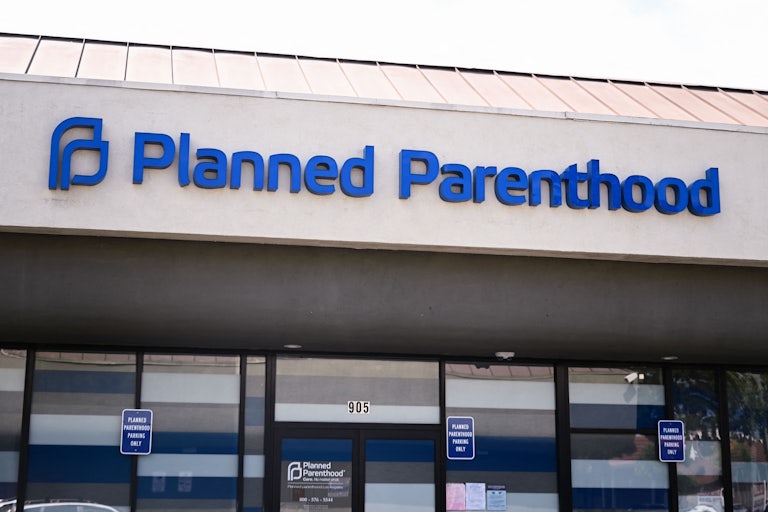
A Planned Parenthood clinic
Patrick T. Fallon/AFP/Getty Images

Planned Parenthood’s public funding is, once again, on the line.

The Supreme Court Wednesday agreed to hear South Carolina’s case against the reproductive health nonprofit. Prosecutors argue that Planned Parenthood’s locations in Charleston and Columbia should not be able to participate in the state Medicaid program.

Those locations currently service hundreds of patients covered by Medicaid and offer many more services than just abortion care, including physicals, cancer screenings, STI testing, and birth control access, reported Reuters. The organization does not use the public funds for abortions but rather for family planning, according to the Associated Press. The case is scheduled to be argued in the spring.

“Pro-life states like South Carolina should be free to determine that Planned Parenthood and other entities that peddle abortion are not qualified to receive taxpayer funding through Medicaid,” John Bursch, an attorney with the right-wing Christian legal group Alliance Defending Freedom, which is representing the state, told the Associated Press.

This is the latest abortion-related case picked up by SCOTUS since the court overturned nationwide abortion access provided by Roe v. Wade in 2022. It could also be another win for conservative-leaning states who want to see Planned Parenthood stripped of all government money.

It’s the third time that South Carolina’s defunding case has reached the Supreme Court. The state initially moved to cut off Planned Parenthood from funding in 2018. In 2020, the nation’s highest judiciary rejected the state’s appeal. Three years later, the justices intervened in a lower court’s ruling, ordering it to reconsider the case after a relevant ruling had been issued by the nine-judge bench.

South Carolina has one of the most prohibitive abortion policies in the nation, restricting access after just six weeks, before most individuals know they’re pregnant and just one week before drug store pregnancy tests can detect pregnancy hormones in their earliest, and least reliable, window.

Planned Parenthood has said it gets less than $100,000 in South Carolina, and that Medicaid does not pay for abortions except in emergency events that compromise a pregnant person’s life or if the pregnancy is the result of rape or incest.

Supreme Court Agrees to Hear TikTok Case—Setting Up Final Showdown

The Supreme Court will hear oral arguments just days before the TikTok ban is set to take effect.

Phone with TiktTok logo
Jakub Porzycki/NurPhoto/Getty Images

The Supreme Court announced Wednesday that it will hear arguments regarding a law that could ban TikTok.

The high court, granting certiorari in the case TikTok v. Garland Wednesday, will soon decide on the constitutionality of the bipartisan Protecting Americans from Foreign Adversary Controlled Applications Act, or PAFACA, which President Joe Biden signed into law in April.

PAFACA, intended “to protect the national security of the United States from the threat posed by foreign adversary controlled applications,” would require the Chinese parent company of TikTok, ByteDance, to sell the application to an American-owned company by January 19 or else be effectively banned in the U.S.

ByteDance alleges that the law is a violation of the First Amendment, denying its users a popular forum for expressive activity. Thirty-three percent of American adults use the app, per a January report from the Pew Research Center.

Civil liberties groups such as the American Civil Liberties Union have come out against the law, on the grounds that “it would violate the First Amendment rights of Americans … who rely on TikTok for information, communication, advocacy, and entertainment” and “would grant the President broad new powers to ban other social media platforms based on their country of origin.”

A federal appeals court upheld the ban earlier this month. Now, SCOTUS says it will hear arguments in the case on January 10: nine days before the app is set to be sold or banned per PAFACA, and 10 days before President Trump—who has has vaguely promised to “save TikTok” while his incoming administration is “deeply divided” on the ban—takes office. The Supreme Court did not block the law upon agreeing to hear the case, suggesting it could issue a ruling before the January 19 deadline, which could possibly help Trump take credit if the law is in fact overturned.

Either way, the decision is guaranteed to have significant implications for social media regulation and how freedom of expression is balanced with national security concerns.

The Real Reason ABC Settled Trump’s Dangerous Lawsuit

ABC agreed to settle a lawsuit with Donald Trump, setting a chilling precedent.

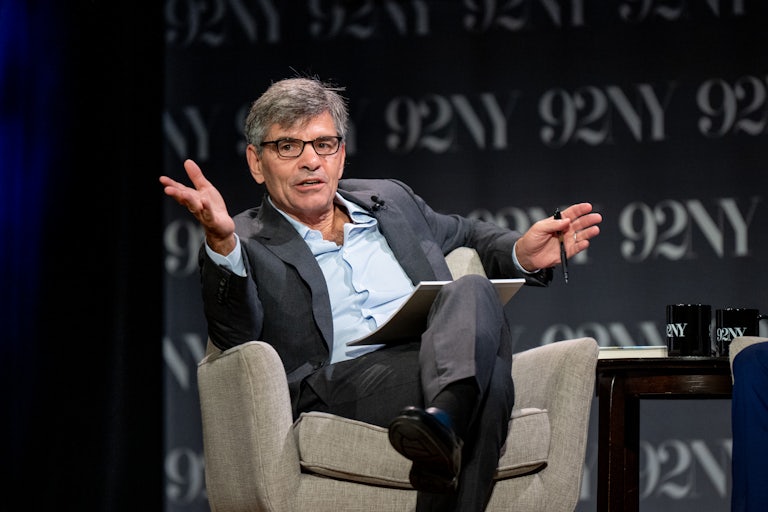
George Stephanopolous sits in an armchair and gestures while speaking
Roy Rochlin/Getty Images

Disney, which owns ABC News, agreed to pay a $16 million settlement to Donald Trump to avoid a messy lawsuit that the company believed would have potentially damaged the Disney brand, ABC News, and potentially undermined First Amendment rights, The New York Times reported Wednesday. 

Earlier this year, Trump launched a defamation lawsuit against ABC News over George Stephanopoulos’s use of the phrase “liable for rape” while discussing Trump’s E. Jean Carroll case verdict, which technically found Trump liable for sexual abuse, not rape. 

It’s worth noting that even the presiding judge in the case thought the distinction between the two terms was semantic and wrote that the decision did not mean Carroll “failed to prove that Mr. Trump ‘raped’ her as many people commonly understand the word ‘rape.’”

Looking down the barrel of a major lawsuit, Disney decided to settle, and did so for three main reasons, according to the Times.

The first is that Disney had already engaged in culture-war lawsuits against Florida’s Republican Governor Ron DeSantis over Disney World, which resulted in criticism from Republican lawmakers and activists and boycotts from Trump supporters—undermining the family-friendly ubiquity of the $205 billion Disney brand name.  

Disney was also concerned that as president, Trump would go after ABC News’s license. In September, Trump said that the network ought to lose its license after he was brutally fact-checked during a presidential debate. The Federal Communications Commission chair rejected this request, but Trump’s pick to lead the agency, Brendan Carr, doesn’t have quite the same hang-ups.

There was also some concern at Disney that the case would go all the way to the Supreme Court, which has a tendency to side with Trump, a move that could place one important precedent in jeopardy: 1964’s New York Times v. Sullivan

That ruling determined that when a public figure hopes to prove a member of the press committed libel against them, it’s not enough to show that the press made a false statement. They must also prove that the defendant did so with knowledge of or reckless disregard for the statement’s falsity. 

Had Trump’s defamation case been tossed to the highest court in the land, it could have seen this essential protection for journalists undone. On the other hand, the settlement showed the president-elect exactly how he can silence the press during his second administration.

Matt Gaetz Loses It After House Ethics Quietly Votes to Release Report

Matt Gaetz is about to be screwed over big-time—and he knows it.

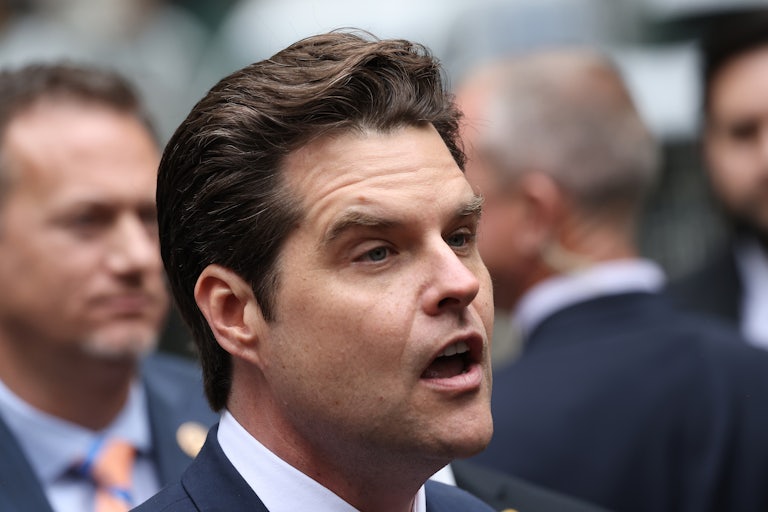
Matt Gaetz looks shocked with his mouth wide open
Michael M. Santiago/Getty Images

After CNN reported Wednesday that the House Ethics Committee has secretly voted to release its report on its multiyear investigation into former Representative Matt Gaetz after all, the former Florida representative immediately lost it.

“House Ethics will reportedly post a report online that I have no opportunity to debate or rebut as a former member of the body,” Gaetz fulminated in a lengthy post on X emphasizing that he has not faced criminal charges for his conduct.

“In my single days, I often sent funds to women I dated—even some I never dated but who asked. I dated several of these women for years. I NEVER had sexual contact with someone under 18. Any claim that I have would be destroyed in court—which is why no such claim was ever made in court,” Gaetz wrote. “It’s embarrassing, though not criminal, that I probably partied, womanized, drank and smoked more than I should have earlier in life. I live a different life now.”

According to CNN, the Ethics Committee secretly voted earlier this month to release the report after the House’s final votes this year—though “it is unclear if the committee will once again change course now that it has voted.”

According to the committee, the report contains its findings regarding allegations that Gaetz had “engaged in sexual misconduct and/or illicit drug use, shared inappropriate images or videos on the House floor, misused state identification records, converted campaign funds to personal use, and/or accepted a bribe, improper gratuity, or impermissible gift, in violation of House Rules, laws, or other standards of conduct.”

It previously appeared that Gaetz would successfully dodge the likely embarrassing revelation. In November, two days before the Ethics Committee was set to vote on releasing the report, the former Florida lawmaker resigned from the House of Representatives, following the announcement of his since-thwarted nomination to be President-elect Trump’s attorney general.

Then, in a party-line vote last month, Republicans blocked the report’s release. The reversal reported Wednesday means some Republicans on the panel defected from party lines, siding with the Democrats in voting to let the report see the light of day.

More on what’s happening in the House: