Breaking News
Breaking News
from Washington and beyond

Trump Just Endorsed Sweeping Medicaid Cuts

Remember when Donald Trump promised not to touch Medicaid? He’s already flipped.

Donald Trump
Andrew Harnik/Getty Images

Trump finally decided to end the GOP’s internal quarreling on how to pass his budget—and broke a huge promise on Medicaid in the process.

For months, Republicans have been split on whether to split Trump’s massive budget agenda on the military, border security, and tax cuts for corporations into multiple, incremental bills (Senate Budget Chairman Lindsey Graham’s preferred method) or combine them into one “big beautiful bill” (the House’s preferred method).

The president settled that debate with a Truth Social post on Wednesday morning.

“The House and Senate are doing a SPECTACULAR job of working together as one unified, and unbeatable, TEAM … unlike the Lindsey Graham version of the very important Legislation currently being discussed, the House Resolution implements my FULL America First Agenda, EVERYTHING, not just parts of it!” the president wrote. “We need both Chambers to pass the House Budget to ‘kickstart’ the Reconciliation process, and move all of our priorities to the concept of, ‘ONE BIG BEAUTIFUL BILL.’ It will, without question, MAKE AMERICA GREAT AGAIN!”

But the House bill Trump endorsed breaks his promise to never touch Medicaid, levying a whopping $2 trillion cut to the budget, including an expected $880 billion cut to the critical health program, in order to pay for tax cuts for the rich.*

“Social Security won’t be touched, other than if there’s fraud or something. It’s going to be strengthened. Medicare, Medicaid—none of that stuff is going to be touched,” Trump claimed as recently as Tuesday, during his and Elon Musk’s sitdown with Fox News’s Sean Hannity.

Some moderate Republicans have already come out against a bill that would slash Medicaid, which could leave thousands of their constituents without reliable access to care.

“​​I ran for Congress under a promise of always doing what is best for the people of Northeastern Pennsylvania,” Representative Rob Bresnahan wrote on X last Friday. “If a bill is put in front of me that guts the benefits my neighbors rely on, I will not vote for it.”

* This piece has been updated to correct the expected cuts to Medicaid under the House budget bill.
GOP Senators Are Having to Literally Beg Trump for Their Own Money

Elon Musk and Donald Trump’s spending freeze has sent Republicans scrambling.

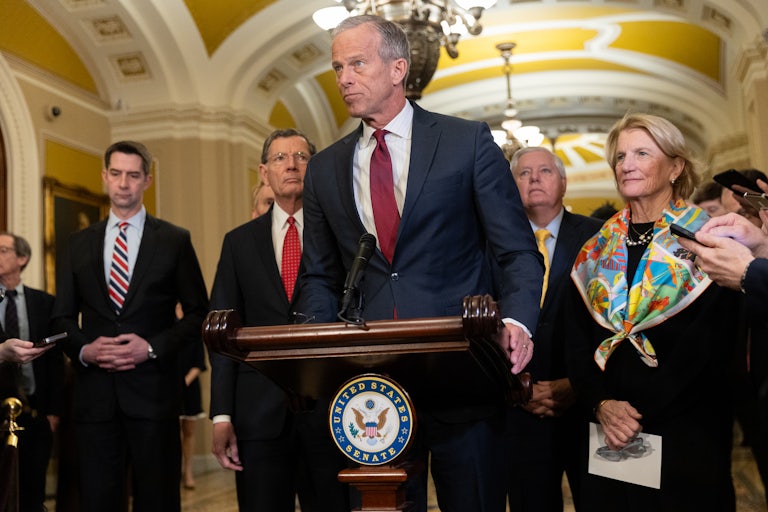
Senate Majority Leader John Thune stands at a podium during a Senate Republicans press conference
Nathan Posner/Anadolu/Getty Images

Republican Senators are being forced to grovel at the thrones of Donald Trump and Elon Musk to collect the very funding they appropriated in the first place.

Amid Trump’s sweeping freezes on spending, massive cuts to the federal workforce, and dismantling of government agencies, some Republican senators have been forced to make their appeals for funding (and mercy) directly to Trump’s Cabinet secretaries and other administration officials, according to a report Wednesday from The Washington Post.

While this system of pleading favors Trump allies who can dial up the president directly, not everyone is opting to give him a ring.

Senator Lisa Murkowski told the Post that she had been on the phone with “pretty much all the departments,” hoping to obtain funding in the face of federal freezes.

The Alaska Republican has spoken with the Environmental Protection Agency, Interior Department, and Agriculture Department, as well as lobbied the Trump administration to exempt Native American tribes from being affected by executive orders targeting programs for diversity, equity, and inclusion.

Senator Shelley Moore Capito told the Post she had been working “aggressively” with EPA head Lee Zeldin to resume the grant program providing money for schools to buy electric buses. The EPA has paused more than 30 grant programs.

Senators Katie Britt from Alabama and Susan Collins of Maine each took their concerns about severe cuts to the National Institutes of Health directly to Trump’s new Secretary of Health Robert F. Kennedy Jr. A new NIH policy announced earlier this month would cap “indirect cost” reimbursements, which cover all research expenses, at 15 percent for research institutions, effectively kneecapping entire fields of research.

Others took more desperate means to beseech Trump’s cadre: tweeting at them.

“I urge @SecRubio to distribute the $340 million in American-grown food currently stalled in U.S. ports to reach those in need,” Senator Jerry Moran wrote in a post on X earlier this month aimed at Secretary of State Marco Rubio, whose agency absorbed some functions of USAID after Musk gutted the agency. “Time is running out before this life-saving aid perishes.”

He followed up with another post days later: “GOOD NEWS: State Dept. has approved shipping to resume, allowing NGOs to distribute the $560 million of American-grown food aid sitting in US & global ports to those in need. Thanks to @SecRubio for helping make certain this life-saving aid gets to those in need before it spoils.”

Senator Tommy Tuberville imagined a future where senators would have to approach the unelected DOGE czar Elon Musk with a line-item list, and beg him not to cut spending on infrastructure.

“If we have to lobby for, ‘Hey wait a minute, what about the bridge in Birmingham?’ or ‘There’s a bridge in Mobile or whatever.’ I think that could be very possible,” the Alabama Republican told reporters.

Crucially, federal agencies are still withholding funding, even after multiple judges ordered a pause on the president’s sweeping funding freeze, summoning a torrent of additional lawsuits alleging that the president is unlawfully withholding money in violation of Congress. The administration’s actions have jeopardized hundreds of billions of dollars to programs across the government, according to the Senate Appropriations Committee.

While Congress, in particular the House of Representatives, is vested with the power of the purse, Trump hopes to use a process called impoundment to refuse to spend the money appointed by Congress.

Trump’s New Executive Order Is His Most Blatant Power Grab Yet

Donald Trump is claiming authority over a slew of independent agencies funded by Congress.

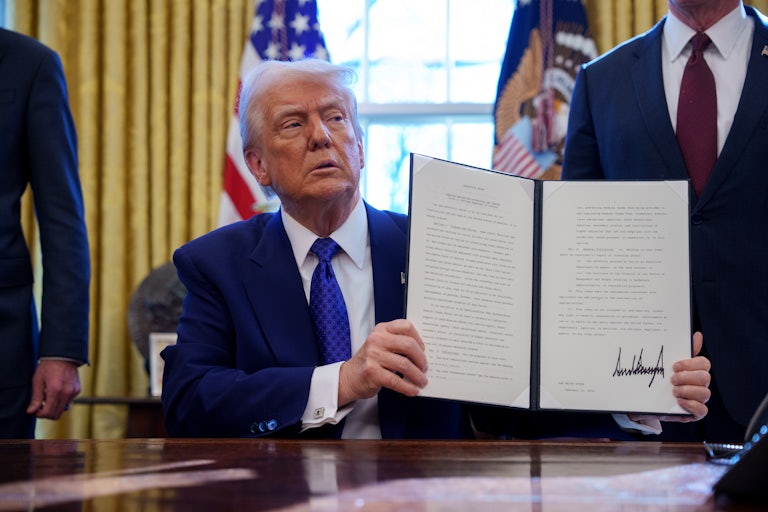
Trump holds up a signed executive order for the cameras (not pictured) while he sits at his desk in the Oval Office.
Andrew Harnik/Getty Images

Donald Trump is trying to extend his authority over government agencies that Congress made independent.

The president issued an executive order Tuesday ordering these agencies to first send any proposed regulations to the White House for review. It also gives Trump the power to block the agencies from using funds for anything that goes against what he wants, and requires agencies to accept the Justice Department and Trump’s interpretation of the law as binding.

The agencies the order is going after include the National Labor Relations Board, the Federal Communications Commission, the Securities and Exchange Commission, and the Federal Trade Commission. It partially covers the Federal Reserve in issues related to regulating Wall Street, but doesn’t include its monetary policies such as controlling interest rates.

The move is a blatant power grab on Trump’s part to control agencies that could push back against his agenda. Plus, it sets up a showdown with Congress over the funding given to these agencies, as the legislature appropriates funds to them for specific purposes. In effect, Trump is trying to take away Congress’s authority over such agencies.

“This is a power move over independent agencies, a structure of administration that Congress has used for various functions going back to the 1880s,” legal scholar Peter M. Shane told The New York Times.

Conservatives have long sought to weaken these independent agencies, if not bring them under total control of the president, in order to free business interests from what they see as restrictive regulations. Russell Vought, recently confirmed to run the Office of Management and Budget and an architect of the conservative manifesto Project 2025, said two years ago that such a presidential takeover was the goal.

“What we’re trying to do is identify the pockets of independence and seize them,” Vought said.

In a court filing Sunday, the Trump administration argued that the president has “unrestricted power” to fire agency heads. It seems that in the opinion of Trump and his fellow conservatives, such power is only the tip of the iceberg.

Republicans in Revolt as Elon Musk’s DOGE Continues Takeover

Republicans in Congress are getting pissed as DOGE keeps wreaking havoc.

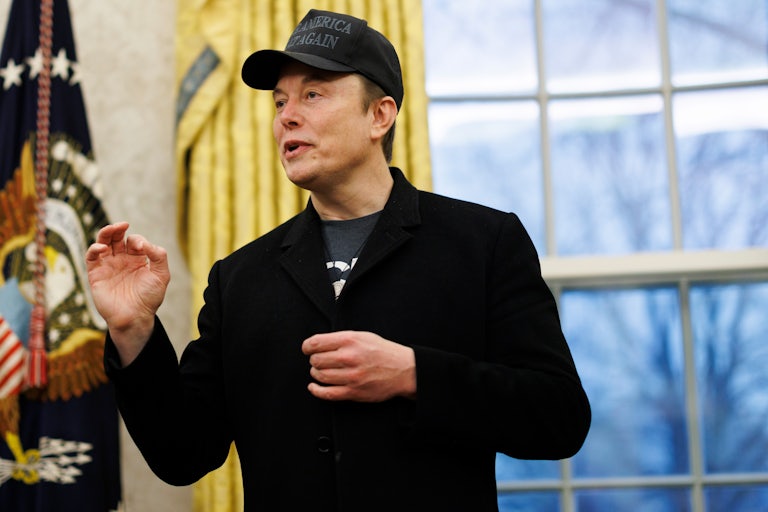
Elon Musk speaks in the Oval Office
Aaron Schwartz/CNP/Bloomberg/Getty Images

Infighting is brewing among the GOP’s congressional ranks, as Elon Musk’s takeover of the government and sweeping federal employee purge begins to hit red states.

Multiple Republican members of Congress  expressed anxiety and dissatisfaction to Axios regarding Trump and DOGE’s cuts, as agencies like USAID, the Federal Aviation Administration, and National Oceanic and Atmospheric Administration—agencies that many Republicans actually like and support—have been crippled. 

Susan Collins, chair of the Senate Appropriations Committee, told Axios that Trump is moving “too fast,” and that Musk and DOGE should adopt “a more surgical approach” instead of slashing indiscriminately, as some of their recent moves “violate restrictions that are in current law.” Collins also said the team is “making mistakes,” referencing the Trump administration accidentally firing USDA employees working amid a bird flu outbreak.

“Before making cuts rashly, the Administration should be studying and staffing to see what the consequences are. Measure twice before cutting. They have had to backtrack multiple times,” Representative Don Bacon said.

“We all want efficiencies, there is a way to do it, and the way these people have been treated has been awful in many cases,” Senator Lisa Murkowski opined. “Awful.”

The elderly Chuck Grassley told RadioIowa the situation is “a tragedy for people that are getting laid off,” but conceded that it was “an executive branch decision,” and that “Congress can’t do anything except complain about it.”

Only time will tell just how far Republicans will let this freight train go before speaking up and slowing it down.

Transportation Chief Insists FAA Purges Aren’t That Bad

Sean Duffy said it was “rich” to blame him or the Trump administration.

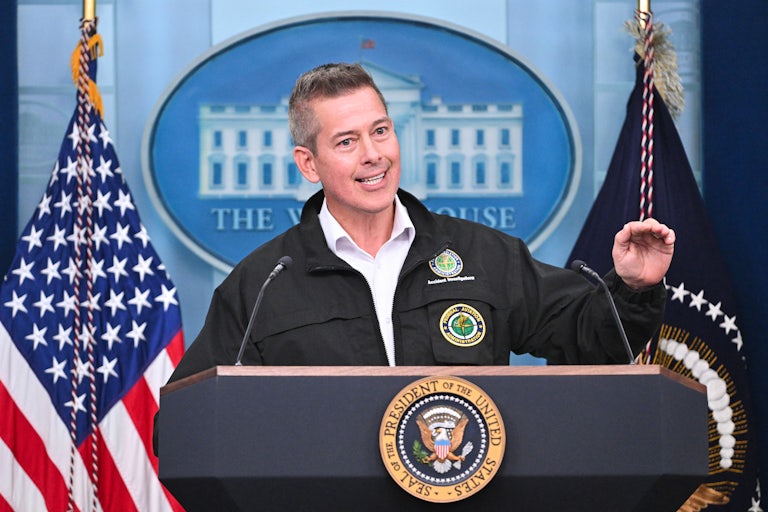
Transportation Secretary Sean Duffy gestures while speaking during a press conference at the White House
Roberto Schmidt/AFP/Getty Images

The U.S. has experienced four serious aviation disasters since Donald Trump took office just last month—but his administration doesn’t want you to believe that the unprecedented uptick has anything to do with their government-wide staffing cuts.

Transportation Secretary Sean Duffy told Newsmax on Tuesday that “it’s rich” for people to blame the Trump administration for the plane crashes, even though they’re the ones in charge.

“To cast blame on this administration for the policy failures of the last four years and say it’s our fault is outrageous, but it’s rich,” Duffy said.

Duffy then went on to confirm that “less than 400 employees” had been laid off at the Federal Aviation Administration since last week, though he attempted to minimize the cuts by highlighting the overall staffing of the agency, which Duffy claimed sits at around 45,000 employees.

Still, the union representing FAA employees slammed the mass firing as a “hastily made decision” that would exhaust a burnt-out workforce “already stretched thin.”

“This decision did not consider the staffing needs of the FAA, which is already challenged by understaffing,” David Spero, national president of the Professional Aviation Safety Specialists, said in a statement. “Staffing decisions should be based on an individual agency’s mission-critical needs. To do otherwise is dangerous when it comes to public safety. And it is especially unconscionable in the aftermath of three deadly aircraft accidents in the past month.”

Before 2025, the last deadly crash involving a U.S. airliner was in 2009—but despite the disturbing trend, Trump has opted to vaguely scapegoat minorities.

After a mid-air crash in January between a passenger plane and a U.S. military Black Hawk helicopter over Reagan International Airport killed 67 people, Trump pointed a finger at diversity, equity, and inclusion programs, blaming inclusive work initiatives for the deadly lapse.

“You’re talking about extremely complex things, and if they don’t have a great brain—a great power of the brain, they’re not going to be very good at what they do and bad things will happen,” Trump said at the time.

Former National Transportation Safety Board investigators and safety advisers have pointed to the decades-long air traffic controller shortage as the underlying cause of the crashes, and told Newsweek that the FAA should re-prioritize “aeronautical decision-making.”

Under former Transportation Secretary Pete Buttigieg’s stewardship, the FAA increased hiring, placing 2,000 new employees in the system. But their numbers will just barely replace some 1,100 staff who are either retiring or exiting the high-stress field.

“That’s because nearly half of those hired in any given year will wash out of the program before they get to actually control aircraft after about three years from their initial start date,” CNN reported.