Life in a Warming World
A weekly reckoning with our heated planet—and the fight to save it

Trump Is Really Screwing Over Some of His Core Supporters

Farming-dependent counties supported Trump at astonishing levels in November’s election. But funding freezes and Department of Agriculture firings could hit them hard.

A blue tractor drives over a field with a red barn in the background.
Design Pics Editorial/Getty Images
A tractor plants no-till soybeans in Ames, Iowa.

Last November, people in farming-dependent counties voted for Donald Trump by a staggering average of 78 percent. So why does he seem so hell-bent on screwing them over?

Earlier this month, multiple outlets reported farmers’ complaints that promised funds—including reimbursements for improvements already paid for and installed—had been frozen, contrary to the administration’s assurances. Missouri cattle farmer Skylar Holden, in a viral video on TikTok, said that although he voted for Trump, his $240,000 contract with the Agriculture Department to improve infrastructure on his farm was now frozen, and he’d already spent $80,000 on materials and labor. The Washington Post last week “spoke with farmers and farm organizations in 10 states who had contacted their congressional delegations about the USDA funding freeze. Some farmers from conservative-leaning districts said they have received no reply. Others said they were told that their representatives supported the administration’s decision—and some representatives appeared to suggest that Trump’s funding freeze was not affecting farmers at all.” These kinds of stories are now proliferating in local news outlets in rural states, whose residents are also being hit by USDA firings.

And this week, the Post revealed a new detail: After a federal judge blocked the freeze on January 28, middle managers at the Department of Agriculture asked superiors whether they could release these funds—and were told they could not. But supposedly, this is getting resolved: Newly confirmed Agriculture Secretary Brooke Rollins recently claimed to have “release[d] the first tranche of funding that was paused due to the review of funding in the Inflation Reduction Act” and promised that the department would “honor contracts that were already made directly to farmers.”

You’ll notice some caveats in there: “already made” and “directly to farmers.” It’s unclear whether this money will be enough, or be disbursed soon enough, for some of the farms in question, NBC’s Suzy Khimm reported Saturday. First, the IRA funds aren’t the only funds that have been frozen. Second, small farms operating on tight profit margins “make up a large proportion of the farms participating in some of the federal grant programs” in question. And third, farming isn’t something that can be put on hold: As March draws near, many farms are heading into thawing, planting, and animal birthing season.

This, on its own, would be cause for concern in an agricultural system that already operates with worryingly few redundancies—especially since American agriculture is also heavily dependent on immigrant workers, whom the Trump administration is also targeting. But it’s not the only crisis at USDA right now. Only days after Rollins was sworn in, the department accidentally fired people working on the government’s response to the H5N1 avian flu and had to set about trying to rehire them. While Trump said Friday that Rollins is “going to do something with the eggs” (by which he apparently meant lower egg prices), this is hardly a good start. NPR recently profiled two other workers fired at USDA, both of whom worked on securing the food system in the face of escalating threats from pests, pathogens, and climate shocks. This is consistent with recent New York Times reporting that some 400 people in the USDA’s Animal and Plant Health Inspection Service have been fired, along with an estimated 800 agricultural scientists. The USDA apparently did not answer Times reporters’ questions about how many employees had been fired overall, but current estimates are that around 4,200 probationary USDA employees alone have been laid off.

Many experts already consider U.S. agriculture to be underprepared for the pathogens, pesticide resistance, weather pattern shifts, and other threats that are predicted to become more common. On Monday, a coalition of environmental groups and the Northeast Organic Farming Association of New York sued the USDA for “unlawfully removing department webpages focused on climate change,” which help farmers “make the best choices and access resources to mitigate harm to their livelihoods,” according to the press release.

Whether Rollins is the best person to sort through this mess is another question. As Mike Lavender, policy director at the National Sustainable Agriculture Coalition, told journalist Tom Philpott on a recent podcast, the USDA is a large department, which means a core component of the job is “managing a huge number of people.” But aside from growing up on a farm, Rollins’s primary qualification for this role seems to have been her time leading the America First Policy Institute, “which was a relatively small think-tank organization that didn’t focus a ton on agriculture,” Lavender said. “So when you start parsing through her record, looking for the substantive linkages to domestic agricultural policy, there’s not a ton there to go on, and there’s not a lot of record of experience in managing huge businesses, organizations with a lot of employees, which is a significant part of the USDA role.”

One of the fired USDA employees NPR profiled was a veteran who’d served in the Air Force for 20 years and was training dogs to detect contraband agricultural products so that potential pathogens and pests can be kept out of the U.S. “I gave blood, sweat, and tears to this country for 20 years to continue service to the federal government,” he told NPR. “I kind of feel like I was just thrown out like a piece of trash.”

Stat of the Week
$5 billion

That’s how much BP now plans to cut from its low-carbon investment plan, instead increasing its oil and gas production targets by 60 percent.

What I’m Reading

Coffee Prices Are at a 50-Year High. Producers Aren’t Celebrating.

Last week, this newsletter mentioned some of the upward pressures on coffee prices right now, including the crop’s particular vulnerability to climate change and weather shocks. The Times recently published a wonderfully in-depth feature on this topic, covering not just the market quirks that make this industry particularly tricky but also farmers’ efforts to shift to new coffee varieties and farming techniques that may make them more resilient. Don’t miss the more hopeful story of one farmer in Corquín, Honduras:

An agricultural engineer by training, Mr. Romero began studying how to shelter his own crop from the elements. He proposed adding a canopy of taller trees like pine and mahogany to cast shade over his coffee. That would keep moisture in the soil and preserve the health of the roots, allowing them to take up more water and nutrients. He made plans to intersperse fruit trees—mangoes, oranges, lemons and plantains—diversifying his harvest while adding additional roots to preserve soil.

In 2009, Mr. Romero persuaded his wife, his parents and his brother to pool their land holdings, turning their 140 acres into a collective plantation that would pursue this new mode of operation, with sustainability as their lodestar.

He organized two dozen other farms into a cooperative called Cafico. Members could share techniques and operate a nursery to produce suitable varieties of coffee plants and shade trees. They financed the construction of a mill to dry and process their harvest and sell the crop. They eschewed chemical fertilizers and pesticides, dedicating themselves to organic production.

His pitch encountered initial resistance from potential members, given the arithmetic.… “Everyone said we were crazy,” said Mr. Romero, 45. “Now, they are copying the model.”

Read Peter S. Goodman’s and Alejandro Cegarra’s full report at The New York Times.

This article first appeared in Life in a Warming World, a weekly TNR newsletter authored by deputy editor Heather Souvaine Horn. Sign up here.
A Furious Trump Is Learning That Food Prices Are Out of His Control

Why Trump and the Republicans are struggling to lower prices

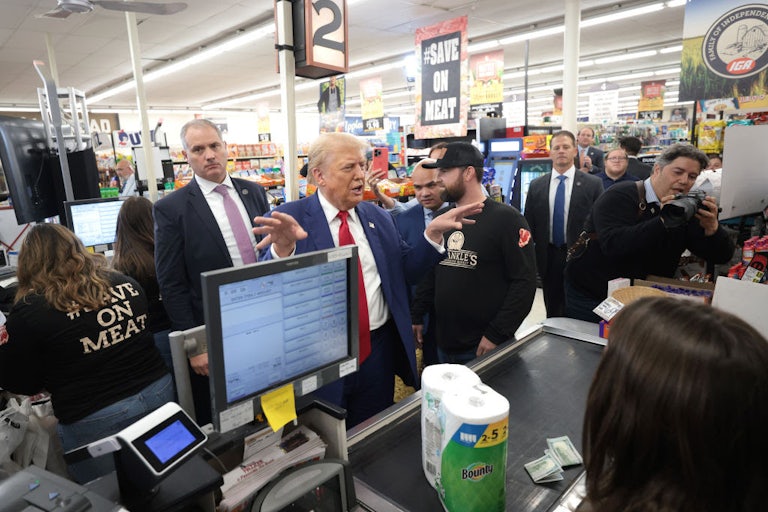
Trump stands amid numerous other people in front of a checkout counter in a grocery store.
Win McNamee/Getty Images
Donald Trump visits a grocery store in Kittanning, Pennsylvania, on the campaign trail in September, 2024.

Last week, new data dropped showing that inflation has hit a seven-month high, driven in no small part by rising food, gas, and housing costs. Egg prices alone jumped 15.2 percent from December. But coffee and other items have also grown more expensive.

As numerous pieces were quick to point out, this is not a great look for President Donald Trump, who campaigned on the promise of lowering costs for consumers on “day one,” and who has also promised lower interest rates, which the Fed is unlikely to deliver unless inflation is under control. Trump reacted to the inflation news by blaming his predecessor. “BIDEN INFLATION UP!” he posted on Truth Social.

At least one survey already suggests consumers aren’t buying this line: The University of Michigan’s February survey of consumers found they expect inflation to increase, particularly in light of the tariffs Trump has slapped on top trading partners. Nor are economists overly impressed by Elon Musk’s proposal to tackle the problem: dramatically slashing government spending. Even if Musk could cut spending as much as he suggests (doubtful, reports The Economist, which finds much evidence of chaos but not much movement in actual numbers) experts say the result would crash the economy.

But the whom-to-blame discourse threatens to obscure a broader truth about food prices in particular right now: These price increases aren’t random. While inflation overall is a complicated topic, to put it mildly, many of these individual price increases have clear causes and were accurately predicted not just months, but years in advance. And Team Trump, even without their sudden enthusiasm for tariffs, would be poorly suited to tackle these particular price hikes. That’s because the dominant conservative model for fighting high cost of living—removing regulations and cutting government spending—isn’t very well suited to the crises driving some of these increases.

As Jan Dutkiewicz wrote at The New Republic last month, egg price increases are being driven partly by the H5N1 avian flu outbreak—which is being exacerbated by longstanding underregulation of animal agriculture. “Virtually all of the 100-or-so billion eggs produced annually in the United States come from factory farms,” and “cramming so many virtually genetically identical birds of the same breed into such tight quarters makes factory farms hotbeds of disease,” Jan wrote. “For decades, public health experts have feared that the next big pandemic would originate in poultry.… Reducing the risk of zoonotic outbreaks in the food system, mostly by reducing land clearing for crops and moving away from the factory farming of animals, is a lesson we should have learned from previous avian flu outbreaks and from the 2009 swine flu outbreak. And it should have been driven home by the scope and scale of the human and economic impact of the Covid-19 pandemic.”

Paradoxically, he continued, the historical cheapness of eggs has fed a national egg-eating habit that now gives egg prices disproportionate sway over our overall experience of inflation:

[I]f consumers eat a lot of eggs, the price of eggs will be weighted heavily in calculating the [Consumer Price Index]. As the Brookings Institute put it, in an article written before the current outbreak of H5N1, “Americans spend more on chicken than tofu, so changes in the price of chicken have a greater impact on the CPI.” In the face of a supply shock like H5N1, egg prices rise much faster than those of other goods, which not only drives up CPI but makes the difference in prices very obviously visible to shoppers, even though most of them don’t connect the price hikes to a disease ravaging farms thousands of miles away from their supermarket.

Cheap eggs might just be a bad long-term goal to aim for, Jan argued. And whether or not you agree with that conclusion, cheap eggs seem like a difficult outcome for the Trump team to deliver merely by slashing spending and regulations. They could, of course, simply stop doing anything about the avian flu: no more testing, and thus no more culling of diseased chicken flocks or federal compensation for those culls. This “let the world burn” strategy is not impossible to imagine of Trump—but it’s hard to see how this would accomplish the putative goal, given that sick birds typically stop laying eggs.

The Trump administration’s economic approach also seems suboptimally calibrated for dealing with the kind of price volatility we’re starting to see with coffee. In January, Arabica coffee futures spiked to record levels amid tariff fears, The Wall Street Journal reported—but that wasn’t the only reason for the volatility. Severe drought in Brazil and wild swings in precipitation in Vietnam—the world’s two top coffee-producing countries—had already lowered yields.

This is consistent with what researchers have long predicted might happen as climate change accelerates. In fact, last March, researchers with the European Central Bank calculated that “weather and climate shocks” alone may drive food price increases of 1.5–1.8 percentage points a year within a decade, and increases of 2.2–4.3 percentage points a year by 2060.

Coffee has long been identified, along with chocolate, as a crop particularly sensitive to these weather changes. In fact, chocolate prices are also way up for weather reasons, leading to multiple stories last week (and a data-heavy report from Climate Central) explaining the context to Valentine’s Day shoppers.

Deregulation and cutting all funds geared at addressing climate change isn’t going to help this problem. “Drill, baby, drill,” the slogan Trump adopted for his inauguration, has long been the Republican rallying cry for economic growth and low cost of living. But Democrats have tried this approach, too, and it’s not even very effective at lowering gas prices—much less the prices of things that get harder to produce the more fossil fuels you burn.

There are, of course, efforts to diversify coffee strains and make the global coffee market more resilient to climate shocks. One of the bodies funding those efforts was the U.S. Agency for International Development, which the Trump administration is now dismantling.

Stat of the Week
$19 billion

That’s how much money—intended for states, municipalities, and nonprofits—remained frozen in EPA coffers as of the end of last week, despite court orders for the Trump administration to resume disbursements, according to Inside Climate News.

What I’m Reading

‘The path forward is clear’: how Trump taking office has ‘turbocharged’ climate accountability efforts

Last spring, Liza Featherstone wrote at TNR about Vermont’s new law, following the federal “Superfund” model for chemical cleanups, that aims to make fossil fuel companies pay into a fund that can then be used to offset the costs of climate disasters. This model of climate policy, The Guardian’s Dharna Noor reports, is now spreading rapidly, although courtroom challenges from the fossil fuel industry are spreading almost as quickly:

“I think Trump’s election has turbocharged the ‘make polluters pay’ movement,” said [Jamie] Henn, who has been a leader in the campaign for a decade.… The state of Vermont in May passed a first-of-its-kind law holding fossil fuel firms financially responsible for climate damages and New York passed a similar measure in December.… Similar bills are being considered in Maryland, New Jersey, Massachusetts and now Rhode Island, where a measure was introduced last week. A policy will also soon be introduced in California, where recent deadly wildfires have revived the call for the proposal after one was weighed last year.

Minnesota and Oregon lawmakers are also considering introducing climate superfund acts. And since inauguration day, activists and officials in a dozen other states have expressed interest in doing the same, said Henn.

“I think people are really latching on to this message and this approach right now,” Henn said. “It finally gives people a way to respond to climate disasters, and it’s something that we can do without the federal government.”

Read Dharna Noor’s full report at The Guardian.

This article first appeared in Life in a Warming World, a weekly TNR newsletter authored by deputy editor Heather Souvaine Horn. Sign up here.

Green Groups Were Lying Low. But Now They Have a Battle Plan.

After a quiet few weeks, environmental and progressive organizations are unveiling strategies to fight the Trump administration.

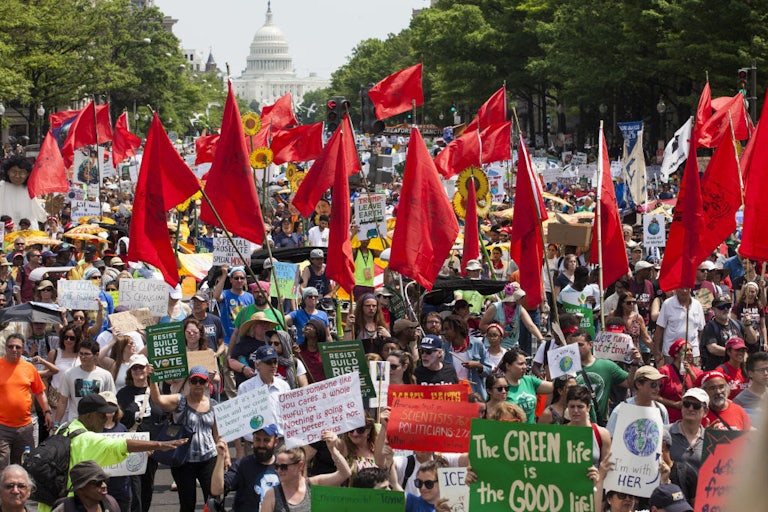
Protesters fill the streets in front of the Capitol, holding signs and waving red flags.
Bloomberg/Getty Images
Climate protestors march in Washington D.C. during Trump’s first term in April, 2017.

On Monday night, a new coalition of progressive and environmental groups held a call outlining a strategy to “fight Trump and the oil oligarchs.” “We’ve been on defensive for the last three weeks, but it’s time for us to go on the offensive,” said Friends of the Earth President Erich Pica. “We can’t keep drinking out of the firehose,” said host Joseph Geevarghese, executive director of Our Revolution, an organizing group born out of Bernie Sanders’s 2016 presidential campaign.

The call was one of several recent signs that, after lying low for the first few weeks of the Trump administration, environmental groups are suiting up for battle. The United to End Polluter Handouts coalition—which among its over 30 members includes the youth-focused Sunrise Movement, NextGen America, and Zero Hour; senior-focused Third Act; consumer rights nonprofit Public Citizen; and social justice grassroots organization Hip Hop Caucus—is embracing a particular strategy, organizers on the call explained: to target the budget reconciliation process in March with a demand to end fossil fuel subsidies.

The goal, organizers say, is not just to strike a blow against the oil and gas industry. It’s also to hit oil executives in a way that undermines Trump’s entire platform.

The reconciliation process needed to pass the tax bill, Pica argued, is where the rubber of the Trump administration meets the road. “They want to pass this tax cut bill so they have to cut other types of social spending. They want to increase defense at the cost of SNAP, increase oil and gas subsidies at the expense of Medicaid. This is their big plan,” he said. “It’s their plan because they don’t have the votes in the Senate to pass anything other than a tax bill.” So that’s where environmental and other progressive groups “can pick a fight,” he said. “And if we don’t win, we will use this moment to gum up the reconciliation package.” A significant part of the task, he and others on the call agreed, would be forcing Democrats to “hold the line.”

That’s easier said than done. As several people on the call acknowledged, politicians typically look for deals in these sorts of negotiations. Democrats so far have not indicated much willingness to fight via all available means. And at the end of the day, the GOP does have the votes to push a reconciliation package through, with or without Democratic cooperation.

But the groups on the call Monday aren’t the only ones unveiling new strategies in the coming weeks. The Center for Biological Diversity, for example, launched 266 lawsuits against environmental rollbacks under the last Trump administration alongside other environmental groups like the Natural Resources Defense Council—winning a striking majority of them. “Because [Trump and Elon Musk] have moved with such speed it has taken a little bit of time for us to catch up,” Center for Biological Diversity Government Affairs Director Brett Hartl told me by phone. “But I think we expect to have at least one or two more lawsuits against DOGE,” he said, in addition to those already filed by such groups as Democratic attorneys general, “and I think there’ll be other lawsuits challenging aspects of some of the executive orders in the next, I would say one to three weeks.”

Despite the widely reported absence of “the resistance” this time around, these groups emphasize that they haven’t gone anywhere. And there’s another common theme: While the opposition is at a significant disadvantage given Democratic minorities in the House and Senate, the dizzying pace of the administration’s opening weeks, they argue, masks vulnerability—which Trump’s opponents can exploit.

“President Trump and the Republicans are weak,” Pica said Monday, pointing to the thin GOP majority dictating a need to pass legislation via the budget reconciliation process. “This is an opportunity to lay out and expose Trump for who he really is,” Sunrise Movement Executive Director Aru Shiney-Ajay said. “The reason he has such a high approval rating is that he was able to fool people into thinking that he fought for everyday people.” Attacking his “oligarch” allies, she and others on the call argued, undermines his core appeal to certain voters.

Environmental advocate Bill McKibben recently proposed a similar approach in his newsletter The Crucial Years. “Our job is not to stop what Trump is doing, because we can’t,” he wrote to fellow activists. “Our basic job is to make what he’s doing is deeply unpopular, because that will stiffen the backbone of the courts and any remaining moderate Republicans, and set us up for possible gains if and when we next have elections. So: witness, communicate, ridicule, amplify strong voices.”

And if the would-be activists reading that newsletter are still sitting stunned on their sofas, uncertain what to do with the barrage of news over the last few weeks? When I asked Hartl what he would say to environmentally concerned readers who might be feeling more overwhelmed than empowered at present, he pointed to the need to distinguish substance from show.

“Make sure that elected officials and your representatives and people know when [Trump’s] actions are causing real harm, as opposed to the noise and chaos that he is so good at generating all the time,” he said. “That is his one true superpower, is flooding the news with nonsensical chaos.” While many of the spectacular Week One executive orders on environmental matters were ultimately symbolic requests for agencies to produce reports, (which is part of why groups were slow to sue, Hartl explained) halting Inflation Reduction Act, or IRA, disbursements is another matter. “People are going to lose their jobs, because the money’s not going to be there so they’re not going to be able to do the work they were promised to do,” he said.

Like many in the past week, Hartl questioned whether Trump actually has the political support for these sorts of moves. “He promised to have the cleanest air and cleanest water in the world. He told everyone RFK Jr. was going to fix our broken food systems and get chemicals out of the environment. He didn’t run a campaign on utterly destroying the environment and killing people’s jobs,” Hartl said. “So folks need to bring all that to light, because they’re deeply unpopular. And his one vulnerability is that he is actually incredibly thin-skinned and sensitive to public opinion. The only thing that really makes him change his mind is when things are going bad—and then he’ll just change on a whim cause he doesn’t really have any principles.”

Stat of the Week
60% to 80% chance

That’s how likely it is that the target set by the Paris climate agreement—limiting warming to 1.5 degrees Celsius above pre-industrial temperatures—has already been crossed, according to a new study. Read CNN’s report on this study and two other grim ones here.

What I’m Reading

Farmers on the hook for millions after Trump freezesUSDA funds

That’s how likely it is that the target set by the Paris climate agreement—limiting warming to 1.5 degrees Celsius above pre-industrial temperatures—has already been crossed, according to a new study. Read CNN’s report on this study and two other grim ones here.

The Washington Post paints a portrait of utter chaos following the president’s Day One order to halt disbursements from the IRA. While the White House “repeatedly said the freeze of agriculture funding and other federal financial assistance would not affect benefits that go directly to individuals, such as farmers,” the Post reports that farmers were still unable to access funds—including reimbursements for projects already completed—as of last weekend.

[Last] Wednesday, National Farmers Union President Rob Larew testified before the Senate Agriculture Committee that the Trump administration’s sweeping decisions on federal funding were creating concern for farmers across the country.

“No one knows what funding will be available or if key programs will have the staff needed to operate,” Larew said. “Freezing spending and making sweeping decisions without congressional oversight just adds more uncertainty to an already tough farm economy.”

Skylar Holden, a cattle farmer in eastern Missouri, said he signed a $240,000 contract in December under the Environmental Quality Incentives Program to share costs on investments for his farm.

With the funding, Holden erected new fencing and installed a well. He had planned further improvements to his farm’s water system and spent $80,000 on materials and labor contracts that he expected would be partly paid back by the government.

This month, a USDA representative told him the funding was paused because of Trump’s executive order.

Read the full report from Daniel Wu, Gaya Gupta, and Anumita Kaur here.

This article first appeared in Life in a Warming World, a weekly TNR newsletter authored by deputy editor Heather Souvaine Horn. Sign up here.
Three Key Themes in Trump’s Environmental Moves So Far

Not all of the spaghetti has to stick to the wall for him to make a mess of our world.

Donald Trump, Melania Trump, and an unnamed official walk through scorched streets.
Mandel Ngan/Getty Images
President Donald Trump and Melania Trump tour a fire-affected area in the Pacific Palisades neighborhood of Los Angeles, on January 24.

If you’ve found it impossible to keep track of all the news in the past two weeks, you’re not alone. Here’s a brief rundown of where things stand on the environmental front, two weeks into Donald Trump’s second term—and a few themes that might not be apparent from the daily headline deluge. (The typical Trump-era caveat applies: This list may be outdated by the time you read it, given the rapid pace of executive actions so far, and it’s not intended to be exhaustive.)

Within hours of his inauguration, Trump signed an executive order titled “Unleashing American Energy,” a roughly 3,500-word document ordering all agencies to review, identify, and begin the suspension or reversal of any policies “that impose an undue burden on the identification, development, or use of domestic energy resources—with particular attention to oil, natural gas, coal, hydropower, biofuels, critical mineral, and nuclear energy resources,” or that somehow restrict “consumer choice of vehicles and appliances.”

The order also revoked a number of Biden-era executive orders to do with clean energy, climate change adaptation, and the establishment of a national Climate Corps; ordered the agencies to take steps to expedite the federal permitting process; barred agencies from using “methodologies that are arbitrary or ideologically motivated” in their environmental analyses (specifically singling out the concept of the “social cost of carbon”); and ordered all agencies to “immediately pause the disbursement of funds appropriated through the Inflation Reduction Act of 2022 … or the Infrastructure Investment and Jobs Act,” with electric vehicle programs specifically put in the crosshairs. It also outlined protocol for fast-tracking the approval of liquefied natural gas ports and instructed agencies to remove any “undue burdens” on the mineral mining industry and prioritize actions to facilitate mineral extraction.

In the same flurry of week one orders, Trump declared a “national energy emergency,” ordering agencies to use emergency authorities to speed oil and gas production (but not solar and wind power). A separate order singled out Alaska’s reserves in particular for exploitation. Trump withdrew the country from the Paris climate accord and Joe Biden’s U.S. International Climate Finance Plan, ordered agencies to rethink water distribution in Southern California (which the federal government doesn’t really control), and ordered a performance review for the Federal Emergency Management Agency, or FEMA. He also ordered a blanket pause on federal grant money, which would affect a number of environmental and clean energy programs—although this order was then rescinded and also paused by multiple federal judges.

On January 29, the Senate confirmed Trump’s nominee for the Environmental Protection Agency head, Lee Zeldin—a noted Trump loyalist. Trump also appointed David Fotouhi (another Trump EPA veteran, who recently as a litigator challenged the EPA’s asbestos ban) as second in command, tapped chemical industry insiders Nancy Beck and Lynn Dekleva to lead the EPA’s chemical regulation, and named two former oil lobbyists—Alex Dominguez and Aaron Szabo—to manage auto emissions and air pollution for the agency. Meanwhile, newly confirmed Transportation Secretary Sean Duffy instructed the Department of Transportation to preferentially fund projects serving areas with higher marriage and birth rates, and began the process of reversing Biden policies on fuel efficiency standards.

This week opened with the administration reminding all recently hired EPA workers via email that “as a probationary/trial period employee,” they could be fired immediately—an EPA-specific escalation from the prior week’s general threats and buyouts offered to all federal workers via the extrajudicial powers of Elon Musk. The White House also announced the nomination of Neil Jacobs, known for altering a map of the projected path of Hurricane Dorian with a Sharpie during Trump’s first administration, in an attempt to corroborate the president’s misleading tweet, to head the National Oceanic and Atmospheric Administration.

The Senate confirmed Trump’s nominee, the fracking executive Chris Wright, to lead the Department of Energy. On Tuesday, The New York Times reported that the EPA would also be “demoting career employees who oversee scientific research, the enforcement of pollution laws, hazardous waste cleanup and the agency’s human resources department and will replace them with political appointees.”

So what does this add up to? And how does it fit into the much larger flurry of executive actions on foreign aid, immigration, public health, LGBTQ rights, and more in the past two weeks?

First, while some aspects of Trump’s first two weeks (such as the speed and scale of some of the assaults on the federal workforce, the attacks on USAID in particular, handing over the federal payment system to Musk and his teenage staff) have surprised even watchful experts, you really can’t say that most of these environmental moves come as a shock. They’re fully in line with what informed observers expected from a reelected Trump administration; the president has been telegraphing these decisions for months, and they’re also found in the pages of the GOP’s Project 2025 policy manifesto.

The second theme here is that—as with many of Trump’s other moves, and as this newsletter predicted two weeks ago, noting the oligarchic aesthetics of the inauguration festivities—you really can follow the money. All of these actions benefit specific industries and people. Gutting the environmental review and permitting process and greenlighting liquefied natural gas terminals will please the oil and gas industry that Trump explicitly courted for donations during his campaign. Killing the electric vehicle subsidy will please Musk—who has openly said this would benefit Tesla (currently struggling) by hurting the company’s competitors. In general, putting corporate lobbyists in charge of regulating the industries they come from is a good way to please corporate interests, and revoking any policy that restricts “consumer choice” in household appliances tends to benefit companies manufacturing appliances that are dangerous.

The third point is one that pertains to many of Trump’s moves in other areas, as well. Right now there seems to be a stark divide in the commentariat: an open argument over whether the administration’s actions over the past two weeks are a catastrophic attack on literally lifesaving programs and American political norms, or merely a predictable show of bluster from team Trump that will inevitably be slowed or halted by legal challenges and lack of congressional support.

But both these things can be true at once. It’s possible—likely, even—that many of Trump’s initial actions will fizzle for legal or organizational reasons. It’s also possible for these actions to do a lot of damage, even if the specific orders are eventually countermanded. “On Friday morning,” Brett Murphy and Anna Maria Barry-Jester recently reported for ProPublica, “the staffers at a half dozen U.S.-funded medical facilities in Sudan who care for severely malnourished children had a choice to make: Defy President Donald Trump’s order to immediately stop their operations or let up to 100 babies and toddlers die.”

The effects of halting funds for environmental programs won’t be as gut-wrenchingly immediate as the halt on foreign aid. But the same principle applies across multiple fields: Programs and projects operating on tight margins and relying on predicted federal funds to show up can’t necessarily wait for this all to be cleared up.

“We have one woman in her 80s who lives alone, and if she does not get her roof fixed, well, we’re going to have a senior in her late 80s who is homeless,” Warren Tidwell, leading efforts to repair storm damage in Alabama using IRA funds, recently told the Times. The same article pointed to farmers and small-business owners waiting for reimbursement who went into debt to fund improvements that the Rural Energy for America Program was supposed to reimburse, or clean energy projects whose status is suddenly up in the air. The uncertainty alone will probably shutter some projects.

The overarching analysis is fairly grim. Trump was hardly an unknown quantity. The chaos he has unleashed was predictable, as was his capture by a slew of cronies benefiting from a rollback of sensible energy and environmental policy. If anything’s getting lost in all the Sturm und Drang, it’s that ordinary people will wind up impoverished or harmed as a select few profit, regardless of how things ultimately play out in the courts. That alone ought to be generating more opposition, and more pointed media coverage, than we’re currently seeing.

Stat of the Week
50%

A paper published this week found a 50 percent increase in microplastics in human brains in 2024 as compared to 2016.

What I’m Reading

How Trump’s USAID shutdown threatens the world’s climate goals

The attempt to completely shutter USAID hasn’t gotten as much attention as other Trump orders. But it’s one of the places where these early actions could do significant and irreversible damage. In addition to USAID’s lifesaving work in public health, Jake Bittle reminds readers at Grist, the agency also distributes funds to help “low-income countries build renewable energy and adapt to worsening natural disasters, as well as conserve carbon sinks and sensitive ecosystems.” The piece also serves as an important reminder that public health and climate change can’t really be siloed into separate categories.

Even if USAID eventually resumes operations to provide emergency humanitarian assistance such as famine support and HIV prevention, the agency is still likely to terminate all its climate-related work under the Trump administration. The result would be a blow to the landmark Paris climate agreement just as significant as Trump’s formal withdrawal of the U.S. from the international pact. By clawing back billions of dollars that Congress has already committed to the fight against global warming, the U.S. is poised to derail climate progress far beyond its own borders.…

In 2022 … USAID offices around the world began tweaking their operations to ensure the projects they were funding would hold up as temperatures continue to rise. For example, the agency would ensure water and sewer systems could handle bigger floods, or would plan to inoculate against diseases that might spread faster in warm weather.…

Zimbabwe’s minister for climate and the environment, Washington Zhakata, said that a shutoff of USAID funding will make it nearly impossible for the country to meet its commitments to the Paris agreement. The country has promised not only to develop renewable energy but also to spend huge amounts of money on drought and flood protections. It has developed a nationwide adaptation plan on the premise that future funding would be provided—and provided in large part by the countries that are responsible for the most carbon emissions historically, like the U.S.

Read Jake Bittle’s full report at Grist.

This article first appeared in Life in a Warming World, a weekly TNR newsletter authored by deputy editor Heather Souvaine Horn. Sign up here.

Trump 2.0’s Deregulation of Chemicals Has Begun

The appointment of two industry insiders to the Environmental Protection Agency revives familiar arguments about regulation harming the economy.

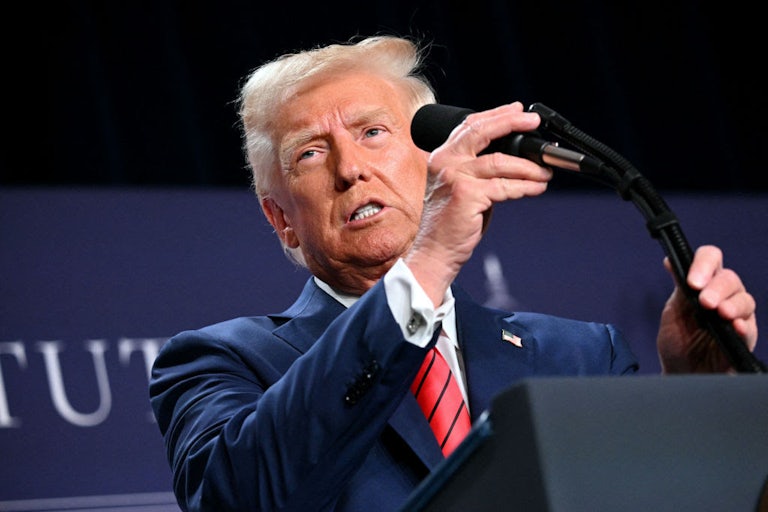
Trump grasps a microphone at a lectern.
Mandel Ngan/Getty Images
Donald Trump delivers remarks at the House Republican Members Conference Dinner on January 27.

Last week, Trump appointed two veterans of his first administration, Nancy Beck and Lynn Dekleva, to lead chemical regulation at the Environmental Protection Agency. Beck is a chemical industry lobbyist. Dekleva is currently senior director at the American Chemistry Council, an organization whose positions include opposing the EPA’s recent, arguably belated ban on noncritical uses of methylene chloride—a chemical so toxic that it has been shown to poison even trained workers using protective gear. These appointments, while buried beneath the landslide of other headlines out of the White House over the past week, served as a critical indicator: Specifically, they dashed the (limited) hopes some advocates were nursing that right-wingers’ newish preoccupation with environmental health—embodied primarily in the chaotic figure of Trump’s Health and Human Services nominee, Robert F. Kennedy Jr.—might make the second Trump administration marginally more environmentally friendly on chemical and plastics regulation than the first one.

The Washington Post, covering the appointments, highlighted the typical rationale for appointing industry insiders to such posts: that the EPA’s chemical approval process needs reform. “The EPA’s flawed decision-making process has consequently inhibited American innovation and our ability to compete in the global market,” according to Republican Representative Brett Guthrie of Kentucky. The Post also quoted lawyer Dimitri Karakitsos, who has represented chemical companies, arguing the approval process for new chemicals is actually impeding environmental progress: “A lot of these new chemicals tend to be greener and safer, and we want that innovation on the market,” he said.

Is that true? It’s a counterintuitive take, given that the EPA has come under heavy criticism in recent years for failing to ban even chemicals that dozens of other countries have chosen to ban over links to severe health damage. I called two experts to get their perspectives on the matter.

“I actually do think that there are tremendous innovations and discoveries of new chemicals happening today,” Yale School of the Environment professor and former director of the U.S. Green Chemistry Program Paul Anastas told me. “And yes … when you can demonstrate these things—that it’s safer, greener, performs better—there should be a more effective way of fast-tracking these innovations into the marketplace so that they can make their positive benefits.” At the same time, he said, “the role of science at EPA is fundamental, and everything that the EPA does must be science-based.”

A key part of the industry position, however, is that U.S. regulatory procedures are somehow exceptionally obstructive, particularly in an international context. Those with experience in this international context say that argument doesn’t hold up.

“The idea that U.S. chemical regulation is so advanced that it hinders and slows down U.S. competitivity is preposterous,” said David Azoulay, director of environmental health at the Center for International Environmental Law, or CIEL, over the phone from Geneva. The U.S. has “the least stringent, least efficient, and least protective legislation compared to any of the other major economies—and that includes economies like the EU of course, which is the most often mentioned, but also includes Korea, Japan, even China.” The EU, for example, “regulates or bans over 1,300 chemicals in cosmetics. The U.S. bans less than two dozen.”

The anti-regulatory argument also rests on the assumption that regulating to prevent environmental harm slows innovation. But when CIEL investigated this in 2013, Azoulay said, using patent applications as a proxy for innovation, “every time there was a new type of regulatory control measure being put in place around phthalates, we saw a spike in a number of patents being filed for new products or new substances or new applications that didn’t use phthalates.” He also pointed to a wealth of recent research showing that, contrary to the assumption that regulations hurt the economy, under-regulating harmful chemicals can cost billions of dollars.

These studies probably aren’t going to prevent people from arguing that EPA regulations harm American companies’ ability to compete. “An additional perspective that’s useful to consider,” Azoulay added, “is that, contrary to some simplified beliefs, the chemical industry is very much a global industry. All of those major chemical producers are multinationals that have production bases in the U.S., in Europe, in China, in the Gulf, in other places, that try to take advantage of being closest to the primary materials or the markets or whatever.” And the arguments everywhere seem to be the same: “Those rules in that particular jurisdiction are hindering competitivity. But because it’s the same companies making the same arguments, what they’re actually doing is trying to bring the floor down, and trying to lower the level of protection of health and the environment.”

If the track record of the first Trump administration is any indicator, those companies may be pleased by what happens next at the EPA. Then again, maybe they won’t. When the first Trump administration tried to weaken methylene chloride regulations, for example, they were quickly and repeatedly sued. Rushed, poorly evidenced environmental rollbacks in the first Trump administration were what allowed groups like the Natural Resources Defense Council to boast that “on average, we sued once every ten days for four years, and we won victories in nearly 90 percent of the resolved cases.” As these battles play out, however, many fear the toll—to insufficiently protected workers, to the people passively absorbing toxic chemicals in their environment, and to ecosystems—may mount.

Good News/Bad News

A new study pushes back against earlier ones suggesting that the Atlantic Ocean’s system of currents is slowing down. This study finds no evidence of the system weakening at all—very good news, given that, as previously discussed in this newsletter, a lot of agriculture depends on the weather systems that depend, in turn, on these currents.

Maryland’s renewable energy program isn’t working, a new report suggests. Inside Climate News’s Aman Azhar explains the findings and talks to the report’s authors, who say this is a “well-known problem in the state that people don’t want to talk about.”

Stat of the Week
35%

A previous edition of this newsletter noted that a so-called attribution study of climate change’s contribution to the L.A. fires might take time. Only two weeks later, a report from the World Weather Attribution group calculates that climate change made the hot, dry, windy conditions that helped the fires spread 35 percent more likely.

What I’m Reading

Kentucky’s Mountaintop Mines Are Turned Into Neighborhoods

Old coal mines that blew the tops off mountains have left lots of manmade plateaus in Kentucky. While these “ecological graveyards” may not be as lush as the landscape they’ve replaced, Austyn Gaffney writes, they may prove to be a lifeline in a state struggling to adapt to increasingly severe floods:

In 2022, apocalyptic flooding swept across eastern Kentucky, killing 45 people, destroying 542 homes and damaging thousands more. Now, instead of rebuilding in the floodplain, the state is permanently lifting residents onto safer land. Officials are more than two years into a nearly $800 million plan to reclaim these landscapes again, turning them from deserts into developments.… Seven communities across four counties, with aspirational names like Skyview and Olive Branch, have been designed for 665 brand-new properties, some of which will run on solar. Fourteen houses have been completed and about a dozen people have moved in to two communities called Thompson Branch and Wayland, according to the state.

Read Austyn Gaffney and Jon Cherry’s feature in The New York Times.

This article first appeared in Life in a Warming World, a weekly TNR newsletter authored by deputy editor Heather Souvaine Horn. Sign up here.