Life in a Warming World
A weekly reckoning with our heated planet—and the fight to save it

How to Avoid Food System Collapse

If Atlantic Ocean currents break down, the Northern Hemisphere could face crop failures. So why isn’t there a plan for that?

A truck drives past a field of wheat.
Ken Cedeno/Corbis/Getty Images
A wheat field in North Dakota

Spring is here, and seeds are in the ground. But what if, a year from now, all the weather patterns our food system takes for granted were suddenly different? Not just the worsening summers, droughts, and floods of climate change but something faster and more dramatic, and much harder to adapt to?

Last month, researchers from Utrecht University in the Netherlands published a disturbing paper suggesting this might actually happen. Scientists have previously speculated that melting ice sheets dumping vast quantities of freshwater into the ocean could change the currents of the Atlantic Ocean. The new modeling suggested, though, that complete collapse of the Atlantic Ocean’s current system is no longer “theoretical” and could occur much faster and more completely than anticipated. Europe would abruptly get much colder, seasons could fully flip in the Amazon rainforest, and many other places could see big changes in weather patterns.

Can our food systems survive this kind of shock? Food systems are dizzyingly complex, encompassing crops grown in fields and greenhouses, meat and dairy animals elsewhere that consume some of those field crops, wild and farmed fisheries, refrigerated supply chains transporting plant and animal products to processing sites or warehouses, the grocery and restaurant industries, and international trade. When I asked experts about how U.S. food supply might be affected by weather shifts like the one outlined in the new paper, their responses weren’t reassuring. In essence: Both domestic and international food systems are quite vulnerable. But figuring out how vulnerable is hard. Not only is the United States failing to make its food system more resilient, it’s not even gathering enough data to know how to make the food system more resilient.

“We’ve done surprisingly little preparing for these kinds of shocks,” said Roni Neff, a professor at the Johns Hopkins School of Public Health and Center for a Livable Future. When Neff and her colleagues surveyed local governments on food system resilience, “the people that responded were those that were already thinking about this, and of those that responded only 10 percent considered their local jurisdiction to be prepared.”

Nor can local governments rely on the feds. The concern with a large-scale shock is that it could trigger what researchers call “multiple bread basket failures,” according to Michael Puma, director of the Center for Climate Systems Research at Columbia University. “As far as I know there is no very clear governmental strategy—at least that’s unclassified—that clarifies how the U.S. would deal with a major disruption in production.”

While the U.S. Department of Agriculture does have grants and loans for building a more resilient food system, that’s far from being a comprehensive plan for responding to giant climate shocks. “Some of us in academia have been trying to push the governmental agencies to take notice of this,” Puma said, “with little success to date.” Because food system resilience in response to crisis involves a mix of domestic agriculture, international trade, disaster response, and more, there’s no one agency that would be able to address this. “In the 1970s the U.S. government had prepared a report on potential strategies for managing U.S. food reserves, and this was in response to the Soviet grain crisis,” Puma added. “But then it was somewhat abandoned and ignored and not really used moving forward.”

A comprehensive strategy would have to start with good data. “We know what to do in general” when it comes to food system resilience, Neff said, but “there’s really quite scant research on confirming what works and what to prioritize.” Changing that would involve a combination of funding and coordination. “We haven’t seen a major amount of funding available for this type of question and specifically to develop policies or new institutional responses to this type of threat,” said Puma.

“When we’ve been trying to do various projects with modeling, like where is the food, who’s got it, how much food is in the Baltimore area right now if all the roads got cut off,” Neff said, “we don’t know, because a lot of it is in various individual businesses and storehouses and they’re each keeping their own data.” (One such study of New York City in 2016 estimated “the New York City food system holds roughly 4 to 5 days of regular consumption of food stock on average”—not an encouraging figure if one were to imagine incoming supply chains being disrupted.)

Even without better data, though, it’s possible to identify specific vulnerabilities in the U.S. food system and changes that should probably be made. The high efficiency of the current food system has often come at the cost of redundancy—meaning backup plans. “We need to have more diverse places where food is coming from; we need multiple routes, roads, where it’s coming from, multiple storage facilities,” Neff said. And while sudden systemic agricultural reform would both be hard and come with its own risks, Puma argued, there’s “low-hanging fruit” like fighting the increasing “consolidation of farmland,” reducing overreliance on fertilizer and pesticides, and being a little more skeptical of so-called smart agriculture: “If you’re introducing the use of drones into the agricultural system, that’s a new type of risk to take into account.”

Then there are things that can be done quickly, and locally. Communities that “had been doing some of this work before the pandemic hit were better able to adapt” to the 2020 disruptions, Neff said. And “one of the key things was having people in the local food system connected to each other and knowing each other and having those relationships in the first place so people knew who to call and contact and help develop responses.”

You’ll be reading more about food system resilience and agriculture reform at TNR shortly. But in the meantime, if you’re not feeling exactly reassured as you read this, you’re not alone. At the end of these calls, given the lack of preparedness at the governmental level, I asked whether the people who have been socking away hundreds of pounds of rice and beans in their basements might have the right idea, if not exactly an equitable one.

“The preppers definitely do have a point,” Puma said. “I think it’s a multiscale solution, and I think low-hanging fruit is to encourage people to have more food stored at home so that they’re not as vulnerable. You want to have a little buffer capacity as individuals so if there’s no food for a week you’re not scrambling.”

Good News/Bad News

Competition among states for the Climate Pollution Reduction Grants instituted by the Inflation Reduction Act have resulted in a new crop of ambitious climate proposals from Democratic governors, Politico reports.

A new report has officially confirmed that air quality last year in the U.S. was dreadful.

Stat of the Week
0.92–3.23 percentage points

That’s how much climate change could be inflating food costs per year by 2035, according to a new study. By that point, climate change could also be contributing to overall inflation (“headline inflation”) by up to 1.18 percentage points per year. Read Axios’s summary here.

What I’m Reading

You may remember stunning photos circulating last year of Tulare Lake, long ago drained for agricultural use, reappearing in California’s Central Valley thanks to record precipitation. “Scientists and officials predicted the lake could remain for years to come, sparking consternation among the local farmers whose land was now underwater and excitement from others who saw the lake as a fertile nature sanctuary and sacred site,” writes The Guardian’s Dani Anguiano. Perhaps just as remarkable as the lake’s reappearance, however, is the fact that it’s almost entirely gone just a year later:

These days the crowds of eager tourists have waned, and the shoreline is getting harder to find. On a recent drive through the central valley, I decided to try my best to see what was left of it.

On a sunny afternoon in late February, almost a year after its arrival, the road closure signs still in place around the county served as the most visible reminder of the lake. They blocked long stretches of muddy roads leading to agricultural facilities.

The remnants of Tulare Lake are located entirely on private land, far from where the public can see it. It has reduced rapidly in size as local agencies moved water from the lake to nearby farmlands. Evaporation also played a “key role.”

Read Dani Anguiano’s report at The Guardian.

This article first appeared in Life in a Warming World, a weekly TNR newsletter authored by deputy editor Heather Souvaine Horn. Sign up here.

The Bleak Backdrop to the Kate Middleton Frenzy

Much like “covfefe” in 2017, the internet is converging on a story that feels safer than everything else that’s going on.

Newspapers lie on top of one another showing front-page stories about Kate Middleton.
Ming Yeung/Getty Images
U.K. newspaper coverage of Catherine, Princess of Wales, being admitted to the hospital on January 18

Dozens of pieces in legacy media publications, including TNR, have looked for broader meaning in the social media frenzy over Kate Middleton’s “disappearance” since Christmas. (To recap: The princess was supposed to be recovering from planned surgery away from the public eye. But the internet was suspicious, and to quell rumors the palace released an image earlier this month that then proved to be heavily edited, for which Middleton claimed the blame. This did not help.) Some say the public relations mess signals a general crisis for the monarchy, some that it’s a sign of contemporary addiction to conspiracy theories. A professor of media ethics told The New York Times that it’s a symptom of “the darkness that is characterizing our politics.”

To me, the flurry of amateur Kate Middleton sleuthing, memes, and jokes on social media resembles nothing so much as the viral “covfefe” tweet by Donald Trump nearly seven years ago. Just after midnight on May 31, 2017, Trump typed the nonsensical, “Despite the constant negative press covfefe,” and seemingly logged off for the night. Because journalists and other political obsessives had learned to keep an eye on Trump’s account during the witching hour, Twitter promptly lit up with confusion and speculation about what Trump could have meant, or whether he’d been tackled while typing. Some created “covfefe” parody accounts. The entire internet, it seemed, had descended into giddy absurdity.

Like the “covfefe” episode, the Middleton frenzy has the feel of a massive online community blowing off steam. You can’t say it’s “good clean fun,” exactly—the speculation ranges from salacious to downright grim. But it has the classic “covfefe” mixture of jokes and theories edged with faint nervousness about such obvious incompetence in the P.R. apparatuses of powerful institutions. It’s the incredulous but gleeful vibe of kids realizing that the adults who were supposed to have everything under control are tripping over their own shoelaces. “I don’t think u understand how badly you’ve f***ed this,” read one tweet with over 36,000 likes, responding to alleged Kate Middleton photos. “There are now people on the internet who could SHAKE HER HAND and still claim she’s four cats in a wig.”

Also like “covfefe,” the Middleton moment has people nostalgic for a more innocent era: a time when the internet seemed like a place to clown around rather than a place for fascist paramilitary recruitment. A time when people could laugh at the grown-ups screwing up because we retained a shred of belief that the grown-ups basically had things under control the rest of the time.

None of these jokes and memes are actually fun when you zoom out. The “covfefe” episode proved to be a precursor for Trump threatening nuclear war on Twitter, getting banned for inciting an insurrectionist mob, then getting his account restored (along with many other accounts banned for hate speech) after Elon Musk bought the platform. The Middleton frenzy contains more than a hint of the macabre: Speculating wildly about the lives of people recovering from major surgery isn’t nice, and doing so as a distraction from other news stories, while understandable, is bleak.

The grown-ups—meaning the institutions that have inherited massive power in our society—quite evidently do not have things under control. The other stories people have the option of reading about are almost impossibly grim. A genocide is playing out in Gaza, and the nations who joined the “Never Again” refrain after Rwanda are actively supporting the genocidal regime. Trump, who many hoped would fade into chaotic obscurity after losing the 2020 election, seems quite likely to regain the presidency—and The New York Times is running stories about the resistance being tired.

Whether the world can withstand this turn of events is unclear. The earth may be warming even faster than anticipated, and rich nations still haven’t gotten it together to bring emissions down to safe levels. Environmental groups, who have been warning for years that the Biden administration, despite the Inflation Reduction Act, isn’t doing enough to avert catastrophe, find themselves with little choice but to hope that Biden will at least prevail over the alternative.

Of course people are going off about Kate Middleton. But it has nothing to do with Kate Middleton. This story is a fantasy about returning to the 1990s, when people could indulge in celebrity gossip without the feeling of laughing on the brink of the abyss. Almost every other story in the news is too much to take.

Good News/Bad News

The EPA has, at long last, fully banned asbestos.

The new and relatively weak Securities and Exchange Commission rule requiring companies in some situations to disclose their emissions and climate-related risks has already been halted by court order pending a suit from oil and gas companies. Meanwhile, 24 Republican state attorneys general are suing over the Environmental Protection Agency’s new rule to reduce methane emissions from oil and gas industry activities—for example, by monitoring leaks and limiting flaring. The Republican attorneys general say this is an “attack” on the oil and gas industry.

Stat of the Week
$9 billion

That’s how much taxpayer money since 2012 has gone to subsidizing plastic plants. “In the past three years, more than 80 percent of the facilities violated their air pollution control permits,” reports DeSmog.

What I’m Reading

FBI sent several informants to Standing Rock protests, court documents show

Alleen Brown’s report on the extent of federal law enforcement’s actions against the Indigenous demonstrators and their allies protesting the Dakota Access Pipeline beggars belief:

Up to 10 informants managed by the FBI were embedded in anti-pipeline resistance camps near the Standing Rock Sioux Indian Reservation at the height of mass protests against the Dakota Access pipeline in 2016…. The FBI also regularly sent agents wearing civilian clothing into the camps, one former agent told Grist in an interview. Meanwhile, the Bureau of Indian Affairs, or BIA, operated undercover narcotics officers out of the reservation’s Prairie Knights Casino, where many pipeline opponents rented rooms, according to one of the depositions.

The operations were part of a wider surveillance strategy that included drones, social media monitoring, and radio eavesdropping by an array of state, local, and federal agencies, according to attorneys’ interviews with law enforcement.

Read Alleen Brown’s full report at Grist.

This article first appeared in Life in a Warming World, a weekly TNR newsletter authored by deputy editor Heather Souvaine Horn. Sign up here.

Southern Europe Is in Serious Trouble

A new report suggests climate change will hit some countries in the EU much harder than others.

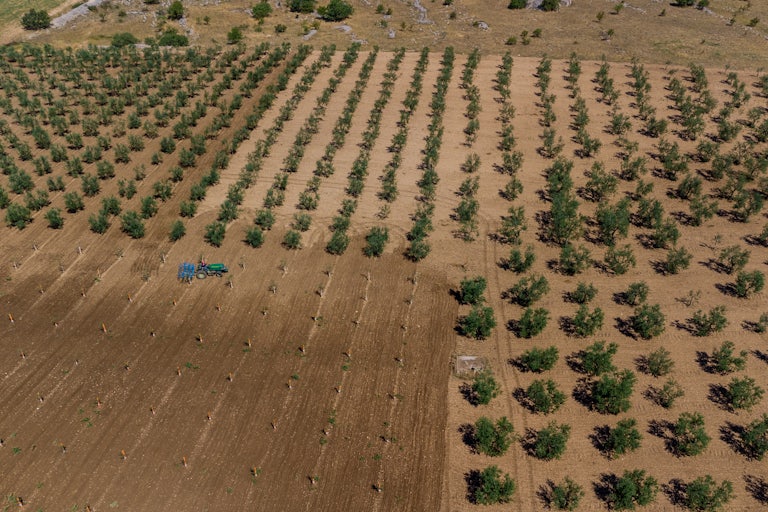
An aerial view shows olive trees and bare earth.
NurPhoto/Getty Images
A field of olive groves is plowed in July 2022 in Puglia, Italy.

The European Environment Agency this week released a meticulous 300-page report on climate risks facing the EU, and it can be summed up thus: Without immediate and significant action, Southern Europe is screwed. There are other takeaways from the report, for sure, about climate threats throughout Europe. But in each of the five main risk categories the report evaluates—ecosystems, food, health, infrastructure, and economy and finance—Southern Europe is going to be hit the hardest. Over the coming decades, the region will lose “biodiversity/carbon sinks due to wildfires,” the flames and smoke of which will also affect human health. Southern Europe will see crops fail at higher rates than in areas farther north. It will experience “energy disruption due to heat and drought.” Its economy will suffer “due to water scarcity,” and its public finances will struggle due to large debt-to-gross domestic product ratios.  

And action is urgently needed because Southern Europe is already seeing dramatic damage from climate change. In agriculture, all of Europe is going to see big shifts, such as reductions of up to 10–25 percent in corn and wheat yields; without policy intervention, the agricultural economic losses in the EU and the U.K. alone could top 65 billion euros (just over $71 billion) per year, per one study cited by the report. But Southern Europe is already seeing reductions that exceed those figures, “with wheat and maize yield reductions of over 60% in some … regions.” The report envisions risk to the European region in general as “substantial” in the current term, near term, and mid term, only rising to “critical” in the 2080s … except for Southern Europe, where the risk is rated as “critical” now, rising to “catastrophic” by the 2080s.

Climate change is already affecting precipitation patterns across the globe. In the United States, it’s predicted that parts of the East Coast will see larger numbers of torrential downpours in the coming decades while parts of the West suffer from extreme drought. And in Europe, the new report says, there may be a similar pattern, with Northern Europe prone to periodic flooding. Yet even here, Southern Europe is in a tougher spot. For while “northern and central Europe experience both beneficial and adverse impacts on water-dependent energy systems … southern Europe faces predominantly adverse impacts as availability of water to support hydropower production or cooling [e.g., for nuclear power plants] is less reliable.” And access to fresh water for drinking and irrigation will face other threats, not limited to drought: Rising seas mean “saltwater intrusion is also affecting water supplies in many coastal regions in Southern Europe.” 

The devastating list of predictions goes on. Wildfires will reduce air quality particularly in Southern Europe, which is “expected to increase respiratory illnesses, morbidity and mortality.” Heat waves in Southern Europe will reach “catastrophic” levels by the 2040s, but are already dangerous for the outdoor workforce. 

Nor can tourism save the day. Thanks to wildfires and heat waves in the summer, “projections of future tourism demand show a clear pattern, with northern regions benefiting from milder conditions while southern regions face significant reductions in tourism demand, especially in a high-emission scenario.” Meanwhile, “European beaches may experience reduced amenity due to sea level rise amplifying coastal erosion and inundation risks, particularly in southern Europe.” The report also states that while there are “substantial current/near-term risks” for public finances at present, these risks are closer to “critical” for countries with high debt-to-GDP ratios. Those too are concentrated in Southern Europe. The highest debt-to-GDP ratios are in Greece and Italy, with Portugal, France, and Spain exchanging third, fourth, and fifth rankings over the past few years.  

The report isn’t solely doom and gloom. One of the reassuring parts is just how many policy interventions have been identified that could make things better. If you’re looking for climate “solutions”—specifically, evidence that societies have tools for addressing the amount of warming that’s already locked in—this report is full of them. Take the water topic, where the report proposes reusing wastewater; investing in desalination infrastructure, sand dams, and other techniques for water harvesting; “creating or improving early warning and alert systems”; switching to “more drought-resistant crops”; building water-retaining soil on farms; and restoring rivers and wetlands to “increase water retention in river catchments.” That represents just a tiny fraction of the report’s proposals. 

Reducing emissions to keep climate change from spiraling out of control isn’t the focus of this report. But the urgent need to limit climate change, rather than just adapt to it, haunts the document. Lots of places in the world, and even in the U.S., are going to be in a position similar to Southern Europe. Quite a few places are in even worse shape. At this point, it’s hard to think of a regional climate risk assessment that wouldn’t have lessons for the entire globe.

Good News/Bad News

Colorado lawmakers, increasingly metal in their conservation policies, have proposed reintroducing wolverines. (Predators, many studies show, are crucial for maintaining the overall health of ecosystems.)

This Washington Post piece on the potential health effects—particularly for kids—of playing sports on artificial turf is careful and balanced. But I wouldn’t exactly call it reassuring.

Stat of the Week

$5.47 for every $1

“For every dollar the government has contributed” to the energy transition via the Inflation Reduction Act, Grist’s Syris Valentine reports, “the private sector has kicked in $5.47, leading to nearly a quarter-trillion dollars flowing into the clean economy in just one year.” Those numbers come from a new analysis by the Rhodium Group, and are likely to be interpreted as a success story. But given abundant evidence that the energy transition still isn’t happening fast enough, Valentine points out, perhaps they should be treated more like proof of concept.

What I’m Reading

Old power lines plus climate change mean a growing risk of utilities starting fires

Texas’s devastating, record-breaking Smokehouse Creek fire, which began in late February and killed two people while burning over a million acres, seems to have been started by a poorly maintained utility power pole, which fell and sparked the blaze. Such aging electrical infrastructure is an increasing problem all over the United States, reports Julia Simon for NPR. But it’s not getting fixed. Even the small improvements that could make things safer aren’t being made:

There are some basic—and relatively cheap—things that utilities with even a small wildfire risk should be employing, [Michael Wara, director of the Climate and Energy Policy Program at the Woods Institute,] says. Things like weather sensors on power poles. They can give power companies a much clearer sense of dangerous conditions like strong winds or dry, hot weather.

“It’s not expensive, right? It’s those little weather stations you’d buy and maybe put on your house if you were a weather nerd,” Wara says.

Also utilities can change settings to automatically turn power lines off when conditions are unsafe, he says. “The utilities have the tools. This is not a mystery,” Wara says.

Part of the problem may be that many utility companies aren’t always incentivized to make the fixes and operational changes that are key to reduce wildfire risk, says David Pomerantz of the Energy and Policy Institute, a utility watchdog. Instead he says many power companies are biased towards building expensive things which can guarantee a profit.

Read Julia Simon’s full report at NPR.

This article first appeared in Life in a Warming World, a weekly TNR newsletter authored by deputy editor Heather Souvaine Horn. Sign up here.
Exxon Wants You to Feel Guilty About Climate Change

CEO Darren Woods says consumers don’t want greener products. If that’s true, why are heat pumps so popular?

Darren Woods sits with his hands clasped.
Bloomberg/Getty Images
Darren Woods, chairman and CEO of Exxon Mobil Corp.

Exxon Mobil CEO Darren Woods has found someone new to blame for the climate crisis: you. “We have opportunities to make fuels with lower carbon in it, but people aren’t willing to spend the money to do that,” Woods told Fortune. “The people who are generating those emissions need to be aware of and pay the price for generating those emissions. That is ultimately how you solve the problem.” He also said it was too late now to develop greener technologies.

There’s a lot to unpack in there. As experts surveyed by Guardian reporters Dharna Noor and Oliver Milman pointed out, Exxon has played a big role in delaying policies fostering greener technologies, due to decades of misinformation campaigns attempting to deny the reality of the climate crisis. The notion that big emitters “need to be aware of and pay the price for generating those emissions” is likewise an interesting argument to hear coming from Exxon, given that the oil and gas industry has gone all out to block a new Securities and Exchange Commision rule requiring emissions disclosures, as TNR’s Kate Aronoff details in a new piece.

But the most complicated claim here is that ordinary consumers are to blame for the climate crisis. “It’s like a drug lord blaming everyone but himself for drug problems,” climate economist Gernot Wagner told The Guardian. It’s an apt comparison. Purdue Pharma did exactly this, blaming users for getting hooked on highly addictive painkillers that Purdue developed and pushed hard on the medical industry despite evidence that this would cause widespread addiction and overdoses. And as with the victim-blaming over drugs, a lot of people find Woods’s individual climate–blame logic compelling.

Getting consumers to focus on their own actions, rather than what politicians can do to curtail fossil fuels, was the whole idea behind the original “carbon footprint calculator” on oil giant BP’s website, which encouraged consumers to “go carbon neutral” by offsetting their own personal emissions while the company continued to profit from high-emissions products. The idea has spread, including among environmentally conscious people, resulting in both defeatist and obstructionist attitudes toward actual climate policy: A lot of people feel guilty about their “green sins,” as climate writer Mary Annaïse Heglar has written, and conclude that if they can’t get to a net-zero lifestyle on their own there’s not much hope for the climate as a whole. This is the defeatist side of the “personal responsibility” belief. A lot of people also think (urged on by corporate and political messaging, of course) that tackling the climate crisis means they will have to pay a lot of money and make a lot of sacrifices, leading them to oppose climate policy. This is the obstructionist side of the “personal responsibility” belief.

But do consumers actually prefer high-emissions products? Are they actually cheaper? The New York Times reported this week that households in Maine are “falling hard” for heat pumps, adopting the energy-saving devices faster than any other state as heat pumps outpaced gas furnace sales for a second year in 2023.

The state rebates and federal tax credits from the Inflation Reduction Act are helping, but the main reason heat pumps are being adopted so quickly, this story suggests, is that once one household installs a heat pump as proof of concept—often despite strong initial skepticism—everyone else wants one. From the Times:

“Ten years ago, they weren’t really popular,” said Josh Tucker, of Valley Home Services, a family-owned heating company outside of Bangor. “No one really knew what they were.” He first installed heat pumps in his sister’s new home in 2014, over the objections of her building contractor who, Mr. Tucker said, “was against it big time.”

“He thought she was going to freeze to death unless she had a furnace or boiler,” he said. She didn’t, and uses the same heat pumps today.

The new technology was embraced especially quickly in one northern Maine community after Mr. Tucker’s father installed heat pumps at a Methodist church there. The Tucker family still sells heating oil and propane, but less and less. Its heat pump business, meanwhile, grew from installing two to three units a week to 3,000 last year, a nearly 20-fold increase.

“We’ve done TV ads, advertising on social media, but the big one’s always been word of mouth and that’s how it exploded,” Mr. Tucker said.

What does this have to do with Darren Woods? Well, recall what the CEO said about consumer choice. One reason it’s interesting to see Maine “falling hard” for heat pumps is that the heating oil and gas industry spent lots of time and money convincing people that heat pumps wouldn’t work in places like Maine, claiming the devices wouldn’t work in cold weather. “Internal documents show that the National Oilheat Research Alliance, a trade association representing heating oil sellers, has funded campaigns fighting electrification that target New England homeowners and real estate agents,” The Washington Post reported almost a year ago. The Propane Education and Research Council, similarly, “has put out training material coaching installers how to dissuade customers from switching to electrical appliances.”

Consumers don’t make their choices in a vacuum. No one does. The options available to them right now are the result of decades of corporate profits on high-emissions products leading to further investments in these products and entrenching economies of scale. Those profits in turn were guided by over a century of government subsidy. The government’s tools for boosting greener products are severely hampered by a tremendous amount of corporate lobbying on Capitol Hill, consumer marketing, and the rulings of judges that these corporations helped put on the bench. And this full-court press works: The Biden administration, for instance, is pulling back from several Environmental Protection Agency rules intended to nudge the market toward more climate-friendly products, due to concerns about court challenges and election-year pushback.

When the playing field is made less uneven, consumers often respond with striking alacrity, as we’re seeing with heat pumps. How many other commonsense solutions would consumers willingly adopt if they weren’t being lied to and constrained by a largely rigged energy market? CEOs like Woods and the politicians in their pockets have created the world that Woods now blames consumers for trying to navigate. CEOs like Woods continue to profit from consumers’ limited options. Consumers will vote with their dollars, yes—but they need genuine choices.

Good News/Bad News

Researchers think they’ve found a nontoxic way to get an organic polymer out of crustacean shells—a possible plastic replacement for packaging, and one that could theoretically make use of shells currently ending up in landfills.

The Republican candidate for North Carolina governor, who won the primary on Super Tuesday, is a climate denier.

Stat of the Week
9,936

That’s the number of “chemical features” detected by researchers in a single plastic packaging sample, in a new study attempting to figure out what plastic food packaging is actually made of and how it might be affecting human health. (Feature detection is a way of determining what chemicals are present.) The authors concluded that “most plastic food packaging contains endocrine- and metabolism-disrupting chemicals” and that “samples with fewer chemical features” were less toxic.

What I’m Reading

Want clean electricity? These are the overlooked elected officials who get to decide.

This excellent piece about the little-known institutions that can speed or impede the energy transition focuses primarily on the Georgia Public Service Commission, “the only government body with direct authority to regulate whatever Georgia Power [the state’s largest utility] does.” But reporter Emily Jones also looks at similar bodies in other states, which climate-concerned voters might want to learn about:

Every state has a public service or public utility commission that controls electricity. In 10 states, utility regulators are elected directly by ballot. In the remaining 40, they’re appointed by other elected officials, like the governor or state legislature. Many, though not all, states require their utilities to file IRPs that predict future demand for power and map out how the utility will meet that need.

What’s common nationwide is that the future of clean energy hinges on the decisions of these public utility commissions. Cities, states, and companies can resolve to cut emissions, but if they buy power from a regulated utility they don’t ultimately control how their power is made; the regulators do. Even the Department of Defense, with its $800 billion budget, is subject to the decisions of these commissions.

Grist | Emily Jones

This article first appeared in Life in a Warming World, a weekly TNR newsletter authored by deputy editor Heather Souvaine Horn. Sign up here.

Politicians Need to Talk About Air Pollution and Alzheimer’s

A new study links fine particulate matter pollution to the incurable disease. But American industry will fight any attempt at regulation.

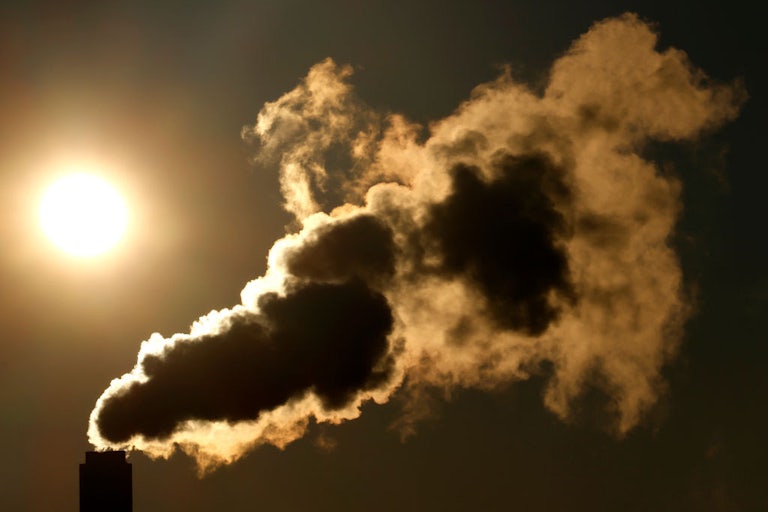
Gas pours into the sky from a smokestack, with the sun in the background.
Gary Hershorn/Getty Images
Emissions from New Jersey's Essex County Resource Recovery Waste-to-Energy Facility

Last week, researchers at Emory University’s Rollins School of Public Health published a disturbing study linking air pollution to Alzheimer’s disease. Examining brains donated to research, they found that people who’d lived in areas with a lot of a certain type of air pollution had higher amounts of the plaque associated with Alzheimer’s disease than those who’d been exposed to less pollution. And the association between air pollution and plaque was particularly strong for people who lacked the genetic markers indicating a predisposition to Alzheimer’s disease.

You might be relieved, therefore, to learn that the Environmental Protection Agency just finalized its new, tougher standard for precisely this type of air pollution. But considering the problem solved would be a mistake: Business groups are fighting the regulation tooth and nail, preparing to challenge it in the courts as well as via lobbying and, presumably, political donations. “The new pollution limits could cause election-year complications for President Biden,” The New York Times’ Lisa Friedman wrote.

The air pollution the Emory researchers were studying is called fine particulate matter, which is produced by cars, cigarettes, industrial emissions, and wildfires, to name a few sources. This is not the first time fine particulate matter pollution has been linked to Alzheimer’s and other forms of dementia. Analysis using data from the Medicare Chronic Conditions Warehouse found a similar association, with “traffic and fossil fuel combustion sources” being “particularly” associated with higher levels of dementia and Alzheimer’s.

Nor is it the first evidence that fine particulate matter can cause serious health problems. This kind of pollution has been linked to heart disease, heart attacks, asthma, premature deaths, and low birth weight. The EPA therefore estimates that its new standard would prevent 4,500 premature deaths per year.

Industry groups insist that the EPA’s rule would impede American manufacturing; cement industry representatives, for example, reportedly have threatened that the rule would lead to layoffs. (That’s despite the fact that the EPA’s rule, lowering the permissible amount of annual fine particulate matter exposure from 12 micrograms per cubic meter of air to nine, isn’t even as stringent as public health experts recommended.)

Findings like those in this new Alzheimer’s study theoretically offer a way to counter political opposition to tougher air quality standards. Alzheimer’s consistently ranks as one of the most feared diseases in the United States, in some polls beating cancer. Poll after poll, both in the U.S. and abroad, suggests that people fear dementia way more than they fear heart attacks or asthma, which are the risks typically invoked when we’re talking about air quality. While it’s worth emphasizing that there’s still a lot researchers don’t know about the association between pollution and Alzheimer’s—it’s going to be hard to definitively establish a causal relationship—it’s conceivable that a lot more people would support tougher air quality standards if elected officials put these kinds of studies on the table and said, “Look, do you really want to err on the side of industry on this one?”

And yet, you probably aren’t going to see politicians talking about this study and using it to defend the EPA rule on the campaign trail this year. The presidential front-runners in both parties have been accused of being old and disoriented, and there is zero chance that President Biden will defend his EPA’s new rule by mentioning the word “Alzheimer’s.”

But particularly because air pollution is very hard for people to wrap their minds around—very hard to turn into a sound bite—it’s important for voters to understand how rapidly scientific evidence is accumulating around its health risks: Two new studies recently reported by The Guardian found that “there is no safe amount” of fine particulate matter air pollution. Every additional amount in the air increases the risk for human hearts and lungs. The preliminary research on the Alzheimer’s link is completely consistent on this score: One study published in 2023 found “largely linear concentration-response relationships at low concentrations” of fine particulate matter pollution, with the authors emphasizing that this suggests there is “no safe level of air pollution for brain health.”

Fossil fuel combustion isn’t the only source of fine particulate matter pollution, of course. Wildfires are now a huge factor in poor air quality as well. And some industry groups have already used this to argue that the EPA’s new rule is unfair and will be ineffective.

But wildfires are, in turn, exacerbated by the climate change that fossil fuel combustion is driving. There’s more than enough evidence, at this point, for policymakers to pull the levers available to them to reduce air pollution and the processes that cause it, regardless of what the businesses that profit off that pollution have to say about it. Because it’s no longer acceptable to claim ignorance.

Good News/Bad News

Swarthmore College joins the list of institutions of higher education building ambitious geoexchange systems for campus heating and cooling.

South Korea’s carbon cap-and-trade system isn’t working. Not only has it failed to reduce industrial pollution, but polluting companies are actually profiting from the program.

Stat of the Week
2.5 million

That’s how many people in the United States were displaced from their homes by extreme weather disasters last year, according to new data.

What I’m Reading

Don’t Panic Over EV Slowdown

Recent reports suggest the electric vehicle transition is stalling, writes Sammy Roth in the excellent Boiling Point newsletter at the Los Angeles Times. But “I’m more concerned,” he writes, “by our seeming inability in modern society—or at least in modern California—to transition quickly away from the personal automobile as the One True Mode of transportation.” Roth points to the example of New York City road building, narrated in Robert Caro’s biography of urban planner Robert Moses:

Three major roadways connecting New York City and Long Island opened in 1936, Caro writes, “bringing to an even one hundred the number of miles of parkway constructed by Moses.” A newspaper editorial “opined that the new parkways would, by relieving the traffic load on [existing parkways], solve the problems of access to Moses’ Long Island parks ‘for generations.’”

Alas, Caro writes, “the new parkways solved the problem for about three weeks.” There were terrible traffic jams almost immediately—not only on the new roads, but also on existing roads.

Moses’ solution? Build more roads. Which he did, again and again, even as the problem repeated itself.… And yet here we are nearly a century later in the nation’s most forward-looking state, still debating whether “induced traffic” is a real thing. It most definitely is, as L.A. Times transportation reporter Rachel Uranga has made extremely clear in her stories. But that hasn’t stopped California from continuing to approve freeway-widening projects that promise to spew air pollution into low-income communities of color—and carbon into the atmosphere—while doing little or nothing to reduce traffic.

Read Sammy Roth’s full newsletter at Boiling Point.

This article first appeared in Life in a Warming World, a weekly TNR newsletter authored by deputy editor Heather Souvaine Horn. Sign up here.