Life in a Warming World
A weekly reckoning with our heated planet—and the fight to save it

Fixing American Farming Shouldn’t Be a Tough Sell

A sustainable food system could be worth up to $10 trillion a year. Meanwhile, Congress can’t even pass a new version of the farm bill.

An aerial view of grape vines surrounded by parched soil
ROBYN BECK/AFP/Getty Images
Drip irrigation at a farm in Fresno, California, where ongoing drought presents a serious challenge, in July 2021.

As The Guardian reported this week, the benefits of switching to a more sustainable food system could be astronomical: worth up to $10 trillion per year. Currently, the “unaccounted costs” of our global food systems come to about $15 trillion a year, meaning “our food systems are destroying more value than they create,” according to the Food System Economic Commission’s Global Policy report, which released its economic modeling on Monday. This is a fixable problem: We could move toward greater food security while reducing emissions and promoting biodiversity, and it would cost only a fraction ($200–$500 billion, i.e., around 5 percent) of the benefits that reform would generate. But the policy proposals that are currently on the table won’t get us there.

Sustainable agriculture experts may disagree on the precise proposals modeled by this report, which pairs relatively uncontroversial ideas (like conserving water, forests, and peatlands) with more hotly debated ones (like intensifying animal agriculture in some locations and getting comfortable with higher food prices). But few people really dispute that our current food systems need reform, whether globally or closer to home: From the multitudinous environmental, epidemiological, and ethical problems of meat production to toxic runoff and poor land use, to suicidal farmers and systematically exploited agricultural workers, to imminent water crises, American agriculture is way past the point where a rational observer would fail to see the glaring need for reform.

The Guardian’s report on the new economic modeling isn’t the only recent headline pointing to the crisis. Avian flu is also back in the news, spreading among poultry farms in California and leading to over a million birds being euthanized—all while the virus also makes devastating inroads into vulnerable wildlife populations in Antarctica. The virus was found in Antarctic seal populations earlier this month, and this week testing confirmed that the strain has moved to gentoo penguins, leaving over 200 penguin chicks dead, according to Reuters. Recent research has shown that while wild birds can and do spread the disease, it originated in an agricultural setting and spreads rapidly in poultry farms. And while some policymakers are apt to blame bird flu on Chinese agricultural practices, since the first cases were found in Southern China, it bears repeating that the United States has historically been and remains a conspicuous hot spot for swine flu.

Meanwhile, states relying on water from the rapidly drying Colorado River are “racing,” per The New York Times’ Christopher Flavelle, to agree on new water cuts before a possible change in presidential administrations leads to more bureaucratic delays. The vast majority of Colorado River water currently goes to agriculture, and, as E&E News’s Jennifer Yachnin observed this week, “ninety percent of this country’s winter vegetables are grown on farms in the sunny, arid corners of California and Arizona dependent on the river”—a figure that should trouble people worried about food security.

The recent Iowa caucus also offered a reminder, Tom Philpott recently wrote here at TNR, that absolutely all of the 2024 Republican and Democratic candidates support ethanol subsidies—despite the fact that ethanol is a wildly inefficient use of land. “We devote about 30 million acres of pristine farmland—an area the size of Virginia—to growing fuel for our cars,” Tom wrote, when solar panels could accomplish the same in vastly less space. Corn farming also leads to both erosion and rampant water pollution from fertilizers and pesticides.

All of which is to say that it’s a heck of a time for Congress to remain stuck in gridlock, unable to pass a new version of the farm bill—which, in case you’ve forgotten, also controls access to the country’s Supplemental Nutrition Assistance Program, or SNAP, which provides food stamps. Lawmakers were supposed to figure something out by October 1, and now negotiations are taking place in an election year. Naturally, a new version of the farm bill won’t be enough to fix American agriculture’s problems. But those concerned about the environment, food security, and inequality in this country will be watching these negotiations closely. Tweaks at the margins could affect a huge number of people and ecosystems—both in the U.S. and far beyond.

Good News/Bad News

The United Kingdom’s National Trust has launched a tree-planting program in an attempt to extend one of the last remaining patches of the country’s ancient temperate rainforest and resurrect some of its historic range.

Investigative outfit DeSmog has found yet more evidence that oil companies knew about climate change as early as the 1950s.

Stat of the Week
> 200

That’s how many rail cars filled with vinyl chloride—the carcinogenic chemical that spilled during the catastrophic train derailment in East Palestine, Ohio, last year—continue to move across the country and through densely populated areas each day, according to a new report. The Washington Post notes in its write-up that Republican senators are resisting the Environmental Protection Agency’s attempt even to study the risks of vinyl chloride, denouncing it as a “war on plastic.”

What I’m Reading

Democrats Say Biden Hasn’t “Made the Case” on Climate Despite Achievements

Buried under the election-year analysis in the first half of this piece is a beautiful and important insight about what actually motivates people to care about climate policy:

“Like I said: When I hear climate, I think jobs,” Mr. Biden said. It is a line he has repeated in multiple settings.

Some data suggests that might not be the winning message.

One of the biggest climate marketing studies of its kind, a public opinion poll across the United States and 18 other countries that was conducted last summer, found that “protecting the planet for the next generation” overwhelmingly beats out other arguments for taking climate action. Researchers found the so-called “urgent generational message” was 12 times more popular than the promise of creating jobs.

“At the heart of this is love,” said Anthony Leiserowitz, director of the Yale Project on Climate Change Communication, which conducted the study with other nonprofit groups including Potential Energy Coalition, the Meliore Foundation and Zero Ideas.

“People love particular people, places and things,” Mr. Leiserowitz said. “And those people, places and things are being threatened.”

Read Lisa Friedman’s full report at The New York Times.

This article first appeared in Life in a Warming World, a weekly TNR newsletter authored by deputy editor Heather Souvaine Horn. Sign up here.

How Fishing Releases Huge Amounts of Carbon Dioxide

A new study shows bottom trawling isn’t just destructive to wildlife along the ocean floor.

A person stands on a boat in the middle of the water holding onto a net that is hoisted above him.
NurPhoto/Getty Images
A fisherman repairing nets after trawling in the Port of Molfetta, Italy

Coal, steaks, gas stoves, and … halibut? You have to wonder how far off we are from a new climate culture war breaking out over the fishing industry. Last week, the U.S. Supreme Court heard arguments in Loper Bright Enterprises v. Raimondo, a suit from a herring fishing company challenging the government’s authority to force the industry to pay for federal monitors on boats. The case is widely expected to end with the justices gutting the power of federal agencies to interpret congressional statutes—and to set and enforce regulations accordingly—by overturning Chevron v. Natural Resources Defense Council, a landmark 1984 decision that affirmed that power.

Also last week, a new study showed that the fishing industry—and bottom trawling in particular—is a strikingly overlooked source of greenhouse gas emissions. We already knew this was a possibility: In 2021, an international team of researchers published a study finding that trawling—in which fishing ships drag nets outfitted with metal panels across the ocean floor to catch seafood like flounder, shrimp, and haddock—releases about a gigaton of carbon dioxide previously stored in the seabed into the water each year. That’s “as much carbon dioxide as the entire aviation industry,” The Guardian pointed out at the time. Carbon dioxide released into the ocean acidifies the water, which can threaten sea life—not just coral and shellfish but also the overall balance of the ecosystem.

Last week, a team that included four of the same researchers published a follow-up: In addition to the acidification effect, over half of that carbon dioxide is then released into the atmosphere “over 7-9 years.” While Enric Sala, one of the authors, acknowledged in National Geographic that this is “small compared to the emissions produced by burning fossil fuels on the land,” the same article noted that this means the effect from bottom trawling “is nearly double the annual emissions from fuel combustion for the entire global fishing fleet.”

That’s for a practice that everyone knew was environmentally catastrophic to begin with. To quote the U.S. Geological Survey: “Trawling destroys the natural seafloor habitat by essentially rototilling the seabed,” destroying an astonishing array of plants and animals as it does so, from coral and other inhabitants of the seafloor to pilot whales and dolphins.

Bottom trawling is restricted in a lot of U.S. waters. But it’s not banned entirely. And while the United States, according to a 2021 report from Flora and Fauna International, accounts for just 4 percent of trawl catch worldwide—well behind China, at nearly 15 percent, and Vietnam, at a little over 8 percent—it’s also a country whose fishing industry shouldn’t, in theory, be particularly dependent on the practice, since bottom trawling accounts for a relatively low percentage of its total fishing haul.

That raises the question of whether policymakers might consider further protections, or even an outright ban. These studies aren’t undisputed, of course—few early studies are. And if Loper Bright v. Raimondo winds up destroying the administrative state, all kinds of environmental protections could get a lot harder. But this finding may prompt policymakers to reexamine the topic, which will doubtless provoke the ire of the fishing industry.

This time last year, a stray comment about regulating gas stoves, which emit greenhouse gases in addition to lung irritants and carcinogens, sparked a bizarre frenzy among right-wingers eager to defend the asthma-linked devices from liberal interference. Panicked posturing over red meat is practically a seasonal sport in American politics. And almost anything can happen in a campaign year. If a candidate brandishes a flounder during a stump speech in a few months, well … that would be about par for the course.

Good News/Bad News

Recycling rare earth metals could go a long way toward meeting the increasing demand for them for clean energy technology, a new study suggests.

The American Petroleum Institute has launched an eight-figure ad campaign, The Guardian’s Dharna Noor reports, to convince Americans that the fossil fuel industry is decarbonizing on its own and that fossil fuels are crucial for the nation’s security and way of life.

Stat of the Week

3 percentage points

That’s the margin by which Donald Trump might have won the 2020 election, if voters’ feelings on climate change had stayed as they were in 2016, according to new statistical modeling. Instead, the number of people rating climate change as “very important” grew, and Joe Biden won climate-concerned voters across the political spectrum by 75 points. Read Anthropocene magazine’s story on this study.

What I’m Reading

The dubious climate gains of turning soil into a carbon sink

Regenerative agriculture techniques, including less tilling and increased use of cover crops, are a good idea for many reasons, Susannah Savage reports. “But the carbon angle has been oversold,” according to Pete Smith, a soil expert at the University of Aberdeen:

There are more serious flaws with soil sequestration than the lack of a clear definition. One is its capacity; research by Smith, working with other academics at Wageningen University in the Netherlands, recently looked at carbon captured in grassland soils and calculated that some 135 gigatonnes of carbon would be required to offset emissions of methane and nitrous oxide from the grazing livestock sector. That is almost twice the carbon currently contained in managed grasslands. In some regions, carbon stocks would need to increase by 2,000 per cent to offset emissions from livestock farming.

Carbon capture in soils has been promoted by the livestock industry as “a get out of jail free card”, says Smith. “‘Yes, we’re producing methane emissions … but no need to worry about it, the soils will offset all the emissions’. This [study] is the nail in the coffin of that argument.”

Read Susannah Strange’s report at Financial Times.

This article first appeared in Life in a Warming World, a weekly TNR newsletter authored by deputy editor Heather Souvaine Horn. Sign up here.

The Optimistic Climate Report That Might Be Too Good to Be True

Journalists hailed it as proof that we can grow the economy while cutting emissions. But between the lines, there’s a different story.

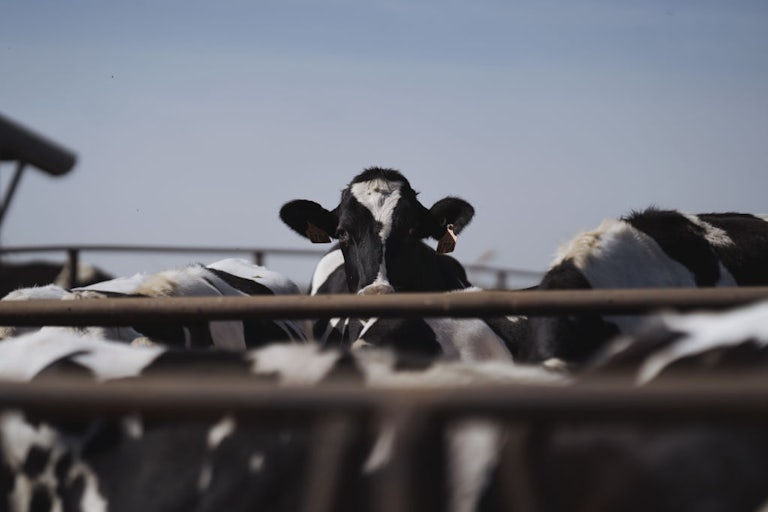
A cow standing among other cows looks at the camera.
Bloomberg/Getty Images
A dairy farm in Porterville, California

A funny thing happened last week. A climate report revealed genuinely good news about U.S. emissions. Or did it?

“U.S. Carbon Emissions Fell in 2023 as Coal Use Tumbled to New Lows,” The New York Times reported. “The falling emissions, driven largely by retirements of dirty, coal-fired power plants, put U.S. climate pollution at its lowest level since 1991,” CNN added. NBC’s headline was cautious—“Good news, bad news: U.S. emissions shrank last year, but very slowly”—but the lede was more optimistic: “Carbon emissions shrank in 2023 even as the economy grew, a sign the U.S. is plodding toward a more sustainable future.”

That was the takeaway of a lot of the coverage. As Robinson Meyer of Heatmap wrote, “It’s the first time since the pandemic began that the American economy has, as the phrase goes, ‘decoupled’—experienced an expanding economy and falling emissions at the same time.” These articles acknowledged that progress remains troublingly slow—the pace isn’t enough to meet the targets set by the Paris Agreement—but characterized the report as proof that we can grow the economy while reducing emissions.

Not so fast. It really depends on what part of the Rhodium report you look at. To quote the summary itself: “This decline in emissions was driven by an 8% drop in emissions in the power sector and a 4% drop from residential and commercial buildings.… In the transportation sector, the highest-emitting sector, emissions rose by 1.6% from 2022 levels, and in the industrial sector, the second highest-emitting sector, there was a 1% increase in emissions.” That’s a little less encouraging.

Consider the 4 percent decrease from buildings. How’d that happen? “In the buildings sector, a milder-than-average winter reduced fuel demand and led to lower overall emissions, since the majority of homes still rely on natural gas, fuel oil, and propane for space heating.” This is a tough one to know how to evaluate. On the one hand, any drop in emissions is good, in that it strictly adds less to the total emissions budget. On the other hand, another way of phrasing this would be to say we reduced emissions by warming the world enough that it was a mild winter, which, given that our buildings still rely on fossil fuels, reduced emissions. That is not a pattern we want to repeat ad infinitum, expecting further success; there are, after all, some knock-on effects from warmer winters, including water crises, ecosystem and agricultural instability, and hotter summers (which can also lead to increased fuel consumption).

Then there’s the power sector. Coal declining is doubtless good news, not just for greenhouse gas emissions but also for human health. But the report also says that “natural gas generation grew more than twice as fast as renewable generation did, year-on-year.” And wind turbine installation rates actually seem to be declining relative to 2021 levels. Meanwhile, the report continues, “the U.S. is on track for record dry gas production in 2023, and crude oil production looks to rival if not exceed 2019 record levels as well.”

And then there’s the other big asterisk. “The researchers looked at planet-warming emissions generated by transportation, electricity, industry and buildings,” The New York Times noted, “but did not include pollution from agriculture, which accounts for roughly 10 percent of the nation’s greenhouse gases.”

There’s little reason to think that U.S. agricultural emissions have gone down. In fact, we already know that agricultural emissions can rise while others fall, because that seems to be what happened in 2020, when Covid hit. Between 1990 and 2021, according to the Environmental Protection Agency’s annual Inventory of U.S. Greenhouse Gas Emissions and Sinks, carbon dioxide emissions from agriculture increased by 16.2 percent, methane emissions increased by 15.7 percent, and nitrous oxide emissions increased by 3.7 percent. And emissions specifically from enteric fermentation—i.e., from the guts of the animals producing red meat and dairy—have increased 7.2 percent over roughly the same period.

None of this is to say that the way the Rhodium findings are being reported is wrong. The top-line summaries, however, emphasize the progress rather than the more troubling signs. Even with all the caveats, Meyer writes, “the analysis nonetheless shows that climate progress in the U.S. is holding its own, just as the Inflation Reduction Act and new Environmental Protection Agency rules are set to kick in in years to come.”

I struggle to match that optimism. None of the sectors where emissions have likely increased are easy to reform, from a political perspective. The sectors where emissions did decrease may not maintain those reductions. Then too, it’s hard to ignore other headlines coming out this week that may have a significant effect on these trends going forward. Hot (so to speak) on the heels of former President Donald Trump’s victory in the Iowa caucus, a poll released Tuesday showed Trump leading Biden 45–37 percent in the key state of Georgia. That same day, Politico reported that team Trump may “show less restraint” in a second term than in his first when it comes to gutting environmental protections and climate policy. That’s in part due to the influence of Project 2025, a policy draft put together by conservative groups for “Day One.” (You can read about Project 2025 and its implications for climate, trans rights, schools, and more in TNR’s extensive coverage of the plan.)

Time will tell how this report from the Rhodium Group ages. It’s a frustrating feature of climate coverage that one of the most important factors in evaluating the meaning of emissions reports often isn’t the climate or emissions data itself but rather the crystal-ball vagaries of American politics. The climate-funding progress of the past few years is real. But the IRA is a law—and an imperfect one, at that. It’s not destiny.

Good News/Bad News

The Maryland Department of Natural Resources reports a “remarkable number” of juvenile oysters in the Chesapeake Bay—more than they’ve seen “in a generation.” Oysters not only contribute to the seafood industry but also filter water, making their populations crucial to waterway restoration.

Wildlife groups have long warned that further construction of barriers between the United States and Mexico would have dire effects, not just for humans but for other species as well. The Guardian now reports that “more than 100 wild animals … were killed in a wildfire in Texas last summer, after becoming trapped behind the concrete border wall.”

Stat of the Week
11,000 pieces

That’s possibly the average microplastic ingestion of an American adult each year, according to a profoundly disturbing piece from The Washington Post on microplastics in food.

What I’m Reading

Fossil Fuel Corporations Are Faking Grassroots Support

Fossil fuel companies have used insights on consumer trust from P.R. firm Edelman to “turn workers into a positive public face for fossil fuels, obscuring the role of the profit-hungry executives who actually pull the strings,” Adam M. Lowenstein reports. The strategy has proven politically profitable.

“Energy Citizens,” an ultimately successful astroturf campaign launched by the American Petroleum Institute while Edelman was the organization’s single largest contractor, hewed closely to Edelman’s proprietary insights about trust. The effectiveness of Energy Citizens, which involved making oil and gas workers the “human face” of the fossil fuel industry to create the impression of widespread grassroots support, contributed to the defeat of US climate legislation in 2010.…

According to Duncan Meisel, executive director of Clean Creatives, such examples illustrate how Edelman has used its insights—under the guise of studying public trust—to help the fossil fuel industry fight climate action. “When Edelman finds that engagement from employees and ‘people like me’ is an important part of developing trust in corporations, you immediately see those tactics being deployed on behalf of the American Petroleum Institute and companies like TransCanada,” said Meisel.

Read Adam M. Lowenstein’s report at Jacobin.

This article first appeared in Life in a Warming World, a weekly TNR newsletter authored by deputy editor Heather Souvaine Horn. Sign up here.

It’s Go Time for the Biden Administration

Biden has a lot of climate policies to push through before the election potentially ends his presidency.

Biden climbs steps to Air Force One, with a clouded sky in the background.
Mandel Ngan/Getty Images
President Joe Biden boarding Air Force One

“Time is running out” is a strange sentence. It’s always true (shush, physicists—I mean from the human perspective), and yet it’s always anxiety-inducing. It’s perfectly calibrated to make the human brain tune out whatever comes next. Time’s running out for me to do it? Great, don’t tell me what it is! I don’t want to know! I’ve practically missed the chance already!

Yet time really is running out if the Biden administration means to fulfill its promises to counter climate change and environmental degradation. The climate clock is ticking: Data released Tuesday by the Copernicus Climate Change Service showed that world average temperatures reached 1.48 degrees Celsius above preindustrial levels in 2023—shockingly close to the 1.5 degree limit (2.7 degrees Fahrenheit) set in the 2015 Paris Agreement. The political clock is ticking, as well: With November’s election looming, it’s far from certain that Biden will prevail over the likely Republican nominee, former president and current four-case criminal defendant Donald Trump. If Trump wins, he’s likely to re-withdraw the United States from the Paris Agreement and gut environmental protections—a process that could be further abetted by a Republican Congress.

The theme in last week’s newsletter was hope. Hope certainly hasn’t run out. As The Guardian’s Damian Carrington reminded readers this week, while the Copernicus Climate Change Service expects us to hit the 1.5 degree mark in the next year, climate scientists won’t consider the target definitively smashed until temperatures are “consistently above 1.5 degrees Celsius.” And as I emphasized last week, even if we cross that milestone, “every fraction of a degree,” in the words of U.N. climate scientist Jim Skea, will matter. Each of those fractions of a degree will be a major victory counted in lives, livelihoods, species, and communities saved.

It is, however, time to get ruthlessly practical about the next 12 months. TNR’s Kate Aronoff has outlined a to-do list for the Biden administration—not just to get reelected but also to finalize a large number of environmental rules so that it will be harder for Republicans to roll them back. As you may recall, the Trump administration did just about everything it could to set fire to the environment on its way out the door in 2020, finalizing more than two dozen new giveaways to fossil fuel companies and curtailments of existing environmental policies, during the period between Trump losing the election and Inauguration Day. Biden’s administration might want to take this time to be just as industrious as his predecessor was in wrecking the planet, and protect as much of it as he can in the months that remain.

In a new piece published Wednesday, Kate adds another key item to the to-do list:

The Department of Justice prosecuted fewer corporations in fiscal year 2022 than at any point since 1994, per an analysis published by the watchdog group Public Citizen in October. The overwhelming majority of corporations it did prosecute (81 percent) had fewer than 50 employees, according to the department’s annual report; just 7 percent had more than 1,000. By its own estimation, enforcement efforts by the Environmental Protection Agency reduced, treated, or eliminated fewer pollutants than such efforts have at any point in the last decade. Also in fiscal year 2023, which started in October 2022, the EPA charged fewer criminal defendants than it has at any point in the last decade.

While EPA enforcements increased last year, “the bar for improvement,” Kate wrote, “was shockingly low.… In fiscal year 2022, EPA civil enforcement cases plummeted to their lowest levels in 22 years, according to an analysis by the Environmental Integrity Project. Jail time for criminal defendants reached an all-time low. Fewer criminal cases were opened in 2022 than at any point since 1992.” While there are demonstrable reasons for that—such as the sharp reduction in agency staff under the Trump administration and stinginess from Congress—there’s a limited amount of time to enforce existing rules before a combination of Supreme Court decisions and elections could make those agencies’ tasks much, much harder.

At the governmental level, policy is about how one uses the time that one has. Politics is about buying more of it. The latter typically outweighs the former in an election year. But if Biden believes, as he has previously stated, that climate change is “literally an existential threat,” his administration is going to have to go full-out in the next 12 months to pursue both.

Good News/Bad News


In a nice break from more villainous tech stories, “a team of beaver scientists and Google engineers have been teaching an algorithm to spot the rodents’ infrastructure on satellite images,” reports Ben Goldfarb at Mother Jones. Beavers do a lot of cool things for the environment, and scientists hope to learn more about that from this A.I. effort. Read the full piece: It’s packed with amusing tidbits like A.I. thinking pavement cul-de-sacs are beaver ponds.


Fuel efficiency for new cars seems to be stalled, largely because of the American love affair with SUVs.

Stat of the Week
28

That’s the number of billion-dollar weather disasters in 2023. You guessed it: It’s a record. No year going back to the beginning of data collection in 1980, and adjusting for inflation, has seen that many billion-dollar extreme weather events.

What I’m Reading

The war zone in Gaza will leave a legacy of hidden health risks

The Israeli government’s massive months-long assault on Gaza in retaliation for Hamas’s October 7 attacks has already killed a staggering number of people. But as Saqib Rahim reports for Grist, the death toll could rise dramatically even if a cease-fire began tomorrow. Pulverizing this many buildings has surely released toxic debris into the air, including asbestos in some cases. And that’s to say nothing of other environmental degradation:

Systematic research after the September 11, 2001, attacks in the United States was among the first to link exposure to such a mix of detritus to pulmonary and respiratory disease and cancer.… In principle, making post-conflict zones livable again requires rigorous field sampling, remediation of pollution hotspots, and health surveillance to watch for disease trends. In practice, these things usually get skipped in the exhaustion that follows hostilities …

Without ground access to Gaza, observers are relying on remote sensing and publicly available information to measure environmental impacts to the Strip. Using satellite analysis, He Yin, an assistant professor of geography at Kent State University, reckons the fighting has damaged 15 to 29 percent of Gaza’s arable land. The PAX report identifies a plume of black smoke from a soda factory, suggesting burning plastics, and heavy damage at an industrial campus that makes pharmaceuticals, cosmetics, plastics and other chemical goods. In November, the New York Times observed a huge fire at a water-treatment plant, a frightening development in one of the most water-stressed places in the world.

Read Saqib Rahim’s full report at Grist.

This article first appeared in Life in a Warming World, a weekly TNR newsletter authored by deputy editor Heather Souvaine Horn. Sign up here.

How to Be Hopeful Going Into 2024

Optimism seems to be a theme in climate coverage. But what does productive optimism look like?

A protester dressed as a snowman holds a sign reading "Stop Global Warming."
Erik McGregor/Getty Images
A protest in New York City in September

Twenty-one species were finally, after much deliberation, declared extinct in the United States last year. Only 11 other species had been declared extinct in the prior half-century. 2023 was the warmest year ever recorded for Earth’s average temperature. Some researchers think 2024 could be worse. The Biden administration made $382 million auctioning off oil-drilling leases on December 20—part of record oil production on Democrats’ watch. By the end of 2024, the country could be preparing for another Trump presidency—likely gutting environmental protections and re-withdrawing the U.S. from the Paris Agreement.

Yet perhaps counterintuitively, an emerging theme as 2023 closed out and made way for 2024 was that of hope. “Here’s How Bad Climate Change Will Get in the U.S.—and Why There’s Still Hope,” was how Wired announced the results of the Fifth National Climate Assessment in November. “Hope is a discipline,” declared one Guardian headline published New Year’s Eve atop an interview with Nathan Baring, one of the young plaintiffs suing the U.S. government for having “willfully ignored” warnings about fossil fuels. (The case was filed in 2015 and still hasn’t gone to trial.) And then there’s Hannah Ritchie’s book Not the End of the World, being released next week to notable press interest. Ritchie argues in interviews in The New York Times and The Guardian this week that, while “it has been an incredibly bad year,” we’ve made more progress than we sometimes acknowledge on climate change, and reframing existential dread as “How can I try to contribute to accelerating the good outpacing the bad?” may be more productive.

Hope is a good thing. Climate “doomerism,” numerous writers have pointed out, is destructive—giving people the false sense that there’s nothing left to fight for, when in reality “every fraction of a degree” matters for communities, species, food systems, and livelihoods. To put it another way: As a practical matter it’s hard for humans to mobilize at either an individual or a collective level when they feel hopeless, and as a scientific matter, portraying the future as a dead-end done deal isn’t accurate.

Hope is searingly politically relevant, and also complicated: The politics of hope run directly counter to the politics of fear, which have a track record of empowering regressive nationalist and racist movements. But hope can also be abused. There is a rich history among rich nations of pushing fossil fuel phaseout ever further into the future, hoping that unproven or unscalable technological solutions will suck carbon out of the air and take care of the problem for us.

Nor can hope alone, as TNR’s Kate Aronoff argued in a vital piece last spring, be expected to fix our dysfunctional climate politics:

On one hand, it’s understandable that climate advocates would think about the best way to communicate about climate change. On the other, fixating on finding the perfect tone for climate communication mistakes messaging and mindset for a theory of change. Getting off fossil fuels requires replacing the lifeblood of capitalism on a stunningly quick timeline, and replacing it with alternatives just now coming into their own. Doing that isn’t so much an issue of pessimism or optimism but of political economy…. The reason there is now a “rapidly closing window of opportunity to secure a liveable and sustainable future for all,” per the latest IPCC report, isn’t because some ill-defined mass of climate-concerned people has been insufficiently hopeful in public. It’s because the people who want to pass adequate climate policies have significantly less power and money than the people who want to obstruct such policies.

This last sentence points to another thing worth remembering: Hope probably shouldn’t be used as a substitute for accountability. A lot of companies have made a lot of money cooking the planet. They knew they were doing it, and they funded misinformation campaigns to keep citizens and their governments from intervening to stop them. And while one could argue that fixating on blame can be counterproductive, naming and blaming could be very helpful if it means people stop wanting to be associated with or do the lobbying and marketing for the entities that got us here. Cultural shifts are important for political change. Then, too, the money needed to save the world has to come from somewhere: Making major polluters pay to clean up the mess is a good start.

As we begin the new year, I like reading these hopeful pieces. I also wonder how they will age: whether editors like me will be greenlighting hopeful pieces a year from now or whether the prospect of a second Trump administration will blitz all this climate discourse into oblivion. Hope doesn’t mean a lot without action, and the precise causal relationship between the two can be tricky to unpack (as a multitude of widely circulated aphorisms attest). Let’s hope 2024 goes well. Let’s not count on it.

Good News/Bad News


Electric vehicles just got more affordable: You can now get instant rebates on electric vehicles rather than waiting until tax-filing time, thanks to a change in federal incentives that took effect this week.


The Great Lakes came into 2024 with the least amount of ice they’ve had in 50 years.

Stat of the Week

305 days

… until Election Day 2024, the outcome of which could have a gargantuan
effect on U.S. climate policy, emissions, and climate change around the world.

What I’m Reading

Strawberry Case Study: What If Farmers Had to Pay for Water?

The fees levied on irrigation in California’s bountiful Pajaro Valley are working, offering hope that similar systems could help address the West’s water crisis, as well as water crises across the U.S. and in fact all over the globe.

Experts from as far away as China and Egypt are traveling to the valley to study the system. But replicating it elsewhere could face major challenges. For one thing, “People don’t like taxes,” said Nicholas Brozovic, an agricultural economist at the University of Nebraska. “There’s nothing mysterious about that.”

New research on the program revealed a direct connection between paying for the groundwater and conserving it: A 20 percent increase in the price of groundwater has resulted in a 20 percent decrease in the extraction of groundwater.

One reason experts see Pajaro as a model: Despite the high price of water, agriculture in the region is thriving.

Read Coral Davenport’s report at The New York Times.

This article first appeared in Life in a Warming World, a weekly TNR newsletter authored by deputy editor Heather Souvaine Horn. Sign up here.