Breaking News
Breaking News
from Washington and beyond

Trump Finally Confirms True Extent of China Tariffs

The White House is clarifying the scope of tariffs on one of our biggest trading partners at last.

Donald Trump speaks outside the White House as several man stand behind him.
Anna Moneymaker/Getty Images

Donald Trump’s tariff reversal Wednesday reduced duties against most countries’ imports to 10 percent—except China, which was instead being raised to a staggering 125 percent, or so he announced at the time.

On Thursday, the White House confirmed to CNBC that tariffs against Beijing are at an even higher 145 percent—125 percent as a reciprocal measure against China’s tariff hikes, in addition to the earlier 20 percent tariffs because Trump claims the country isn’t doing enough to prevent fentanyl from coming into the U.S.

While Trump’s decision to back down from most of his tariffs helped international markets rally late Wednesday (and gave his billionaire friends a nice boost), those gains were wiped in half Thursday, with NASDAQ, the Dow Jones Industrial Average, and the S&P 500 all down by at least 4 percent each.

China is a major trading partner with the United States, with many corporations such as Apple depending on the country. Tariffs against Canadian and Mexican goods not covered by the United States-Mexico-Canada Agreement, including automobiles and aluminum, are also still in place at 25 percent.

And there’s no telling what Trump will decide to do next, as he has reversed his tariff positions several times, opening himself up to online ridicule and having hedge fund managers wonder if he is insane. Wall Street, as well as markets around the world do not like uncertainty, and the president seems to have no real plan, making it up as he goes along. This self-inflicted financial crisis will not be ending for the foreseeable future.
Trump Can’t Stave Off Recession Even After Chickening Out on Tariffs

Analysts are not thrilled with the outlook for the U.S. economy.

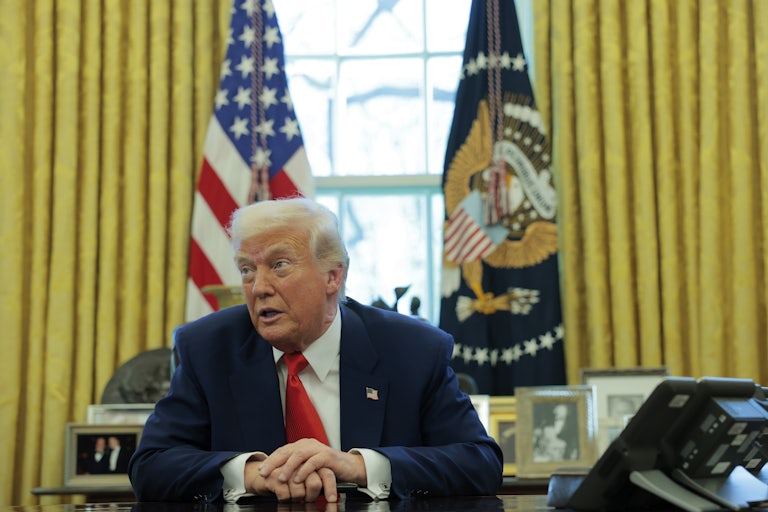
Donald Trump speaks to reporters while sitting at his desk in the Oval Office
Anna Moneymaker/Getty Images

Donald Trump may have reversed course on tariffs, but that doesn’t mean the economy has reversed course away from a recession.

Some of the country’s largest investment firms—including JP Morgan and MetLife—are still warning their clients that the country is on the verge of a recession, despite the seemingly temporary market frenzy sparked by Trump’s decision to cave on his trade war.

JP Morgan said Wednesday evening that it wouldn’t change its economic forecast, predicting a 60 percent chance of a recession both at home and around the world. Goldman Sachs said that the odds of entering an economic downturn had been slightly buoyed by Trump’s news, but the odds were still elevated at around 45 percent.

“My sense here is that the economy is still likely to fall into recession, given the level of simultaneous shocks that it’s absorbed,” Joe Brusuelas, chief economist of consulting firm RSM, told CNN. “All this does is postpone temporarily what will likely be a series of punitive import taxes put on U.S. trade allies.”

Before Trump announced the 90-day tariff pause (except those placed on China) on Wednesday, MetLife released a note indicating to its investors that Trump’s policies had done permanent damage to the American market.

“Even if there is a near-term resolution of the tariff and other trade issues, damage has been done to the economy and to consumer expectations,” the note reads. “It is also unlikely that markets will rebound fully meaning that for the large cohort of workers approaching retirement and for those workers striving toward home ownership, the boost in the savings rate prompted by this volatility may be sustained. “

Meanwhile, Trump is continuing to stoke tensions with China. After volleying with the foreign economic powerhouse over reciprocal tariffs for the bulk of Wednesday, Trump revealed yet another levy hike, bringing the total tariff on China to 145 percent. That was composed of a 20 percent fentanyl tariff—which the White House has claimed is effectively punishment for contributing to a domestic fentanyl crisis—tacked onto a 125 percent reciprocal tariff. Unfortunately for American wallets, that once again sent stocks tumbling.

Volatility in the bond market—which has traditionally served as an investment safe haven during the market’s rough waters—has also sparked fears that Americans no longer see the U.S. government as a stable, long-term investment.

Trump Brags About How Tariff Pause Made His Friends Even Richer

Donald Trump’s decision to pause his tariffs sent the stock market soaring.

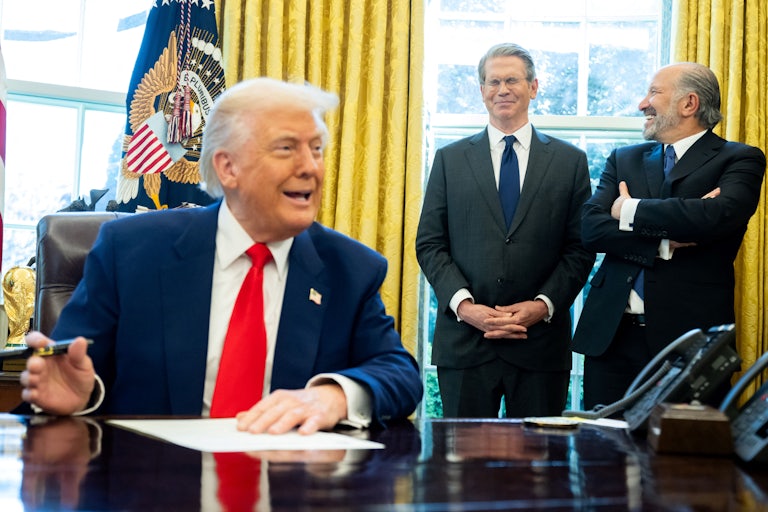
Donald Trump speaks to reporters while sitting at his desk in the Oval Office. Treasury Secretary Scott Bessent and Commerce Secretary Howard Lutnick stand behind him and laugh.
Saul Loeb/AFP/Getty Images

Donald Trump is openly bragging about just how much money his billionaire buddies made off of his dangerous tariff gambit.

After announcing a 90-day pause Wednesday on his sweeping “reciprocal tariff” policy on nearly every country—with the exception of China—Trump was excited to take credit for making a buck for his guests at the Oval Office.

“He made $2.5 million today, and he made $900 million! That’s not bad,” Trump said, pointing to financial investor Charles Schwab and Roger Penske, a Nascar team owner, respectively.

Schwab’s estimated net worth is $12.6 billion, while Penske’s is $5.6 billion.

Bloomberg reported that Wednesday was the “best day ever” for billionaires, as the world’s wealthiest people raked in a heaping $304 billion as the markets shot back up.

The day’s biggest individual winner should come as no surprise: Elon Musk made a whopping $36 billion as Tesla stock soared up 23 percent. Trump’s surprising decision to temporarily back off his steep tariffs has sparked major concerns of obvious market manipulation, and even potential insider trading.

AOC Calls Out Suspicious Stock Trades in Congress Amid Tariff Fiasco

Representative Alexandria Ocasio-Cortez is using Trump’s tariffs whiplash to call for an end to insider trading in Congress.

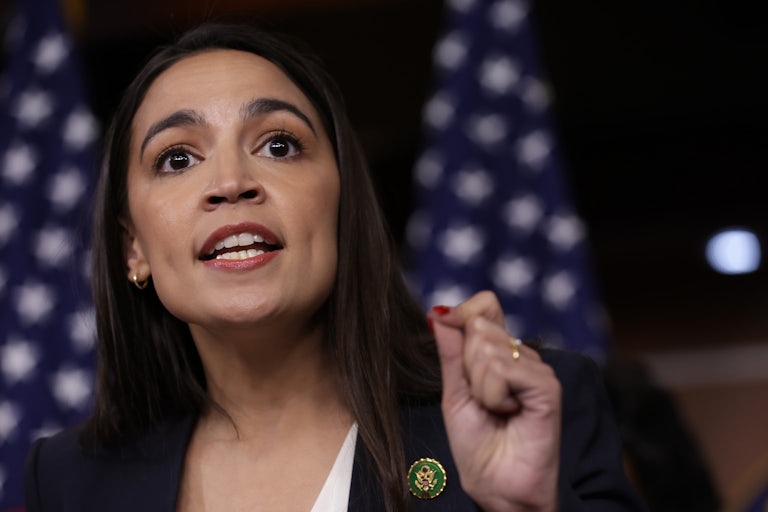
Representative Alexandria Ocasio-Cortez speaking. Two U.S. flags are in the background, out of focus.
Alex Wong/Getty Images

Representative Alexandria Ocasio-Cortez and other Democrats are accusing Donald Trump and his administration of manipulating the market to their benefit. 

Just days after Trump announced his”Liberation Day” tariffs that sparked global financial chaos and tanked markets, Trump at the last minute paused most of the tariffs for 90 days, despite previous vehement claims that he would not back down on his plan.

Following the pause, stock performances across the board surged drastically—the Nasdaq jumped by 12.2 percent and the Dow Jones Industrial average increased by 3,000 points, the largest single-session increase ever recorded. Anyone who knew about the pause in advance would’ve made a killing.

“Any member of Congress who purchased stocks in the last 48 hours should probably disclose that now,” AOC wrote in a post on X on Wednesday. “I’ve been hearing some interesting chatter on the floor. Disclosure deadline is May 15th. We’re about to learn a few things. It’s time to ban insider trading in Congress.”

Her post was accompanied by a screenshot that showed a drastic spike in Nasdaq call volume right before Trump announced the pause, indicating the president may have leaked the information to his allies, who could have invested knowing stocks would soar. Just hours before his shocking flip went public, Trump also published a series of suspicious posts on Truth Social.

“BE COOL! Everything is going to work out well. The USA will be bigger and better than ever before!” he wrote Wednesday morning. “THIS IS A GREAT TIME TO BUY,” Trump posted minutes later.

AOC isn’t the only Democrat suspicious of the GOP’s brinkmanship. In a floor speech Wednesday, Senator Elizabeth Warren called for an investigation into Trump’s volatile change of course.

“We need an independent investigation into market manipulation because Americans need to know whether President Trump or anyone in his administration manipulated the market to benefit their donors, all while they are working for the American people, and while small businesses and those working families are paying the price,” Warren said.

Senator Adam Schiff warned the president’s “constant gyrations in policy provide dangerous opportunities for insider trading.”

“Who in the administration knew about Trump’s latest tariff flip flop ahead of time? Did anyone buy or sell  stocks, and profit at the public’s expense?” the California Democrat wrote in a Bluesky post. “I’m writing to the White House—the public has a right to know.”

The GOP is now left scrambling to defend Trump’s seemingly unjustifiable decision, as the fear of recession looms and U.S. legitimacy continues to dwindle.

Elon Musk’s DOGE Gives Tesla Massive Helping Hand With Newest Purge

Elon Musk’s minions in the federal government have just fired key experts who regulate Tesla.

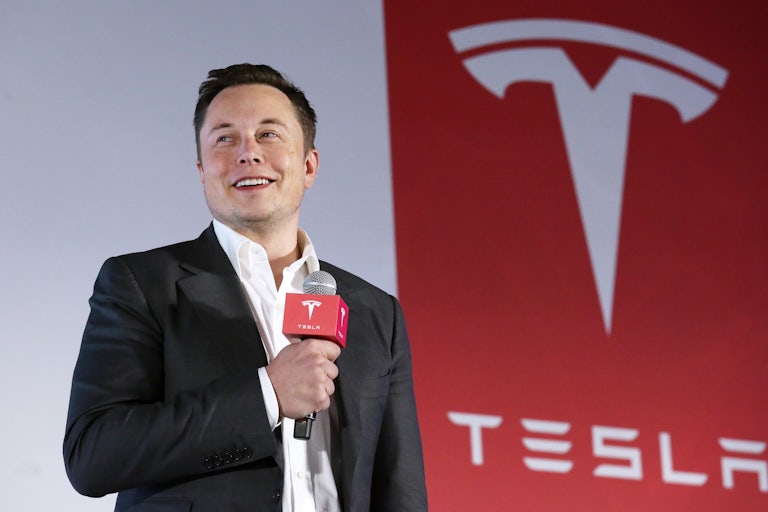
Elon Musk gives a speech in front of a massive Tesla logo.
Nora Tam/South China Morning Post/Getty Images

Elon Musk’s Department of Government Efficiency fired car safety experts in the National Highway Traffic Safety Administration who directly regulated Tesla.

The Financial Times reports that DOGE fired 30 employees from the agency back in February, including several from the office of vehicle automation safety, which is in charge of regulating self-driving vehicles, a key part of Musk’s car company.

The layoffs made up 4 percent of the agency’s 800-person staff, including employees who were due for promotions and workers who had just been hired. The automation safety staff were disproportionately affected because the office had only been formed in 2023 and was predominately made up of probationary hires.

In a Valentine’s Day email announcing the firings, poor performance was cited as the reason, although this was rejected by an unnamed senior employee still at NHTSA who spoke to the Times.

The NHTSA has eight active investigations against Tesla, including five focusing on Musk’s claims about the company’s Autopilot system and Full Self-Driving software, and has published over 10,000 complaints about the company from the public. The agency has also ordered multiple recalls of Tesla cars and delayed the rollout of the company’s self-driving and driver-assistance software.

Musk has promised to launch a driverless ride-hailing service in Austin, Texas, in June, and to start building a fleet of autonomous “cybercabs” next year, which would require an NHTSA exception because the cybercabs don’t have a steering wheel or pedals.

“Letting DOGE fire those in the autonomous division is sheer madness—we should be lobbying to add people to NHTSA,” one Tesla manager told the Times. They “need to be developing a national framework for [autonomous vehicles], otherwise Tesla doesn’t have a prayer for scale in FSD or robotaxis.”

And, much like DOGE’s other firings at agencies across the government that regulate or deal with Musk’s companies, the NHTSA layoffs have major ethical implications.

“There is a clear conflict of interest in allowing someone with a business interest influence over appointments and policy at the agency regulating them,” a former NHTSA employee told the Times.

Musk owes much of his wealth to government subsidies and contracts, and many of DOGE’s moves have squashed government oversight into his businesses. As long as Trump keeps giving him unprecedented power, the tech oligarch and fascism enthusiast will continue to keep serving his own interests.