Breaking News
Breaking News
from Washington and beyond

The New Pope Doesn’t Seem to Be a Huge Fan of Trump or JD Vance

Robert Prevost, a.k.a. Pope Leo XIV, has a long history of criticizing Trump on his X account.

Robert Prevost, aka Pope Leo IVX, waves both hands from the Vatican balcony.
ALBERTO PIZZOLI/AFP/Getty Images

The first American-born pope is not a fan of the Trump administration.

Cardinal Robert Francis Prevost, who is now Pope Leo XIV, has multiple posts on his X account that criticize or outright rebuke the words and policies of President Trump.

In February, he shared an article from the National Catholic Reporter titled “JD Vance is wrong: Jesus doesn’t ask us to rank our love for others,” in response to Vance’s bastardization of the concept of ordo amaris, a narrow interpretation of love that Pope Francis himself admonished.
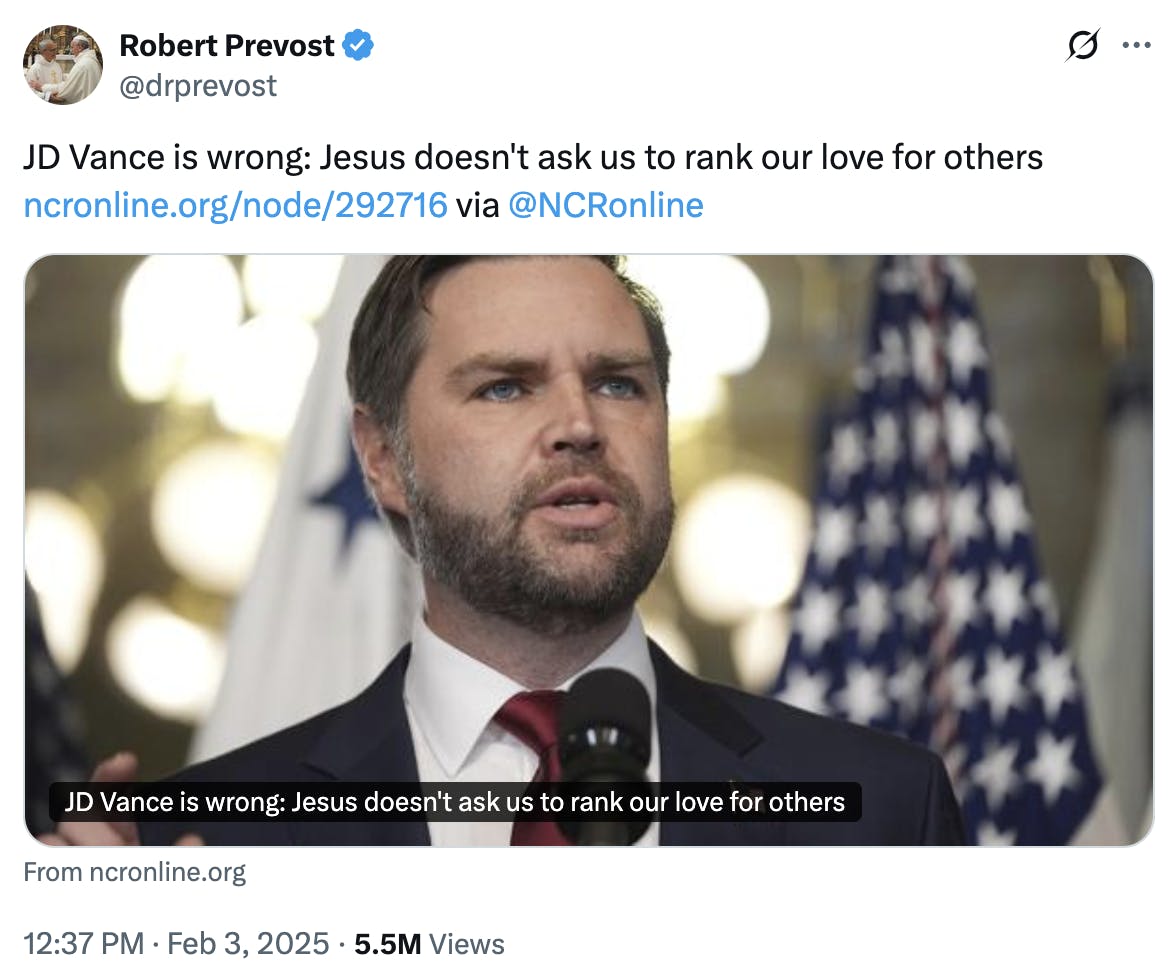
X screenshot Robert Prevost @drprevost JD Vance is wrong: Jesus doesn't ask us to rank our love for others https://ncronline.org/node/292716 via @NCRonline Feb 3, 2025

In April, he reposted Catholic writer Rocco Palmo, who wrote, “As Trump & Bukele use Oval to [aid] Feds’ illicit deportation of a US resident, once an undoc-ed Salvadorean himself, now-[Auxiliary Bishop Evelio Menjivar of Washington, D.C.] asks, “Do you not see the suffering? Is your conscience not disturbed? How can you stay quiet?”

Pope Leo was also critical of Trump’s family separation policy. In 2018, he retweeted a scathing post from Cardinal Cupich: “There is nothing remotely Christian, American, or morally defensible about a policy that takes children away from their parents and warehouses them in cages. This is being carried out in our name and the shame is on us all.”

The new pope also has multiple reposts showing sympathy and support for George Floyd, the Black man whose police murder was a catalyst for racial justice movements in 2020. He reposted words in opposition to Trump’s refugee ban and Muslim ban, as well as articles on “rivers of blood” flowing from Russia’s invasion of Ukraine and the Russian attack on a Catholic missionary headquarters in Mariupol.

The pope is expected to strike a Francis-like chord on issues of immigration and poverty, two things the current administration is directly opposed to.
Trump Exposes Own Idiocy With Comment About Looming Shortages

Donald Trump had a mind-blowing defense for the pending supply shortages.

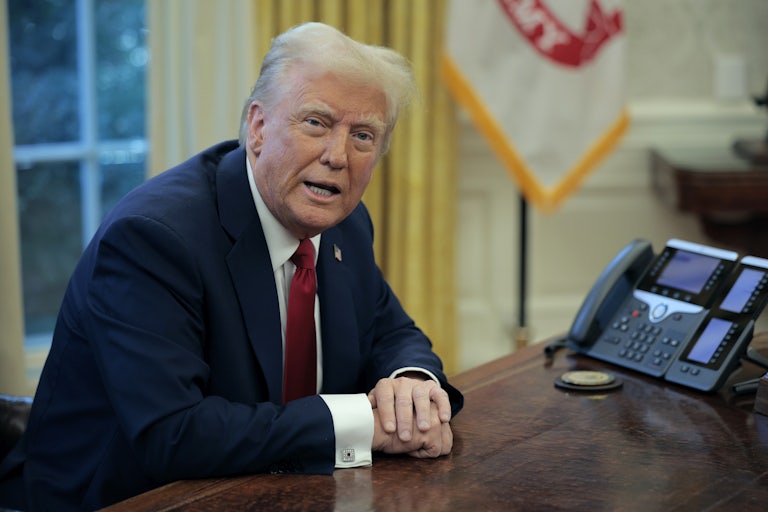
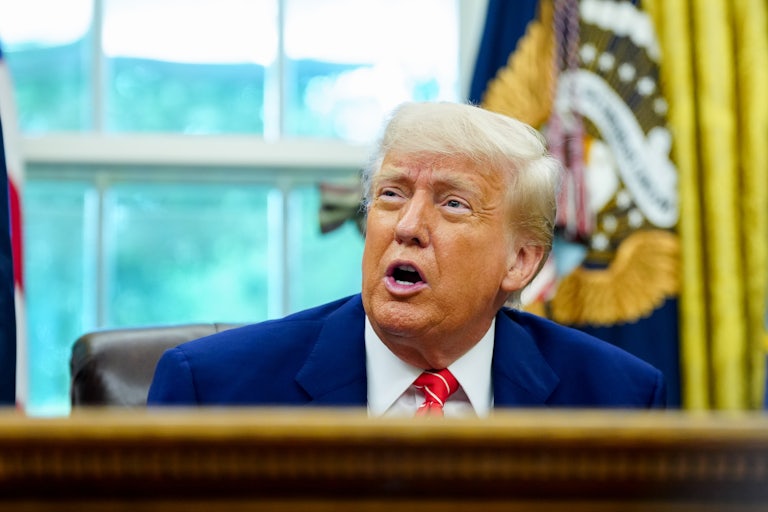
Donald Trump speaks while sitting at his desk in the Oval Office
Bonnie Cash/UPI/Bloomberg/Getty Images

President Donald Trump said Thursday that it was “a good thing, not a bad thing” that he’d crippled the international economy, putting workers’ livelihoods in jeopardy.

During a press briefing in the Oval Office, Trump downplayed concerns over job security sparked by a significant drop in cargo volumes as a result of his sweeping tariff policy and ongoing trade negotiations with China.

One reporter said that traffic at U.S. ports “has really slowed, and now thousands of dockworkers and truck drivers are worried about their jobs,” before being interrupted by the president.

“That means we lose less money, you know? When I see that, that means we lose less money,” Trump replied. He claimed that China had been making “over a trillion, 1.1 trillion, in my opinion.”

“And frankly if we didn’t do business, we would have been better off,” Trump continued. “So, when you say it slowed down, that’s a good thing, not a bad thing.

Trumpian algebra dictates that shrinking trade with China may curtail the country’s trade deficit, but he doesn’t even know what a trade deficit is, let alone how big it is.

Unlike Trump’s enormous estimate, America’s trade deficit with China was just $295.4 billion in 2024. The president has previously claimed that the U.S. is losing $2 trillion a year on trade, but the country’s trade deficit with the rest of the world was $917.8 billion in 2024.

All of this comes back to Trump’s fundamental misunderstanding of economics. A deficit isn’t money lost but an indication that the U.S. has imported more goods and services than it exports. Economists say that having a trade deficit is not an inherently bad thing at all, because the U.S. simply can’t and shouldn’t make everything.

Trump’s continued insistence we’ve been taken for a ride betrays a fundamental misunderstanding of economics, built off a dislike of other countries. Crucially, when he says that the U.S. would be “better off” if they hadn’t done business with China, what he actually means is that China would be worse off, which to him is the same thing.

But what gets lost in Trump’s phony economic model? Actual workers, whose jobs at U.S. ports undoubtedly will be affected by a sudden reduction in trade.

In Seattle, port commissioner Ryan Calkins told CNN Wednesday night that there were “no container ships at berth.”

“That happens every once in a while at normal times, but it’s pretty rare,” Calkin said. “And so to see it tonight is I think a stark reminder that the impacts of the tariffs have real implications.”

Ports in Los Angeles and Long Beach, California, have already seen a 44 percent drop in docked vessels from the same time last year, according to NBC4 News.

Trump also has no concern for consumers, who soon will begin to see shortages on goods from other countries, and an inevitable price increase on the scant products that remain. The president has suggested that concerns over shortages are as trivial as having fewer dolls and pencils.

Read more about Trump’s thoughts on shortages:

Trump’s FBI Director Grilled on What He Thinks Fifth Amendment Says

Kash Patel has quite the interpretation of “due process.”

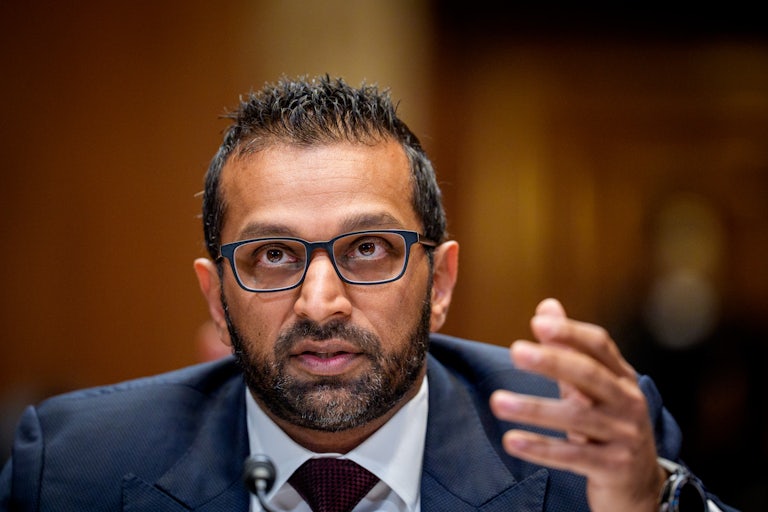
Kash Patel holds out his hand while speaking before Congress
Andrew Harnik/Getty Images

FBI Director Kash Patel seems to be interpreting the Fifth Amendment to the Constitution how he sees fit, contradicting legal precedent. 

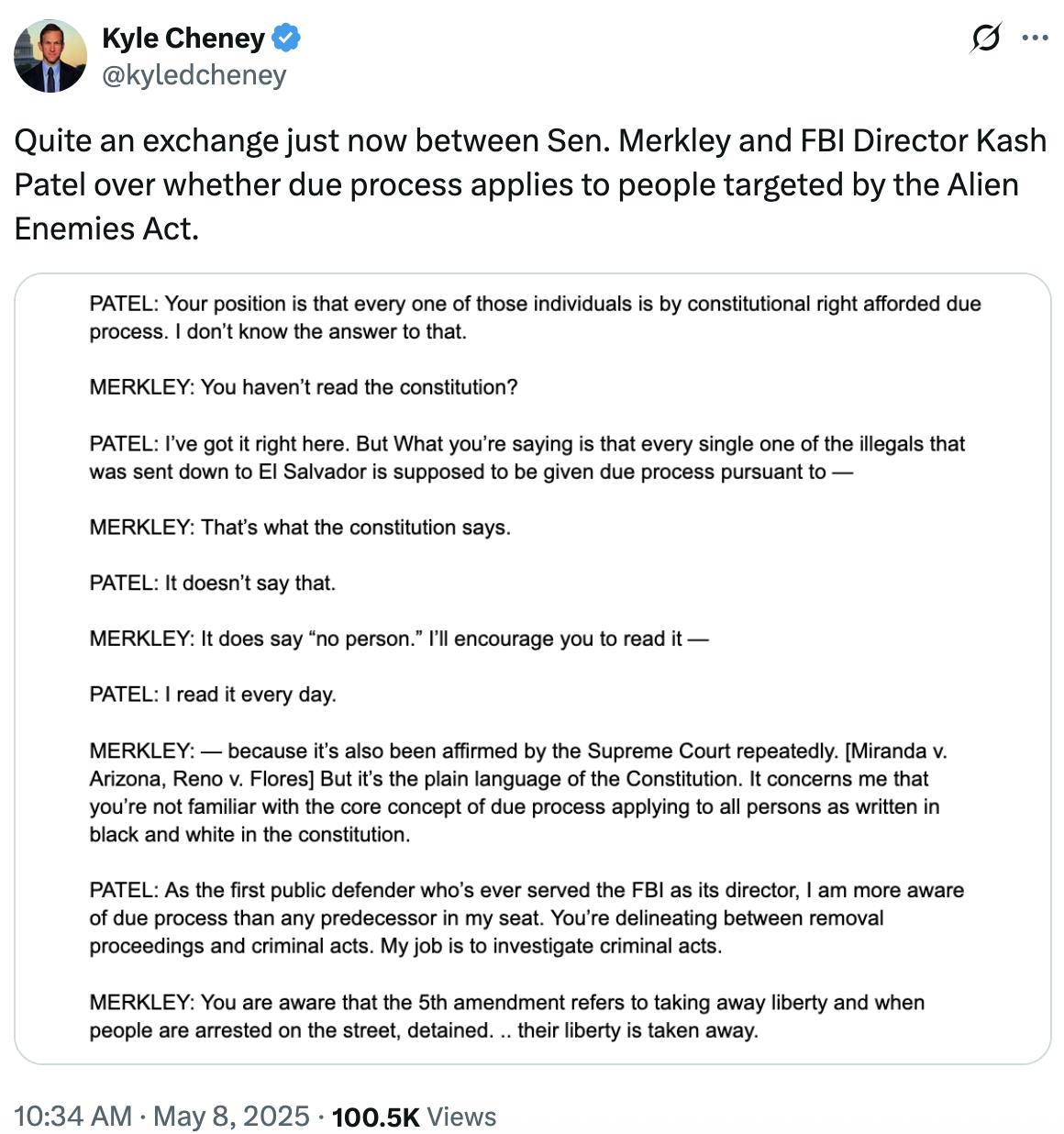
At a Senate hearing Thursday, Patel was asked by Senator Jeff Merkley if people deported under the Alien Enemies Act of 1798 had the constitutional right to due process, which the Trump administration claims is not the case. 

“Are you gonna launch an investigation of the reported violation of the due process of several hundred individuals?” Merkley asked Patel. The FBI director’s answer was not comforting, as he began by saying, “It’s not for me to call the balls and strikes on it.”  

“Your position is that every one of those individuals is by constitutional right afforded due process. I don’t know the answer to that,” Patel replied, before questioning whether immigrants sent to El Salvador were afforded due process. 

Transcript of exchange between Patel and Merkkley

“You haven’t read the Constitution? It says ‘all persons,’” Merkley said, adding that “it concerns me you’re not familiar with the core concept of due process applying to all persons.”  

Patel was evasive on whether he would enforce the law against other agencies found to be violating the Fifth Amendment to the Constitution, claiming that no government agencies were doing so and the Supreme Court had not ruled to that effect. 

Patel’s stance shows that the Trump administration is interpreting the law, and even federal court rulings that are supposed to be binding, to serve its own mass deportation agenda. Already, the administration continues to defy a Supreme Court ruling urging the return of Maryland resident Kilmar Abrego Garcia from El Salvador, where he was mistakenly deported in March. 

As a Trump appointee with very little law enforcement experience, it’s not surprising that Patel is pushing legal limits, and probably crossing them, to defend Trump expelling as many people from the United States as possible. It’s funny that Patel sees this as his job as head of the FBI, even as he isn’t living up to many of his other responsibilities.

Unfortunately more on this man:

John Roberts Sends Pathetic Message to Trump on Takeover of Courts

The chief Supreme Court justice only lightly pushed back on Donald Trump’s efforts to control the judiciary.

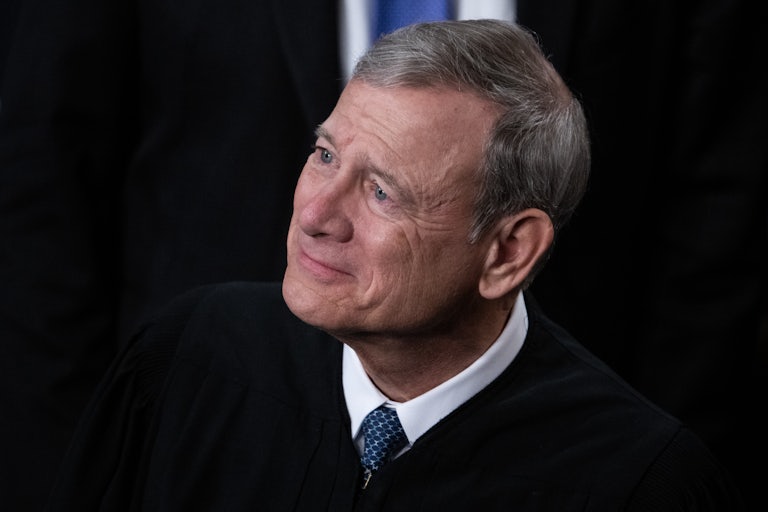
Chief Justice John Roberts looks up while attending Donald Trump’s address to Congress
Tom Williams/CQ-Roll Call, Inc/Getty Images

Chief Justice John Roberts offered a gentle rebuke of Donald Trump’s escalating attacks on the judiciary. 

During a fireside chat Wednesday night marking the twenty-fifth anniversary of the U.S. District Court for the Western District of New York in Buffalo, Roberts emphasized the importance of judicial independence. 

“In our Constitution, judges and the judiciary is a coequal branch of government separate from the others with the authority to interpret the constitution as law, and strike down, obviously, acts of Congress or acts of the president,” Roberts said. “And that innovation doesn’t work if the judiciary is not independent.

“Its job is to, obviously, decide cases, but in the course of that, check the excesses of Congress or of the executive, and that does require a degree of independence,” he said.

The chief justice’s impartial recounting of the nation’s founding document flies in the face of the Trump administration’s efforts to sidestep the checks and balances provided by the judiciary. 

Roberts also doubled down on his rare public criticism of Trump, after the president called to impeach a federal judge who ruled against his illegal deportations under the Alien Enemies Act. 

“Well, I’ve already spoken to that, and impeachment is not how you register disagreement with decisions,” Roberts said

But Roberts’s mild criticism may not be enough, as the administration has escalated into making direct threats. When announcing his inane plan to reopen Alcatraz Sunday, Trump listed “judges that are afraid to do their job and allow us to remove criminals” alongside the “criminals” and “thugs” he hoped to imprison there. 

Josh Gerstein, a senior legal affairs reporter at Politico, suggested that there may be a method to Roberts’s missing madness. 

“Subdued Roberts seemed to be keeping his powder dry since many of the big fights, like law firms, deportations, contempt, are making their way to the court or already there,” Gerstein wrote on X Thursday.  “A reasonable strategy, but that’s not some rousing defense of the judiciary or separation of powers.”

Gerstein noted that Roberts’s “‘judicial independence’ stuff” was “thinner” than his 2024 Year End report on the federal judiciary, which had compared political bias to doxxing and disinformation as some of the “illegitimate activity” that threatens independent judges. At the time, his comments seemed to echo Trump’s complaints about critics who went after judges that ruled in his favor. Now the Trump administration has taken to attacking so-called “activist” judges who rule against him. 

Roberts’s refute is comparatively limp when held beside Justice Ketanji Brown Jackson’s recent indictment of the right-wing campaign of threats being used to intimidate judges.

“The threats and harassment are attacks on our democracy, on our system of government. And they ultimately risk undermining our Constitution and the rule of law,” Jackson said last week.

Read more about Trump’s attempts:

Trump Admits He’s Wildly Exaggerating Benefits of U.K. Trade Deal

Trump’s trade deal with the United Kingdom isn’t even official yet.

Donald Trump speaking at his desk in the Oval Office of the White House.
Chip Somodevilla/Getty Images

Trump had a press conference Thursday to explain to everyone that the beautiful, spectacular trade deal that he’s made with Britain is actually unfinished.

“The final details are being written up in the coming weeks; we’ll have it all very conclusive, but the actual deal is a conclusive one,” Trump said to reporters with British Prime Minister Keir Starmer on the other line. “We think just about everything has been approved, so good for both countries.”

While details remain extremely unclear, this “deal” is said to include greater market access and mutually lowered tariffs.

Trump taking a victory lap for an unfinished, undefined deal immediately raised eyebrows.

“Why Britain? And why now? … You’ve described this deal as a full and comprehensive deal, and yet … clearly, there’s much more work left to do,” said James Matthews of Sky News. “With respect, are you overstating the reach and significance of this deal, because you’re a president who needs a result at a difficult time?”

Trump proceeded to ramble, almost completely avoiding Matthews’s question.

“I think that it’s a great deal for both parties.… It opens up a tremendous market for us. It works out very well, very well. A lot of assets, you see the chart. Those are tremendous assets. But we’ve been trying, and when you say, ‘Why us?’ meaning your country; we’ve been trying for years, and they’ve been trying for years to make a deal.… This is a maxed-out deal, not like you said it, really incorrectly. This is a maxed-out deal that we’re gonna make bigger. And we’ll make it bigger through growth.”

The framework of the deal that has been announced would reduce U.S. tariffs on steel and aluminum imports to 0 percent and reduce auto tariffs to 10 percent, while leaving in a baseline 10 percent tariffs on all other products. Trump also bragged about greater market access in the United Kingdom for American beef, before being reminded by a reporter that the U.K. doesn’t accept American beef because of its higher food standards.