Breaking News
Breaking News
from Washington and beyond

Trump Fails Basic Math Problem in His Own Drug Prices Executive Order

Donald Trump made some wild claims about how much he’s about to bring down drug costs.

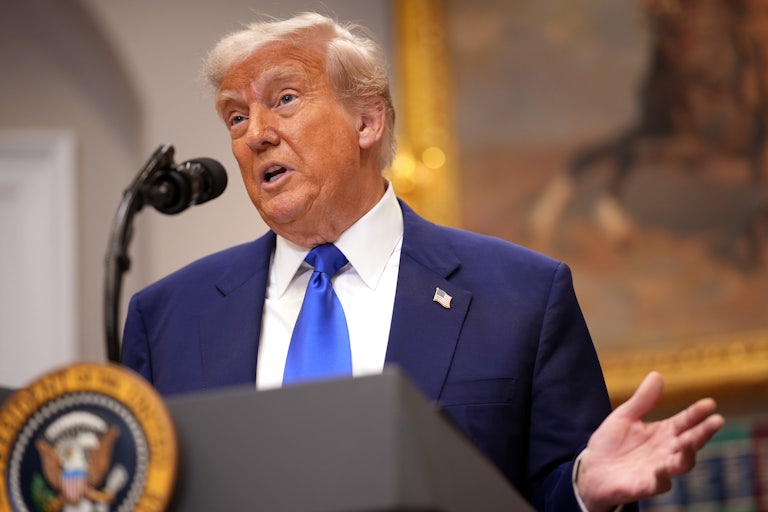
Donald Trump holds his arms out to the side while speaking at a podium in the Oval Office. He is flanked by Mehmet Oz and Marty Makary.
Jim Watson/AFP/Getty Images

Does Donald Trump know the details of his own executive order to reduce the price of pharmaceuticals?

During an address from the White House Monday morning, the president stumbled over the terms of his latest executive order, which set a 30-day deadline for drugmakers to negotiate lower prices in the U.S.

“Drug prices will come down by, much more really if you think—59, if you think of sometimes a drug that is 10 times more expensive, it’s much more than the 59 percent. You know, it depends on the way you want to analyze it, but in one way you could analyze it that way,” Trump said. “But between 59 and 80, and I guess even 90 percent.”

Trump insisted that the prices would be slashed by a far more significant rate than the cut he pushed in his first term. “Well, we’re getting them down 60, 70, 80, 90 percent—but actually more than that if you think about it in a way, mathematically,” he added.

Trump got one thing right: It’s entirely unclear how much prices will be reduced. If pharmaceutical companies fail to strike a deal to lower prices, then the U.S. will tie its drug prices to those paid by other countries. But as of now, nothing has changed.

This is far from the first time the president has struggled trying to explain a policy idea. Last week, the president rambled incoherently when asked to explain why he wanted to reopen Alcatraz.
Trump Tries Totally Bogus Defense on Qatar Private Jet Gift

Donald Trump’s defense for accepting a $400 million private jet from Qatar is that Ronald Reagan did the same thing. Here’s the truth.

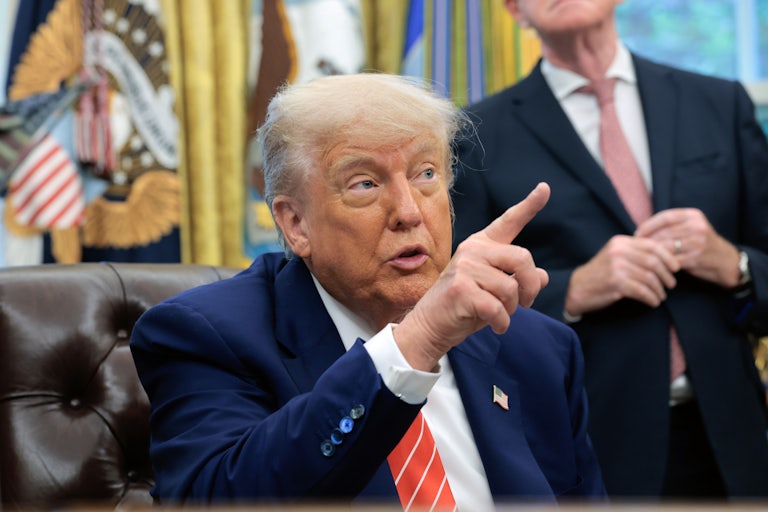
Donald Trump points at something or someone off camera, while speaking and sitting at his desk in the Oval Office of the White House.
Anna Moneymaker/Getty Images

Donald Trump is trying to claim Qatar’s luxury plane “gift” to him isn’t a big deal because Ronald Reagan did the same thing. 

“I think this was just a gesture of good faith, and, uh, I don’t get it,” Trump told reporters Monday at the White House regarding backlash over what suspiciously looks like a bribe. 

“Someday, it’ll be like Ronald Reagan, they decommission them, you know, they get to a certain age, they decommission ’em. It’ll go to my library. They’re talking about going to my library in years out,” Trump added, saying that he wouldn’t be using the jet after he leaves office. 

There is an Air Force One jet at the Ronald Reagan Presidential Library and Museum in Simi Valley, California. But it was used by seven presidents from 1973 to 2001 before being donated to the library in 2004. Reagan left office in 1989 after two terms as president, and passed away two months before the plane arrived at his library. 

When does Trump plan to receive the jet, and when does he plan to have it “decommissioned” and sent to his future presidential library, wherever that may be? The plane gift is not only receiving criticism from Democrats and Trump’s usual critics but even his far-right allies, as a foreign government making such a large donation smacks of corruption. It also isn’t a good look for the primary mode of transportation 
of the president of the United States to come from a foreign country, given potential surveillance concerns.  

No matter how much Trump tries to deflect, receiving a luxury plane from Qatar looks very much like a bribe, especially since the Trump family business struck a deal late last month to build a luxury golf resort in Qatar. But Trump hasn’t shied away from unethical behavior in his second term, especially when there’s money involved.

New Pope Delivers Speech That Sure Seems Like Shade at Trump

Pope Leo XIV praised journalists seeking the truth in polarizing times.

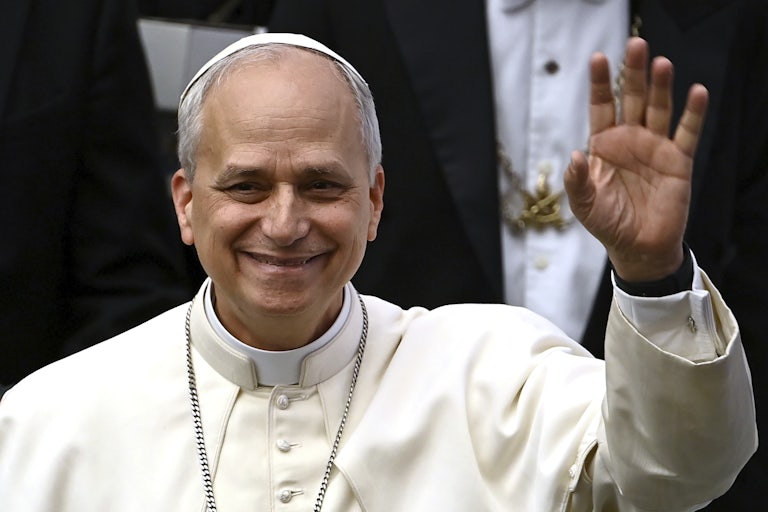
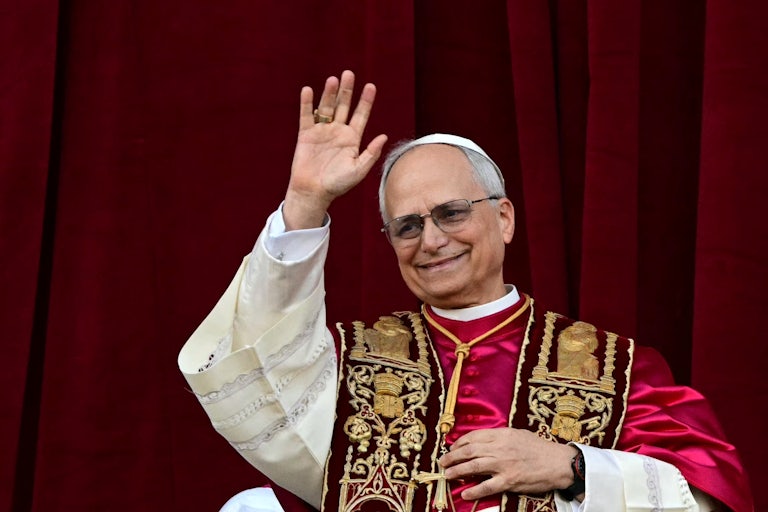
Pope Leo XIV waves to a crowd (not pictured) while standing on the main central loggia balcony of the St Peter's Basilica for the first time. A red curtain is behind him.
TIZIANA FABI/AFP/Getty Images

Pope Leo XIV is calling for an end to the “war of words,” and for the world to stand with journalists seeking truth.

The newly minted pope directly addressed journalists in Italian at a press conference at the Vatican on Monday, making an appeal for kindness, truth, and journalistic freedom.

“The way we communicate is of fundamental importance: We must say ‘no’ to the war of words and images, we must reject the paradigm of war,” he said. “Let us disarm communication of all prejudice and resentment, fanaticism, and even hatred; let us free it from aggression. We do not need loud, forceful communication, but rather communication that is capable of listening and of gathering the voices of the weak who have no voice.”

Pope Leo also raised support for journalists jailed or reporting from war zones.

“The Church recognizes these witnesses—I am thinking of those who report on war even at the cost of their lives—the courage of those who defend dignity, justice, and the right of people to be informed, because only informed individuals can make free choices,” he said.

According to Reporters Without Borders, at least 550 journalists are being detained across the world. Around 160 Palestinian journalists have been killed by Israel in Gaza.

The speech may catch Trump and JD Vance’s attention, especially given news last week that the pope doesn’t seem to be a huge fan of the two.

This statement is yet another example of Pope Leo setting the tone, leaning into the Catholic social justice that his predecessor, Pope Francis, was known for. Leo has also called for a ceasefire in Gaza and an end to Israel’s blockade on humanitarian aid to the territory.

Trump’s Drug Prices Executive Order Is a Big Pile of Nothing

Donald Trump has tried something like this once before—and failed.

Donald Trump gestures while speaking at a podium in the Oval Office
Andrew Harnik/Getty Images

Donald Trump is resurrecting one of his controversial first-term policies to supposedly hack prescription drug prices—but the whole effort is such a nothingburger that he very nearly forgot to sign the executive order enacting it.

“Starting today the United States will no longer subsidize the health care of other countries, that’s what we were doing,” Trump said at a White House press conference Monday, referring to the European Union. He then claimed that low drug prices outside the U.S. were because the federal government had been financially offsetting would-be high prices in other countries.

But that’s detached from reality—the U.S. pays more for drugs because it’s an outlier among high-income, first world countries, which predominantly support universal public health coverage.

Trump’s first-term rule—“Most Favored Nation”—was focused on lowering the cost of Medicare payments on certain drugs, but it barely made it out of the White House. The policy was blocked by federal courts shortly after it was announced in late 2020, and was then rescinded by President Joe Biden in 2021.

This time around, Trump’s order sets a 30-day deadline for drugmakers to negotiate lower prices. If there is no deal, then the U.S. will tie its drug prices to those paid by other countries. But as of now, nothing has changed.

Trump reiterated that the U.S. would no longer “subsidize” drug prices in other countries, telling reporters that the “game is up,” while alluding to potentially increasing auto tariffs if they don’t comply.

“If they want to get cute, they don’t have to sell cars into the United States anymore. They won’t get cute,” Trump said. “I’ll defend the drug companies from that standpoint.”

He was also characteristically vague on how much prices would change.

“Drug prices will come down by much more really if you think,” Trump said. “But between 59 and 80 and I guess even 90 percent.”

“We’re getting them down 60, 70, 80, 90 percent. But actually more than that if you think about it in a way, mathematically.”

Other things that researchers point to as potentially resolving high drug prices in the U.S. include restricting pharmaceutical monopolies within the country, reworking insurance benefits to restrict out-of-pocket costs, and recentralizing price negotiations through the leverage of a single-payer system (like those of Australia, Germany, the U.K., or any number of other wealthy nations), according to a report by the Commonwealth Fund, a private American foundation focused on health care reform.

But none of that was on Trump’s radar. Instead, the president took time out of his morning to deride Obamacare, which (as of 2024) provided public health insurance to some 45 million Americans. Trump, however, claimed that it “doesn’t work.”

Vermont Senator Bernie Sanders, who ran for president on a “Medicare for all” platform in 2016, released a statement agreeing with Trump. But he flipped the president’s script slightly, arguing that the problem with drug pricing is not that foreign nations pay too little, but rather that American citizens pay far too much. Sanders also warned Trump’s efforts are doomed to fail.

“Further, as Trump well knows, his executive order will be thrown out by the courts,” Sanders wrote in a press release. “If Trump is serious about making real change rather than just issuing a press release, he will support legislation I will soon be introducing to make sure we pay no more for prescription drugs than people in other major countries.”

“If Republicans and Democrats come together on this legislation, we can get it passed in a few weeks,” Sanders said.

In a post on Truth Social Sunday, Trump pledged that the initiative would save the government trillions of dollars and falsely claimed that Democrats had stood in the way of this kind of pharmaceutical reform, ignoring the fact that health care and pharmacy drug reform has been a pillar of the progressive platform in recent years (see: Representative Alexandria Ocasio-Cortez’s “Medicare for All” 2021 revival, which would have created a single-payer system in this country).

“Campaign Contributions can do wonders, but not with me, and not with the Republican Party. We are going to do the right thing, something that the Democrats have fought for many years,” Trump wrote.

But in 2006, Republicans were the ones who adamantly stood in the way of federal drug-price negotiations, ripping the teeth out of a bill that would have mandated drug companies to negotiate lower drug prices with Medicare officials.

“Instead of actually tackling the issues that concern average American families, the Republicans have passed legislation to help their wealthy friends and the huge corporations that support their campaigns,” said former North Carolina Representative G.K. Butterfield at the time before the measure passed.

This story has been updated.

Did Trump Just Try to Take Credit for the New Pope?

Pope Leo XIV is the first American pope in history. Donald Trump apparently thinks that’s his own doing.

Pope Leo XIV waves while standing in the Vatican
Isabella Bonotto/Anadolu/Getty Images

Donald Trump is trying to take credit for the selection of the first American pope—who doesn’t seem to like him all that much.

In a post on Truth Social Sunday, the president claimed that ABC News’s chief global affairs correspondent Martha Raddatz had suggested that he’d had absolutely nothing to do with the selection of Chicago-born Cardinal Robert Prevost to be the next leader of the Catholic church.

“So funny to watch old timer Martha Raditz on ABC Fake News (the Slopadopolus show!) this morning, blurt out that, effectively, Pope Leo’s selection had nothing to do with Donald Trump,” the president wrote. “It came out of nowhere, but it was on her Trump Deranged Mind.

“Remember, I did WIN the Catholic Vote, by a lot!” Trump added.

Trump appeared to be reacting to a Sunday roundtable on This Week (formerly hosted by George Stephanopoulos but now hosted by Raddatz), where ABC News senior national correspondent Terry Moran said that, according to Vatican insiders, Trump hadn’t been a factor in the cardinals’ decision.

“The question that we had was, ‘How much did the American moment with President Trump matter?’” Moran asked. “They’re telling us not at all. It was [Prevost] that mattered.”

“That’s what we’ve been hearing this morning. It was him,” Raddatz replied.

It’s also possible that Trump’s presidency did have some effect on the selection of Pope Leo—but maybe not in the way he imagines.

Cardinal Robert Barron, bishop of the Diocese of Winona–Rochester in Minnesota who traveled to Rome for the papal conclave, relayed the words of Cardinal Francis George, the former American prelate, to CBS News right after Leo’s election last week.

“Cardinal George of Chicago, of happy memory, was one of my great mentors, and he said: ‘Look, until America goes into political decline, there won’t be an American pope,’” Barron recounted.

“And his point was, if America is kind of running the world politically, culturally, economically, they don’t want America running the world religiously. So I think there’s some truth to that, that we’re such a superpower and so dominant, they don’t wanna give us, also, control over the church,” he added.