Breaking News
Breaking News
from Washington and beyond

Elon Musk Gives Strange Excuse for Massive Black Eye

Musk showed up a press conference with Donald Trump sporting a noticeable shiner.

Elon Musk purses his lips while wearing a DOGE cap.
Kevin Dietsch/Getty Images

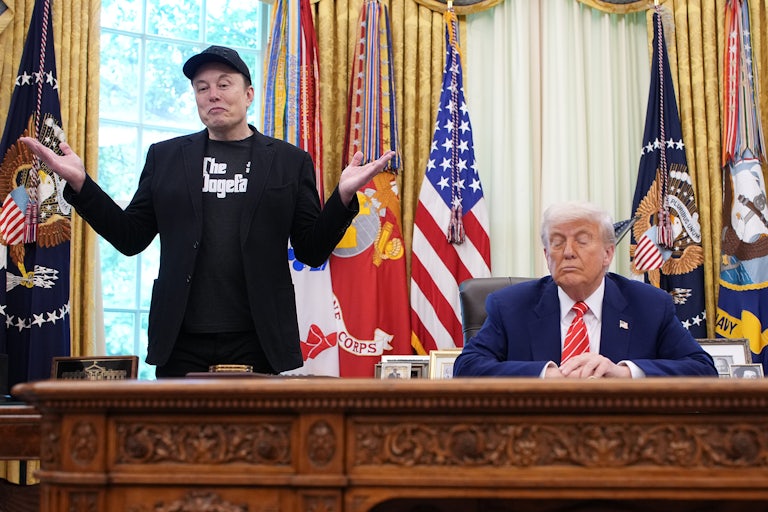
Elon Musk sported what looked like a black eye during his DOGE goodbye press conference with President Trump on Friday. When asked about it, he blamed the bruise on his 5-year-old son punching him in the face.

“Mr. Musk … is your eye OK? What happened to your eye; I noticed there’s a bruise there?” one reporter finally asked near the end of the press conference.

“Well, I wasn’t anywhere near France,” Musk said, in a weak attempt at a joke regarding footage of French President Emmanuel Macron’s wife slapping him in the face.

“I was just horsing around with [my son] little X and said, ‘Go ’head and punch me in the face,’ and he did. Turns out even a 5-year-old punching you in the face actually does—”

“That was X that did it? X could do it!” Trump chimed in. “If you knew X …”

“I didn’t really feel much at the time; I guess it bruises up. But I was just messing around with the kids.”

Musk chose an impeccable time to show up to a press conference with a black eye. Earlier in the day, The New York Times reported on Musk’s rampant drug use on and off the campaign trail, as the world’s richest man frequently mixed ketamine and psychedelics and kept a small box of pills, mostly containing Adderall. The shiner only adds to speculation around his personal habits.

Trump and Elon Musk Have Ominous Warning About Future of DOGE

Elon Musk’s time as a government employee has come to an end, but his time with Donald Trump has not.

Elon Musk shrugs while standing next to Donald Trump, who sits at his desk in the Oval Office
Kevin Dietsch/Getty Images

Despite the fanfare over Elon Musk’s supposed departure from the Department of Government Efficiency, Donald Trump says that the billionaire bureaucrat isn’t really going anywhere.

“Many of the DOGE people are staying behind, so they’re not leaving. And Elon’s not really leaving. He’s gonna be back and forth, I think. I have a feeling. It’s his baby, and he’s gonna be doing a lot of things,” Trump said during a press conference in the Oval Office Friday.

The press conference was held to mark the end of Musk’s time as a so-called “special government employee,” a title that allowed him to bypass certain ethics requirements during his 134-day stint in Trump’s administration.

The president made sure to give Musk a gaudy golden key—what it actually unlocks went totally unaddressed—to make sure he could get back into the White House.

“This is not the end of DOGE, but really the beginning,” Musk said, promising that DOGE’s “influence” would “only grow stronger” over time.

Earlier Friday, the billionaire bureaucrat shared a post on X asserting that the legacy of DOGE was more psychological than anything else. Surely, it will take longer than four months to forget the image of Musk running around with a chainsaw.

Dem Governor Vetoes Ban on Surprise Ambulance Bills in Shocking Move

The bill had unanimous support in both chambers of the state legislature.

Colorado Governor Jay Polis
Michael Ciaglo/Getty Images

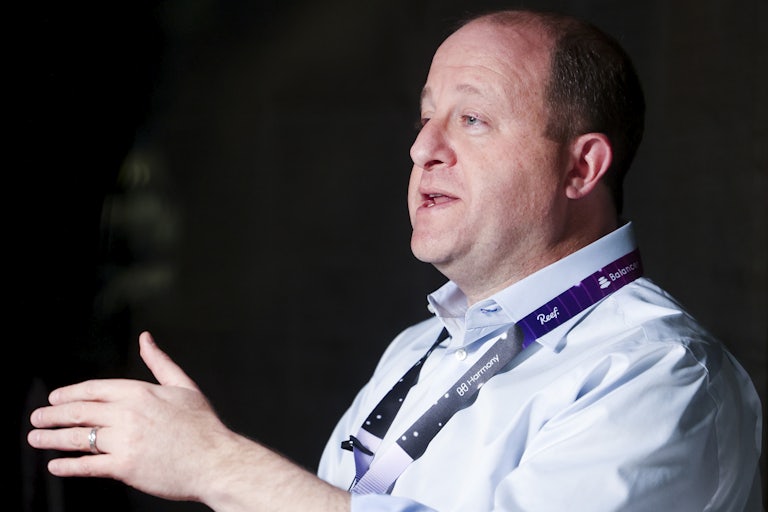
Colorado’s Democratic Governor Jared Polis has vetoed a bill that would ban surprise billing by ambulance companies, over the unanimous objections of both chambers of the state legislature. 

Why would Polis veto a bill that’s popular with everyone, even Colorado Republicans? The governor wrote in his veto statement that drafting errors in the bill made it “unimplementable” and estimated that it would make insurance premiums go up by as much as $0.73 to $2.15 per person. 

“I am committed to working with proponents and sponsors to protect Coloradans from surprise bills, but I encourage all parties to work towards a more reasonable reimbursement rate that mitigates premium impacts and nets a better deal for Colorado families,” Polis wrote. 

In Colorado, if legislators in both chambers repass the bill with a two-thirds majority, they can override the governor’s veto, especially considering that the bill passed with the support of every single legislator. But the legislature adjourned on May 7, meaning that the bill has to be passed again when the legislature reconvenes in January.  

For some reason, ending surprise ambulance billing nationally is not the slam-dunk issue it should be. Congress ended most surprise medical bills in 2020 but exempted ground ambulances from the bill. Was Polis’s veto due to badly drafted language and a (seemingly modest) price hike in insurance premiums, as he said, or was it for a different, more nefarious reason? We might not know unless and until the bill is reintroduced next year.

Trump’s Pardons Since Jan 6 Spree Show an Infuriatingly Corrupt Trend

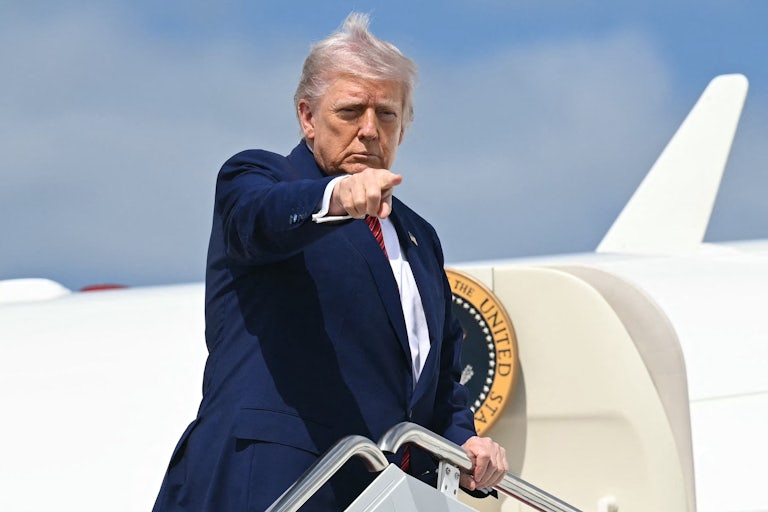
Since his January 6 pardon spree, Donald Trump has tended to grant clemency a little closer to home.

Donald Trump points while boarding Air Force One
Saul Loeb/AFP/Getty Images

A good chunk of the white-collar criminals pardoned by Donald Trump after his massive “Day One” pardoning spree either have a political or financial tie to him.

The president has issued 60 pardons since he offered political forgiveness to some 1,600 individuals charged in the January 6, 2021, attack on the U.S. Capitol. But out of those subsequent 60 unrelated to the attack, 12 people—or roughly one in five—were already in Trump’s orbit, according to ABC News.

They included several politicos, including former Illinois Governor Rod Blagojevich, who was convicted on several counts of corruption, including for an attempt to sell Barack Obama’s Senate seat after he left the position for the White House; former Republican Representative Michael Grimm, who pleaded guilty to tax fraud; former Nevada gubernatorial candidate Michele Fiore, who allegedly stole public funds intended to commemorate a slain police officer; and former Tennessee state Senator Brian Kelsey, who pleaded guilty to campaign finance fraud in 2022.

Trump also pardoned major financiers of his presidential campaigns. Trevor Milton, the founder of the Nikola electric vehicle company, donated nearly $2 million toward Trump’s 2024 campaign. Imaad Zuberi, who has donated to both parties, issued “at least $800,000 to committees associated with Trump and the Republican Party,” ABC reported.

Others helped Trump advance his retribution campaign against his political enemies, or helped advance his own image in the broader Republican Party. Devon Archer and Jason Galanis, both former business partners of Hunter Biden, accused the younger Biden of leveraging his father’s name and influence in order to conduct business overseas. Archer had defrauded a Native American tribal entity, while Galanis was serving time for multiple offenses.

Trump also forgave Todd and Julie Chrisley—reality TV stars known for their show Chrisley Knows Best who were sentenced to a combined 19 years on fraud and tax evasion charges—after their daughter Savannah Chrisley spoke at the 2024 Republican National Convention.

Speaking to press Friday after her parents’ release, Savannah Chrisley said that the “biggest misconception right now is I either paid for a pardon or slept for a pardon—,” but she couldn’t finish her sentence before Todd interjected: “That’s something I would have done,” he said.

Trump Knew He Was Deporting Innocent People to El Salvador All Along

Many of the people deported to El Salvador have no criminal record, and Donald Trump knew it.

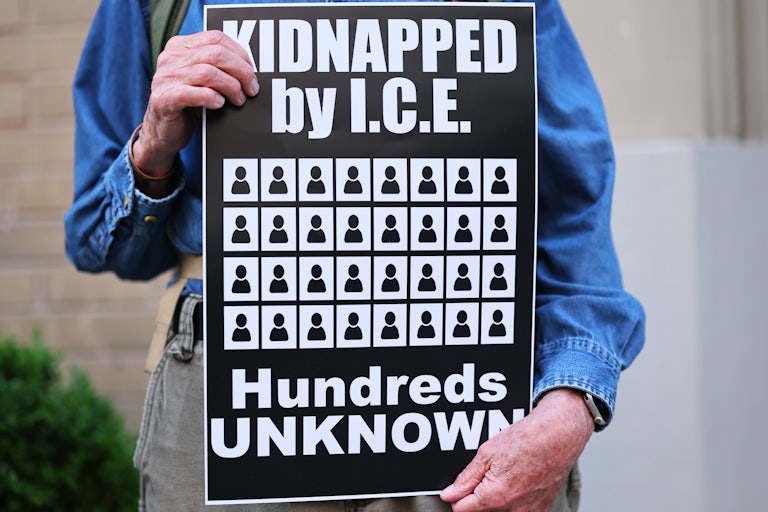
A person holds a sign that says, "Kidnapped by ICE. Hundreds unknown" at a rally protesting against Donald Trump's deportations
Michael M. Santiago/Getty Images

Donald Trump’s administration was well aware that many of the 238 Venezuelan immigrants it shipped off to a notorious megaprison in El Salvador had no criminal records at all, according to a Friday report from ProPublica.  

While Trump officials claimed that the deportees were brutal gang members and “the worst of the worst,” only 32 of the deportees had actually been convicted of crimes, and most of them were minor offenses such as traffic violations, according to data from the Department of Homeland Security reviewed by ProPublica, The Texas Tribune, and a team of journalists from Venezuelan media outlets. One of the men, 23-year-old Maikol Gabriel López Lizano, faced a misdemeanor charge after he was arrested in 2023 for riding his bike and drinking a can of beer.

Little more than half of the deportees, 130 of the 238, were charged only with violating U.S. immigration laws. Twenty of them had criminal records from other countries. The U.S. government data showed that 67 individuals had pending charges, with only six being for violent crimes. 

In several cases, the government data about the pending charges differed from what ProPublica was able to find. In some cases, the men had actually been convicted, and in one, the charges had been dropped. 

But in many cases, these individuals were remanded to a foreign prison before their criminal cases were ever resolved. 

The Trump administration has touted allegations of gang affiliation as a justification for denying the deportees their due process rights. But none of the men’s names appeared on a list of roughly 1,400 alleged Tren de Aragua members kept by the Venezuelan government, ProPublica reported. 

Trump’s border czar Tom Homan tried desperately in March to downplay reporting that many of these individuals did not have criminal records. “A lot of gang members don’t have criminal histories, just like a lot of terrorists in this world, they’re not in any terrorist databases, right?” Homan said on ABC News. But the methods the government relies on to classify individuals as gang members—such as identification of gang-affiliated tattoos—have been disproven by experts. 

Not only were many of the men who were deported not proven gang members, they weren’t even criminals, and by denying them the right to due process, they were remanded to a foreign prison notorious for human rights abuses without ever getting to prove it. 

Trump has continued to pressure the Supreme Court to allow him to sidestep due process as part of his massive deportation campaign, claiming that the judiciary has no right to intrude on matters of “foreign policy.” But immigrants residing on U.S. soil—who are clearly not the bloodthirsty criminals the administration insists they are—are still subject to protections under U.S. law.