Breaking News
Breaking News
from Washington and beyond

Does Trump Even Know What’s in His Big Beautiful Bill?

At an event on Thursday, the president touted “no taxes” on Social Security. The bill actually does the opposite.

Donald Trump smiles as he walks into a doorway
Chip Somodevilla/Getty Images

President Trump promised “no taxes” on Social Security in his stump speech for his One Big Beautiful Bill Act. The bill contains the exact opposite, and Trump’s approach to the Social Security Administration at large is only further damaging the floundering program.

“We will make the Trump tax cuts permanent, and expand the child tax credit, and deliver no tax on tips, no tax on overtime, and no tax on Social Security for our great seniors,” Trump said with a collection of working-class American citizens standing behind him.

It would do the president well to be transparent about taxes on Social Security and the impact they’ll have on the elderly, especially in relation to the most significant piece of legislation of his second term.

“They couldn’t remove tax on Social Security in reconciliation, so they added a short-term standard deduction boost for seniors,” David Dayen of The American Prospect wrote on X. “People on Social Security will not get the deduction (which starts at age 65) and people not on SS will get it.”

Tens of millions of people, including many of Trump’s supporters, rely on monthly retirement, survivor, and disability checks from the Social Security Administration. Not only is the SSA predicted to run out of money a year earlier than previously thought, Trump’s policies like mass deportation are crippling the workforce that is currently paying into the program.

Trump and Elon Musk have also spread unsubstantiated claims about rampant “waste, fraud, and abuse” within the SSA, and they’re still aiming to levy massive cuts to the program while raising the retirement age and reducing benefits for high earners.

Only time will tell how much Trump’s “for the people” schtick will resonate with his supporters, especially when the current iteration of Trump’s bill further endangers the SSA while giving them nothing but crumbs.
Cognitive Decline? Trump Rambles About Paper Clip During Speech

“Somebody came up with the idea of the paper clip many years ago. 1817.” It was, in fact, much later.

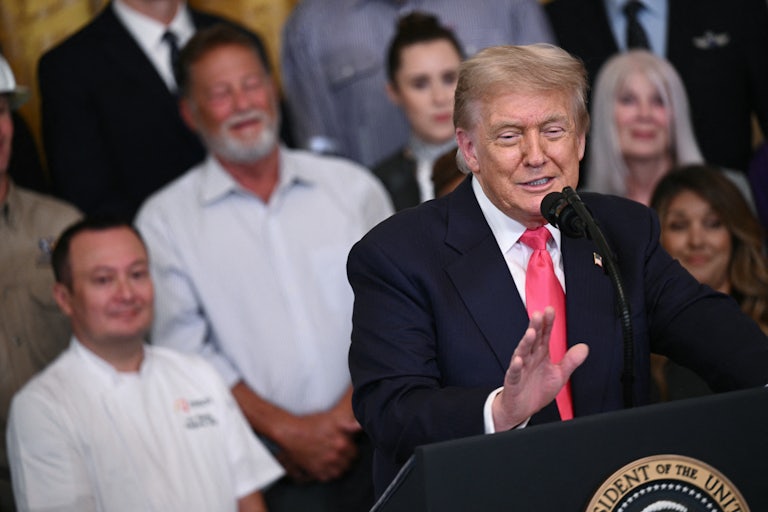
Trump stands behind a lectern and in front of an audience and holds out a hand while he speaks. He's grinning
BRENDAN SMIALOWSKI/AFP/Getty Images
Donald Trump at the One Big Beautiful Event on Thursday

During Donald Trump’s “One Big Beautiful Event,” an attempt by the president to win over holdouts in the Senate and push through his tax and spending plan, his remarks meandered briefly into an alternate history of the paper clip.

Trump’s speech touted the bill, in typical Trump fashion, as “one of the most important pieces of legislation in the history of our country.”

It also briefly touched on one provision that would make interest on auto loans for American-made cars tax deductible, an idea Trump suggested he thought up himself—and which, MarketWatch reports, “you probably won’t notice … once you factor in tariffs.”

“What a great idea,” Trump said “people” told him. “It’s like the paper clip.” Trump used the same analogy when announcing the proposal in October 2024.

Here, the 79-year-old president strayed from his monotonously delivered prepared remarks to edify us with a made-up factoid: “Somebody came up with the idea of the paper clip many years ago. 1817. And he became a very rich person, and everybody looked at it and said, ‘Why the hell didn’t I think of that?’”

Trump’s guess was a little bit off, as paper clips didn’t appear in their familiar modern form until around 1892, and the invention was never patented, according to Scientific American.

But a more significant falsehood followed, as Trump went on to claim that his supposedly automaker-friendly policies accounted for his past electoral successes in Michigan, falsely stating, “I actually think we won it three times in a row” because of them. Trump lost Michigan in 2020 against Joe Biden by more than 150,000 votes.

The Trump Administration Wants to Deny Kilmar Abrego Garcia a Trial

The administration is seeking to deport him before he can potentially embarrass them in court.

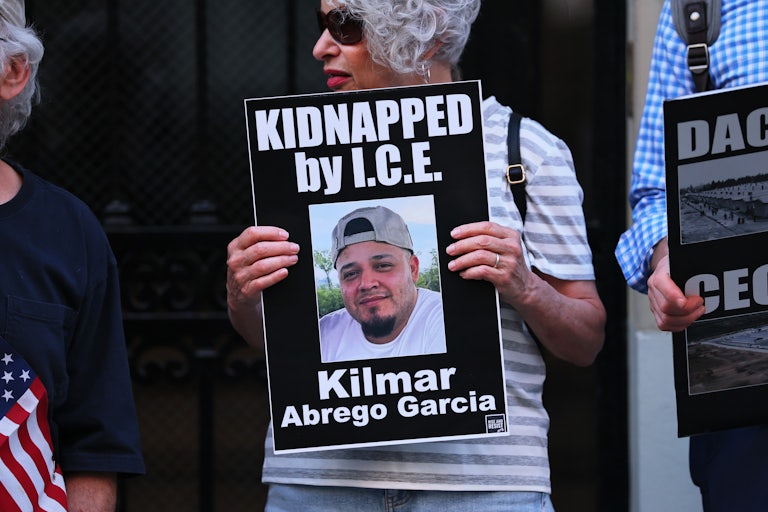
A woman wholds a sign reading "Kidnapped: Kilmar Abrego Garcia" with a picture of Garcia wearing a baseball hat
Michael M. Santiago/Getty Images
A protester demands the release of Kilmar Abrego Garcia, who was mistakenly deported to El Salvador earlier this year.

The Trump administration is once again planning to deport Kilmar Abrego Garcia, this time as he waits in custody for the trial for his first wrongful deportation. This comes as its efforts to criminally prosecute him for being a gang member and drug smuggler fizzle out in court.

This time the administration is looking to send Abrego Garcia to an “unnamed” third country before he gets to have the fair trial he deserves in the United States. Trump maintains that Abrego Garcia is a dangerous criminal, part of the notorious MS-13 gang. Abrego Garcia has vehemently denied this, and even federal judges are having a hard time believing that story.

“The government cannot simply rely on the general reputation of a particular street gang to satisfy its burden,” U.S. Magistrate Barbara D. Holmes wrote as she ordered Abrego Garcia released on bail. “The government’s evidence that Abrego is a member of MS-13 consists of general statements, all double hearsay.… The government’s evidence of Abrego’s alleged gang membership is simply insufficient.”

Abrego Garcia was accidentally deported to El Salvador, sat in the CECOT megaprison, came back to the United States, was charged with crimes he very well may have never committed, and is now being deported to another random country before he can be put on trial for those alleged crimes. This feels like an administration trying to cover for the obvious, brutal mistake that it made by doubling down on Abrego Garcia’s alleged criminality and folding him into the countless other detainments and deportations that have been devoid of due process.

“We have said it for months and it remains true to this day,” DHS spokesperson Tricia McLaughlin said to Axios. “He will never go free on American soil.”

The Justice Department has said there is no timeline for Abrego Garcia’s deportation, and that it is not “imminent.”

ICE’s Sweeping L.A. Arrests Aren’t Even Catching Criminals: Report

More than half of the people ICE has arrested in Los Angeles have never even been charged with a crime.

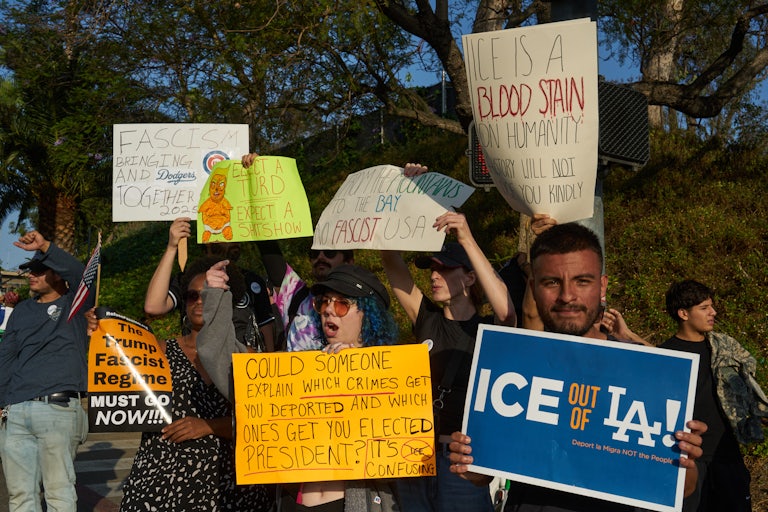
People protest against ICE and Donald Trump in Los Angeles
Bing Guan/AFP/Getty Images

White House deputy chief of staff Stephen Miller is getting exactly what he wants: seven in 10 people arrested as part of Immigration and Customs Enforcement’s sweeping raids in Los Angeles earlier this month had no criminal convictions, the Los Angeles Times reported. 

Between June 1 and June 10, ICE arrested 722 individuals across the greater Los Angeles area. But 69 percent of those arrested had no criminal conviction, and 58 percent had never even been charged with a crime, according to a Times analysis published Tuesday of data from UC Berkeley Law’s Data Deportation Project

Despite the Trump administration’s hollow assurances that ICE would target criminals, the reality of the government’s massive deportation scheme has targeted average upstanding individuals, ripping family members, friends, and neighbors out of their communities. 

But to Miller, who is on a campaign to ethnically cleanse the country, that must be music to his ears. 

As ICE’s sweep of Los Angeles began at the beginning of June, Miller was reportedly furious when he heard that ICE officers had narrowed their field to undocumented immigrants with criminal records. 

“Stephen Miller wants everybody arrested. ‘Why aren’t you at Home Depot? Why aren’t you at 7-Eleven?’” one official recalled after a tense meeting between the ghoulish homeland security adviser and officials from ICE and the Department of Homeland Security.  

But DHS Assistant Secretary Tricia McLaughlin insisted to the Times that ICE arrests were “highly targeted.” 

“We know who we are targeting ahead of time. If and when we do encounter individuals subject to arrest, our law enforcement is trained to ask a series of well-determined questions to determine status and removability,” McLaughlin said. But reports of other arrests suggest that ICE will detain someone even if they know they’re not the target. 

Trump Press Sec Admits He’s Chickening Out Again on Tariff Deadline

Donald Trump could extend his self-imposed deadline on implementing global tariffs.

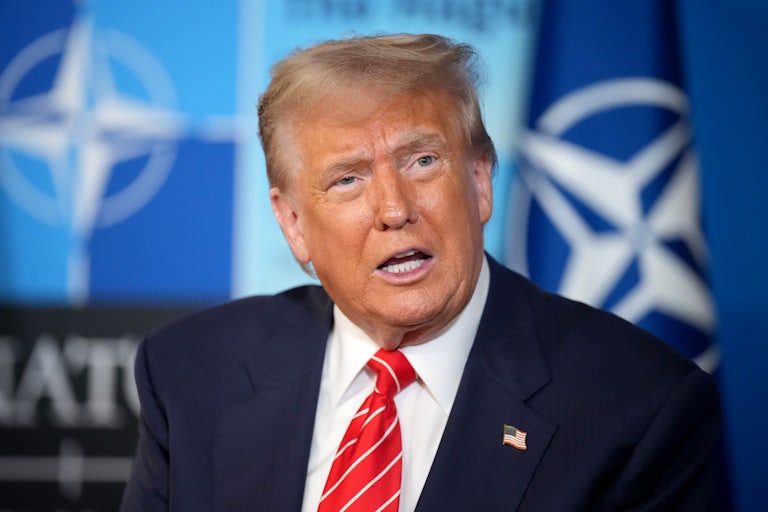
Donald Trump speaks during the NATO summit at The Hague
Andrew Harnik/Getty Images

Wall Street was right about the president: Trump always chickens out.

Despite spending weeks fuming about the fact that investors had clocked him for repeatedly reneging on his tariff plan, Donald Trump has once again decided to extend the deadline to implement them.

The White House said Thursday that the deadline for countries to strike trade deals with the United States may be extended past July 9, a deadline that press secretary Karoline Leavitt described as “not critical.”

“The president can simply provide these countries with a deal if they refuse to make us one by the deadline,” Leavitt said during a press briefing. “And that means the president can pick a reciprocal tariff rate that he believes is advantageous for the United States and for the American worker.”

Ultimately, it’s a “decision for the president to make,” Leavitt noted.

The TACO theory was coined in early May by Financial Times columnist Robert Armstrong, who added a catchy acronym to the practice of loading up on stocks when Trump first announces tariffs and then selling when he ultimately backtracks on enforcing them.

So far, that’s been true for enacting additional tariffs on Mexico and Canada, postponing his “reciprocal” tariff plan on dozens of countries after his April “Liberation Day” announcement went south, delaying a tariff on imports from the European Union, and smashing his plan to fine China, decreasing tariffs on Chinese products to 55 percent from 145 percent.

At the end of last month, Trump threatened to impose a 50 percent tariff on the European Union but quickly delayed the penalty to July after European Commission President Ursula von der Leyen agreed to negotiate.

The extension for implementing practically all of Trump’s “reciprocal” tariffs, however, is set to expire July 8.

Trump’s tariff proposals haven’t won the U.S. too much negotiating ground. Instead, countries around the world began observing that—rather than playing the waiting game to meet with the White House over potential trade relief—China’s tough negotiating strategy with the former real estate mogul had actually gotten the Eastern powerhouse a significantly better deal.

In the end, it will be the U.S. that pays the price when the Trump administration runs out of time on its “90 deals in 90 days” promise. On Tuesday, Federal Reserve Chair Jerome Powell said that the central bank would wait to see the residual impacts of the country’s new tariff plan before reducing its key interest rate, as companies have already decided to increase product prices this year in reaction to hampered global supply chains.